Chappie

Posted on March 5, 2015 at 5:59 pm

B
Lowest Recommended Age: Mature High Schooler
MPAA Rating: Rated R for violence, language and brief nudity
Profanity: Constant very strong language
Alcohol/ Drugs: Drinking, drugs
Violence/ Scariness: Intense and graphic violence, characters injured and killed
Diversity Issues: Diverse characters
Date Released to Theaters: March 6, 2015
Date Released to DVD: June 15, 2015
Amazon.com ASIN: B00UC9SOKW
Copyright Sony 2015
Copyright Sony 2015

So, basically, no one here saw “Terminator.” Or “Frankenstein.” But maybe they did see “Robocop?” Or “Short Circuit?”

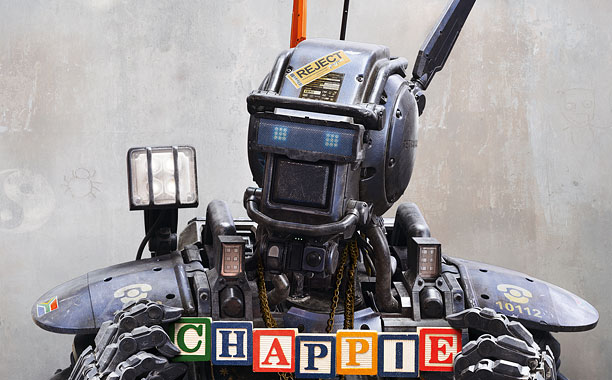
Writer/director Neill Blomkamp likes sci-fi allegories of social and political conflicts, as we saw in “District 9” and “Elysium.” Here he imagines that a couple of years from now South Africa will replace most of its front-line police force with robots from a government contractor. Efficient and just about unstoppable, they bring the crime rate down substantially. They are trusted by the law-abiding population and feared by the criminals. The CEO of the contractor is Michelle Bradley (Sigourney Weaver), who has turned down requests from two of her staff. Deon Wilson (Dev Patel) wants to develop artificial intelligence to see if he can create a form of mechanical consciousness. Counter to his Athenian dreams of a holistic robot spirit that can create poetry and assess the merits of works of art, there is the Spartan, Vincent Moore (Hugh Jackman), whose pet project is a super-powerful weapon called Moose that is all brawn and no brain. It operates entirely under human control, through a helmet that reads its operator’s thoughts. One dreams of heart and brains, one believes in brawn and firepower.

Michelle reminds them that she is CEO of a publicly traded weapons corporation. Her job is to provide powerful but obedient robot foot soldiers to the police force, not to explore existential questions or create military-force destructive capacity.

In brief opening scene set a year before the events of the film, a journalist explains, “Historically, when we look at evolution, it’s not surprising that Chappie’s left turn happened.” So we know from the beginning that Chappie will be a major turning point in human history. Then we go back to see how he is created, as Deon takes a discarded robot with an unreplaceable fused battery that has just five days before it will run down and brings the not-so-failsafe guard key card from the office to his apartment (where of course he has created a cute little wall-eyed home robot with decorative red glasses). He revs up on Redbull and slams down some bangin’ code to, you know, play God.

Just to make it clear, he introduces himself to the robot, who will be dubbed Chappie, as his maker. And just to show you how human sentient consciousness, at least as conceived by human screenwriters, will inevitably be, Chappie’s relationship to his creator is more conflicted than his relationship to the couple he sees as his mommy and daddy. These underground, off the grid, self-styled gangsta characters share the names of the performers who play the roles, Ninja and Yo-Landi (rappers from Die Antwoord) and “America” (Jose Pablo Cantillo), who live in an abandoned building covered with graffiti.

Chappie is caught in a tug of war between the idealistic Deon, who sees him as having infinite possibilities beyond the capacities of humans, and the gangstas, who see him as the key to bigger and better ways to create mayhem and steal cars and money. Deon makes him promise never to commit a crime. But Ninja covers him in bling and promises him a new body before the battery dies.

Blomkamp’s ambition is admirable and the broad scope of his imagination is impressive. The action scenes are vividly staged and the special effects are superb. It is Chappie’s movement that makes him seem human as much as his curiosity and spirit. seeing him gently stroke a dog’s back is so endearing we barely stop to consider whether his “hands” have the sensory capacity to “feel” the softness of the fur or the warmth underneath. When a human character transitions to robot form, the fact that his voice transitions as well makes no sense as a matter of mechanics, but this is more allegory than science. Unfortunately, the fact that the robot is more human than the humans is, to put it in computing terms, a bug, not a feature.

Parents should know that this film has constant very strong language and intense and graphic violence with some disturbing images and many characters injured and killed, as well as drinking, drugs, and brief nudity.

Family discussion: If you had the chance to upload your consciousness to a robot, would you do it? Could robot police ever work? How did Chappie’s innocence affect the people around him?

If you like this, try: “District 9” and “Elysium,” from the same director
Related Tags:


DVD/Blu-Ray Pick of the Week Science-Fiction

Jupiter Ascending

Posted on February 5, 2015 at 5:55 pm

Copyright 2015 Warner Brothers

“Jupiter Ascending” was released in early 2015 but it was originally scheduled for release in the summer of 2014. It does feel like a summer movie. Somehow warm weather makes us more in the mood for explosions and less in need of superfluities like plot, character, and dialogue that never feels snicker-worthy. It is not quite up to snuff for this time of year. The story feels like a mash-up of sci-fi/fantasy movies past (especially “Terminator” and “Star Wars”), with a little “Cinderella” and “Princess Bride” added in for romance and some rage against the one percent to add some political heft. It is often downright silly, even snicker-worthy. It is well over the quota for just-in-time saves, both in the falling and about-to-make-an-irrevocable-decision categories.

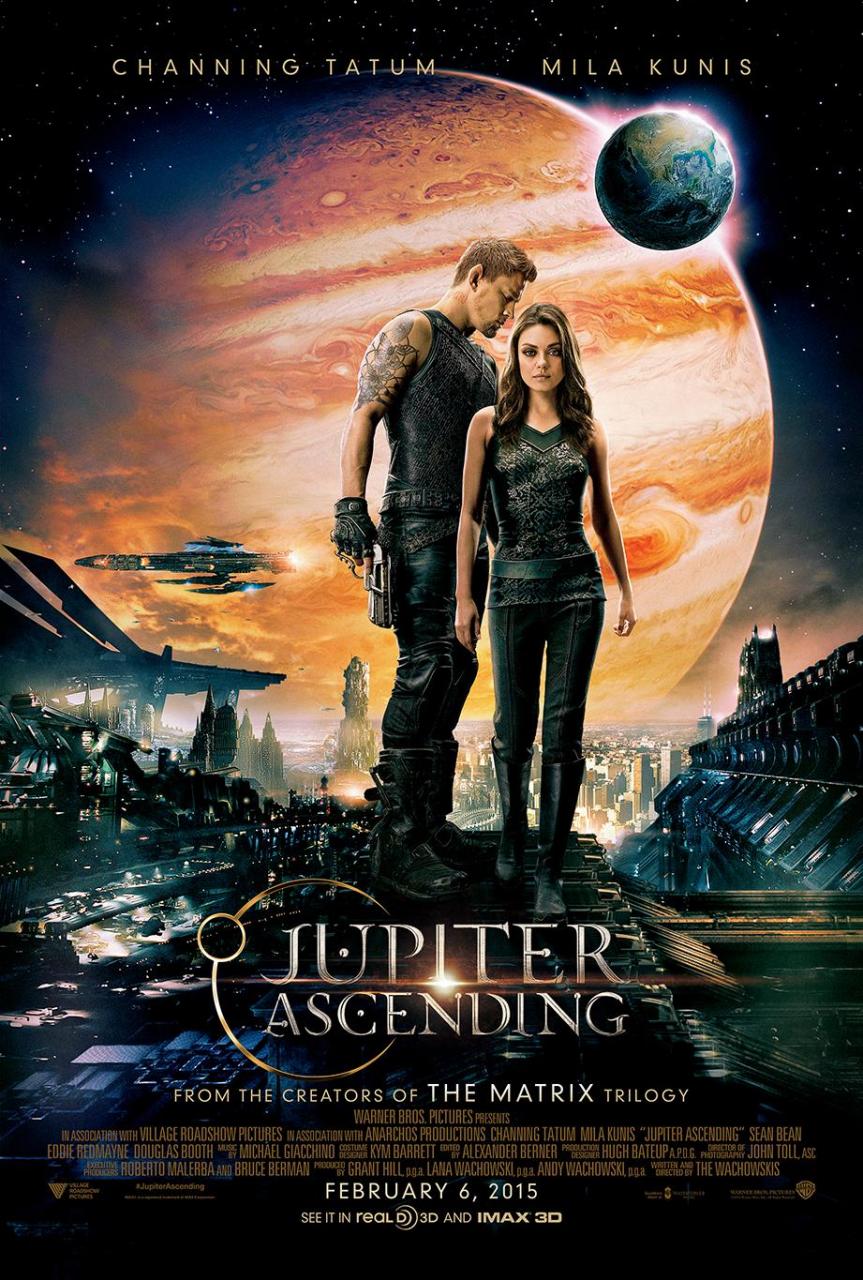
And yet, it is fun, especially on a big, big screen. And there are even a few moments that are shrewdly conceived and hit the mark. The Wachowskis (“The Matrix” trilogy, “Cloud Atlas,” “Speed Racer”) specialize in vast, colorful, grandly conceived new worlds and in this film they mean that literally. We visit several planets, and each is visually complex, sumptuous, and wildly imaginative, often dazzling. If you’re in the mood for eye candy, head for the box office. Don’t wait to see this one at home.

Mila Kunis plays Jupiter, an illegal alien (get it?) from Russia, working in Chicago as a maid and living with her extended family. “I hate my life,” she says when she has to get up at 4:45 am for another day of scrubbing toilets. But like Neo and Speed Racer, she is special. Not for a particular talent or quality of character but because of her very essence. Like infinite monkeys banging away on infinite typewriters until one of them randomly produces “Hamlet,” it seems that throughout the universe there are so many humans that every so often the random accumulation of cells produces a genetic mix identical to someone who has already lived. Jupiter, whose father was a British astronomer killed in a robbery, turns out to be identical to an intergalactic royal, which makes her a threat to three battling siblings in a dispute over their inheritance. Yes, this is a story about inheritance and real estate. We might as well be back at Downton Abbey or in “King Lear.” The particular piece of real estate they are so concerned about: Earth.

One of the noble siblings wants her captured. Another wants her killed. Just as assassins are about to take her out, Caine (Channing Tatum), a pointy-eared hunk arrives to carry her off like Richard Gere at the end of “An Officer and a Gentleman.” Except that this is the beginning, and he will have many more opportunities to lift her in his manly arms as things develop. He has some cool toys, too, especially some wonderful shoes that operate like a hoverboard crossed with ice skates, so that he glides through the air.

There are some clangers ahead, like the fact that Jupiter’s special genetic makeup is recognized by bees. But there is some fun stuff, too, especially an extended sequence through a delightfully steampunk series of bureaucratic offices that show that even the most highly evolved civilizations we can imagine still have not found a way around petty rules and red tape. In the rare category of both clangish and fun is Eddie Redmayne as Balem (the names are all faintly Latinate, “Hunger Games”-style). If Mount Everest were built on top of wherever over the top lives, he’d be on top of that. But I got a kick out of his full-on commitment to petulant decadence turned up to 11.  And Gugu Mbatha-Raw shows that a spectacularly beautiful and talented woman can take a costume reminicient of John Candy in “Spaceballs” and make it work.

It’s long and messy and unforgivably silly in place, but somewhere under all the eye candy and under-written dialogue there are some interesting ideas about the true meaning of consumption and what, if we had all the time in the world, we would do with it.  I wasn’t sorry to spend some of my limited time seeing Channing Tatum treat the air like a 3D ice rink.

Parents should know that this film has extended sci-fi/fantasy peril and violence, some graphic images including brief torture, characters injured and killed, rear nudity, some strong language, and drinking and sexual references.

Family discussion: If life requires consumption, how do we make responsible choices? How were the siblings different?

If you like this, try: “The Princess Bride,” “Looper,” “The Matrix,” and the “Star Wars” series

Related Tags:


3D Action/Adventure Fantasy Science-Fiction

Trailer: Ex Machina

Posted on January 18, 2015 at 8:00 am

Imagine they were beta-testing Samantha in “Her,” or one of the replicants in “Blade Runner” and you were brought in to try out the latest model. That’s the idea behind “Ex Machina,” with two of today’s most fascinating actors, Oscar Isaac and Domhnall Gleeson. Opening in April 2015.

Related Tags:


Science-Fiction Trailers, Previews, and Clips

Interstellar

Posted on November 5, 2014 at 8:55 am

Copyright Relativity Media 2014

Writer/director Christopher Nolan takes on literally cosmic issues with “Interstellar.” It is an ambitious, provocative, thoughtful, and highly entertaining film that deals with, well, pretty much everything, and, all things considered (believe me, ALL things are considered), it holds together very well.

It’s the near future and some blight has turned humans from progressive, curious, and optimistic to beaten down, hopeless, close to desperate. “We once looked up to the stars and dreamed,” says Cooper (Matthew McConaughey). “Now we look down to the dirt and worry.” Cooper was once an engineer at NASA. Now, like most people left, he is a farmer, struggling to grow crops in a world that has turned into a dustbowl, with plant species dying off until all that is left is corn. Cooper is a widower with two children, teenaged Tom and 10-year-old Murphy, and they live with his father-in-law (John Lithgow). The earth is not all that has been blighted. It is a post-enlightenment society scrambling for “caretaking,” with no intellectual aspirations or opportunities. Cooper’s wife died because medical technology and expertise that was once available no longer exists. And he is called into school because Murphy is in trouble for insisting that Americans once landed on the moon. That never happened, Murphy’s teacher explains a little impatiently. That was just a clever ruse to bankrupt the Soviet Union. The clear implication is that this revisionist history is itself a clever ruse to prevent young people from developing an interest in science that human society no longer believes has any value when the only possibility of survival is to return to the cultural norms of a thousand years ago, when most of human endeavor was devoted to making food. We do not know why the idea that science might be of aid in solving the food production crisis is no longer of interest. A comment by one person that greed created problems may be a clue.

Murphy insists that she is getting messages from a ghost who throws books off the shelf in her bedroom. When Cooper investigates, it appears to be an anomaly of some kind, a gravitational singularity, a message. The “ghost’s” message points to a location. When Cooper goes there, Murphy stows away in the car. It turns out to be a secret NASA facility led by Dr. Brand (Michael Caine). They have concluded that Earth can no longer sustain human life. They have sent out rocket probes to find an alternate planet that can sustain human life. Plan A is to be able to transport Earth’s inhabitants to a new location. The project is called Lazarus. Plan B, if no one alive can be saved, is to transport fertilized eggs to the new location and begin again, a new Genesis. They want Cooper to pilot the ship.

And this sets up the central conflict of the story. It is only secondarily about whether humans can, will, or should continue as a species and culture. The primary concern is the relationship between Cooper and Murphy. He wants more than anything in the world to stay with her and watch her grow up. But he knows his participation is critical to the mission — no one else going has ever actually flown before — and if the mission fails, Murphy’s generation will be the last. In a wrenching scene, Cooper has to leave while Murphy is furious and hurt. He promises he will come back. Parent-child relationships and especially promises broken and kept, echo throughout the storyline.

Dr. Brand’s daughter (Anne Hathaway) is on the crew and the trip into space leads to some mind-bending conversations about cosmology, including wormholes, black holes, and why an hour on one planet can translate into seven years for the occupants of the spaceship circulating above. The visual effects (all built or “practical” effects, no digital/green screen) are stunning.

The storyline also provides an opportunity for extremely complex and difficult moral choices, as the crew has to make decisions based on very limited information and even more limited time.  The broad sweep of themes means that some choices work better than others.  The ending seems rushed and not entirely thought through. Cutting back and forth between scenes in outer space and back on earth during one passage goes on too long, and one mention of Dylan Thomas’ famous poem would be plenty.  A detour involving an unbilled actor with an almost-unforgivably on-the-nose character name is particularly poorly conceived.  But even that scene is so visually striking that it barely registers as a diversion.  And overall, the film’s willingness to place the biggest questions in the grand sweep of the universe is absorbing and it is impossible not to be moved by it.

Parents should know that this film includes themes of environmental devastation and potential human extinction, sci-fi-style peril and violence, sad deaths of parents and children, attempted murder, characters injured and killed, and a few bad words.

Family discussion: Why did the school insist that the moon landing was faked and what does that tell us about this society? What should the crew have considered in deciding which planet to try?

If you like this, try: “2001,” “Silent Running,” and “Inception”

Related Tags:


Action/Adventure Science-Fiction
THE MOVIE MOM® is a registered trademark of Nell Minow. Use of the mark without express consent from Nell Minow constitutes trademark infringement and unfair competition in violation of federal and state laws. All material © Nell Minow 1995-2026, all rights reserved, and no use or republication is permitted without explicit permission. This site hosts Nell Minow’s Movie Mom® archive, with material that originally appeared on Yahoo! Movies, Beliefnet, and other sources. Much of her new material can be found at Rogerebert.com, Huffington Post, and WheretoWatch. Her books include The Movie Mom’s Guide to Family Movies and 101 Must-See Movie Moments, and she can be heard each week on radio stations across the country.

Website Designed by Max LaZebnik