
Interview: Dominic Cunningham-Reid and Taran Davies of ‘Journey to Mecca’

Interview: Dominic Cunningham-Reid and Taran Davies of ‘Journey to Mecca’

Posted on January 19, 2010 at 3:55 pm

In 1325 a 21-year-old man named Ibn Battuta set out from his native Tangier on pilgrimage to Mecca that would take him 18 months. And now the story of that journey has become an extraordinary IMAX film, stunningly beautiful, soul-stirring, and genuinely historic.
The Hajj, or obligation to visit Mecca, is one of the core requirements of Islam. Battuta found it to be so important that he would return five more times over the course of travels that would take him 75,000 miles over 29 years. He was the greatest explorer of the Old World, traveling three times further than Marco Polo before returning home to write down the story.
Journey to Mecca” follows Battuta (played by Chems Eddine Zinoun) on his perilous journey in the context of a compelling picture of Islamic civilization during the 14th century. The story is book-ended by a close-up look at the contemporary Hajj, a pilgrimage to Mecca that draws three million Muslims from around the world every year who perform rituals that have taken place for over 1,400 years. JourneyToMeccaPoster01_250px.jpg
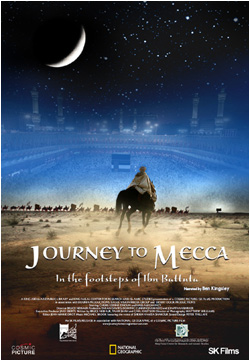
Dominic Cunningham-Reid and Taran Davies took time to speak to me on their recent visit to Washington about why the film was important to them and what was involved in getting it made.
It seemed to me that if you had made a list of every single obstacle to making a film, you not only covered them all, you added a few new ones. You had everything but a temperamental star — or maybe that was the camels.
TD: The camels might have been a little temperamental. It was really our personal Hajj in a sense. It just had to be done; I think that was the point. The IMAX challenges are enormous, particularly in this environment. There are millions of people there. Each roll of film lasts only three minutes and then you have to change your magazine. And each roll is incredibly expensive and you need several people to change the magazine. It is an incredibly daunting process in any environment but put that into one of the largest gatherings of people on earth and have them pull that off and it’s almost impossible.
The Hajj has been filmed before but only in low-quality video. It is so difficult to film logistically with the massive amount of people. And so we chose to really rise to that challenge and bring the greatest quality of production to this extraordinary cultural and spiritual event that deserves to be documented in such a fashion.
The images are stunning, exquisitely breathtaking. IMAX was really made for those vistas.
TD: There is some CGI in the film. We re-created Medina and Cairo in the 14th century. But the contemporary Mecca material with the Hajj, that is as it is. You see Mount Arafat on the Day of Standing, the holiest day of the Hajj from a helicopter we’re circling at dusk just a couple of hundred feet above the ground — totally unique, never been done before shot — with literally two million people in that frame. If you asked why would anyone do this, why would anyone make this film, that is the reason.
That is such a powerful image. Tell me about the historians. You worked with a wide variety of experts who did not always agree about some of the most sensitive issues.
TD: One of the crazy things we set out to do was really make the definitive film about the most sacred sanctuary of Islam and its rituals and we needed to get it right. We were working in a very sensitive environment where getting it wrong is not an option. We wanted to make sure that we brought on board as many experts on this subject as possible to make sure that we got it right. We had the leading experts on the Hajj, on Ibn Battuta, on Islamic architecture, on the architecture of Mecca, from all over the world, the United States, Morocco, Saudi Arabia, France, the UK, Kuwait, amongst other countries.
DC-R: The Grand Mosque of the year 1325, we had no visuals to go on. We had history books with verbal descriptions. We had to translate with all of the experts and research into a visual representations. One of the great moments we had is when we had actually sunk 18 pillars of the mosque and then the lead researcher calls up and says, “No, no, they weren’t square, they were round!”
Oh, no!
DC-R: So we had to pull them all out. And start again. Very, very challenging.
The biggest of challenges had to be your subject matter. It could not be more sensitive both from the perspective of believers and people who are ignorant of or hostile to Islam. How did you mediate differences between your experts?
TD: As I look back through time it is such a rosy picture of collaboration, I can’t really recall any disagreements! I think that would be too strong a word to describe what was a collaboration. We needed to receive as much information as we could on the subject of Islam and so we reached out to as many people as we could to provide it. We wanted to get things right from the way the ihram, the white cloth is worn. Do you have the shoulder uncovered or covered? Off-white? How off-white? What material is the cloth made of? Do the pilgrims in the 14th century wear sandals? When they perform the tawaf, what prayers do they say as they are circumambulating the ka’ba. If there were disagreements often among the Muslim community, they have different ways of doing things. It is a very daunting experience for them and many of them don’t know precisely how they are supposed to do it. It was as if we were doing the Hajj because we had to learn how do it right. We were approaching the ka’ba. We had to learn the proper way to perform the tawaf to be able to represent it.

(more…)

Related Tags:


Interview Spiritual films
Interview: Bruce Faulk of ‘Soul of the Church’

Interview: Bruce Faulk of ‘Soul of the Church’

Posted on January 18, 2010 at 12:00 pm

I was able to speak to the man behind the Black History Collection: Soul of the Church DVD, Bruce Faulk, who assembled a treasure trove of gospel performances into this stirring and inspirational collection. It even includes some of the vintage commercials.
Tell me how this production came together.
This was a syndicated mid-60’s television series called “TV Gospel Time.” It was the idea of a Chicago advertising agency. Their idea, which was rare at the time, was to go from town to town and record local gospel choirs and feature singers with the hosts being some of the best-known gospel singers of the time. The premise was unique. There were many many many many shows and we have just about all of them. This first release has sixteen of them and we were able with bonus material to include six songs from “Mahalia Jackson Sings.” It is an amazing array of the icons of the golden age of gospel. In many cases these are the only visual recordings of these artists. It’s just totally amazing. Just on this release we have James Cleveland, Sally Martin, the Blind Boys of Mississippi, Ernestine Washington, the Dixie Hummingbirds, Alex Bradford, Clouds of Joy. The Highway QC’s a group from Chicago was founded by two people you don’t think of as gospel — Sam Cooke and Lou Rawls. One of the celebrities is Ruth Brown. You don’t think of her as gospel; you think of her as a pop and R&B singer. But she’s here. This is an amazing look at Americana and gospel as an American form of music. It gives me chill bumps! Gospel means good news and this is certainly good news.
What a treasure trove! And it is history as well as music, culture, and worship.
It’s amazing that these survive; it’s amazing that they were recorded to begin with. Even though the show was sponsored by, recorded for, and broadcast to the African-American market, it crossed over to the Caucasian market. It was broadcast during church hour and it opened the music up to an entire new demographic.
Where did these come from and how did you come to them?
My background is in children’s programming. I worked in television animation and produced some well known seasonal pieces. I met a gentleman at CBS, a controller there, and to save room they were throwing away some old shows and he started buying. He now has the largest privately help film library in the world. These are kinescopes, camera pointed at the camera as it was broadcast live. Even though we’ve digitally enhanced it, it is still kinescope.
Growing up, a lot of these songs, I immediately wanted to see how they were handled by these singers. How did Marie Knight treat “Jesus Lifted Me?” “When the Saints Go Marching In,” or Tommy Browns doing “Keep Trusting.” I wanted to know how they did with the songs that were my all-time favorites and they were just amazing.
It’s like any other type of music — but jazz and gospel are American music. Gospel was the call and response put to music for an era when so many did not read. Over the years it’s been changed, augmented, tampered with, but you still find that line almost like a jazz riff that goes right through it. These recordings are like those early Sun recordings with Elvis. To see them work, to see their enthusiasm and spirit is something to behold.
Is there one performance that really is special to you?
Ernestine Washington doing “Down by the Riverside” just tears me up! She is the quintessential queen of gospel. The six songs from Mahalia Jackson, especially “Walk On” and “Just as I Am.” She was President Kennedy’s favorite singer and performed at his inauguration. She was Dr. Martin Luther King’s favorite singer.
What’s next?
We are working on a separate Mahalia Jackson release and we have enough for several more collections.
To order, click on Black History Collection: Soul of the Church

Related Tags:


Documentary Interview Music Musical Spiritual films Television Understanding Media and Pop Culture

Movies Increasingly Feature Spiritual Themes

Posted on January 3, 2010 at 10:40 am

In today’s Washington Post, Robert W. Butler writes about the increasing number of wide-release films that include themes of religion and spirituality.

It’s everywhere at the multiplex these days: religion. Or if that word makes you uncomfortable, you can go with the more general “spirituality.”

In movies as varied as the dead serious “The Road,” the uplifting family picture “The Blind Side,” the biting comedy “The Invention of Lying” and even James Cameron’s sci-fi opus “Avatar,” issues of faith and morality and mankind’s place in the universe are all the rage.

Not all of these movies embrace religion. Some question human gullibility. Some ask for evidence of a higher purpose in what often seems a random universe. But whether they encourage prayer or doubt, they’re all part of the zeitgeist.

Butler asked some thoughtful observers of the influence that religion and pop culture have on each other to comment on this trend, but, as usual, everyone forgets that it takes many years for a movie to be made — twelve years in the case of “Avatar” — and so it does not make sense to try to tie them to current economic conditions. It may, however, affect the audience response to those themes. “Up in the Air” is mentioned in the article as not specifically religious in its themes but compared to “A Christmas Carol” as a story of a man who finds that there is more meaning in personal connections than in money. It benefitted from the timeliness of its character’s job, flying from company to company to tell workers they were being laid off. But it was based on a book that was published nine years ago.
The portrayal of religious themes I have found the most meaningful this year was in “The Blind Side,” with its unabashed and explicit acknowledgement that Christian faith was a guiding inspiration and base of support in the real-life story of a wealthy family who adopted a homeless teenager. This — and the box office success of “Fireproof” and other modestly-budgeted films with Christian themes targeted to a Christian audience — should address some of Hollywood’s traditional skittishness about portraying people of faith in a positive way.
Upcoming films with themes of religion and spirituality include “The Lovely Bones” (told by a murdered girl from a sort of heavenly waiting room), “Legion” (a battle between angels for the future of humanity), and “The Last Station” (about writer Leo Tolstoy’s religious conversion and its effect on his wife).

Related Tags:


Spiritual films Understanding Media and Pop Culture

Touched by an Angel

Posted on November 10, 2009 at 12:00 pm

B+
Lowest Recommended Age: Middle School
MPAA Rating: NR
Profanity: None
Alcohol/ Drugs: Drinking and alcohol abuse
Violence/ Scariness: Some tense, sad, disturbing, and scary situations
Diversity Issues: Diverse characters
Date Released to Theaters: 1994-2003
Date Released to DVD: November 10, 2009
Amazon.com ASIN: B0002ERWVE

Today’s special release of selected episodes from the beloved television series from Beliefnet columnist Martha Williamson is the DVD pick of the week for its compelling stories, outstanding guest appearances, and enduring message of hope and inspiration.

Related Tags:


DVD/Blu-Ray Pick of the Week Spiritual films Television
THE MOVIE MOM® is a registered trademark of Nell Minow. Use of the mark without express consent from Nell Minow constitutes trademark infringement and unfair competition in violation of federal and state laws. All material © Nell Minow 1995-2026, all rights reserved, and no use or republication is permitted without explicit permission. This site hosts Nell Minow’s Movie Mom® archive, with material that originally appeared on Yahoo! Movies, Beliefnet, and other sources. Much of her new material can be found at Rogerebert.com, Huffington Post, and WheretoWatch. Her books include The Movie Mom’s Guide to Family Movies and 101 Must-See Movie Moments, and she can be heard each week on radio stations across the country.

Website Designed by Max LaZebnik