“Grace Stirs Up Success” is the latest in the excellent “American Girl” series, all featuring spirited young heroines confronting real-life problems, and learning some important lessons. They always include a lot of fun and a loving family, too.
In this especially delicious entry, Grace (the darling Olivia Rodrigo) is a talented and hard-working young chef who loves to help out in her grandparents’ bakery. When her mother’s pregnant sister needs help, Grace and her mother go to Paris to stay with them and Grace gets to work in a real French pastry shop. She makes some big mistakes in the kitchen and outside, but she learns a lot about cooking and about being careful and following directions.
There is a wild and very funny food fight in the kitchen as well, and learns how to make friends with her cousin, too.
Back at home, there is trouble at the bakery, which may have to close. Grace enters the Master Chef Junior competition, hoping to win enough money to keep the bakery going. It is a lot of fun to see the fictional Grace on the real-life reality show.
This terrific series is one of the few that really delivers top quality for elementary schoolers, with thoughtful, interesting stories and outstanding production values. Virginia Madsen is warm and winning as Grace’s mother and the Parisian settings and costume design are colorful and appealing. The films are always frank about the problems the girls face, both external and growing-up challenges, and show how friends and family can work together to make things better.
Parents should know that there are some difficult family issues, including financial problems.
Family discussion: What would you like to learn how to cook? What was the most important thing Grace had to learn?
If you like this, try: the other American Girls films
The story of the plucky little Depression-era orphan with the curly red hair has been not just re-booted but re-imagined into the world of rent-a-bikes, viral videos, DNA tests, YOLO, corporate privacy invasions, and Katy Perry tweets. There are some nice shout-outs to the original version, with a character named for Little Orphan Annie creator Harold Gray and a music group named the Leapin’ Lizards after the redhead’s favorite way to express surprise.
A cheeky opening briskly bridges the decades. It begins with a red-headed girl named Annie giving a school report, concluding with a tap dance. She looks like the Annie we remember. But then the teacher calls on another Annie, and we meet our Annie, played by “Beasts of the Southern Wild’s” Quvenzhané Wallis. She gives a rollicking report about Franklin Roosevelt and the New Deal that sounds like a call to action from Occupy Wall Street. The whole classroom bangs on their desks along with her. Annie is all about the 99 percent. (The famously very right-wing Gray would be horrified.)
And, as she repeatedly reminds us, she is not an orphan. She is a foster kid. Every Friday evening, she waits outside the restaurant where her parents were last seen, in hopes that they will return. She was four when they left her with a note and half of a locket, and since then she has gone from foster home to foster home, now living with Miss Hannigan (Cameron Diaz), a bitter, abusive, alcoholic woman who once sang with C&C Music Factory and was almost a Blowfish. She resents the girls who are her only source of income, and makes them do all the work in the apartment.
Will Stacks (Jamie Foxx) is a cell phone company billionaire running for mayor of New York. (That’s “Stacks” as in “stacks of money,” with “Warbucks” a bit too on the nose for our more euphemistic times.) When he grabs Annie to save her from getting hit by a truck, his approval numbers spike, and his aides encourage him to spend some time with her to give him a more relatable image. Grace (Rose Byrne) is his all-purpose, super-efficient second-in-command and Guy (Bobby Cannavale) is his whatever-it-takes spin-master campaign advisor. Annie, about to be thrown out by Miss Hannigan, persuades Stacks to let her stay in his mega-luxurious apartment, promising that her “game face” will get him good press, combating his image as “a rich elitist who can’t relate to regular people.”
It works for a while until some unscrupulous people hire a couple to pose as Annie’s real parents.
Some of the updates work well, and there is a nice energy in the opening scenes as Annie uses the last ten minutes of a bike share to navigate the city, passing street performers riffing on the well-known score. Co-writer/director Will Gluck keeps things bright and bouncy, but his filming of the dance numbers is clumsy to the point of incompetence, undermining even the nearly unkillable numbers like “It’s a Hard Knock Life” with angles and edits that take the energy out of the songs instead of boosting it.
Wallis is inconsistent, occasionally appearing checked out of the scene. She is better in the few scenes with the other girls, but she has very little chemistry with Byrne or Foxx. And one barfing scene is bad, but four? Plus a spit take? And a hooker joke? There is a movie-within-the-movie that is very cute, but the cameos are a distraction. The tweaking of the script works better in individual scenes than in the overall plot, which feels slapped together and unsatisfying. Ah, well, the sun will come out tomorrow, so maybe next time they’ll get it right.
Parents should know that this movie has themes of child abandonment and abuse, a character abuses alcohol and there is a joke about alcoholism, and there is some mild peril and potty humor.
Family discussion: What did Annie mean when she said Stacks did not know he was good yet? How is Annie different from the other girls?
If you like this, try: the other musical versions and “Game Plan”
Interview: Jet Jurgensmeyer of “A Belle for Christmas”
Posted on November 4, 2014 at 7:00 am
Copyright Anchor Bay Entertainment 2014
A Belle for Christmas, available today on DVD, is a cute holiday story of a dog named Belle who comes to live with kids named Elliot and Phoebe and their widowed father (Dean Cain). Kristy Swenson plays Dani, the crafty baker trying to win the father’s heart so she can quit her job, send his children away to school, and enjoy being supported. But she is allergic to Belle. If she is going to move into the house, she has to find a way to get rid of the dog. I had a chance to talk to Jet Jurgensmeyer, the charming young actor who plays Elliot. He might just be the politest actor I’ve ever interviewed.
I asked him to describe Elliot as if if was a friend. “He loves his grandma, he loves hanging with his friend Malcolm, he has a crush on a girl on the other street and he is very outgoing and he loves his dad, you can kind of tell that. And if he needs to he can come with some kind of plans and pranks and stuff.” He said the adults were as good as the children at remembering their lines. “You know we had some fumbles in our lines ever so often. Everybody does but I don’t know I think a little bit of both. Maybe kids are better because they have got that fresh mind.” He loved the two dogs that played Belle. “She was the sweetest thing in the world, she was so cute and fluffy. Two dogs actually. I used both of them. I don’t think I’d ever seen a cream colored shepherd. And when I first saw both of them, I was like ‘Oh my gosh!’ They were like the snow, they were so cute and I guess from the first time when all the kids and the grownups met the dogs it was like, ‘Oh yes this is going to be awesome.'”
The dogs’ trainer helped make sure that Belle performed on cue. “The part in the movie in the beginning where the dog comes out of the lady’s arms and comes over towards me and I pick her up — they actually put some dog treats, I can’t remember if it was on my boots or right next to my boot. So the dog would come over and start nibbling on that and I would pick her up. She actually really did what she was told to do.”
In the film, Elliot and Phoebe can tell right away that Dani is not to be trusted. I asked Jet how they figured it out. “Kids can kind of like see that from like a mile away. We could tell she didn’t care about us – she just cares about our dad. So basically when that happens they are just like…’Okay, this is war.'”
He enjoyed hanging out with the other kids in the cast between film set-ups. “We hang, we tell jokes. In the trailer all the kids had we had bunk beds. Four kids so four bunk beds. So me and my friend Connor we got the top bunks then the girls were on the bottom ones but we every so often, we’d go on everybody else bed. Ee just laughed and had fun. Everybody on the set knew right away ‘This set is going to be really fun. That’s what this is.'”
When he’s not working or in school, Jet likes movies about basketball and soccer. He enjoys the baseball classic “The Sandlot,” too. He likes books about sports as well, and recently read a book about Satchel Paige. He really enjoys acting, but his favorite thing about making a movie is asking questions about pretty much everything. “Why are you putting this right here?” “What’s this lens going to do?” He also enjoyed “hanging with Dean and Kristy” and being reunited with Connor Berry and Avary J. Anderson, who play his friends in the film, and have appeared with him before. “Every time I would see Dean he would always do this trick. It’s that trick which where he is like ‘Oh is that something on your shirt?’ and then he would bang you on the nose and even till this day he will do it to me like three times when I see him. Every single time I will fall for it. I need to have a buzzer that says, ‘Don’t do it!’ but every time I’m like ‘urrrh!’ He’s hilarious.”
And Jet says the best advice he ever got about acting is “just don’t worry about it if you make mistakes. Just have fun with it and go with the flow and if you feel something, go with it and do it.”
Rated PG for action, some peril and mild rude humor
Profanity:
None
Alcohol/ Drugs:
None
Violence/ Scariness:
Cartoon-style peril and some violence, comic allergic reaction, references to disturbing violence, some gross images
Diversity Issues:
A theme of the movie
Date Released to Theaters:
September 26, 2014
Date Released to DVD:
January 19, 2015
Amazon.com ASIN:
B00HLTDARS
Copyright LAIKA Studios 2014
LAIKA Studios (Paranorman and Coraline) has created another loveably crooked world, this time inspired by Alan Snow’s Here Be Monsters! (The Ratbridge Chronicles). It’s their first period setting, a sort of slightly bent Edwardian with a touch of steampunk, in the town of Cheesebridge. LAIKA’s motto may be “No straight lines, no right angles, no perfect circles,” but this wobbly community is rigidly stratified, with the White Hats at the top of society, nibbling on exotic cheeses in the elegant Tasting Room and hosting elegant parties, the lower class Red Hats desperate to be accepted by them. There is an entirely separate group, the gentle Boxtrolls, who live underneath the city, turning rubbish into Rube Goldbergian machines and tending their garden. They are called Boxtrolls because of their attire — discarded cardboard boxes. And their names come from the boxes they wear: Fish, Fragile, Shoes, and Specs.
And then there is Eggs (Isaac Hempsted Wright). He thinks he is a Boxtroll, but he is a human, left as a baby by his father, who was trying to keep him safe. Apparently Cheesbridge follows Noam Chomsky’s theories of language: while the Boxtrolls speak in a sort of mumbly pidgin talk, Eggs speaks flawless and rather aristocratic-sounding English. Their happy life is disturbed by Snatcher (Sir Ben Kingsley), the leader of the Red Hats, who conducts raids to capture the Boxtrolls. He knows they are harmless, but he has persuaded the White Hats that the Boxtrolls capture and eat human children so that they will depend on him to exterminate them. If Snatcher gets rid of all of them, the Mayor of Cheesebridge has promised to give him a White Hat and allow him into the sanctum sanctorum, the Tasting Room. There is one problem, though. Snatcher, despite his protestations to the contrary, is massively lactose-intolerant.
Mayor Lord Portly-Rind (Jared Harris) and his wife Lady Portly-Rind (Toni Collette) have a daughter named Winnie (Elle Fanning, the sister of “Coraline” star Dakota Fanning). She longs for them to pay attention to her. Their neglect has led her to develop a macabre fascination with what she imagines are the atrocities of the Boxtrolls and she decides to investigate. When she finds out that the Boxtrolls are harmless, she agrees to help Eggs tell her father that Snatcher has lied. Eggs will need to be persuaded that he is in fact human and then taught some of the basics of human interaction so that he can deliver the message.
The word “immersive” is often used to describe movies with 3D effects that seem to make the images surround the viewer by extending both in front of and behind the screen. But LAIKA’s films are more deeply immersive than that because of the intricacy of the world they create. Most animated movies use miles of code to show us how every individual hair in an animal’s fur rustles in the wind. But the handmade touch and infinite care of LAIKA’s stop-motion films, where figures and props are nudged ever so slightly for each individual frame and craftspeople spend months creating practical (not digital or virtual) effects to evoke water, fire, and clouds, creates an environment that is tantalizingly complex and invites many viewings to explore its wonders.
LAIKA is perfectionist in its dedication to not being perfect. It embraces the messiness of life. The Boxtrolls’ cavern is grimy and dank, and the Portly-Rind home filled with dessicated finery, but both are brimming with endlessly inventive detail, especially the elaborate mechanics of the Boxtrolls’ cave and the meticulous choreography of the White Hats’ ball. Every single object reflects the care taken by the filmmakers and every detail reflects some element of character and story, which are messy as well. Winnie, who has so much, is lonely and neglected. But she is brave and honest.
Eggs, who has so little, is surrounded by love. He is loyal and courageous. And Snatcher, who is so desperate for acceptance that he will don an elaborate disguise, make libelous accusations, and put his health and even his life at risk, is ultimately not really able to destroy the Boxtrolls. His henchmen, played by Tracey Morgan, Nick Frost, and Richard Ayoade are less wicked than existentially confused, trying to persuade themselves that they are on the right side.
The visuals are deliciously grotesque at times, but the message is a sweet one: families come in all sizes and shapes, sometimes biological, sometimes not, but what defines them is love.
NOTE: Be sure to stay through the credits to see some existential ponderings by the characters and a brief cameo by animator/CEO Travis Knight.
Parents should know that there are some comic but grotesque and macabre images. Characters are in peril and apparently killed, though shown later to be imprisoned. A character appears to have lost his mind. Another character explodes (offscreen).
Family discussion: Why was it so important for Snatcher to be a White Hat? Why didn’t Winnie’s parents pay more attention to her? Why did some of the Red Hats think they were the good guys?
If you like this, try: “Coraline,” “Paranorman,” and “Monster House”
The warmest, wisest, most pleasurable live-action family film of the year is “Dolphin Tale 2,” even better than the 2011 original. This really is that rare movie for the whole family.
The first film was inspired by the true story of Winter, a rescued dolphin who was able to thrive in Florida’s Clearwater Marine Aquarium after an innovative new prosthetic tail helped to protect her spine and allow her to swim. She has been an inspiration to millions of visitors in person and via webcam, especially to wounded veterans and other adults and children with disabilities. In the original, directed by Charles Martin Smith (Terry the Toad in “American Graffiti” and Farley Mowat in Never Cry Wolf, a sensitive loner named Sawyer (Nathan Gamble) bonds first with the wounded dolphin and then with the staff who care for the marine animals, especially aquarium head Clay (Harry Connick, Jr.) and his pretty daughter Hazel (Cozi Zuehlsdorff). Ashley Judd played Sawyer’s mother, Kris Kristofferson played Clay’s houseboat-dwelling dad, and Morgan Freeman played crusty Dr. McCarthy, who figures out how to make the prosthetic comfortable and stable.
Everyone returns for this follow-up, and this time Charles Martin Smith does triple duty as writer, director, and actor, appearing as a strict but not unsympathetic USDA official responsible for making sure the facility meets federal standards in caring for the animals. He may refer to Winter at CMA1108, but he is trying to do what is best for her.
The kids have gone from middle school to high school. They are now experienced marine animal specialists, and spend most of their time at the aquarium, much of that in the water. We see how capable and knowledgeable they are when they assist in the rescue of an injured dolphin they name Mandy and a sea turtle ensnared in fishing line they dub Mavis. And we see how deeply they care for the animals when the veteran of their dolphin population, a 40-year-old deaf dolphin who is “paired” with Winter, dies suddenly. This is more than a sad loss. Dolphins are deeply social creatures. If Winter cannot or is not willing to be be paired with another dolphin, she will die. The USDA inspector says that if they cannot find a friend for Winter in 30 days, she will have to be moved.
Mandy’s arrival seems providential. But then the best thing happens, which is also the worst thing. They are able to restore Mandy to health. But that means that she can no longer remain in captivity, which is just for animals who can no longer take care of themselves. The motto of the facility is three words: rescue, rehabilitate, release. “You didn’t build this place to keep animals,” Clay’s father reminds him. “You built it to heal them and let them go.” The wrenching task of weighing those competing considerations is sensitively presented as a moral issue, an economic issue, and as a part of growing up that Hazel and Sawyer must understand. It is an issue of more complexity than we normally get to see in family films, and it is presented with exceptional insight. A scene where Hazel follows Sawyer’s mother’s advice to speak to Clay the way she would like to be spoken to is a small gem that got some appreciative laughs of recognition from the audience. Smith knows his audience, though, and expertly seasons the storyline with cute animals, especially Rufus the pelican, who is back for more comic relief. Even with Rufus, though, the slapstick moments are just part of the story. His protective concern for Mavis is genuinely touching.
A storyline about whether Sawyer will accept an opportunity to take a special semester at sea is less intriguing. But Gamble’s quietly sincere and thoughtful performance grounds the film, with Zuehlsdorff (who provides a sweet song over the closing credits) more ebullient, but never less than completely real and in the moment. The completely natural performances of the two leads perfectly matches the sun-drenched naturalism of the setting, utterly at home in the water, interacting with the dolphins, or struggling to grow up. When Dr. McCarthy sits down next to the conflicted Sawyer to hand him a family heirloom, Sawyer says knowingly, “I’m about to get a lesson here, aren’t I?” He is, and we are, too, but it is a good lesson and it goes down easy. So does the film, ambitious in scope but light in presentation. And it is no disrespect to the movie to say that the best part is the closing credits, where we see Wounded Warriors and other people with disabilities coming to visit Winter and Hope for inspiration and, somehow, a sense that they are being understood and cared for.
Parents should know that this film includes mild peril, some scenes of animal and human injuries and a sad animal death.
Family discussion: What was the lesson of the watch? What were the best reasons for releasing Mandy? For keeping her? Did they make the right decision?



 , available today on DVD, is a cute holiday story of a dog named Belle who comes to live with kids named Elliot and Phoebe and their widowed father (Dean Cain). Kristy Swenson plays Dani, the crafty baker trying to win the father’s heart so she can quit her job, send his children away to school, and enjoy being supported. But she is allergic to Belle. If she is going to move into the house, she has to find a way to get rid of the dog. I had a chance to talk to
 ) has created another loveably crooked world, this time inspired by Alan Snow’s
  . It’s their first period setting, a sort of slightly bent Edwardian with a touch of steampunk, in the town of Cheesebridge. LAIKA’s motto may be “No straight lines, no right angles, no perfect circles,” but this wobbly community is rigidly stratified, with the White Hats at the top of society, nibbling on exotic cheeses in the elegant Tasting Room and hosting elegant parties, the lower class Red Hats desperate to be accepted by them. There is an entirely separate group, the gentle Boxtrolls, who live underneath the city, turning rubbish into Rube Goldbergian machines and tending their garden. They are called Boxtrolls because of their attire — discarded cardboard boxes. And their names come from the boxes they wear: Fish, Fragile, Shoes, and Specs.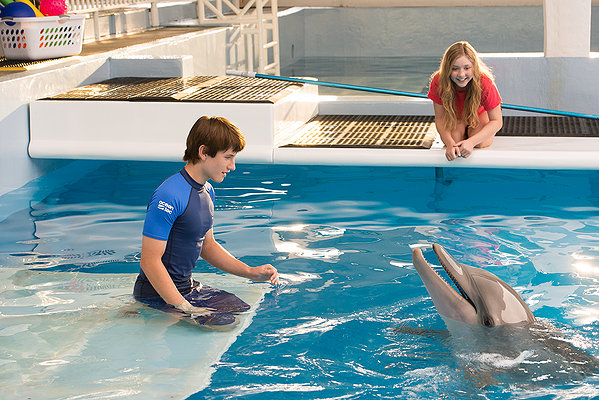
 , a sensitive loner named Sawyer (Nathan Gamble) bonds first with the wounded dolphin and then with the staff who care for the marine animals, especially aquarium head Clay (Harry Connick, Jr.) and his pretty daughter Hazel (Cozi Zuehlsdorff). Ashley Judd played Sawyer’s mother, Kris Kristofferson played Clay’s houseboat-dwelling dad, and Morgan Freeman played crusty Dr. McCarthy, who figures out how to make the prosthetic comfortable and stable.