The Water Diviner

Posted on April 23, 2015 at 5:58 pm

B-
Lowest Recommended Age: Mature High Schooler
MPAA Rating: Rated R for war violence including some disturbing images
Profanity: Brief language
Alcohol/ Drugs: Drinking, smoking
Violence/ Scariness: Wartime violence with battles and terrorist attacks, characters injured and killed, graphic and disturbing images, suicide, mercy killing
Diversity Issues: A theme of the movie
Date Released to Theaters: April 24, 2015
Amazon.com ASIN: B00WFNPPVY
Copyright 2015 Warner Brothers

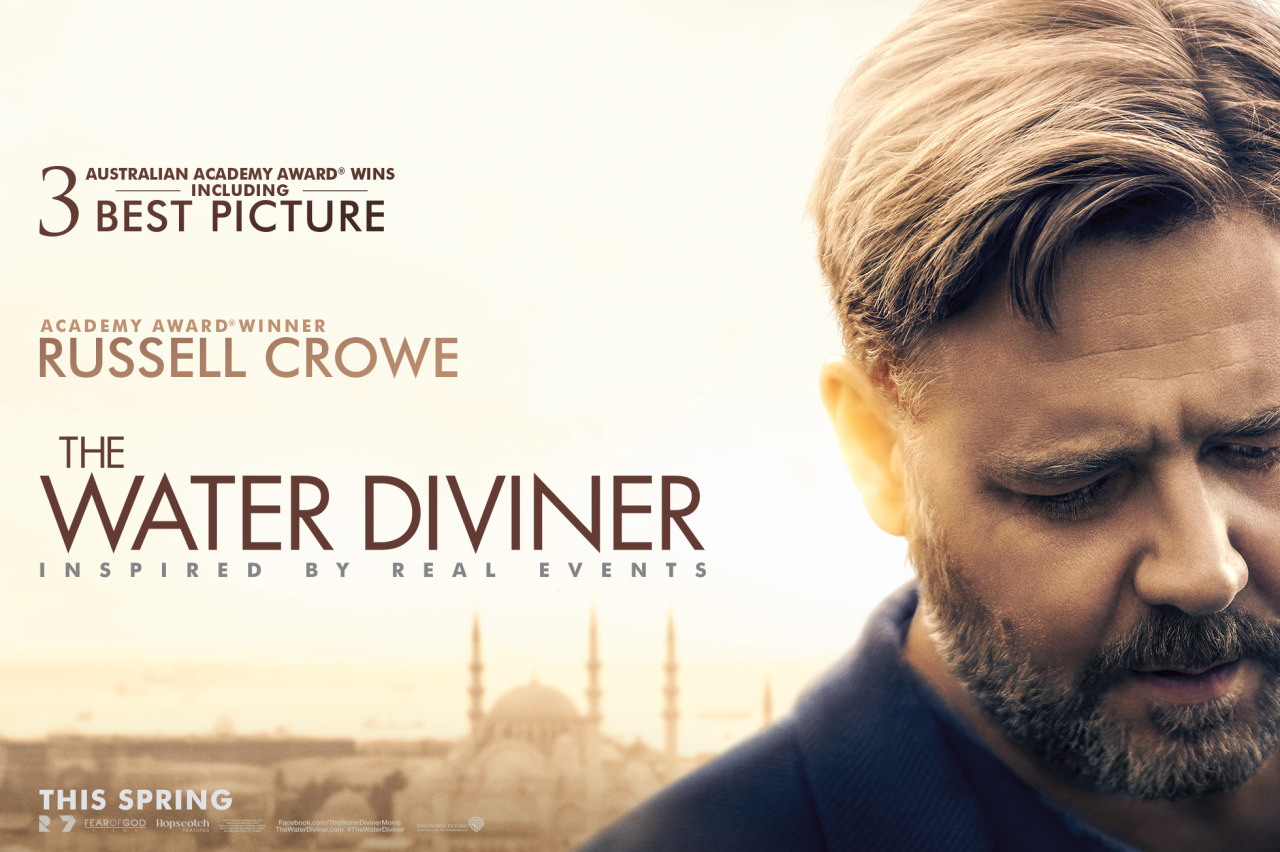
Before it detours into not one, not two, but at least three preposterous Hollywood twists, “The Water Diviner” is an absorbing drama about Joshua Connor, an Australian farmer (Russell Crowe, making his directing debut as well) who travels to Turkey to find the remains of his three sons, all killed in the battle of Gallipoli, so he can bring them home for burial. We first see Joshua dowsing for water. He selects the spot he is drawn to, then digs with skill, focus, and determination, until he hits water. He has a well.

He returns to the house where his wife tells him to read a bedtime story to their three sons. It is too much for her to accept that they are long gone to war and killed in battle. Finally, she is so overwhelmed by grief that she commits suicide. Joshua insists that she be buried in the church cemetery, and then leaves to bring their sons home and bury them next to her.

Crowe’s greatest asset as a director is himself as leading man, and his performance is powerful, with a muscular masculinity and sense of honor, but shredded by the loss of his family and by his fears that he may be responsible because he “filled their heads with heroic nonsense.” The clash of cultures and the unthinkable tragedies are intriguing. The best part of the film is the depiction of the way the defeated Australian command must work with the Turkish nationals to bury their dead as respectfully as possible, the tensions are inevitable. Was the end of the battle a “retreat” or an “evacuation?” “You killed my sons.” “You sent them. You invaded us.” Both, of course, are right. When one says, “I don’t know if I forgive any of us,” the other side has to agree.

“Four years ago you’d have given me a VC for shooting that bastard,” one of the ANZAC (Australian/New Zealand) officers growls. “That bastard” is Major Hasan (Yılmaz Erdoğan). The former enemies must work together on a task of unimaginable sadness and defeat, creating a sacred burial ground for thousands of dead soldiers, who will remain for eternity in the site of their defeat. “This is the first war anyone has given a damn,” to do even that much, says an ANZAC officer. Previous war dead were piled into pit graves with the horses.

Joshua finds a place to stay — or rather, it finds him, as a boy takes his bag and runs to the home where his mother and uncle have established a small hotel. They do not want an Australian there, but they need the money, so they gingerly make him welcome. The boy’s mother, Ayshe (Olga Kurylenko), is still insisting that her husband will return from battle, to keep her son’s hope alive more than her own, and perhaps also to protect her from the pressures put on a single mother to remarry. Joshua is forbidden from going to the burial ground, but Ayshe helps him find a way. Once he gets there, no one wants to help him. But “because he is the only father who came looking,” they grudgingly allow him to look through the piles of bones.

And then it starts to get Hollywood. The water diviner somehow uses that same skill to locate the remains of two of his sons. And then it may be that the third is still alive. The last section of the film takes a turn that even Indiana Jones would find daunting and a romance even Nicholas Sparks would find improbable. It is too bad that the earlier part of the film’s appreciation of conflicts and complexity is followed by a fairy tale ending.

Parents should know that this movie features wartime scenes of battle violence and terrorism with some disturbing and graphic images and a suicide and a mercy killing. Characters are wounded and killed. In addition, it includes some strong language, domestic abuse, sexual references, drinking, and smoking.

Family discussion: What did Joshua and Major Hasan have in common? What do we learn from the flashback to the sandstorm? What should Arthur have done?

If you like this, try: Gallipoli and “A Very Long Engagement”

Related Tags:


Drama Inspired by a true story Movies -- format War

The Woman in Gold

Posted on March 31, 2015 at 5:58 pm

B+
Lowest Recommended Age: Middle School
MPAA Rating: Rated PG-13 for some thematic elements and brief strong language
Profanity: Brief strong language including anti-Semitic epithets
Alcohol/ Drugs: None
Violence/ Scariness: WWII-era peril and violence
Diversity Issues: A theme of the movie
Date Released to Theaters: April 1, 2015
Date Released to DVD: July 6, 2015
Amazon.com ASIN: B00VU4YO7K

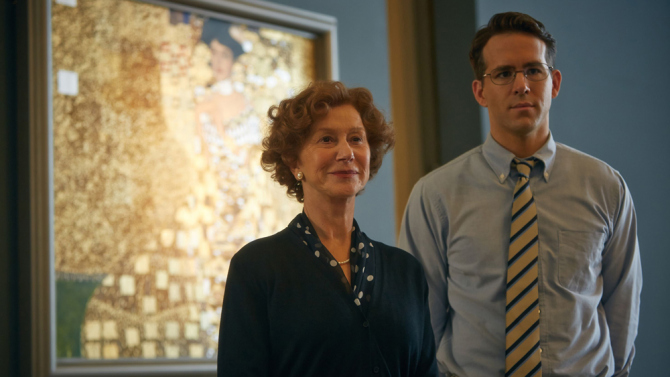
WOMAN IN GOLDThe very title is a form of theft. When Gustav Klimt painted the portrait that gives this film its name, he called it “Portrait of Adele Bloch-Bauer.” She was a warm, vibrant young woman who was a vital part of the extraordinary period of intellectual and cultural life in Vienna known as the Sacred Spring era. Adele Bloch-Bauer died in 1925, and the portrait hung in a place of honor in the apartment her husband shared with his brother, sister-in-law, and two young nieces.

And then the Nazis invaded Germany, their atrocities included stealing the valuables of the Jews they were sending to concentration camps. They took the portrait of Adele Bloch-Bauer and hung it in a place of honor, after they renamed it to remove identity of the subject and the Jewish association of her name. “Portrait of Adele Bloch-Bauer” became the anonymous “The Woman in Gold.” The beautiful choker necklace she wore in the painting was also stolen and given to the wife of Nazi officer Hermann Goering.

More than half a century later, Maria Altmann, the niece of Adele Bloch-Bauer, asked the grandson of her old friend from Vienna if he could help her get the painting back. This film is the story of the painting, the lawsuit, and Maria’s indomitable spirit.

Dame Helen Mirren is radiant as Maria, witty, spirited, an irresistible force who cannot give up. While we never doubt for a moment that she will prevail, Mirren makes us want to watch it all unfold. It is an extremely difficult case, with many arcane legal details, and the real-life story, like all real-life stories, is more complicated and controversial than any movie can convey. Director Simon Curtis (“My Week with Marilyn”) and first-time screenwriter Alexi Kaye Campbell keep the focus on the odd-couple relationship between Maria and the young lawyer (Ryan Reynolds), with flashbacks to show us Maria’s relationship with her Aunt Adele, and then her wedding to a handsome opera singer, just as the Germans are about to invade. Tatiana Maslany (“Orphan Black”) is lovely as the young Maria, and makes us believe she could grow up to become Helen Mirren.

The portrait of Adele Bloch-Bauer now hangs in the Neue Galerie. And now this movie is a part of its story, putting Adele back into the picture and giving us a portrait of the niece who insisted that her story be told.

Parents should know that this film includes WWII-era peril and violence, with references to concentration camps and genocide. There is brief strong language including anti-Semitic epithets.

Family discussion: Why did Maria refuse Ronald Lauder’s offer to get her more experienced lawyers? What was the most important discovery in winning the case?

If you like this, try: the documentary about Nazi art theft, “The Rape of Europa” and learn more about the lawsuit and read up on the real story

Related Tags:


Based on a book Based on a true story Courtroom Drama DVD/Blu-Ray Pick of the Week War

Unbroken

Posted on December 24, 2014 at 5:49 pm

A-
Lowest Recommended Age: Mature High Schooler
MPAA Rating: Rated PG-13 for war violence including intense sequences of brutality, and for brief language
Profanity: Some strong and offensive/abusive language
Alcohol/ Drugs: None
Violence/ Scariness: Intense wartime peril and violence, characters injured, abused, and killed, some disturbing images, parent strikes a child with a belt
Diversity Issues: A theme of the movie
Date Released to Theaters: December 25, 2014
Date Released to DVD: March 23, 2015
Amazon.com ASIN: B00HLTDC9O
Copyright 2014 Universal Pictures

Oscar-winning actress Angelina Jolie breaks into the top ranks of American directors with “Unbroken,” showing an exceptional understanding not just of actors, but of tone, scale, and letting the camera tell the story. Working with the magnificent cinematography of Roger Deakins (“True Grit,” “Skyfall”), she adopts a classical style well-suited to the WWII setting, but every choice is careful, thoughtful, and powerful.

Based on the best-seller by Laura Hillenbrand, this is the story of Louis Zamperini, the son of Italian immigrants. He was a rebellious kid who became an Olympic athlete. His bomber plane crashed over the Pacific, and he survived for 47 days at sea, before being captured with one surviving crewmate, by the Japanese. In the prison camp, he was singled out for horrific abuse and repeatedly beaten.

The screenplay by the famously off-beat Joel and Ethan Coen is straightforward, direct, and sincere, keeping the focus on the war years, with the incidents from Zamperini’s past brought it primarily to show us how he relies on his memories to keep going. “Nobody’s chasing me,” he tells his brother who is urging him to run faster as he trains for a race. “I’m chasing you,” his brother tells him.

That internalized sense of mission helps him hold onto the idea of his own power as the brutal Japanese captors try to take everything away from him.

The opening scene puts us in the sky, and Jolie superbly evokes the thrill and the terror of flying on a bombing mission in aircraft that seem barely past the era of the Wright brothers. The crash scene is vertiginously disorienting. Jack O’Connell plays Zamperini with an effortless masculinity, understanding that it has nothing to do with macho posturing, just an imperishable sense of integrity, courage, and honor. O’Connell, Finn Witrock (“Noah”), and Domhnall Gleeson (“About Time”) perfectly capture the rhythms of an experienced crew, some amiable wisecracks and bravado to recognize the perilousness of their situation, but always focused, on task, and always, always, putting the team first.

We become so attached that it is sharply painful to see the characters experience such deprivation and abusive treatment. Japanese pop star Miyavi (real name Takamasa Ishihara) plays the sadistic Mutsushiro Watanabe, known as Bird. He knows of Zamperini’s celebrity as an athlete and sees that he is a symbol to the other prisoners.

If the Bird can break Zamperini, it will crush the morale of the whole camp. So, he singles Zamperini out for beatings and mind games. But Zamperini knows that “we beat them by making it to the end of the war alive.” He simply will not give up, and defining his own sense of what it means to win allows him to maintain a sense of control that is his most powerful weapon.

It is gorgeously filmed, superbly acted, and directed with great sensitivity and compassion, but the real impact of the film comes at the end, when we learn through a few simple titles, what happened to Zamperini after the war. Even Jolie recognizes that there is nothing she can put on screen to match the real-life footage of Zamperini, back in Japan at four days before his 81st birthday, running with the Olympic torch.

Parents should know that this movie includes very intense and disturbing wartime peril and violence, with a plane crash, an extended period lost at sea, and grueling prison camp abuse, and some strong language including racist epithets. School-age bullies harass and punch a character and a parent beats a child with a belt.

Family Discussion: What was the toughest challenge for Louis? Why didn’t he give up? Why did he forgive his captors?

If you like this, try: the book, Unbroken: A World War II Story of Survival, Resilience, and Redemption, and Zamperini’s own book, Don’t Give Up, Don’t Give In: Lessons from an Extraordinary Life, along with the films Stalag 17 and The Great Escape, also based on real-life WWII stories of American prisoners of war.

Related Tags:


Action/Adventure Based on a book Based on a true story Drama DVD/Blu-Ray Pick of the Week Sports War

The Hobbit: The Battle of the Five Armies

Posted on December 16, 2014 at 5:47 pm

Copyright Warner Brothers Studios 2014

Visually stunning, capably presented, and utterly unnecessary, this final in the six-movie Tolkien cycle is just for the fans.  I think even Tolkien himself would cry “no mas” at this point.  Remember how the third LoTR movie had about five or six endings because Jackson just could not bear to let go?  This whole movie is like that.

It’s not bad.  There’s just too much of it.

The second of the Hobbit movies remains my favorite because it had the most excitingly staged action scenes and the best characters.  And it left us with a heck of a cliffhanger as Smaug the dragon delivered on the promise of the title, leaving his lair to desolate the village of Lake-Town.  But that all gets resolved pretty quickly (and excitingly) and then, as this title makes clear, most of the rest of the time is not about the original quest to reclaim the Lonely Mountain or the sub-quest to obtain the powerful Arkenstone.  It is about a battle of just about everyone, with shifting loyalties and heartbreaking losses.  If you are not a hard-core Tolkienite at the Stephen Colbert level, here’s the one key guideline to keep in mind: the worse the teeth, the more evil the creature sporting them.  The elves, dwarves, and men may have their grievances with each other and may even go into battle against each other, but as any crossword puzzle fan knows, Orcs are the bad guys, ugly cusses with terrible gnashy teeth, and nothing unites rivals and enemies quicker than the arrival of a much worse enemy coming after all of them.

Martin Freeman (television’s “Sherlock” and “Fargo”) returns as Bilbo Baggins, the heart and the moral center of the story.  While my mind wandered at times to consider such questions as who does all that intricate hair-braiding that the characters sport?  It must be like a middle school slumber party around those campfires, with everyone in a circle doing the hair of the person in front of them.  Isn’t that total turnaround by Thorin Oakenshield a little unbelievable? And I can never figure out exactly the scope of the powers and jurisdiction of characters like Gandalf and Galadriel. Plus, the snively traitor guy gets much too much screen time.

But I never stopped admiring the gorgeously imagined visuals or the subtle complexity of Freeman’s performance. As we see on “Sherlock,” there is no one better at showing us a thoughtful and deeply honorable struggle over how to respond to terrifying and complex challenges. There may be epic battles, shifting loyalties, elaborate stunts, and a lot of gnashing of very scary-looking teeth, but it is the part of the title before the colon that is what matters.

Parents should know that this movie has extensive and graphic peril and war violence with many sad deaths and some disturbing images.

Family discussion: What was the most difficult decision made by Thranduil? By Bilbo?

If you like this try: The other Hobbit and Lord of the Rings films by Peter Jackson and the books by J.R.R. Tolkien

Related Tags:


3D Action/Adventure Based on a book Drama Epic/Historical Series/Sequel War

The Imitation Game

Posted on December 4, 2014 at 5:03 pm

B+
Lowest Recommended Age: High School
MPAA Rating: Rated PG-13 for some sexual references, mature thematic material and historical smoking
Profanity: Some strong language
Alcohol/ Drugs: Drinking, smoking
Violence/ Scariness: Wartime violence
Diversity Issues: A theme of the movie, homophobia, suicide
Date Released to Theaters: November 21, 2014
Date Released to DVD: March 30, 2015
Amazon.com ASIN: B00RY85CQI
Copyright 2014 The Weinstein Company

Alan Turing was a brilliant mathematician with an enormous intellect, an almost equally enormous ego, and an almost equally enormous secret. He was one of the founding thinkers behind modern computing and it is his name that we use for the test that determines whether a computer has achieved true artificial intelligence status. The Turing test standard is human conversation. If a human cannot tell whether he or she is communicating with a person or a computer, than the program has passed the Turing test and is true artificial intelligence.

I’m not sure that Alan Turing could have passed the Turing test. Cumberbatch, who also plays a super-smart, arrogant, and obnoxious guy in “Sherlock,” creates a very different character here. Turing himself is an Enigma. In the opening scene, a sort of job interview nightmare in which Commander Denniston (Charles Dance) is trying to interview Turing (Benedict Cumberbatch) for a spot on the team working at the famous Bletchley Park estate to break the code the Germans were using to send orders to their troops. If passing as human means meeting even the most minimal standards of civility and responsiveness, Turing failed that interview. He seemed to think that it was he who was interviewing Denniston to determine whether the task was of sufficient interest and import to merit his attention.

Denniston begins to dismiss him. But when Denniston says that everyone thinks the code, known as Enigma, is unbreakable, Turing says briskly, “Let me try, and then we’ll know for sure.” Denniston does not have a better idea or a better option.

The German code is unbreakable because it is constantly changing, so by the time any one message has been decrypted, whatever was learned could not be applied to whatever comes next. The Allies are perpetually behind. [The process, complicated as it is, has been simplified for the purposes of the movie, glossing over the important work done by Polish mathematicians, the contributions of the French, and the challenges faced as the Germans continued to make the Enigma more complicated and impenetrable as the war continued.) While a bunch of brilliant mathematicians, scientists, and puzzle-solvers (including Joan Clarke, played by Keira Knightley) worked away, Turning realized not only that what made the code unbreakable was the inability of any then-existing computational mechanism to perform enough calculations fast enough to decrypt the messages before the code was reconfigured the next morning, but that he could create a machine to do it.

We know how it turned out. But director Morten Tyldum keeps the story gripping on several levels. First, there is the conflict between Turing and just about everyone, and the pressure for immediate results as he is spending a lot of time (years) and money on something no one has ever seen before. Second, there are the interpersonal struggles, and Turning’s internal difficulties. He did want intimacy, and we see in his memories of his first love, a boy at his school. He likes Joan, and is briefly engaged to her. But he was gay at a time when being gay was punishable by prison. Then there are other kinds of secrets. One of the people working on breaking the code may be a spy. And once the code is broken, the Allies have the wrenchingly painful decision about what to do with the information. It’s not just a puzzle. It is statecraft, and terrible compromises and terrible losses are part of the job.

The film adds some unnecessary drama and oversimplifies parts of the story. But it is a powerful, complex drama and a long-overdue tribute to a true hero and visionary.

Parents should know that this film includes wartime themes and images, some disturbing, wrenching moral choices, betrayal, the pressures of being a closeted homosexual when it was a crime, drinking, smoking, and some sexual references.

Family discussion: Do you agree with the decision to withhold the news that the code had been broken? To allow the mole to keep spying?

If you like this, try: Read up on the history of the codebreakers at Bletchley (The Secret Lives of Codebreakers: The Men and Women Who Cracked the Enigma Code at Bletchley Park, Seizing the Enigma: The Race to Break the German U-boat Codes, 1939-1943) as well as those in Poland and the spies who helped them get the information they needed and try some online version of the Turing Test.

Related Tags:


Based on a true story Biography Drama DVD/Blu-Ray Pick of the Week War
THE MOVIE MOM® is a registered trademark of Nell Minow. Use of the mark without express consent from Nell Minow constitutes trademark infringement and unfair competition in violation of federal and state laws. All material © Nell Minow 1995-2026, all rights reserved, and no use or republication is permitted without explicit permission. This site hosts Nell Minow’s Movie Mom® archive, with material that originally appeared on Yahoo! Movies, Beliefnet, and other sources. Much of her new material can be found at Rogerebert.com, Huffington Post, and WheretoWatch. Her books include The Movie Mom’s Guide to Family Movies and 101 Must-See Movie Moments, and she can be heard each week on radio stations across the country.

Website Designed by Max LaZebnik