War Dogs

War Dogs

Posted on August 18, 2016 at 5:51 pm

Copyright Warners 2016


“What does AEY stand for?” a newly hired employee asks Efraim Diveroli (Jonah Hill). “You mean morally?” No, he just wants to know what the initials represent, though the answer is the same: nothing. And, as it turns out, asking the question and correcting Efraim’s mistake get him fired. AEY “stands for” making money, no questions asked. That will be the basis for great success, until it is also the basis for catastrophe.

We this know right from the beginning, when we see Efraim’s partner David Packouz (Miles Teller) released from the trunk of a car and beaten up at gunpoint by some very evil-looking masked guys. In Albania. And then we go back in time to see how David, a college drop-out now on his seventh job, working as a massage therapist, and smoking a lot of weed, met up with Efraim, an old friend from middle school, and joined him at AEY, a company that sold equipment to the Pentagon.

It was 2008. The United States was fighting two wars and outsourcing pretty much everything. If it costs more than $17,000 to outfit each soldier, that means someone has to sell them all that gear. The Bush administration got into trouble for dealing exclusively with “Dick Cheney’s friends” and was under pressure to give some of that procurement business to small companies. And Efraim, a high school dropout, had mastered the art of constantly scrolling through the website that was essentially the government’s wish list and bidding on contracts so small they were beneath the notice of enormous government contractors who sell tanks and planes. “All the money is made between the lines,” Efraim says. He tells David that while big companies go for the pie, they can make plenty of money from the crumbs. David, bored and worried about money for his pregnant girlfriend, signs on.

At first it works. They make tons of money. But buying and selling guns puts them in contact with some untrustworthy and violent people. And a little bit of success makes them eligible to go beyond the crumbs. An international arms dealer who is barred from selling to the US because he is on a watch list (producer Bradley Cooper) offers them a deal too good to pass up on ammunition they can sell to the Pentagon at a huge mark-up. But Efraim and David are very good at the details when it comes to making the pitch; not very good at the details when it comes to delivering the product. This is a business school case study in failure of operations and execution. And in the failures of government procurement.

Director and co-screenwriter Todd Phillips is clearly trying to make the kind of shift from raunchy, slob comedies (“Old School,” “The Hangover”) to sharp, trenchant satire that Adam McKay did with “The Big Short.” And Jonah Hill, looking disturbingly puffy and pasty, clearly wants to play the Leo role instead of the Jonah Hill role in his own “Wolf of Wall Street.” Both get partway there. Hill clearly enjoys being the trigger-happy hotshot who can brashly invite a girl to skip ahead to the third date for $1000 instead of his usual role as either the dumb shlub or the smart shlub. Phillips does a good job in laying out the parameters of the story, making it clear how the window of opportunity opened for AEY and Efraim and David were in the right place at the right time. There are even chapter headings for each section, foreshadowing telling comments we will hear, from “God bless Dick Cheney’s America” to “That sounds illegal.”

He also lays out a classic Hollywood movie structure: set-up, early triumph, hubris, wipeout. There are some fine moments, like the surreal use of identical actors (or CGI) as the Pentagon officials who sign off on the deal. But Phillips’ control of tone and character is uncertain and he relies too much on songs (“Fortunate Son,” “Time in a Bottle”) to carry the story.

Parents should know that this film includes wartime and crime-related peril and violence including automatic weapons, war profiteering, constant very strong language, crude and explicit sexual references, non-explicit situations, drinking, and drugs.

Family discussion: When and why did David and Efraim make different choices? What was their biggest mistake? Were they appropriately punished?

If you like this, try: “The Wolf of Wall Street”

Related Tags:


Based on a true story War
Free State of Jones

Free State of Jones

Posted on June 23, 2016 at 5:40 pm

B+
Lowest Recommended Age: High School
MPAA Rating: Rated R for brutal battle scenes and disturbing graphic images
Profanity: Some strong and racist language
Alcohol/ Drugs: Alcohol
Violence/ Scariness: Intense and graphic violence including battle scenes, hanging of adults and children, brutal abuse, rape, and lynching
Diversity Issues: A theme of the movie
Date Released to Theaters: June 24, 2016

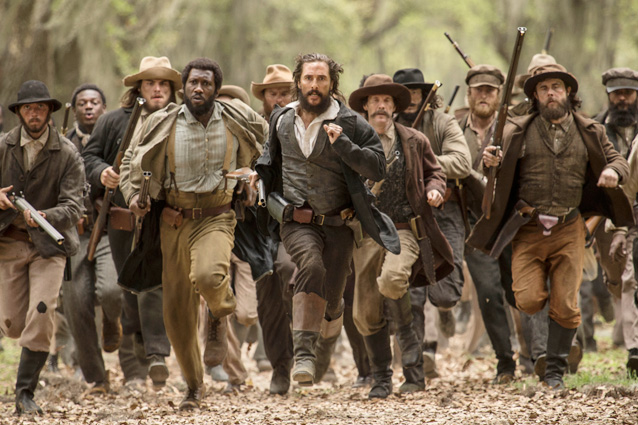
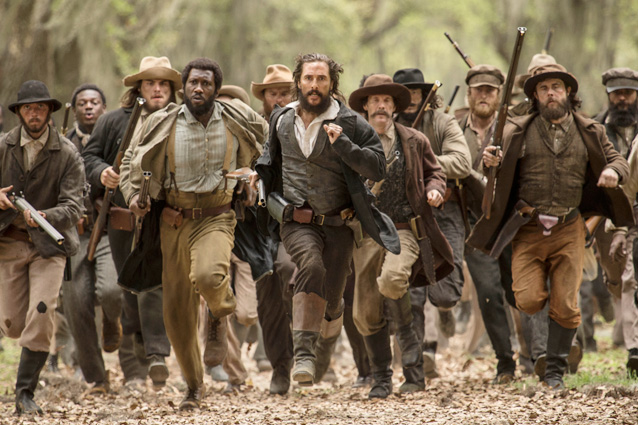
freestateofjonesThe timing is not great. “Free State of Jones” is a Civil War drama based on the true story of a community of Confederate deserters and runaway enslaved people who banded together to fight for their own vision of freedom. It was filmed once before as “Tap Roots,” with Van Heflin, Susan Hayward, and Boris Karloff (as an Indian!), but this version, from “The Hunger Games'” Gary Ross, deals forthrightly with the racial issues, or at least tries to. There is an inescapable and maybe unconquerable problem in telling a story set in Civil War era Mississippi with a glorified white man as the hero, in a time when one of the most anticipated films of the year is the Sundance Grand Jury and Audience award winner “Birth of a Nation,” a film that grabbed and repurposed its title from the blatantly racist D.W. Griffith film of the silent era.

Ross brings the same passion for tackling tyranny to this story that he did to “Hunger Games.” It’s just that we’re no longer dealing with speculation and metaphor, and that means a political overlay reflecting both historical and contemporary controversies.

Matthew McConaughey plays Newt Knight, a Mississippi farmer with a wife and young son who is serving as a nurse in the Confederate army. Early on, we see him removing the uniform from a wounded enlisted man so he can tell the doctors he is an officer and get him treated. Increasingly frustrated with the endless carnage on behalf of wealthy elites who exploit the poor, it is too much for him at last when his nephew is killed in battle and he leaves, taking the body home to be buried. There he finds the Confederate forces are taking all of the food from the local farmers, leaving them to starve. On the run from the military seeking defectors, he hides out in a swamp, where he meets up with runaway slaves. There he decides that his allegiance is not to the Confederacy, which is sending poor boys to fight to preserve what today we might call the 1 percent. “I ain’t fighting for cotton,” another solider tells him. “I’m fighting for honor.” “That’s good,” Knight responds. I’d hate to be fighting for cotton.”

Writer/director Ross, working with the locations where these events occurred and a touching score from Nicholas Britell, evocatively conveys the hardscrabble lives, the literal and spiritual grit, the desperation and conviction it inspires. Knight hands guns to three little girls and, when the Confederate officer does not take them serious, Knight tells him that guns will shoot anybody. “It don’t seem to matter where the bullet comes from.” The depth of research is evident throughout, but it is never pedantic. The storyline is grounded in historical events like the Confederacy’s requisitioning of food and supplies, and post-war exploitation and terrorism, led by former Confederate officials, that prevented former enslaved persons from basic rights and murdered those who tried to assert them. There are brief glimpses into a conflict 85 years later, as the descendent of Knight’s relationship with a former slave named Rachel (Gugu Mbatha-Raw) is criminally prosecuted for marrying a white woman in violation of the state’s laws prohibiting mixed marriages. It is there to remind us that we can never dismiss the events of the past as behind us.

Parents should know that this film has very intense and graphic violence including Civil War battles and skirmishes, hanging, rape, and lynching, adults and children injured and killed, very disturbing images, some strong language with racist epithets, some sexual references

Family discussion: What did Knight find most unjust about the Confederacy?  What did we learn from the 1948 courtroom scenes?

If you like this, try: “Glory” and “The Red Badge of Courage” and read about the story that inspired the film.

Related Tags:


Based on a book Based on a true story Drama Epic/Historical Movies -- format Race and Diversity War
Memorial Day: Tributes to Our Troops

Memorial Day: Tributes to Our Troops

Posted on May 29, 2016 at 3:24 pm

I’ve already written about great documentaries and feature films about the military to watch on Memorial Day.  These recent documentaries about our 21st century conflicts give the military a chance to tell their own story.  They are not pro-war or anti-war. They are pro-soldier.

The War Tapes Operation Iraqi Freedom was filmed by three soldiers on the front lines in 2006.

Restrepo This documentary tells the story of the deployment of a platoon of U.S. soldiers in Afghanistan’s Korengal Valley. The movie focuses on a remote 15-man outpost, “Restrepo,” named after a platoon medic who was killed in action.

Gunner Palace This film shows us the lives of soldiers from the 2/3 Field Artillery in a bombed-out former pleasure palace once belonging to Uday Hussein.

Bomb Hunters: Afghanistan The US Army’s 23rd Engineer Company is are charged with clearing routes in southern Afghanistan and disarming the military’s number one threat: IEDs.

https://www.youtube.com/watch?v=KDvFdXyFw6c

Always Faithful Military dog teams are on the front lines of war in Iraq and Afghanistan. “Always Faithful” follows five young Marines and their four-legged partners.

Baghdad ER Like a real-life update on the kinds of facilities portrayed in “MASH,” this film looks at life and death at the 86th Combat Support Hospital, the U.S. Army’s premier medical facility in Iraq.

https://www.youtube.com/watch?v=NODPhWuXImo
Related Tags:


Documentary War

Memorial Day on PBS: Of Men and War

Posted on May 28, 2016 at 1:35 pm

Post-traumatic stress disorder, or PTSD, affects almost 30 percent of the 834,467 Iraq and Afghanistan War veterans treated through the U.S. Department of Veterans Affairs. Consumed by anger and traumatic memories long after their return, soldiers often resort to drugs or suicide to end their suffering. 

Filmmaker Laurent Bécue-Renard provides a searing account of how the disorder has affected veterans and their families in Of Men and War. The film offers an unparalleled look at the enduring consequences of PTSD and the role treatment can play in helping soldiers reclaim their lives. An Official Selection of the 2014 Cannes Film Festival, the documentary has its national broadcast premiere during the 29th season of POV (Point of View) on Memorial Day, Monday, May 30, 2016 at 10 p.m. on PBS. (Check local listings.)

 Of Men and War, made between 2003 and 2014, begins with a scenic drive through California’s Napa Valley, where therapist and social worker Fred Gusman, who pioneered revolutionary PTSD programs at the Veterans Administration in the late 1970s, opened The Pathway Home residential treatment center in Yountville in 2008. The beauty of the surroundings stands in stark contrast to the intense inner turmoil suffered by the veterans arriving by van.

 Bécue-Renard filmed the servicemen speaking for the first time about their experiences. Survival in a war zone required a hardened attitude—“Rage and anger carried me through everything,” says one veteran—accompanied by alienation even from those in their units. “He was there and then he was gone,” a soldier says of a friend killed during their deployment together in Iraq. “It’s hard being close to anybody because you know they’re going to leave any time.” These attitudes did not disappear when combat tours ended.

“The return to civilian life is not what they thought it would be,” says Gusman, Pathway’s lead therapist. One veteran says that he “woke up mad” and “took things out” on loved ones. “When you come back you feel like you should have died over there. It would have been a hell of a lot easier to just fall down over there and not get back up.” Something as ordinary as driving can cause severe distress; in the combat zone, a soldier explains, an approaching vehicle was always seen as potentially carrying a bomb. That fear returns if a car pulls too close to his in traffic.

The war resurfaces in nightmares and panic attacks. A sudden noise might trigger a flashback. Other times, all it takes is a disagreement with a spouse or an ambiguous look from a stranger. Then the groundswell takes over—all that was buried from the war boils up, and the veteran lashes out. “The day I came home from Iraq was the last time I saw my daughter,” says one soldier. “I was given a restraining order.”

The film underscores another problem: Seeking help for PTSD can be a difficult step to take. “What we have is embarrassing,” a soldier says. It makes him feel “small” and “defective.” Wives and girlfriends often feel helpless. “I’m scared he’s going to give up trying,” says one.

 Bécue-Renard says his camera performed a significant role in the soldiers’ therapy. “They came to perceive the filming itself as an additional glimmer of hope. Consciously or not, the veterans began to sense that voicing their brutal experiences might uncover deeper meaning: Their stories might contribute to a greater public consciousness of the hardships veterans confront long after the war’s end.”

Of Men and War shows that for many veterans, recovery will be a lengthy process. Although therapists cite the necessity of forgiveness, one soldier, who killed a colleague by mistake, responds, “I think it would be really selfish for me to learn to forgive myself.”

Of Men and War came out of a reflection on what was left unspoken by my grandfathers,” says Bécue-Renard. “They had died by the time I was born—but they had also staunchly refused to talk about their experiences from the First World War while they were alive. Of Men and War is my way of honoring them.

“It took 11 years between my first idea for the film—when the Iraq war began in 2003—and its completion in May 2014. I spent 14 months in the therapy center and returned many times in the four years that followed. Filming therapy was a way of acknowledging people who had decided to move forward with their lives. Some days I’d leave the therapy room overwhelmed. How was I to make sense out of this mess? How could I communicate it to an audience? I became convinced that from all this mud, I could eke out rays of light. In doing so, I could find meaning for the protagonists in Of Men and War as well as for its viewers.”

Related Tags:


Documentary War

Trailer: Miles Teller and Jonah Hill in “War Dogs”

Posted on March 25, 2016 at 3:11 pm

Based on a true story and from Bradley Cooper’s production company, “War Dogs” follows two friends in their early 20s (Jonah Hill and Miles Teller) living in Miami Beach during the Iraq War who exploit a little-known government initiative that allows small businesses to bid on U.S. Military contracts. Starting small, they begin raking in big money and are living the high life. But the pair gets in over their heads when they land a 300 million dollar deal to arm the Afghan Military—a deal that puts them in business with some very shady people, not the least of which turns out to be the U.S. Government.

Related Tags:


Trailers, Previews, and Clips War
THE MOVIE MOM® is a registered trademark of Nell Minow. Use of the mark without express consent from Nell Minow constitutes trademark infringement and unfair competition in violation of federal and state laws. All material © Nell Minow 1995-2026, all rights reserved, and no use or republication is permitted without explicit permission. This site hosts Nell Minow’s Movie Mom® archive, with material that originally appeared on Yahoo! Movies, Beliefnet, and other sources. Much of her new material can be found at Rogerebert.com, Huffington Post, and WheretoWatch. Her books include The Movie Mom’s Guide to Family Movies and 101 Must-See Movie Moments, and she can be heard each week on radio stations across the country.

Website Designed by Max LaZebnik