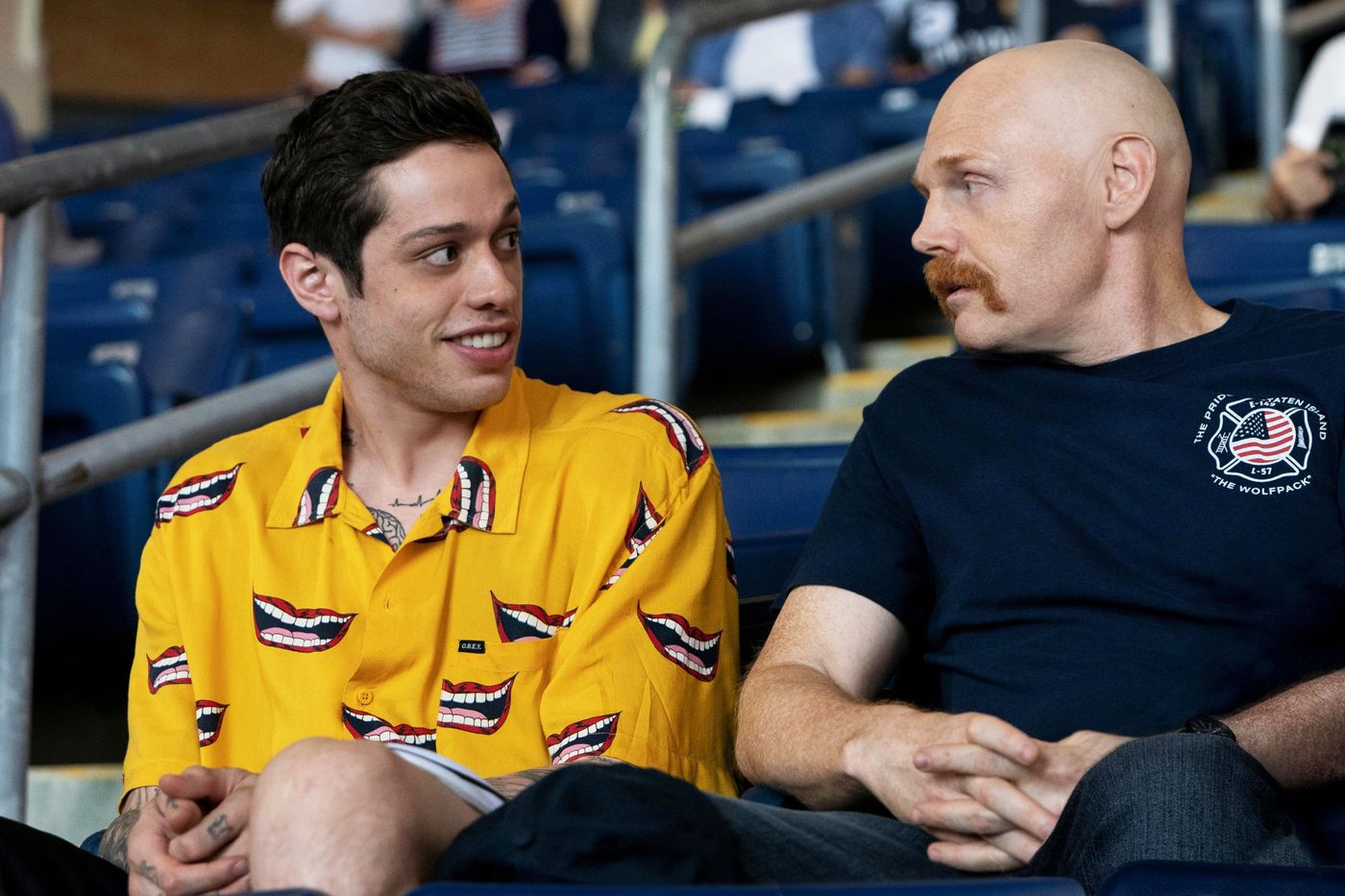
The King of Staten Island

The King of Staten Island

Posted on June 11, 2020 at 3:13 pm

B-
Lowest Recommended Age: Mature High Schooler
MPAA Rating: Rated R for language and drug use throughout, sexual content and some violence/bloody images
Profanity: Constant very strong and crude language
Alcohol/ Drugs: Drinking, drugs
Violence/ Scariness: Some violence, fires, sad death, suicide attempt
Diversity Issues: None
Date Released to Theaters: June 12, 2020

Copyright 2020 Universal Pictures
Here we go again. Another too-long Judd Apatow movie about an arrested development, failure to launch man-child we are expected to find far more endearing than we do. “The King of Staten Island” shares these essential ingredients with earlier films like “The 40-year-old Virgin” and “Knocked Up,” and one more: the main character played by a charismatic comedian or comic actor. In Apatow’s earlier films, those actors have included Paul Rudd, Steve Carell, and Seth Rogen. This time, it is stand-up comedian and SNL cast member Pete Davidson.

But there are a couple of significant differences between the sunny sensibility of those glossy Hollywood confections and “The King of Staten Island,” with the significance of its setting reflected in the title. It’s not sunny. It’s dingy and gritty, with the help of superb cinematography from Robert Elswit, and very little music on the soundtrack. And the reasons that the main character is stuck in a perpetual directionless funk of helplessness, sorrow, self-pity, resentment, self-harm, numbness, and weed, are darker, much darker because we know the story is semi-autobiographical.

Normally, I might describe a film like this as the co-writer/star working through some issues (as, say, in Shia LeBoeuf’s “Honey Boy,” where he played his own abusive father). But it is not clear that Pete Davidson is working through much here, except to the extent he is re-enacting some of what has happened to him. Davidson is currently living at home with his mother, as we see (literally) in his appearances, some with her, in the videos he shoots for the pandemic-era SNL episodes. Davidson was seven when his fireman father was killed on 9/11. In this film, his character’s name is Scott, after his real-life father, to whom the film is dedicated. Scott’s father, also named Scott, was a fireman who died trying to rescue someone. As the film begins, Scott’s sister (played by Apatow’s daughter Maude) is leaving for college. And his mother (Marisa Tomei, in another wonderfully warm and radiant performance), 17 years after his father’s death, is beginning to date someone new, also a fireman (Bill Burr). Seeing the people closest to him taking chances, moving on, and accepting responsibility are deeply unsettling. But what he is most threatened by is allowing himself to feel the feeling he has numbed with weed, denial, and tattoos that are more like self-mutilation, mortification of the flesh, and self-inflicted pain to reduce feelings of worthlessness than aesthetics or self-expression. He says he wants to be a tattoo artist and practices on his friends (and briefly on a child). He says his dream is to have a combined restaurant/tattoo parlor. What he really wants to do is erase himself.

Davidson is an exceptionally appealing performer, and it is clear he is trying to blend art and life here, using the film itself to become more vulnerable and more present. But there is a reason one of the most frequent characters he plays on SNL (other than himself) is a teenager whose only reaction is a shrug. He is still operating within a pretty narrow range, in contrast to Tomei and Burr, and Pamela Adlon, who briefly appears as a bitter ex-wife, all excellent. Making the most of an even briefer appearance is Steve Buscemi, a real-life fireman playing one on screen.

There are touching moments, and some scenes have a satisfyingly authentic impact, especially those with a group of guys showing their ride or die support for each other by ragging each other mercilessly, an Apatow speciality. It could have been half an hour longer, first by cutting the weird scenes where restaurant waiters and bus staff literally fight for tips. But we keep rooting for Scott, and especially for Pete.

Parents should know that this movie includes constant very strong, explicit, and crude language, sexual references and situations, alcohol and drugs, including the use of both to numb pain, risky and foolish behavior, including a possible suicide attempt, criminal activity, a gun, and discussions of the death of a parent and divorce.

Family discussion: Why did Scott and his sister respond to the loss of their father differently? Why was it so difficult for Scott when he mother dated another fireman? What made him decide to change?

If you like this, try: Pete Davidson’s stand-up special, “Alive from New York”

Related Tags:


Drama Inspired by a true story movie review Movies -- format Movies -- Reviews
Think Like a Dog

Think Like a Dog

Posted on June 10, 2020 at 8:26 am

B +
Lowest Recommended Age: Kindergarten - 3rd Grade
MPAA Rating: Rated PG for rude and suggestive material
Profanity: Some schoolyard language
Alcohol/ Drugs: None
Violence/ Scariness: Low-key peril, chase scenes, marital estrangement
Diversity Issues: Diverse characters
Date Released to Theaters: June 9, 2020
Copyright 2020 Lionsgate

As the title “Think Like a Dog” suggests, this family friendly fantasy from writer/director Gil Junger is a welcome throwback to Disney live-action fantasy classics like “The Absent-Minded Professor,” “The Shaggy Dog,” and “The Monkey’s Uncle.” A very likable Gabriel Batemen plays Oliver, a young science whiz who invents a contraption that allows him to hear what his beloved dog Henry is thinking. As he tries to figure out a way to talk to the girl he has a crush on and remind his parents how much they care about each other, Henry helps with support and advice. Meanwhile, there are adults who are very interested in Gabriel’s technology, including a charismatic high-tech billionaire and the US government.

Oliver’s parents, Lukas (Josh Duhamel) and Ellen (Megan Fox), are devoted to him but are having a hard time communicating with each other. They do their best to hide from Oliver that they are considering a separation. Oliver is so busy with his invention for the school’s science fair that he does not notice. With the help of a friend half a world away in China (Neo Hooo as Xiao), he figures out a way to access a government satellite to get the signal he needs to make it work.

The special guest at the science fair is a charismatic Silicon Valley superstar known as Mr. Mills, played by Kunal Nayyar, as a very different kind of super-brianiac than the one he played on “The Big Bang Theory.” Oliver wants to make a good impression on Mr. Mills and on his crush, Sophie (Madison Horcher), but his demonstration fails. Disconsolate back at home, he is comforted by Henry, and then accidentally discovers that his contraption actually works — on Henry!

As Mr. Mills tries to steal Oliver’s invention and government agents try to track down whoever is hacking the satellite, Henry advises him on talking to Sophie and gently urges him to pay attention to his parents so he can help them remember to pay attention to each other.

There’s a lot more going on here, including a school play (Oliver plays Romeo!) and a bully, and some of Henry’s canine friends and rivals. Writer/director Gil Junger keeps things moving briskly, with just the right balance of action, humor, and heart.

Parents should know that this movie includes themes of parents considering a separation, and may need to talk to children about how it is not always possible to resolve differences and stay together — and not the responsibility of children to keep them together. They may also want to talk about cybersecurity. This film includes some schoolyard language, potty humor, and some chases and mild peril.

Family discussion: If you could hear your pet’s thoughts, what do you think they would be? Whose thoughts would you like to hear? Who would you like to hear your thoughts? Why did Mr. Mills want the device? Why is Henry so confident?

If you like this, try: “Clockstoppers,” “The Shaggy Dog,” and “A Dog’s Way Home” And read my interview with dog trainer Sarah Clifford.

Related Tags:


Family Issues Fantasy movie review Movies -- format Movies -- Reviews Stories About Kids Talking animals
The High Note

The High Note

Posted on May 25, 2020 at 12:01 pm

B
Lowest Recommended Age: High School
MPAA Rating: PG-13 for some strong language, and suggestive references
Profanity: Brief strong language
Alcohol/ Drugs: Social drinking
Violence/ Scariness: None
Diversity Issues: None
Date Released to Theaters: May 25, 2020

Copyright 2020 Focus
If you find yourself, in what all the commercials are calling “these challenging times” looking for cinematic comfort food, “The High Note” is here, and when I say “here,” I mean coming to you in your home. One of the films switched to streaming as the question of when, how, and whether movie theaters will open remains unsettled, “The High Note” is entertaining without being challenging. If its twist is among the least surprising ever scripted, that itself has its own satisfactions when everything else is so uncertain. It’s a Cinderella tale with (not much of a spoiler alert) a happy ending, in a glamorous setting with beautiful people and some good songs.

Maggie (Dakota Johnson) is personal assistant to a world-famous, if slightly fading singer named Grace Davis, played by Tracee Ellis Ross, the daughter of a world-famous and never-fading superstar Diana Ross. Grace has not released any new music in many years, but still fills arenas with adoring fans. Her manager (Ice Cube) is urging her to accept a very lucrative residency in Las Vegas. She can stop touring and sing her hits every night for as long as she wants.

No one pays much attention to Maggie, unless Grace needs some green juice or some highly inconvenient errand run. But Maggie loves music and, though Grace does not realize it, Maggie is Grace’s truest fan, the only one around her who sees her as a songwriter and performer and not just as a nostalgia cash cow. Seeing the world of music, even from the edges, inspires Maggie to want to be a producer. She hesitantly disagrees when a successful producer wants to remix one of Grace’s hits by adding synth, with digitally created voices for back-up singers. And when she meets a young singer/songwriter who busks outside of a grocery store (fast-rising star Kelvin Harrison, Jr. of “Luce” and “Waves”), she tells him she is a producer and persuades him to let her bring him into a recording studio.

So far, so good. But then it veers off the rails. Cinderella without a godmother makeover — fine. “All About Eve” without the ferocious, greedy ambition — also fine. But then we get a wholly unnecessary scheme so preposterous that even Lucy and Ethel would consider idiotic. And Maggie is supposed to be savvy about the music business and supremely competent. The only benefit of this ridiculousness is a lovely scene with Eddie Izzard, who brings such an air of lived-in wisdom that for a moment it almost makes sense. Almost. And the non-surprising surprise is on top of that.

Ross is fun to watch as the diva, especially when she is on stage, the many opportunities she has had to watch from the wings paying off as she brings authentic star quality to her interactions with the audience (for better) and the crew (for not so much better). She’s especially good in a scene where Grace gets real about the prospects for an over-40 woman of color in the music business. Johnson is sadly underused. She has such a rare gift for comedy, glimpsed in “22 Jump Street” and “The Five-Year Engagement” and yet Hollywood keeps casting her as a wide-eyed little mouse. She would have been better cast as the high-spirited roommate (Harrison is the one to watch her, with very bit of the star quality the part or the goofy housekeeper (though Zoë Chao and June Diane Raphael are reliably delightful in those roles). Harrison has all of the star quality his character requires and more, especially impressive given the wide range of his recent appearances.

There are moments when a movie’s predictability is an advantage rather than otherwise. It benefits this film that it is released I such a time, into our homes, where we most appreciate its comforts.

Parents should know that this film includes brief strong language, some sexual references and a non-explicit situation, and questions of parentage.

Family discussion: Why didn’t Maggie tell David the truth about herself? Which song was your favorite? If you were producing a song, how would you begin?

If you like this, try: “Music and Lyrics” with Drew Barrymore and Hugh Grant and “Black-is” with Tracee Ellis Ross

Related Tags:


Comedy movie review Movies -- format Movies -- Reviews Musical Romance
Military Wives

Military Wives

Posted on May 21, 2020 at 5:26 pm

B +
Lowest Recommended Age: Middle School
MPAA Rating: Not rated, some mature material
Profanity: Strong language
Alcohol/ Drugs: Drinking and drunkenness, teen drinking
Violence/ Scariness: Offscreen wartime violence and peril, characters injured and killed
Diversity Issues: Diverse characters and issues of diversity
Date Released to Theaters: May 22, 2020
Copyright 2020 Bleeker Street

“They also serve who only stand and wait.” Those lines by Milton are a powerful reminder of the quiet struggles of the families left behind when soldiers go to war. “Military Wives” is based on the real-life story of British women who stood and waited while their spouses were fighting in Afghanistan, and came together to form a choir that inspired audiences and led to the creation of choirs on other military bases.

The choir is as much the result of opposing forces as common interests. Kate (a frosty Kristen Scott Thomas) is the wife of one of the base’s commanding officers. He is about to return to duty for the first time since the death of their only son in action. We get a sense of their different ways of grieving — and the way his death has driven them apart — as they talk about a photograph of their son. Should it be left casually on the refrigerator as it was when he was alive or upgraded to a frame and protected by glass?

Lisa (“Catastrophe’s” Sharon Horgan) seems to have been designed to annoy and be annoyed by Kate. She is earthy, unpretentious, and outspoken and just generally messy. She is, in theory, in charge of organizing the morale-boosting base activities for the spouses. But she is not by nature or inclination an organized person. She has a rebellious teenage daughter she can barely manage. And she considers Kate’s “helpful” suggestions snobbish and unrealistic. How much comfort can worried, lonely wives of soldiers get from a knitting club or a film series to explore the auteur theory?

But Lisa cannot dispute Kate’s point that the women “need something to focus on, something to keep them together.” The idea of singing seems to have some appeal. Lisa tentatively agrees but want to keep it casual. “It’s like a drop-in,” she tells the women. “And then you commit,” says Kate. “A lot of fun,” says Lisa. “And uplifting,” says Kate.

They have different ideas about what to sing and how to rehearse. But just as different notes can make beautiful harmonies, the two women find a way to combine forces and even develop some respect for one another. With some bumps along the way. Kate says “it has to be challenging to give them something else to think about.” But it turns out that the challenge is what helps them think about all of it — worry, grief, fear — better.

“It’s like ‘Sister Act’ without the Mafia hit men!” one character says cheerfully. No Mafia hit men, no nuns, but real war, with real casualties, and real pain. The real turning point is when the women bring the people they miss into their performance. And the real highlight is the glimpses we get of the real choir and the others it inspired over the closing credits.

Families should know that this film includes some strong language, teen misbehavior, and sad offscreen war-related injuries and deaths.

Family discussion: Did your sympathies toward the characters shift over the course of the movie? Why? How did characters find different ways to deal with stress?

If you like this, try: “Young at Heart,” a documentary about a choir of elderly singers

Related Tags:


Based on a true story movie review Movies -- format Movies -- Reviews Musical
Scoob!

Scoob!

Posted on May 15, 2020 at 3:15 am

B-
Lowest Recommended Age: Kindergarten - 3rd Grade
MPAA Rating: Rated PG for some action, language and rude/suggestive humor
Profanity: Some schoolyard language, brief strong language
Alcohol/ Drugs: None
Violence/ Scariness: Cartoon-style peril and action, some scary monsters, no one hurt
Diversity Issues: Diverse characters and issues of diversity
Date Released to Theaters: May 15, 2020

Copyright Warner Brothers 2020
Oh, jinkies, here they are again. You might think that the Scooby-Doo clan has exhausted every possible storyline for the members of Mystery, Inc. or, to put it another way, you might think that they have exhausted every possible variable on the theme of figuring out that what looks like some sort of paranormal phenomenon turns out to be some ordinary (but evil) person who would have gotten away with it except for those meddling kids.

If so, you’re pretty much right. But the gang’s first feature-length animated film sticks to the formula but winks at it a little bit, too. And those who have wondered how the gang first got together will get a chance to see them as kids on the fateful Halloween night when they met and solved their first mystery. You’ll even get to find out Shaggy’s real name.

We first see a lonely young Shaggy, maybe about 10 or 11 years old, walking to the beach and listening to songs about loneliness and a podcast from Ira Glass (as himself) about the importance of friends. The best Shaggy can manage is to start a conversation with two mounds of sand on the beach.

Hiding in one of the mounds with some gyro meat he stole is a puppy who can talk. Soon they are sharing an exotic sandwich that includes gummy bears and tater tots, Shaggy has named him after a packet of Scooby snacks, and they are the best of friends. They go trick or treating together as Shaggy’s favorite superhero, Blue Falcon and his sidekick Dyno-Mutt. When bullies steal his candy and throw it into the local spooky house, three kids come to the rescue: Fred (dressed as a knight), Daphne (Wonder Woman), and brainy Velma as Supreme Court (Justice Ruth Bader Ginsburg). The kids retrieve the candy and solve the mystery of the creepy house. “We’ll go into the haunted house this one time, but we’re not going to make a habit of it,” Shaggy inaccurately predicts. In just a few moment, they’ve solved the mystery and unmasked the culprit, who says, come on, say it with me, “I would have gotten away with it if it wasn’t for those meddling kids.” Cue the theme song.

And cut to present day, when the Mystery Inc. crew (Zac Efron as Fred, Will Forte as Shaggy, Amanda Seyfried as Daphne, and Gina Rodriguez as Velma) is seeking some investment funds to fix up the van and expand their operations. Simon Cowell (as himself) says he can see the value of Fred (muscle), Daphne (people person), and Velma (brains), but like many observers, he notes that Shaggy and Scooby don’t do much but eat sandwiches and get scared. And so, Shaggy and Scooby go off on their own adventure, which includes a new partnership with Blue Falcon (Mark Wahlberg), Dyno-Mutt (a delightfully dry Ken Jeong), and his pilot (the charming Kiersey Clemons of “Hearts Beat Loud” and the live action “Lady and the Tramp”). But this is the son of Blue Falcon, not quite the man his father was. Then there’s Dick Dastedly (Jason Isaacs, Lucious Malfoy in the Harry Potter films), who has all of the essentials for a supervillain, cool technology, an evil guy mustache, and a British accent. He’s after Shaggy and Scooby. Can the rest of the Mystery Inc. crew save them in time?

The CGI animation style is a departure from the traditional Scooby-Do Saturday morning aesthetic. But it is colorful, just the right mix of adventure and comedy, it benefits from top-notch voice talent (Tracy Morgan is a very funny caveman) and it is even witty at times, with some meta-commentary along with the usual silly wisecracks. A character describes Shaggy’s use of “like” all the time as “some middle-aged man’s idea pf how a teenage hippie talks.” There are the classic elements the fans will want like an abandoned amusement park and some un-masking, but also some new ideas, like the struggles of Blue Falcon 2.0 to be the hero his dad was. It is traditional enough to please the fans but contemporary enough to address (I’m not kidding) toxic masculinity and of course some nice reminders about the importance of friendship. And of the fun of movies for the whole family.

Parents should know that this film includes extended action-style peril and violence with some scary monsters. Characters use schoolyard language and make some threats and the movie has some potty and body part humor.

Family discussion: Why did Scooby leave when Shaggy asked him to stay? What kind of hero blames other people for his problems? Was there a time when you were scared or made a mistake but then learned to be braver or do better?

If you like this, try: The many, many other Scooby-Doo stories, especially “Scooby-Doo on Zombie Island” and “Scooby-Doo and the Ghoul School”

Related Tags:


Animation Fantasy Movies -- format Movies -- Reviews Mystery Series/Sequel Talking animals VOD and Streaming
THE MOVIE MOM® is a registered trademark of Nell Minow. Use of the mark without express consent from Nell Minow constitutes trademark infringement and unfair competition in violation of federal and state laws. All material © Nell Minow 1995-2026, all rights reserved, and no use or republication is permitted without explicit permission. This site hosts Nell Minow’s Movie Mom® archive, with material that originally appeared on Yahoo! Movies, Beliefnet, and other sources. Much of her new material can be found at Rogerebert.com, Huffington Post, and WheretoWatch. Her books include The Movie Mom’s Guide to Family Movies and 101 Must-See Movie Moments, and she can be heard each week on radio stations across the country.

Website Designed by Max LaZebnik