Keanu

Keanu

Posted on April 28, 2016 at 5:58 pm

B+
Lowest Recommended Age: Mature High Schooler
MPAA Rating: Rated R for violence, language throughout, drug use and sexuality/nudity
Profanity: Very strong language including n-word
Alcohol/ Drugs: Drinking, drugs, and drug dealing
Violence/ Scariness: Extended action violence, many guns, characters injured and killed
Diversity Issues: A theme of the movie
Date Released to Theaters: April 29, 2016
Date Released to DVD: August 1, 2016
Amazon.com ASIN: B01DYX9Y9M

Copyright 2016 Warner Brothers
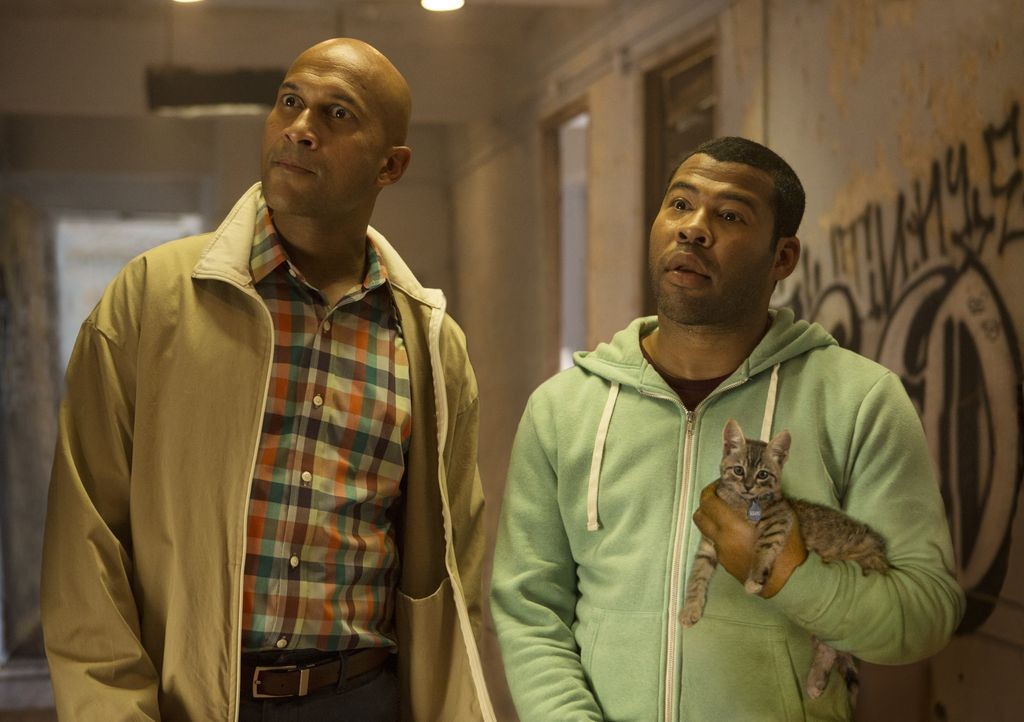
I laughed so much and so hard at this movie that by the time it was over I had become of those Key and Peele show parking valets. I just wanted to stand in front of a hotel in my red vest saying over and over, “How about them Keys and Peeles, though! How ABOUT them Keys and Peeles!”

Keegan-Michael Key and Jordan Peele, with a script co-written by Peele and directed by their series director Peter Atencio, have made one of the smartest and funniest comedies of the year, a film that works at every level from slapstick to sophisticated wit to social commentary and slam-bang action, with even a little romance.

Fans of the series will appreciate references like a trip to see a movie starring “Liam Neesons” but even those who have never heard of their Obama anger translator routine or their legendary East-West Bowl player names will immediately understand their characters and their situation.

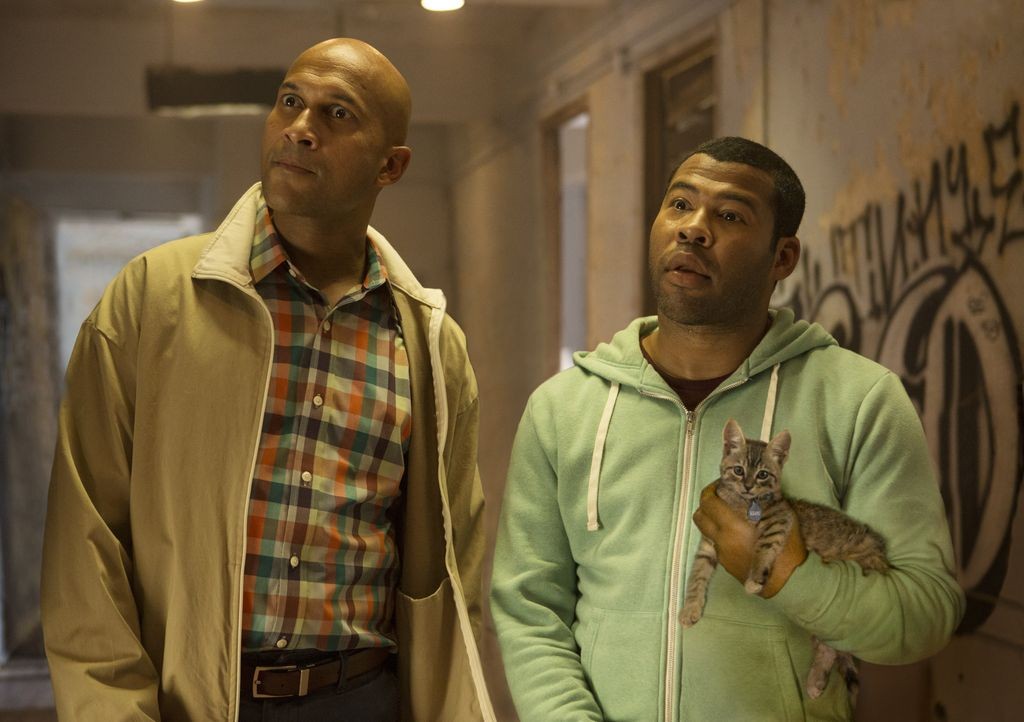
Clarence (Key) is a happily married father who drives a minivan and listens to George Michael. His cousin Rell (Peele) is a pot-smoking slacker who is devastated following a break-up. But when he adopts an abandoned kitten his spirits lift, and he names it Keanu. When Keanu is stolen by the 17th Street Blips, a gang made up of gangsters who could not make it in the Bloods or the Crips, Clarence and Rel decide to rescue him. This leads to a strip club called HPV with a two-for-one lap dance special, run by drug dealer known as Cheddar (Wu-Tang Clan’s Method Man). Clarence and Rell, trying to look tough, introduce themselves as Shark Tank and Tectonic. Clarence wonders how tough someone named Cheddar could be, but Rell points out that “You only name yourself something adorable if you can back it up.” When they explain to Cheddar that they are in the market for a “gangster pet,” Cheddar tells them they can have the kitten he has dubbed New Jack (complete with do-rag and gold chain) if they lead his gang on the delivery of an ultra-potent new drug. A series of encounters, escalating in peril, violence, and hilarity. It would be wrong to spoil more, so I will leave it at this: there is a very funny surprise guest star and Clarence’s professional team-building skills come in handy.

Key and Peele, both biracial, have always found comedy/commentary gold in their ability to reflect on race and culture. By casting themselves as highly and somewhat self-consciously assimilated black men who assume the media-created image of violent black drug dealers, they have added some sharp meta-commentary to a classic set up: fish-out-of-water, normal characters drawn into abnormal circumstances. Rell’s own weed dealer, played by SNL alum Will Forte, is a white man who is also taking on a stereotyped black persona, including cornrows. Clarence, who tries to order a white wine spritzer in the strip club and who tells Rell he sounds like John Ritter, swings into what he thinks is gangster mode when Chedder’s hostile n-word-spouting henchmen approach him. The transformation is wildly funny, both the specificity of it, and the way it fits so seamlessly into our own media-created notion of that archtype and the porous aspects of his new persona as the “real” Clarence keeps peeking out. Clarence and Rell are as innocent and helpless as the adorable kitty in the midst of druglord shoot-outs. Key and Peele are pretty adorable, too, in a gangster pet sort of way.

Parents should know that this film includes extended peril and violence, many guns, characters injured and killed, drugs and drug dealing, sexual references and nudity, strip club, and very strong and crude language including the n-word.

Family discussion: Where did Rel and Clarence get their ideas of how to behave with the Blips? How did Clarence’s team building training come in handy?

If you like this, try: the Key and Peele television series, “Date Night,” and “Analyze This”
Related Tags:


Comedy DVD/Blu-Ray Pick of the Week Race and Diversity
Elvis & Nixon

Elvis & Nixon

Posted on April 21, 2016 at 5:30 pm

B+
Lowest Recommended Age: High School
MPAA Rating: Rated R for some language
Profanity: Some strong language
Alcohol/ Drugs: Drinking, references to drugs
Violence/ Scariness: None
Diversity Issues: None
Date Released to Theaters: April 23, 2016
Date Released to DVD: July 18, 2016
Amazon.com ASIN: B01EZ6PZSQ

Copyright 2016 Amazon Studios
Today it does not seem at all odd to see Beyoncé hanging out with the Obamas or a reality television star as a popular Presidential candidate. But in the before-social media days of 1970, celebrity culture was not as all-encompassing as it is now. Frank Sinatra memorably supported John F. Kennedy in 1960 and just as memorably was not-so-gently pushed aside when his possible ties to organized crime and general inability to follow orders became a problem. Politicians, even today, want the support of celebrity fans but do not want the controversy that sometimes comes with them. And certainly the very serious-minded Richard Nixon would not want to appear frivolous by hanging out with a singer, even the most famous singer in the world. When told that “the king” wanted to see him, he said, “The king of what?” He was used to visits from actual royalty, and prided himself on learning a few pleasantries in their native language to put them at ease. But what could be the native language of a man from Tupelo, Mississippi who was known as “Elvis the Pelvis” for his sexy, hip-swaying performances, and who sang songs of teddy bears and hound dogs that made girls swoon?

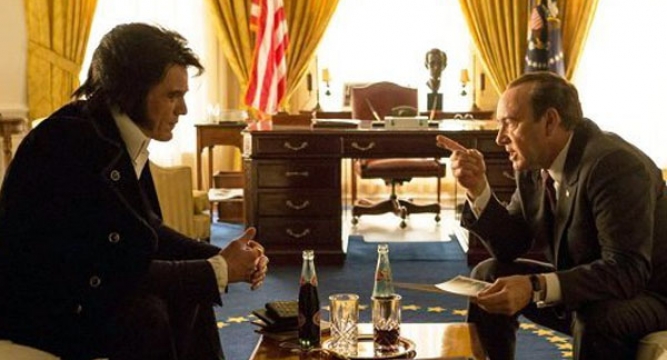
Elvis Presley and Richard M. Nixon did meet in the Oval Office. No one knows exactly what they talked about, but this charming film makes a believable case that they had more in common than we might think. As the President points out (he did insist on being briefed on Presley), they both came from humble beginnings and worked hard to rise to the top of their respective fields. They both feel badly treated by the press. They both find the Woodstock-era flower children and Vietnam war protesters disturbing, even seditious. Both are keenly aware of their level of support and power, which will never be enough. They may not be aware, but we are, that their very success has isolated them in a way that leaves them endearingly unaware of some elements of everyday interaction that the rest of us take for granted. Both have daughters they love very much. And both, constantly surrounded by young men somewhere between acolytes, enablers, managers, and favor-seekers, are, somehow, lonely.

The movie is so delightful that its shrewdness sneaks up on you. There is a very funny line about astronaut Buzz Aldrin that makes an insightful point about celebrity, as does a technique Elvis and his “Memphis Mafia” use repeatedly when they are thwarted, to greater comic effect every time. The parallel scenes as two respective entourages brief Elvis and Nixon about the appropriate protocol for the other is well done and the songs — not by Elvis but of his era — are especially well chosen, particularly when Elvis sings along to “Suzy Q.” Director Liza Johnson makes the most of a witty script (“Princess Bride’s” Carey Elwes was a co-author) and maintains a tone that is slightly heightened but just plausible, given the heightened reality of the two men at its center.

Parents should know that this film includes strong language, guns, and smoking.

Family discussion: What did Elvis Presley and Richard Nixon have in common? How did each rely on the young men around them? Why is there no Elvis music in the film?

If you like this, try: “Frost/Nixon” and “Elvis Presley: Thats the Way It Is”

Related Tags:


DVD/Blu-Ray Pick of the Week Inspired by a true story
Sing Street

Sing Street

Posted on April 21, 2016 at 5:28 pm

A-
Lowest Recommended Age: Middle School
MPAA Rating: Rated PG-13 for thematic elements including strong language and some bullying behavior, a suggestive image, drug material and teen smoking
Profanity: Strong language
Alcohol/ Drugs: A lot of smoking by adults and teens, some drug use
Violence/ Scariness: Bully, some fights, reference to sexual abuse
Diversity Issues: None
Date Released to Theaters: April 22, 2016
Date Released to DVD: July 26, 2016
Amazon.com ASIN: B01E698HZA

When you’re a teenager, suddenly, nothing you thought you knew seems certain anymore. Your parents do not understand you. Your siblings don’t understand you. Your teachers don’t understand you. You don’t understand yourself — everything outside and inside of you seems to be changing all the time.

Copyright 2016 The Weinstein Company

Only one thing understands you: the music. For most of us, that means rock music. Somehow, those songs reach us when nothing else can. Improbably, they understand us, they accept us, and they believe in us and in unlimited possibilities for ourselves and the world we can hardly begin to imagine. That’s why the music of your teen years feels visceral in a way no other music can. No matter how much you love music you discover later in life, it is never a part of you like the music that helps you discover yourself.

“Sing Street” is the rare movie that not only recognizes and portrays this experience; it goes farther than that. It is as close to re-creating the experience as it is possible for a movie to be. Watching this movie is not like remembering what it is like to be 14 and have your soul restored through rock and roll. It is like being there, but having it all work out the way better than you could have wished.

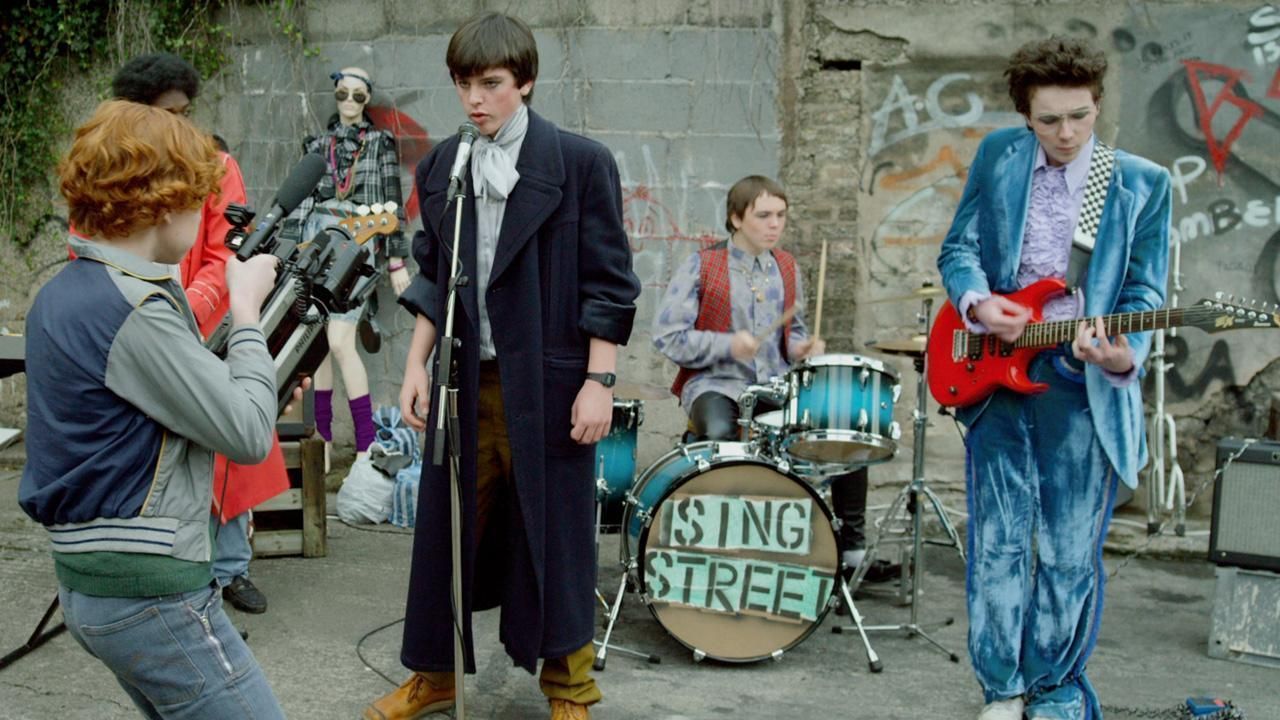
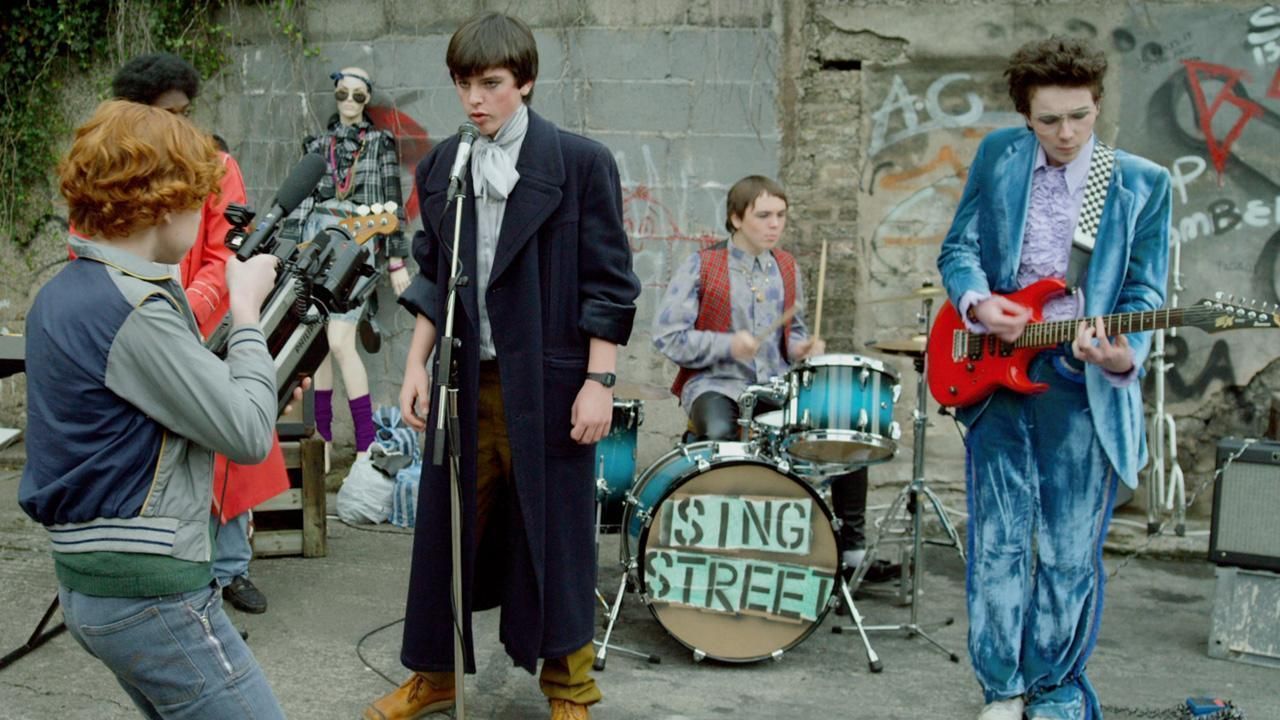
Writer/director/lyricist John Carney, who showed a gift for movies about music and musicians with Once and Begin Again, says that this movie is inspired by his own teen years, but about what he wished had happened instead of what did. Like the main character, Conor (enormously appealing newcomer Ferdia Walsh-Peelo), Carney grew up in 1980’s Ireland, in love with the music of the era, and the soundtrack features a sensational selection from The Cure, Depeche Mode, Duran Duran, A-Ha, Spandau Ballet, and The Jam, and dead-on instant classics from Carney and composer Gary Clark. Carney knows that when your feelings get too big for the song, you have to dance. When they get bigger than that, you have to make a music video. And when you desperately want to reach someone who is irresistible but apparently unobtainable, you just have to start a band.

It’s about more than music; it’s about how to respond to the toughest challenges life throws you, adolescence being just one of them. Music in this film performs the same function that the depiction of emotions did for a younger child in Pixar’s “Inside Out.” As Riley did in that film, Conor comes to understand how sadness and happiness need each other. And, after all, there’s no better place to combine them than a rock song.

As the movie opens, Conor is writing song lyrics based on the bitter fight his parents are having on the other side of the wall. They are having financial problems, which means Conor will have to transfer to a less expensive school. And they have run out of patience with one another and are close to splitting up. His new school is much rougher than his old one, both the teachers and the students. Across the street, though, there is a girl. She’s a year older than he is, which in teenage and gender years means that she is infinitely more sophisticated. Her name is Raphina (Lucy Boynton). When she says she is a model, he impulsively invites her to be in his music video (he has just seen Duran Duran’s seminal music video for “Rio”). When she says she might, he realizes that now he has to start a band.

With guidance from his older brother (a terrific Jack Reynor), who gives him albums to listen to and tells him to seize the moment, Conor puts together a band. The combination of the gritty reality of recession-era Dublin and the purity of the kids’ passion for what they are doing is just the right setting for the kinds of emotion that only rock and roll can express.

Parents should know that this movie includes strong language and a racist term, smoking by adults and teenagers, drug use, some bullies and violence, and some sexual references including sexual abuse.

Family discussion: Why did Conor say he was a futurist? How did he respond to being bullied?

If you like this, try: “Once,” “School of Rock,” “The Commitments,” “Billy Elliot,” “Pirate Radio,” “We are the Best,” and the music of the 80’s

Related Tags:


DVD/Blu-Ray Pick of the Week Musical School Stories about Teens
A Hologram for the King

A Hologram for the King

Posted on April 19, 2016 at 5:36 pm

B+
Lowest Recommended Age: Mature High Schooler
MPAA Rating: Rated R for some sexuality/nudity, language and brief drug use
Profanity: Some strong language
Alcohol/ Drugs: Drinking, drunkenness, drugs
Violence/ Scariness: Some disturbing scenes relating to medical issues
Diversity Issues: A theme of the movie
Date Released to Theaters: April 22, 2016
Date Released to DVD: August 8, 2016
Amazon.com ASIN: B01GP4HSH2
Copyright 2016 Roadside Attractions

“Hologram for the King” is an uneven but engaging and always-watchable film based on the book by Dave Eggers. Like Arthur Miller, David Mamet, and many others, Eggers chose a salesman as a central figure and metaphor to illustrate the mixture of optimism, determination, and despair that is the Sisyphean life of someone whose job is to take no after no after no and keep coming back.

Tom Hanks plays Alan Clay, who has all the people skills of a lifelong salesman and all the desperation of a man who has one last chance to make a deal. He is under intense pressure from his ex-wife and his boss. His daughter has had to take time off from college because he cannot pay the tuition, and her kindness and encouragement just make him more desperate to get the money to get her back in school. And there is a troubling lump on his back that he is not prepared to confront until he

But what he has to sell is an elaborate hologram-based conference call system to the king of Saudi Arabia. Even with his advance team in place he discovers that the set-up is not what he expected. The extensive business and university complex he is hoping to service is not yet built beyond one huge office building. The advance team has been relegated to a tent with no food or wi-fi. And the king is not there and no one knows when he will be there or if he will ever be there.

Alan is so jet-lagged he keeps oversleeping and missing the shuttle, and so he gets transported back and forth day after day of pointless frustration by a genial “driver, guide, hero” named Yousef (Alexander Black). He tries everything he can think of to make progress but is always met with polite deferrals. Drunk one night, he tries to dig out the lump on his back himself and ends up in the hospital, where he is treated by a woman doctor named Zahra (Sarita Choudhury).

Metaphors usually work better in books than in films, and the effort to translate Eggers’ commentary on geopolitical and capitalistic forces like outsourcing is not always successful. But Hanks is ideal as the decent guy trying to do the best for everyone, with a long-practiced salesman’s ability to project good cheer and quiet competence. Director Tom Tykwer (“Run Lola Run”) brings a lot of vitality to the story, beginning with a captivating version of Hanks performing the Talking Heads song “Once in a Lifetime.” Choudhury is a warm, wise presence as the doctor trying to be true to herself despite the restrictions of the culture. Whether or not Alan makes the sale, he sells us on the value of trying to make things work.

Parents should know that this film includes very strong language, some disturbing images and health issues, drinking and drunkenness, sexual references and situations, and nudity.

Family discussion: What should Alan have done at Schwinn? What qualities made him good at his job?

If you like this, try: “Up in the Air”

Related Tags:


Based on a book Comedy Drama DVD/Blu-Ray Pick of the Week Romance
The Jungle Book

The Jungle Book

Posted on April 14, 2016 at 5:32 pm

B+
Lowest Recommended Age: 4th - 6th Grades
MPAA Rating: Rated PG for some sequences of scary action and peril
Profanity: None
Alcohol/ Drugs: None
Violence/ Scariness: Extended peril and violence including bees, a tiger, a snake, and fire
Diversity Issues: A theme of the film
Date Released to Theaters: April 15, 2016
Date Released to DVD: August 29, 2016
Amazon.com ASIN: B01CTNDO58

Copyright 2016 Disney
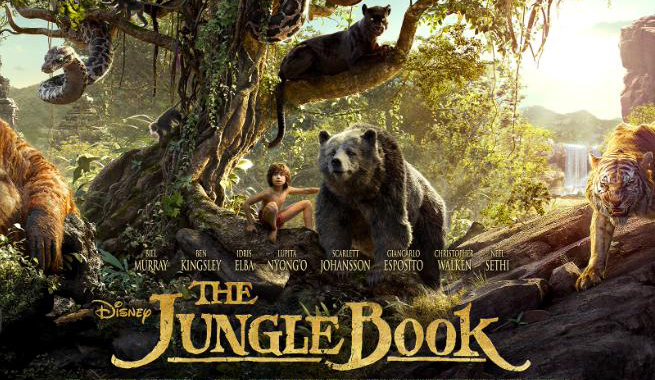
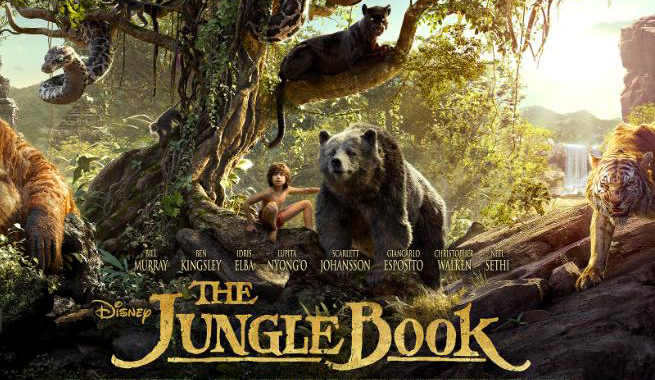
The camera swoops behind the familiar Disney castle logo to take us to that magical place — you know, like the one that is found second star to the right and straight on ’til morning or through the wardrobe in the attic, down a rabbit hole, or via a house swept up in a Kansas tornado. Just a moment past the castle we are deep, 3D IMAX deep, in the midst of of a lush and luscious jungle, where a mop-headed, big-eyed boy in a red loincloth is running for his life.

The wolves are after him. No, the wolves are with him and a sleek black panther is after him. No, he catches him. No, they are friends. It is Mowgli (newcomer Neel Sethi) and the Bagheera (Sir Ben Kingsley), the panther who discovered him as a toddler and delivered him to the best mother he knew, the wolf Raksha (Lupita Nyong’o) who raised him lovingly along with her other cubs. While he matures more slowly and cannot do some of the things they can to stay safe, he can climb and use tools. Although Raksha tells him not to use “tricks” like pulleys, knots, and scoops, he feels very much a part of the wolf pack and solemnly recites along with the others:

Now this is the Law of the Jungle —
as old and as true as the sky;
And the Wolf that shall keep it may prosper,
but the Wolf that shall break it must die.

As the creeper that girdles the tree-trunk
the Law runneth forward and back —
For the strength of the Pack is the Wolf,
and the strength of the Wolf is the Pack.

When the rainy season ends, a dry spell shrinks the river so that the “peace rock” is showing. According to the well-established rules of the jungle, as long as they can see that rock, everyone may drink together in peace, meaning the predators cannot attack their usual prey. The one-eyed tiger with burn scars named Shere Khan (Idris Elba) sees Mowgli and warns the others that as soon as the rock is submerged again and the truce has ended, he will come for the boy and will do whatever it takes to kill him. Raksha reluctantly agrees to let Bagheera take him to the town, where Mowgli can be with other people. On the way, they have encounters with Kaa the mesmerizing snake (Scarlett Johansson), Baloo the easy-going bear (Bill Murray), and King Louis (Christopher Walken), an enormous ape (based on the extinct Gigantopithecus) who presides over an orangutan kingdom living in an ancient temple.

Fans of the Disney animated musical version will be happy to find some familiar moments within the superb score from John Debney.

But this is very much its own film, with stunning integration of the digital animals and the real-life boy. (Disneyphiles may think of Walt’s earliest short films featuring a real-life girl interacting with hand-drawn characters.) The world of the jungle is enchanting and vital, a Rousseauian dream of an Edenic natural world (in this PG film, while there is peril and some characters are injured and killed, any carnivore behavior happens off-screen). Sethi has an engagingly natural quality that is as important in bringing the digital characters to life as the brilliant work of the many, many artists and technicians whose names appear in the credits.

So does the storyline’s respect for this world and its inhabitants. Mowgli does not have many of the physical gifts of his wolf family or his friends in the forest. He does have some skills they do not, and it is heartwarming to see him develop simple tools like a stone ax and a pulley because they are not presented as superior or used to establish dominance, but to help his jungle community and to give thanks for all they have given him. This is gorgeous, inspiring filmmaking.

Parents should know that this movie includes extended peril with some violence and some disturbing images. A theme of the film is the tiger’s determination to kill Mowgli, and characters are injured and killed (including parents).

Family discussion: Why did the wolves and Baloo have different ideas about Mowgli’s “tricks?” Should Mowgli stay in the jungle or live with other humans?

If you like this, try: Rudyard Kipling’s Just-So Stories and two earlier films based on this story, one starring Sabu and the Disney animated version.

Related Tags:


3D Action/Adventure Based on a book DVD/Blu-Ray Pick of the Week Fantasy Remake Scene After the Credits Stories About Kids Talking animals
THE MOVIE MOM® is a registered trademark of Nell Minow. Use of the mark without express consent from Nell Minow constitutes trademark infringement and unfair competition in violation of federal and state laws. All material © Nell Minow 1995-2026, all rights reserved, and no use or republication is permitted without explicit permission. This site hosts Nell Minow’s Movie Mom® archive, with material that originally appeared on Yahoo! Movies, Beliefnet, and other sources. Much of her new material can be found at Rogerebert.com, Huffington Post, and WheretoWatch. Her books include The Movie Mom’s Guide to Family Movies and 101 Must-See Movie Moments, and she can be heard each week on radio stations across the country.

Website Designed by Max LaZebnik