Love & Friendship

Love & Friendship

Posted on May 12, 2016 at 5:54 pm

B+
Lowest Recommended Age: Middle School
MPAA Rating: Rate PG for some thematic elements
Profanity: None
Alcohol/ Drugs: Alcohol
Violence/ Scariness: Scuffles
Diversity Issues: Class issues
Date Released to Theaters: May 13, 2016
Date Released to DVD: September 6, 2016
Amazon.com ASIN: B01HE7NTX6

Copyright 2016 Westerly Films
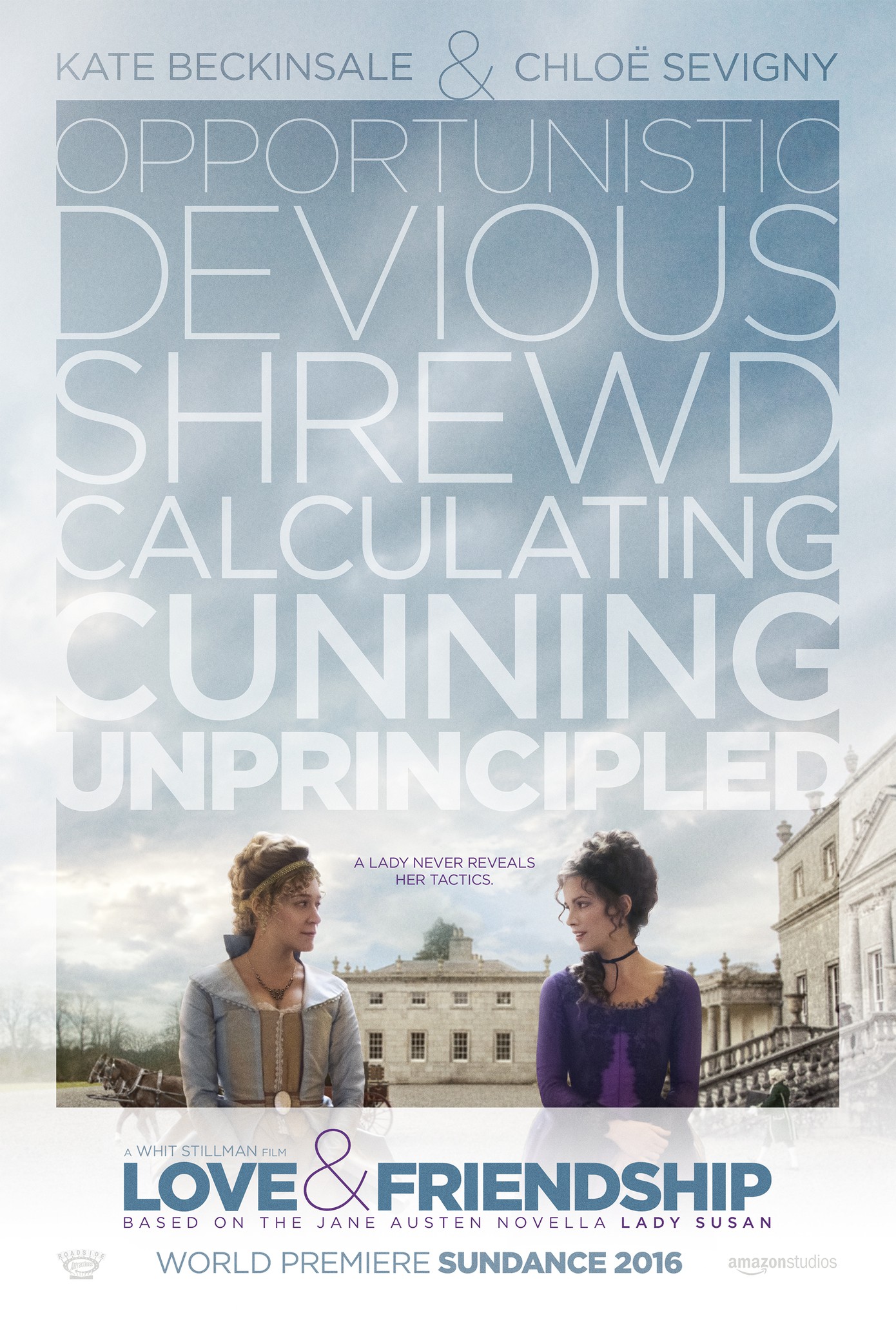
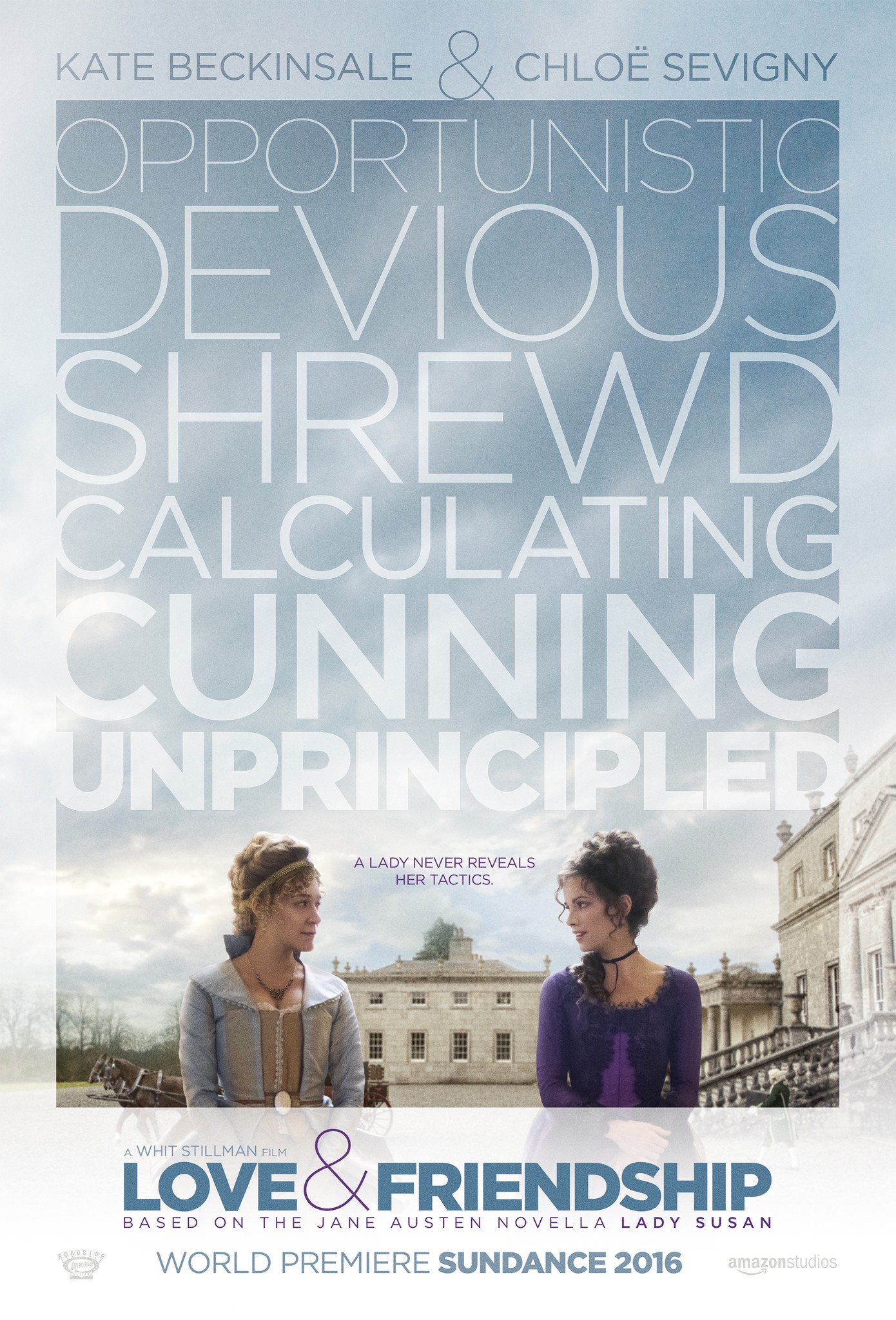
Who better to adapt Jane Austen’s epistolary novel, Lady Susan, for the screen than our finest contemporary observer of life among the “haute bourgeoisie,” Whit Stillman? A highlight of his first film was a conversation about Austen’s Mansfield Park, and his gift for epigrammatic dialog and understanding of class and money — and female protagonists — make it a natural fit. The result is a delightful confection about a woman described by Austen via one of the other characters as “the most accomplished coquette in England,” and one who “does not confine herself to that sort of honest flirtation which satisfies most people, but aspires to the more delicious gratification of making a whole family miserable.”

That assessment is not exactly accurate. Making a whole family miserable is somewhere between collateral damage and side benefit.

Lady Susan (fearless but effervescent Kate Beckinsale) is a recent widow with a teenaged daughter. In the manner of the era, when the gentry visited each other for months at a time, she has been staying with friends. First, she has no money and therefore her primary asset, aside from her guile and is her relationships with more comfortably settled members of her class. And second, the best chance for her to have a home of her own again is to marry her daughter off to a wealthy man. Stillman makes Lady Susan a more sympathetic character than Austen did, in part due to the vivacity of the actress who portrays her. It’s hard to have her believably portray such a captivating figure without our being captivated ourselves. But in addition, it is clear throughout that she may be ruthless and mercenary, but she has no other options. Her very status and gender constrain her from any other option, but she is undeterred. “In one’s plight is one’s opportunity,” she says. She has a gift for outrageous comments made with so much confidence they almost sound reasonable: About being sent away by her hostess: “If she were going to be jealous, she should not have married such a charming man.” About her daughter’s school: ““The fees are too high to even think of paying!” In the midst of an era of polite misdirection and euphemism, she is focused and direct, a hint of the coming modernity in the days of the harpsichord.

If she was around today, she’d be a CEO. Or a reality star.

Lady Susan has very little by way of education. She is not sure how many Commandments there are or what they contain. But she knows people, especially men. She knows her husband’s family has no socially acceptable vocabulary to tell her she can no longer stay with them. And when a handsome, eligible man warned about her skill with the opposite sex appears ready to resist her, she cleverly upends his expectations and before he knows it, he is captivated.

Stillman presents the story with wit and brio, introducing us to the characters with helpful on-screen descriptors: “his wealthy wife,” “a divinely attractive man.” The slight archness is his, or Austen’s, or Lady Susan’s; all are a bit reductionist when it comes to assessing everyone in the story according to his or her usefulness. He resists the usual musty respect for all classics, especially those featuring corsets, and presents the story with elegance and a refreshing briskness. Lady Susan would approve.

Parents should know that this film includes themes of deception and adultery.

Family discussion: Why did Lady Susan confide in Alicia? How did Lady Susan show her understanding of what it took to gain the affection of the different men around her?

If you like this, try: more Jane Austen films including “Sense and Sensibility” and “Pride and Prejudice,” as well as the books that inspired them

Related Tags:


Based on a book Comedy DVD/Blu-Ray Pick of the Week Romance
Last Days in the Desert

Last Days in the Desert

Posted on May 12, 2016 at 5:45 pm

B+
Lowest Recommended Age: Middle School
MPAA Rating: Rated PG-13 for some disturbing images and brief partial nudity
Profanity: None
Alcohol/ Drugs: Alcohol
Violence/ Scariness: Disturbing images, sad death of a parent
Diversity Issues: None
Date Released to Theaters: May 13, 2016

Copyright 2-16 Different Drummer
Copyright 2016 Different Drummer
The Gospels of Matthew, Mark, and Luke tell us that after he was baptized, Jesus entered the desert and spent 40 days fasting and praying. It was only when he left the desert that he was ready to take up his ministry. We do not know much of what went on, but two of the gospels say that during that time he was tempted by the devil.

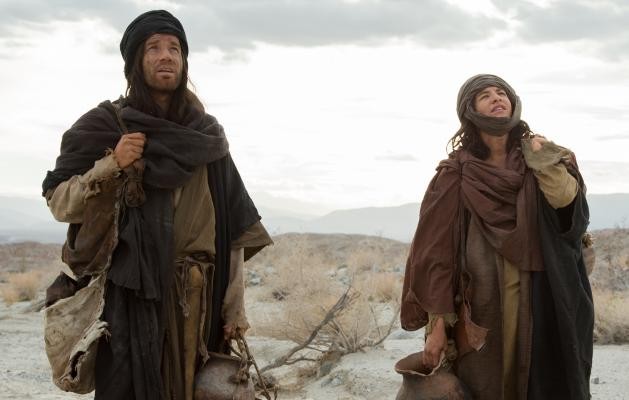
Writer/director Rodrigo Garcia (“Nine Lives,” “Mother and Child”) wanted to explore that moment when the divine and the human sides of Jesus were both tested. With three-time Oscar-winning cinematographer Emmanuel Lubezki (“Gravity,” “The Revenant”) giving a burnished glow to the bleak and beautiful California desert, he tells the story of the last few days in the desert, as Jesus struggles with his destiny and spends time with a family with its own problems.

Ewan McGregor plays both Jesus (called Jeshua) and the devil. If God has made us in his image, then why wouldn’t the devil try to tempt us by having us see ourselves in him? But the real interaction here is with a family, a father (Irish actor Ciarán Hinds), a mother who is dying (Israeli actress Ayelet Zurer), and a son (Tye Sheridan) who live in an isolated hut. Like fathers throughout the millennia, this one thinks he knows what is best for his son, and it is doing what he has done. He is losing his wife and cannot bear to think of his son moving away. But like sons throughout the millennia, this one disagrees with his father. He wants to try life in the city. They cannot even talk to each other about it.

Don’t worry that this is going to be Jesus arriving like Dr. Phil or even Oprah to straighten everyone out. One of the wisest choices of the film is that Jesus, who will soon be performing miracles and instructing his followers is here in this place to listen and try to understand. There is no question of curing the mother or sitting the father and son down to try to negotiate or even get them to acknowledge the legitimacy and good intentions of each other’s positions. Jesus seems to understand that this is as close as he will ever get to what it is like to be in a family and he is there to listen, to observe, and to learn.

The quiet beauty of the film adds a meditative power, and McGregor’s performance reminds us how essential the human qualities of Jesus’ experience were in making possible the miracles that followed his time in the desert.

Parents should know that this film includes brief nudity and a sexual situation, sad death of a parent, some disturbing images, and spiritual struggles.

Family discussion: What did Jesus learn from the disagreement between the father and son? Why were Jesus and the devil played by the same actor?

If you like this, try: “The Gospel of John” and “Risen”

Related Tags:


Drama Epic/Historical Movies -- format Spiritual films

A Bigger Splash

Posted on May 12, 2016 at 5:23 pm

B+
Lowest Recommended Age: Adult
MPAA Rating: Rated R for graphic nudity, some strong sexual content, language and brief drug use
Profanity: Very strong and crude language
Alcohol/ Drugs: Drinking, smoking, drugs
Violence/ Scariness: Violence including homicide
Diversity Issues: Background of race and class issues
Date Released to Theaters: May 13, 2016

Where there is Eden, there is usually a serpent. In this case, it is literal and metaphoric, as Paul (Matthias Schoenaerts) and Marianne (Tilda Swinton) are blissfully happy in a lovely home with a pool on an exquisite island near Sicily. Occasionally they are confronted by local wildlife, including a couple of snakes. But mostly they lie naked outdoors, make love in the pool, and go swimming, slathering mud all over each other then sleeping as it dries. Both are recovering, which means both are vulnerable. Marianne is a rock star — in a flashback we see her on stage at an enormous arena with the crowd shrieking her name. She has had an operation on her vocal chords and must not speak at the risk of losing her voice entirely. Paul is a photographer and documentarian who has been to rehab for substance abuse and a suicide attempt. They are gentle and loving with each other.

And then the cell phone rings. It is Harry (Ralph Fiennes), Marianne’s former producer and lover, and he says he is landing on the island in five minutes and needs to be picked up. He arrives with a very young woman named Pen (Dakota Johnson) and it is clear that they are there to break things — to break the silence, to break hearts, to break the fragile peace Marianne and Paul have found when they left home to get away from people like Harry. “We’re hiding out,” Paul tells him. “Not from me!” Harry replies.

Harry is loud, carelessly arrogant, and needy. Some people are obnoxious because they do not know better; Harry knows and relishes it. He is the kind of guy to take up with a girl Pen’s age, but it turns out she is his recently discovered American daughter. Partly because he did not know he was her father until she was grown and partly because he lives in the space between outre and obscene. He literally pees on a grave. “Everyone’s obscene,” he says, “that’s the whole point.” He does not believe in limits, with one possible exception he claims to put on himself. After a lot of hinting from Harry, Marianne invites him and Pen to stay in the house they are renting.

“A Bigger Splash,” takes its title from a David Hockney swimming pool painting, is a remake of the 1969 Alain Delon film “La Piscine” (“Swimming Pool”). The characters experience need, fear, love, loss, and deception. They reflect the power and corruption of celebrity while around them we see glimpses of desperate refugees held in pens. Beautifully composed images show dreamlike settings, but there are intrusions within the pristine purity of the house: the shadow of an airplane about to land, a reptile on the table, some gauche visitors invited by Harry. “You’re not speaking, sweetheart,” he says to Marianne. “So I had to make other plans.” Small details are superbly chosen — a dress awkwardly worn in one scene turns up again later where it is more suitable, Harry’s story about producing a Rolling Stones song (with a fabulous dance), both Harry and Paul placing pills on Marianne’s tongue, a glint of gold and silver on her eyelids. It’s a mood piece, brilliantly performed, resonating like a bell that was rung days before.

Parents should know that this film includes very explicit nudity, sexual references and explicit situations, drinking, smoking, drugs, violence including homicide, and very strong language.

Family discussion: Why did Marianne invite Harry to say with her? Why did Pen lie?

If you like this, try: “Swimming Pool” and “Laurel Canyon”

Related Tags:


Drama Movies -- format Remake
Mothers and Daughters

Mothers and Daughters

Posted on May 5, 2016 at 5:18 pm

B
Lowest Recommended Age: High School
MPAA Rating: Rated PG-13 for brief drug content
Profanity: Some strong language
Alcohol/ Drugs: Drinking, drugs
Violence/ Scariness: Tense family confrontations
Diversity Issues: None
Date Released to Theaters: May 6, 2016
Copyright 2016 Screen Media Films

No one matters more to us than Mom and there is no one we can at the same time want everything and nothing from. We need their unconditional love and approval. We need them to always be glad to see us, always comfort us when we hurt. But we also need to feel that we can do without her, be independent. And then we don’t want to.

Last week’s awful “Mother’s Day” attempted to mine this material. This week, “Mothers and Daughters” does a better job. It still falls into the trap of putting the story in New York City but having all of the characters white and having them keep running into each other and resolving everything too neatly. But it avoids the sit-com vibe and intrusive product placement and has some understated and affecting moments.

In one of the movie’s highlights, Susan Sarandon appears with her real-life daughter, Eva Amurri Martino, who plays Gayle, a woman who is estranged from her family. She insisted on living with her boyfriend, who wants to start a high-end bakery and is sure he will get the loan he needs. But Gayle is getting nervous about the money he is spending and determined not to ask her parents to help them.

Selma Blair plays Rigby, a photographer whose married boyfriend has just — kindly — broken up with her to return to his wife. She is offered her dream job, accompanying a rock star on tour as his official photographer, when she discovers she is pregnant. “How long do I have?” she asks her doctor (“The Blind Side’s” Quinton Aaron). He smiles and tells her it’s a baby, not a terminal disease. She makes an appointment for an abortion, certain that she does not have it in her to care for a child, especially because she feels guilty about not doing more for her own mother, who is in a nursing home.

Sharon Stone is Nina, a fashion mogul whose daughter has dropped out of a prestigious internship and won’t tell her what she is doing instead. Mira Sorvino is Georgina, whose new line of bras is launching, and who has a secret she has not told her very supportive boyfriend. And Courteney Cox is Beth, a wife and mother of a teenage son. Her own mother has just died, leading to the revelation of a family secret that has caused great anger and pain.

There is a quiet sincerity to the film that makes up for some slickness in the screenplay, with its overly convenient twists and rapid progress toward hugs and forgiveness.

Parents should know that this film has mature material including sexual references and discussions of family secrets. There is some alcohol and brief drug use.

Family discussion: Which family had the most difficult problem? Why did Rigby change her mind?

If you like this, try: “The Meddler”

Related Tags:


Drama Family Issues Movies -- format
Captain America: Civil War

Captain America: Civil War

Posted on May 4, 2016 at 8:00 pm

B+
Lowest Recommended Age: Middle School
MPAA Rating: Rated PG-13 for extended sequences of violence, action and mayhem
Profanity: Brief strong language
Alcohol/ Drugs: None
Violence/ Scariness: Extended superhero/action violence with chases, crashes, and explosions, characters injured and killed.
Diversity Issues: Diverse characters
Date Released to Theaters: May 6, 2016
Date Released to DVD: September 13, 2016
Amazon.com ASIN: B01D9EUNB4
Copyright 2016 Marvel

The most important element of any superhero movie is the villain. He (or she) has to pose a credible threat to humanity and challenge particular strengths and vulnerabilities of someone with extraordinary powers. In “Captain America: Winter Soldier” there was a paranoiac Pogo-esque “we have met the enemy and he is us” theme that is expanded in “Civil War.” It goes to the heart of the Avengers themselves as a critical issues divides them so they are fighting each other.

The issue is not one we usually see in superhero movies or indeed action movies in any category: consequences. Part of the fun of action movies is seeing all of the chases, fights, and explosions, without having to worry about the cleanup or what the military euphemistically calls “collateral damage.” But this story has more impact because it acknowledges and engages with the damage that superheroes do while they are preventing worse damage. It falls somewhere between “The Incredibles” and “Eye in the Sky.”

The true meaning of collateral damage is presented early on in “Civil War.” Tony Stark (Robert Downey, Jr.) has just announced that he will fund all of the student research projects at MIT when he is confronted by a mother (a small masterpiece of devastation and fury from the extraordinary Alfre Woodard). Her son was on a humanitarian mission when he was killed in the Sokovia crash of an entire city at the end of Avengers: the Age of Ultron. For her, it doesn’t matter that the entire world was saved in theory by a supervillain who is not around when her son was killed in reality by a man who is. “You think you fight for us,” she says. “You fight for yourself.”

Stark is devastated. “We’re no better than the bad guys.” The man we first saw demonstrating his company’s military weapons as though he was a rock star performing an arena show and who had no problem defending the money he made in munitions finally has to reckon with the truth he barely realized he had been moving closer to. And that is why, after the typical superhero opening action sequence we get a non-typical reaction. With SHIELD collapsed following “Winter Soldier,” the Avengers are operating on their own, without any oversight. A coalition of 117 nations insist that they agree to be subject to a UN commission (the “or what” is not ever spelled out because, what would it be?).

One of the film’s most intriguing developments is that not only do the Avengers line up on opposite sides but they don’t take the positions we might expect. Stark’s post-confrontation grapple with guilt has the most anarchistic of superheroes suddenly looking for the comfort of some rules. And the shock of SHIELD’s corruption has the most Boy Scout-ish of all superheroes, Captain America (Chris Evans) suddenly resistant to putting himself under anyone’s control. Some of the avengers pick a side on principle; some are more instrumental or practical. The Black Widow (Scarlett Johansson), who has her own history of unspeakable crimes, says, “Staying together is more important than how we stay together.”

Directors Anthony and Joe Russo deftly manage an enormous cast of characters. It’s easier to list those who do not appear in this film: Pepper Potts, Thor, Nick Fury, and the Hulk. Pretty much everyone else is here, and superbly added to the mix we have Paul Rudd as Ant-Man, who has some surprises in store, Black Panther (a lithe, powerful, and compelling Chadwick Boseman), avenging the death of his father, and the brand-new Spidey (Tom Holland, with Marisa Tomei as Aunt May). Bucky/Winter Soldier (Sebastian Stan) is here, too, and his storyline nicely mirrors the larger themes. He has been responsible for terrible crimes and abuses and some can never forgive him. But Captain America knows something about military operations. “We try to save as many people as we can,” he says. “Sometimes doesn’t mean everybody.” He knows how a human can become a weapon, and he is determined to get his friend back. Remember, this is not the Justice League. They are Avengers, and another character’s determination to get vengeance provides one of the movie’s most signficiant twists.

I don’t want to give away too much, so I’ll just say the action is everything you’d hope, with superhero-on-superhero collisions beyond the dreams of fanboy heaven. Keep an eye on the motorcycle. And the helicopter. And Ant-Man. And some cool special effects with Stark’s augmented flashback/therapy. And stay through the credits, of course.

Parents should know that this film includes extended sci-fi/comic book action violence with chases, crashes, and explosions, characters injured and killed, and brief strong language.

Family discussion: What are the best arguments for Ironman’s position on the accords? For Cap’s? How is this Spider-Man different from other portrayals of the character?

If you like this, try: “The Avengers” and “Captain America: The Winter Soldier”

Related Tags:


3D Action/Adventure Comic book/Comic Strip/Graphic Novel DVD/Blu-Ray Pick of the Week Scene After the Credits Science-Fiction Series/Sequel Superhero
THE MOVIE MOM® is a registered trademark of Nell Minow. Use of the mark without express consent from Nell Minow constitutes trademark infringement and unfair competition in violation of federal and state laws. All material © Nell Minow 1995-2026, all rights reserved, and no use or republication is permitted without explicit permission. This site hosts Nell Minow’s Movie Mom® archive, with material that originally appeared on Yahoo! Movies, Beliefnet, and other sources. Much of her new material can be found at Rogerebert.com, Huffington Post, and WheretoWatch. Her books include The Movie Mom’s Guide to Family Movies and 101 Must-See Movie Moments, and she can be heard each week on radio stations across the country.

Website Designed by Max LaZebnik