Big Game

Big Game

Posted on June 25, 2015 at 5:41 pm

Yes, it is basically “Die Hard” and “Under Siege” in the mountains of Finland, if Bruce Willis was a kid on a rite-of-passage solo hunting trip.  And instead of executive hostages in a big office building, the kid has to save the President of the United States, who has been ejected from Air Force One in some sort of attack we will learn more about later on.

So, the storyline is far from fresh.  But the location is, and it is excitingly filmed and engagingly performed.

Samuel L. Jackson plays President William Allen Moore, en route to a G8-style meeting when his Secret Service officer, Morris (Ray Stevenson) sends him out in a parachute pod to protect him from what appears to be an assassination or kidnap attempt, led by known terrorist-type bad guy and obvious mercenary sociopath Hazar (Mehmet Kurtulus).  Meanwhile, back in the Situation Room back home, the vice president (Victor Garber), the head of the CIA (Felicity Huffman), and a national security expert (James Broadbent) are trying to locate and rescue the President.

Copyright Big Zero Film Entertainment  2015
Copyright Big Zero Film Entertainment 2015

But you probably suspect that some of the people we are supposed to be trusting will turn out not to be trustworthy, and you are right.

Meanwhile, Oskari (the nicely underplaying Onni Tommila) in on his Finnish walkabout.  He is on his own in the wilderness with a bow and arrow, expected to bring home an impressive kill.  He is under a lot of pressure, because his father is a legendary hunter.  But the bow is nearly as big as he is and the hint his father gave him about where the best spot is to find his prey.  But his father’s idea of help was not what Oskari thought.  And the big game he found was a guy in a suit who is pretty big stuff in Washington but not so powerful away from home.

Writer/director (and Tommila’s uncle) Jalmari Helander knows Hollywood movies and matches the pacing and tone of the best of the genre.  There is nothing new in the twists of the plot, but the relationship between the canny President and the unruffled boy, each with different skills, and the action sequences that are unrealistic but fun keep things entertaining.

Parents should know that this film incudes extended action-style violence, characters injured and killed, themes of treason and assassination, some strong language, and potty humor.

Family discussion: How did Oskari feel when he saw what his father left for him? What was Oskari’s biggest challenge?

If you like this, try: “Masterminds” with Patrick Stewart

Related Tags:


Action/Adventure Stories About Kids
Infinitely Polar Bear

Infinitely Polar Bear

Posted on June 25, 2015 at 5:36 pm

B+
Lowest Recommended Age: High School
MPAA Rating: Rated R for language
Profanity: Very strong language
Alcohol/ Drugs: Drinking, smoking
Violence/ Scariness: Family tension
Diversity Issues: A theme of the movie
Date Released to Theaters: June 19, 2015
Date Released to DVD: January 4, 2016
Amazon.com ASIN: B016UTP3V0

“Infinitely Polar Bear” is the term a young girl uses in this film for bipolar disorder, the mental illness that her father struggled with as he cared for his daughters. It indicates that this sensitive, touching story reflects the perspective of the children who lived with him.

Writer/director Maya Forbes based the film on her family’s story, when she and her sister lived with their father near their school in Boston in the 1970’s so that their mother could attend an MBA program in New York.

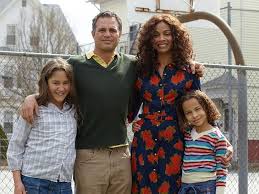
Because their father could not work, and because his wealthy family would not give them enough money to live on, the only way their mother could support them was to get a business degree, but she wanted the girls to stay in their home and school.  And so, Cam (Mark Ruffalo), who had been living alone, moves into the family apartment, and Maggie (Zoe Saldana) lives in New York during the week and comes home on weekends.  And the girls, Amelia (Imogene Wolodarsky, Forbes’ daughter) and Faith (Ashley Aufderheide) spend their weeks with a man who loves them very much but who fills the apartment with chaos and clutter, chain-smokes, drinks, and, worst of all, is SO embarrassing.

Copyright 2015 Sony Pictures Classics

There is something both perceptive in presenting embarrassment as their primary reaction.  Children naturally see the world in terms of how it affects them, and school-age children are first discovering the way that they are judged by their peers and are therefore excruciatingly sensitive to it, and can become near-frantic about blending in.  But it is reassuring as well.  The girls know that both of their parents love them very much.

Forbes presents the story with enormous insight and compassion for each member of the family.  The young actresses who play the two girls are wonderfully natural.  Saldana gives a performance of endless grace.  And Ruffalo manages to make Cam a complete and complex character, unlike the typical movie portrayal of mental illness as a bundle of cute quirks or sociopathic fury.  There is nothing as carelessly lofty as the Boston upper class.  While Cam knows their era is ending and would not want it to continue, it persists in his speech and carriage and in occasional flashes of a sense of entitlement.  He impulsively decides to take his daughters on a tour of his family’s mansion, even though it is now owned by someone else, who reasonably thinks that no one, even former owners, should be allowed to enter without an invitation.  He visits his grandmother, who still controls the family money, and has dinner with his parents (Keir Dullea and Beth Dixon, nailing the effete accents, snobbery, and helplessness).  He tinkers with a dozen projects and stays up all night creating a mermaid costume.  And he self-medicates with chain-smoking and constant sips of beer.  Ruffalo plays Cam not as a mentally ill man but as a man who has a mental illness, along with a lot of other qualities, including a deep love for his wife and children.

Parents should know that this film has very strong language, themes of mental illness, smoking, drinking, drugs, and family dysfunction.

Family discussion: Do you agree with the decision made by the parents about leaving the girls with Cam?  How have ideas about mental illness changed since the era of this film?  How does the writer/director, who based the story on her own life, feel about her parents?

If you like this, try: “Donnie Darko,” “A Beautiful Mind” and “Silver Linings Playbook”

Related Tags:


Based on a true story Disabilities and Different Abilities DVD/Blu-Ray Pick of the Week Family Issues
Ted 2

Ted 2

Posted on June 25, 2015 at 5:22 pm

“Subtle” is not a word that naturally comes to mind for a movie that features a bong in the shape of male genitalia (which is more powerful — the longing for weed or the ew-factor of a straight guy who does not want to appear to be sucking on a dong-shaped bong)?  Or for a movie that shows us a fertility clinic accident drenching a character with an output of said body part, followed by a joke insulting African-American men and those with a genetic ailment.  A trifecta!

The raunch-fest “Ted 2” does indeed rely on gross-out, juvenile, misogynistic, homophobic, racist, marijuana-philic, oh-no-they-didn’t humor, though much of it is more humor-ish, fake-funny, outrageousness pretending to be comedy.  It spends most of its running time, too long at almost two hours, on jokes about bodily parts and functions, drugs, the joys of slackerdom, and pratfalls, which I admit pretty much sums up my least favorite kind of comedy.  So if the two examples above strike you as hilarious, kick my rating up a couple of notches and go enjoy yourself.

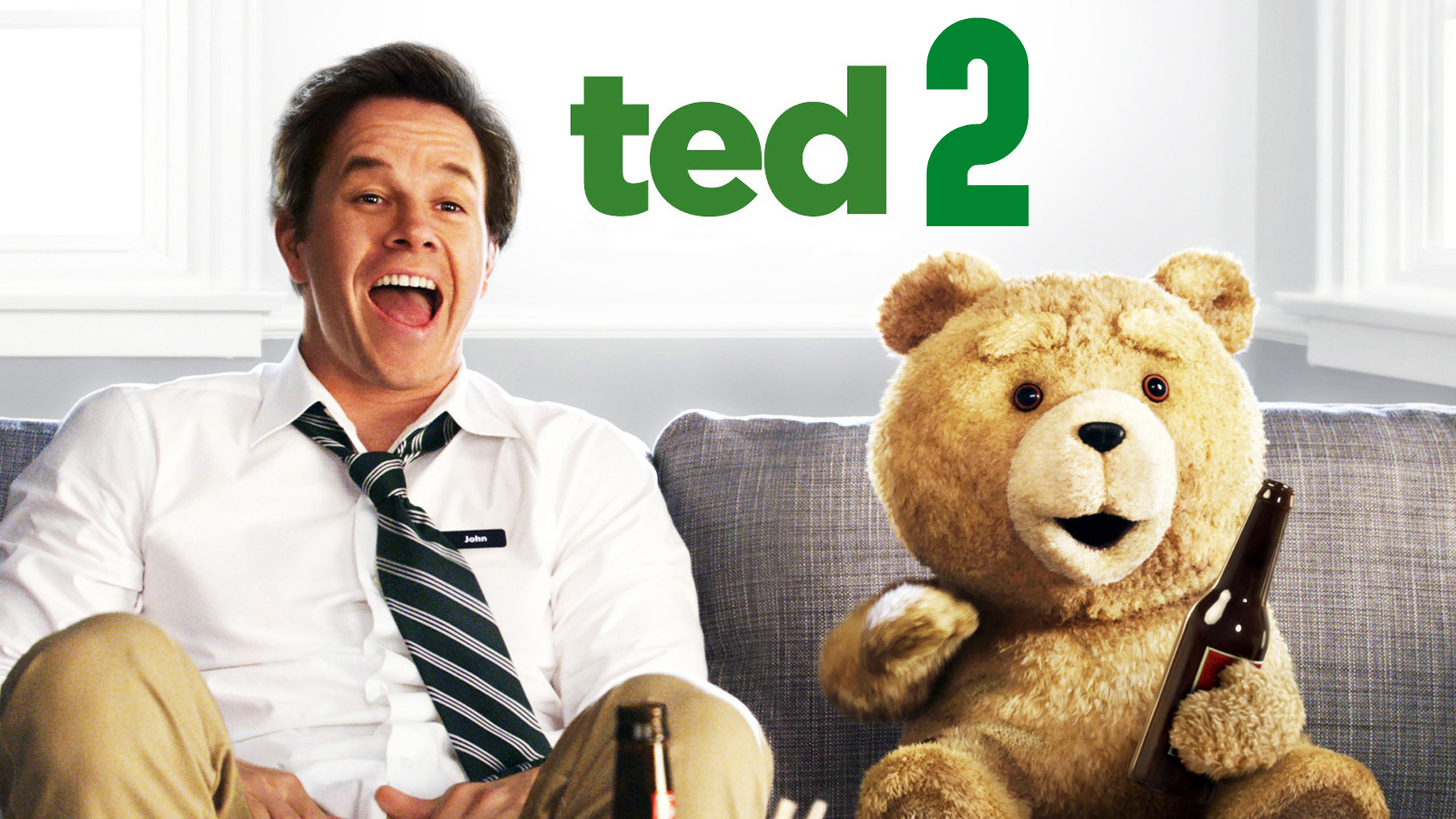
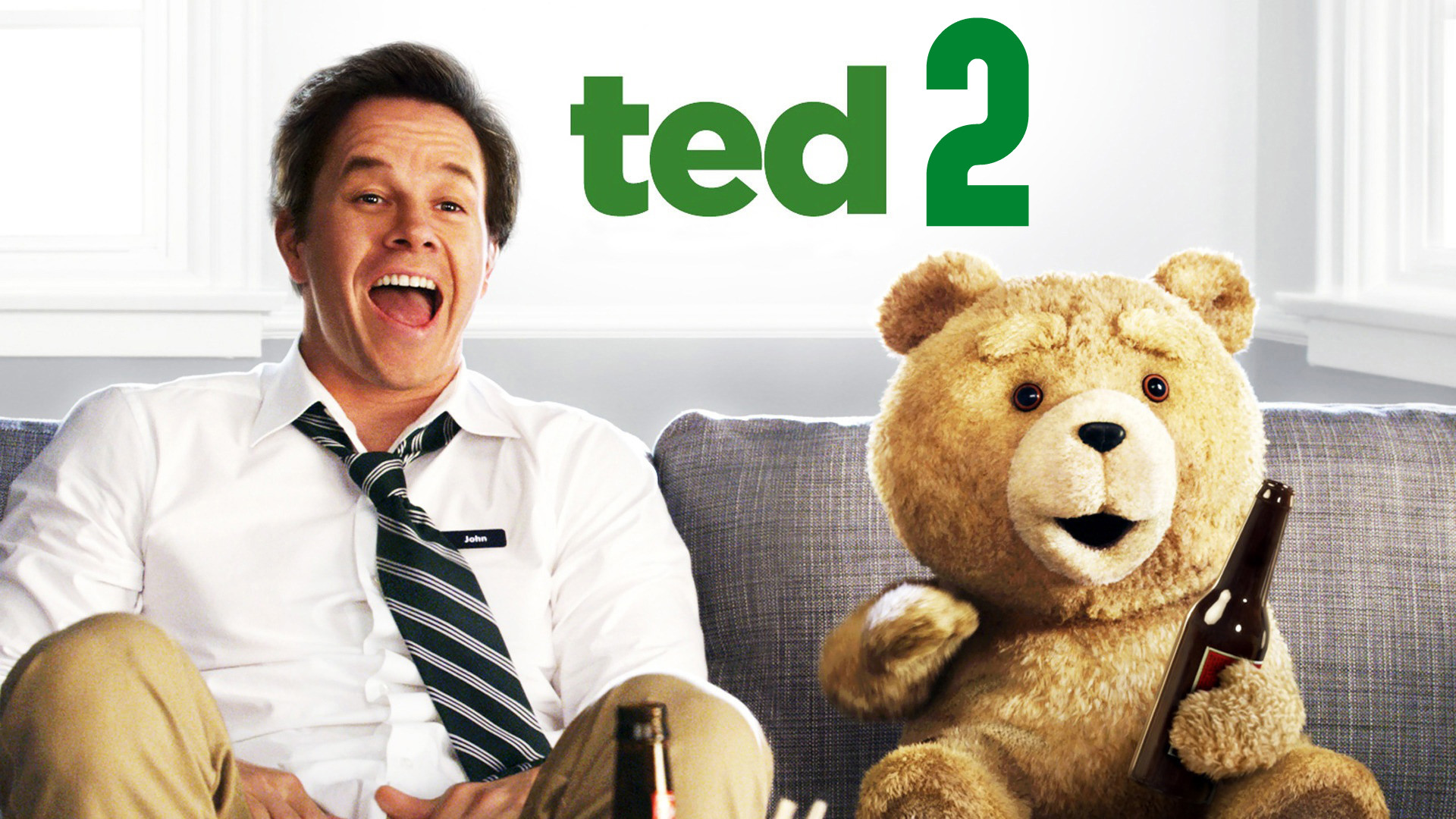
The parts I did enjoy were the low-key, random, off-beat moments, especially in the performances of Mark Wahlberg and, briefly Liam Neeson.  The gimmick may be the talking teddy bear, but the star of the film in every way is Wahlberg, who in the midst of a slob comedy gives a performance that is so precise and witty it is close to adorable.

Copyright Universal 2015

“Ted” was an amiably crude film about a boy named Johnny who wished that his teddy bear would come alive, like Pinocchio, or the Nutcracker.  Ted does come to life and decades later, John (Wahlberg) and Ted (voiced by writer/director Seth MacFarlane), are happily still best friends, enjoying the pleasures of adulthood (sex, porn, weed, beer) while happily holding on to childhood when it comes to thunderstorms and responsibility.  The happy ending of course has to be unraveled for a sequel, so we begin with John now divorced from the long-time girlfriend who gently suggested he might want to grow up, and Ted getting married to his girlfriend, Tami-Lynn (Jessica Barth).  After a great musical production number right out of a Busby Berkeley film, we skip ahead a year, and find Ted and Tami-Lynn bickering to the point of not speaking to one another.  So, of course they decide to have a baby.  This requires the assistance of a fertile male human.  Ted’s first choice is, of course, Tom Brady, so he and John come up with a plan to obtain a sample without Brady’s finding out.

It does not end well, so John volunteers to provide the sample himself, leading to the scene described above.  That does not work out well, either, so they try adoption, which brings Ted’s situation to the attention of the authorities.  Apparently, one has to be human to adopt a child.  Ted is classified as property, and is thus ineligible to adopt, work, or even be married.  This being America, they find a lawyer (Sam L. Jackson — get it? played by a very game Amanda Seyfried) to go to court and have Ted declared human.  This leads to a thoughtful exploration of existential ontology.

Kidding!  It’s just a series of dumb situations and dumb jokes made by dumb characters in various locations, including the aforesaid fertility clinic, courtroom, and very lovely home of Tom Brady, plus a pot farm and New York Comic-Con.  Giovanni Ribisi returns as the demented Donny, who conspires with the head of Hasbro (did they really consent to product placement in this film) to kidnap Ted because, oh, who cares.  Certainly not MacFarlane, who makes no attempt at any kind of storyline or character.  He just throws in a gross joke, pop culture shout-out, or surprise cameo (the cast of SNL!  Some “Star Trek” actors!  Liam Neeson, who clearly did not learn anything from his appearance in “A Million Ways to Die in the West!”  Patrick Warburton in a Tick costume!) instead.  Neeson is wonderful.  Wahlberg is terrific. But not enough to overcome the movie’s limp, puerile, vapidity.

NOTE: Stay all the way to the end of the credits for an extra scene.

Parents should know that this film has constant very strong language with crude and explicit sexual references, sexual situations, drinking, extensive drug use, comic peril, and violence.  Some of the humor is intentionally offensive. Some is is just offensive. See the thoughtful discussion of the racist themes and jokes by Wesley Morris in Grantland.

Family discussion: Is Ted human?  Who should decide?

If you like this, try: “Ted” and “Harold and Kumar Go to White Castle”

Related Tags:


Comedy Scene After the Credits Series/Sequel
Inside Out

Inside Out

Posted on June 18, 2015 at 5:53 pm

A-
Lowest Recommended Age: Kindergarten - 3rd Grade
MPAA Rating: Rated PG for mild thematic elements and some action
Profanity: Some schoolyard language
Alcohol/ Drugs: None
Violence/ Scariness: Some peril and anxiety, sad death
Diversity Issues: None
Date Released to Theaters: June 19, 2015
Date Released to DVD: November 3, 2015
Amazon.com ASIN: B00YCY46VO
Copyright 2015  Pixar
Copyright 2015 Pixar

Roger Ebert liked to refer to movies as an “empathy machine.” He said that the great gift of movies, more than any other art form, is the way they can put us inside the world, experiences, culture, and perspective of someone completely outside our own experience. But the best movies do that in a way that helps us understand ourselves as well. “Inside Out” is a rare film that takes us inside the mind of one very particular 11-year-old girl in a way that illuminates the vast breadth of human experience, with deep insights about our own particular quirks, struggles, and emotions. It is exciting, hilarious (two of the funniest jokes you will see on screen this year), and deeply profound, making the most complex concepts accessible in so that children and adults will learn more about who they are and how they got that way.

Riley (Kaitlyn Dias) is in the midst of internal and external turmoil. She was very happy in Minnesota, playing on a hockey team, with lots of friends, and feeling, well, at home. But her parents have just moved to San Francisco, so that her father can take a new job with a start-up. Everything is new and different and scary. Everything she liked about her life, everything she took for granted, is up for grabs. And all of this is happening just as that developmental leap that comes around age 11 is causing her to change from the bright-spirited, optimistic, happy little girl who was confident in herself and in her family.  She is getting old enough to see and feel more of what is going on inside and out. Her parents try to be reassuring, but she knows that her father’s new job is risky. She does not know anyone at school and they do not know her. The old friends from the place she still thinks of as home do not have as much time for someone who is far away.

Of course we have seen this before. There are a lot of movies about people of all ages who are forced to adjust to changed circumstances, or to find a way to make a strange new place feel like home. What is different about “Inside Out” is that Riley is not the character we follow through this story. She has her own adventure, but the story takes place in her mind and it is her emotions who take center stage. They operate the helm of the — yes — Headquarters.

The characters are Joy (Amy Poehler), a pixie-ish blue-haired sprite who is resolutely energetic and upbeat, Anger (Lewis Black), a stocky red fellow who is fiery-tempered and easily outraged, Disgust (Mindy Kaling), green, with a round head, long eyelashes, and a sensitive spirit quick to resist anything new or icky, Fear (Bill Hader), a lean blue creature who usually assumes the worst, and Sadness (Phyllis Smith), who feels everything very, very, very, very deeply. Each of these characters is introduced with what they help Riley do. Anger helps her see unfairness. Disgust helps her to avoid poisonous foods. Fear helps keep her safe. Joy helps her see the world as a place filled with imagination, adventure, and opportunity. And Sadness — we will learn more about what Sadness does later, but for now we will say that it helps her feel empathy. Joy is the leader of the group. She is the most focused and direct and the best able to negotiate with the others. But her goal is to keep all of Riley’s memories happy, and that might not be possible.

As Riley tries to use her mind, her memories, and her emotions to navigate her new community, Joy and Sadness are accidentally transported to where Riley’s memories are stored, and they must make it through an Oz or Wonderland-style land where we learn about everything from abstract thinking to why you CAN’T GET THAT DARN JINGLE FROM THAT STUPID COMMERCIAL OUT OF YOUR HEAD.  A surprising — in every sense of the term — new character shows up to provide support and insight, and to embody the sweet sorrow of growing up.  Co-writer/director Pete Docter told Terry Gross that it was when Mindy Kaling came to talk to him about the film that he understood what it was really about: you have to grow up, and it’s okay to be sad about it.  That applies whether you are the one growing up or just watching it as a parent or friend.  This movie speaks to all of us, whether we have children, are children, were children, or still keep the child we were near our hearts.  A lot of good movies are smart.  But this one is wise.

Parents should know that this movie includes some mild peril, family tension, running away, and a sad death.

Family discussion: Can you think of a time that Joy was steering your mind? How about the other emotions?  When can you feel them working together?  Did you have a Bing Bong? Why did he make that choice?

If you like this, try: “Everybody Rides the Carousel,” “Up,” and “Monsters Inc.”

Related Tags:


3D Animation Comedy Coming of age Drama DVD/Blu-Ray Pick of the Week For the Whole Family
Jurassic World

Jurassic World

Posted on June 10, 2015 at 5:54 pm

Copyright 2015 Universal

One problem is that we really do not know very much about dinosaurs, especially live ones, and especially genetically tweaked live ones. A bigger problem is that we keep ignoring what we do know about humans. Over and over again we see that humans are petty, greedy for both money and power, and very unclear about the line between optimism and hubris. Maybe someday we will figure out a genetic tweak to adjust that problem, but for the time being we are stuck with it, which is bad for us, but pretty good for movies. It gives us just enough of a framework for the storyline without interfering with the real purpose of the movie, which is, let’s face it, seeing people get chased by dinosaurs. And that is what happens, all right. A lot of people get chased by a lot of dinosaurs, and it is exciting and cool and a lot of fun.

Remember what Jeff Goldblum said in the first “Jurassic Park” movie?   The man behind the idea of taking dino DNA from amber and re-creating creatures who died out 70 million years ago compared the delays to the opening of Disneyland. Yes, Goldblum’s expert in chaos theory replied, but “if The Pirates of the Caribbean breaks down, the pirates don’t eat the tourists.” Despite the devastation inflicted on the planet in the first three movies (remember that optimism/hubris problem), things have moved on, and Jurassic World is now a flourishing theme park with 20,000 visitors at a time. Indeed, it is all a little been there-done that, the dinosaurs so tame there is actually a petting zoo portion of the park, where children can ride on triceratops. Investors want better returns and Claire (Bryce Dallas Howard), the director of the park, is under a lot of pressure to create more “wow factor.” The dinosaurs are no more exotic than the elephant at the zoo. “We want to be thrilled.”

She and the eighth richest man on the planet, the CEO of the company who owns Jurassic World, have decided the best way to do that is to spend $28 million to create a bigger, smarter, angrier dinosaur made up of all the scariest parts of all the other dinos. You know, Frankensaurus. What could possibly go wrong?

Making up the rest of the human cast are some disposable red shirt types whose primary job is to be clawed and/or eaten, as well as Claire’s two nephews (Nick Robinson and Ty Simpkins) and a couple of Navy vets who have been working on an experimental program to see whether raptors can be trained, Owen (Chris Pratt) and Barry (Omar Sy). There’s also a computer guy (Jake Johnson), a scientist (B.D. Wong), and the grand prize winner of the really bad idea competition, a military type (Vincent D’Onofrio) who wants to weaponize the dinosaurs and use them in combat.

There’s a terrific opening, as powerful talons crack through egg shells, terrifying literally from the very first second. Then there’s a clever twist to remind us that we are here to have PG-13-style fun. We have about an hour to familiarize us with the characters, the layout, and the vulnerabilities, oh, yes, and the characters. And the rest is people getting chased by dinosaurs in a variety of extremely intense and exciting and creative ways, and in many different locations. The 3D effects are jump-out-at-you scary. Howard makes the best of a thankless part.  Claire starts out as a caricature of a control freak, dressed all in Olivia Pope white, with perfectly groomed, razor-styled red hair.  We know how inhuman she is because she barely remembers the names of her nephews and refers to the dinosaurs briskly as “assets.” And she once went on a date with a print-out of the schedule.  It is fun to see her become more messy and human, though ridiculous that she never takes off her high heels and gets the vapors over seeing a Real Man do Manly things.

The real wow factor in the film is Pratt, who exhibits a natural Indiana Jones-style, all-American heroism. Not many actors can hold their own against a genetically modified T-Rex the size of Godzilla, but Pratt, whether dinosaur whispering or racing his motorcycle, is an old-school hero. Even if we don’t believe there is any chemistry between his character and Howard’s, his quiet confidence and skill are as much fun as all the CGI-asauruses.

Parents should know that this film includes very intense peril and violence involving big, scary creatures with lots of teeth, many characters (human and animal) injured and killed, some graphic and disturbing images, brief strong language, brief sexual reference, discussion of parental divorce.

Family discussion: Why did things go so wrong? Whose fault was it? How did the relationship of the brothers change and why?

If you like this, try: the earlier “Jurassic Park” movies and “Walking With Dinosaurs”

Related Tags:


Based on a book Fantasy Series/Sequel Thriller
THE MOVIE MOM® is a registered trademark of Nell Minow. Use of the mark without express consent from Nell Minow constitutes trademark infringement and unfair competition in violation of federal and state laws. All material © Nell Minow 1995-2026, all rights reserved, and no use or republication is permitted without explicit permission. This site hosts Nell Minow’s Movie Mom® archive, with material that originally appeared on Yahoo! Movies, Beliefnet, and other sources. Much of her new material can be found at Rogerebert.com, Huffington Post, and WheretoWatch. Her books include The Movie Mom’s Guide to Family Movies and 101 Must-See Movie Moments, and she can be heard each week on radio stations across the country.

Website Designed by Max LaZebnik