Wild

Posted on December 4, 2014 at 5:58 pm

“If your Nerve, deny you—
Go above your Nerve—”

Cheryl Strayed (Reese Witherspoon) adds the name of the author, Emily Dickinson, to the quote she has inscribed in a journal for hikers kept at her entry point on the Pacific Coast Trail. And then she adds her own name as well. It is her own name in a very real sense as she was not born with it and it was not her husband’s name. It was a name she chose from a dictionary at the end of her marriage as the name she wanted to go on with, a name for going above her nerve.

Copyright 2014 Fox Searchlight

Strayed was lost. Her mother Bobbi (a glowing Laura Dern), the “great love of (her) life,” died of cancer. Her husband Paul (“Newsroom’s” Thomas Sadoski) was loving and supportive but Strayed fell into a self-destructive death spiral, obliterating herself through “detached” sex with strangers and substance abuse that ultimately included shooting heroin. She and Paul recognized their divorce with matching tattoos to keep some part of the idea of permanence connecting them. And then, with nowhere else to go, she decided to take a walk, more than a thousand miles. It was a chance to reconnect with something she knew she loved to do and to get away from the bad choices she was making. The Chinese proverb says that the longest journey begins with a single step. Strayed wanted to take those steps between her old life and whatever was ahead, to begin to feel an un-obliterated life.

Her 60 pounds of equipment filled a backpack called The Monster. She did not practice putting up her tent or using her stove before she left. She was scared, and soon she was also hungry. She had brought the wrong fuel for her stove. A burly farmer driving a tractor gruffly agreed to give her a ride to some food, and then told her he was bringing her back to his house. She looked at him, trying to figure out if he was planning to attack her, hoping he was not. He was not. The farmer and his wife were kind and generous with her. She got the right fuel, and, a few stops later got some advice about getting rid of some of her load, down to burning each night the book pages she had finished reading. Plus, she didn’t really need all those condoms, did she?

Strayed’s book became an international-bestseller, so poetic and inspirational Oprah rebooted her Book Club to endorse it. Like other memoirs combining real and spiritual/emotional journeys, what makes it work is the narrator’s voice. This is as much an internal story as an external one. Screenwriter Nick Hornby (“High Fidelity”) and director Jean-Marc Vallée (“Dallas Buyer’s Club”) understand that this is not a travelogue, though there is some stunning scenery. It is about Strayed thinking back through her chaotic, messy life through the experience of putting one foot in front of the other on her way to a place called The Bridge of the Gods. As she thinks back on her life, we begin to understand the context for this trek at the same time that she does. As we expect from Hornby, there are some great song choices, too.

Strayed’s adventures and encounters along the way resonate with her memories. The farmer is not the only potential danger. The film understatedly but clearly shows how any woman in any sort of wild has to constantly calculate the threat level of the men she encounters. And, in a scene where Strayed comes across another hiker taking a bath in a lake, we get something we rarely see in films, a woman appraising, or maybe just appreciating, a male body. This is a character moment for Strayed, who as we see, has been too impulsive in sexual encounters. But here, she stands back and just savors the moment on its own, owning it without having to do anything about it. “I’m lonelier in my real life than I am out here,” she says.

Feeling your feelings can be painful. Strayed loses toenails and, at one point, her shoes. There are angry, raw patches of skin where The Monster digs into her. She thinks through painful memories of her mother’s illness, her father’s abuse. She remembers being inconsiderate of her mother, a woman who was thrilled to get a chance to go back to school, to think and question and learn. And for the first time, she begins to understand what her mother said about putting yourself in the line of beauty. Just because some things are terrible doesn’t mean everything is. “This has the power to fill you up again if you let it,” someone tells her.

Witherspoon gives a performance of quiet vulnerability and courage. In some ways, as producer as well as star, this was as daunting an undertaking for her as the hike was for Strayed. There was a real risk of making it a glamorized, soapy star vehicle. But as producer and actor, she gives this story the film it deserves.

Parents should know that this film includes explicit sexual references and situations and nudity, substance abuse, references to domestic abuse, and very strong language.

Family discussion: What do you think the quote means and why did Strayed use it to begin her hike? What does it mean to say that wounds come from the same source as power?

If you like this try: Strayed’s books, Wild: From Lost to Found on the Pacific Crest Trail, Torch, and Tiny Beautiful Things: Advice on Love and Life from Dear Sugar, and another 2014 film about a real-life woman on a long, long walk, Tracks.
Related Tags:


Based on a book Based on a true story Drama

The Imitation Game

Posted on December 4, 2014 at 5:03 pm

B+
Lowest Recommended Age: High School
MPAA Rating: Rated PG-13 for some sexual references, mature thematic material and historical smoking
Profanity: Some strong language
Alcohol/ Drugs: Drinking, smoking
Violence/ Scariness: Wartime violence
Diversity Issues: A theme of the movie, homophobia, suicide
Date Released to Theaters: November 21, 2014
Date Released to DVD: March 30, 2015
Amazon.com ASIN: B00RY85CQI
Copyright 2014 The Weinstein Company

Alan Turing was a brilliant mathematician with an enormous intellect, an almost equally enormous ego, and an almost equally enormous secret. He was one of the founding thinkers behind modern computing and it is his name that we use for the test that determines whether a computer has achieved true artificial intelligence status. The Turing test standard is human conversation. If a human cannot tell whether he or she is communicating with a person or a computer, than the program has passed the Turing test and is true artificial intelligence.

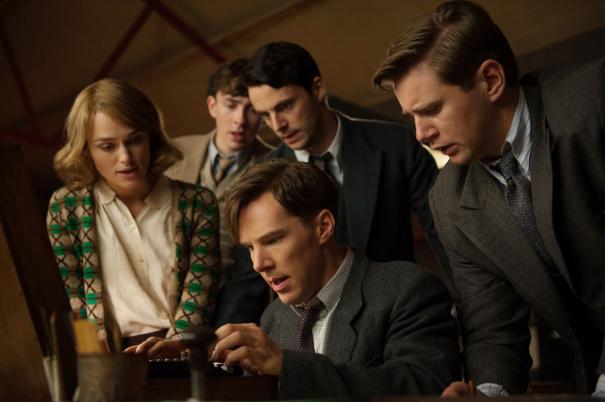
I’m not sure that Alan Turing could have passed the Turing test. Cumberbatch, who also plays a super-smart, arrogant, and obnoxious guy in “Sherlock,” creates a very different character here. Turing himself is an Enigma. In the opening scene, a sort of job interview nightmare in which Commander Denniston (Charles Dance) is trying to interview Turing (Benedict Cumberbatch) for a spot on the team working at the famous Bletchley Park estate to break the code the Germans were using to send orders to their troops. If passing as human means meeting even the most minimal standards of civility and responsiveness, Turing failed that interview. He seemed to think that it was he who was interviewing Denniston to determine whether the task was of sufficient interest and import to merit his attention.

Denniston begins to dismiss him. But when Denniston says that everyone thinks the code, known as Enigma, is unbreakable, Turing says briskly, “Let me try, and then we’ll know for sure.” Denniston does not have a better idea or a better option.

The German code is unbreakable because it is constantly changing, so by the time any one message has been decrypted, whatever was learned could not be applied to whatever comes next. The Allies are perpetually behind. [The process, complicated as it is, has been simplified for the purposes of the movie, glossing over the important work done by Polish mathematicians, the contributions of the French, and the challenges faced as the Germans continued to make the Enigma more complicated and impenetrable as the war continued.) While a bunch of brilliant mathematicians, scientists, and puzzle-solvers (including Joan Clarke, played by Keira Knightley) worked away, Turning realized not only that what made the code unbreakable was the inability of any then-existing computational mechanism to perform enough calculations fast enough to decrypt the messages before the code was reconfigured the next morning, but that he could create a machine to do it.

We know how it turned out. But director Morten Tyldum keeps the story gripping on several levels. First, there is the conflict between Turing and just about everyone, and the pressure for immediate results as he is spending a lot of time (years) and money on something no one has ever seen before. Second, there are the interpersonal struggles, and Turning’s internal difficulties. He did want intimacy, and we see in his memories of his first love, a boy at his school. He likes Joan, and is briefly engaged to her. But he was gay at a time when being gay was punishable by prison. Then there are other kinds of secrets. One of the people working on breaking the code may be a spy. And once the code is broken, the Allies have the wrenchingly painful decision about what to do with the information. It’s not just a puzzle. It is statecraft, and terrible compromises and terrible losses are part of the job.

The film adds some unnecessary drama and oversimplifies parts of the story. But it is a powerful, complex drama and a long-overdue tribute to a true hero and visionary.

Parents should know that this film includes wartime themes and images, some disturbing, wrenching moral choices, betrayal, the pressures of being a closeted homosexual when it was a crime, drinking, smoking, and some sexual references.

Family discussion: Do you agree with the decision to withhold the news that the code had been broken? To allow the mole to keep spying?

If you like this, try: Read up on the history of the codebreakers at Bletchley (The Secret Lives of Codebreakers: The Men and Women Who Cracked the Enigma Code at Bletchley Park, Seizing the Enigma: The Race to Break the German U-boat Codes, 1939-1943) as well as those in Poland and the spies who helped them get the information they needed and try some online version of the Turing Test.

Related Tags:


Based on a true story Biography Drama DVD/Blu-Ray Pick of the Week War

Horrible Bosses 2

Posted on November 25, 2014 at 5:58 pm

Copyright 2014 New Line

Maybe it’s just the proximity to the horrible “Dumb and Dumber To,” but the cheerily offensive “Horrible Bosses 2” made me laugh. Full warning — it begins with an elaborate sight gag as our hapless heroes demonstrate their new product on a relentlessly cheery morning show. When the product, a “Shower Buddy” that combines the soap and shampoo with the shower head, demonstrated by Kurt (Jason Sudeikis) does not work at first, Dale (Charlie Day) kneels down behind it to make some quick repairs. His back-and-forth motions in the vicinity of Kurt’s lower torso make it appear to be a sexual act. This is followed by an expression of interest in the Shower Buddy by the TV host (the wonderful Keegan Michael Key), until he hears the name of the company. The trio has combined their three names: Nick, Kurt, and Dale, to sound like a racist epithet. If you’re still with me, then this is your movie.

Nick (Jason Bateman), Kurt, and Dale are very happy to be free of their horrible bosses and running their own company, especially when a wealthy entrepreneur named Bert Hanson (Christoph Waltz) places a large order. The guys rent a manufacturing facility, hire staff (mostly girls Kurt wants to have sex with, plus a black felon they are scared of and a Latina woman they can’t understand), and go into production. They are proud to report to Hanson ahead of schedule. But it turns out that Hanson planned from the beginning to bankrupt them and take over their company. They are back in the world of horrible bosses again.

They get some advice from one of their old horrible bosses, Dave Harken (Kevin Spacey), now serving his jail term, and from M****F**** Jones (Jamie Foxx), the criminal they sought guidance from in the last movie, not realizing that his crime was only pirating “Snow Falling On Cedars.” They decide the best option is to kidnap Hanson’s spoiled, arrogant son (Chris Pine) and hold him for ransom. Their plot requires some laughing gas as a sedative, so they visit the dental office of Dale’s former horrible boss, the sexually predatory Julia (Jennifer Aniston), not knowing her sex addiction support group is going to be meeting there.

The kidnapping plot does not go well. They are not even sure how to spell kidnapping when they write it with permanent marker on their dry-erase board. But there’s a surprising twist that gives the story a second wind. Waltz and Pine, not known for comedy, are both excellent, especially Pine, clearly enjoying himself enormously. A lot of the humor is sheer outrageousness, much of it racist or sexist or both, but some of it is pleasantly loopy, like a doorbell that plays Badfinger. The three guys have great chemistry. And nobody is better at playing a horrible boss than Spacey. But the highlight of the film is the outtakes over the end credits, showing us that this movie was more fun to make than to watch.

Parents should know that this movie includes extremely crude, offensive, and graphic sexual references and situations, nudity, constant very strong language, and violence including murder.

Family discussion: Who was the worst boss you ever had? Who was the best?

If you like this, try: The first “Horrible Bosses” movie and “Ruthless People”

Related Tags:


Comedy Series/Sequel

Penguins of Madagascar

Posted on November 25, 2014 at 5:17 pm

B+
Lowest Recommended Age: All Ages
MPAA Rating: Rated PG for mild action and some rude humor
Profanity: Some schoolyard language
Alcohol/ Drugs: None
Violence/ Scariness: Comic peril and violence
Diversity Issues: None
Date Released to Theaters: November 26, 2014
Date Released to DVD: March 16, 2015
Amazon.com ASIN: B00SK573RU

The most adorable characters from the first three animated “Madagascar” movies were the penguins, the seldom right but never in doubt leader Skipper (Tom McGrath), the often right but never listened to Kowalski (Chris Miller), the literally explosive Rico (Conrad Vernon), and the ever-loyal Private (Christopher Knights). They spun off into their own television series and now they star in their first feature film, a sublimely silly spy farce that has them globe-hopping through exotic locations with a cosmopolitan spy (Benedict Cumberbatch) in pursuit of a dastardly villain known as Dr. Octavious Brine, aka Dave (John Malkovich). It is one of the best family films of the year.

Copyright DreamWorks 2014

First, we get the origin story, hilariously narrated in the inimitable voice of director/documentarian Werner Herzog. It is Antarctica, and a film crew led by a cartoon Herzog (who did make a movie in Antarctica, “Encounters at the End of the World”) is there to shoot the march of the penguins. But Skipper, Kowalski, and Rico step out of line to rescue an egg that is rolling away, and the decision to think for themselves and to opt for adventure and loyalty to the team over tradition and instinct — plus a more-than-healthy dose of boundless confidence and optimism soon has them floating away from the frozen South Pole and on their way to uncharted lands, or lands uncharted by any penguins anyway. The egg they have saved finally hatches, and while they are a bit distressed to find that the miracle of birth is messier than they thought, they are charmed by the tiny hatchling and especially by the way they imprint on him as the only family he has ever known.

We next see the penguins years later, following the events of Madagascar 3: Europe’s Most Wanted. They are on a mission to break into that most impenetrable of fortresses, Fort Knox, repository of the US Government’s store of gold. But their goal is not what we might think. And the outcome is not what they expect. They are kidnapped by an enormous purple octopus, brilliantly animated, with every tentacle and crooked tooth creating comic menace. His human identity is Dr. Octavius Brine, well-known geneticist, aficionado of fine cheeses, and regular contributor to NPR pledge drives. But inside that lab coat is his real persona, the evil purple octopus named…Dave.

Yeah, I know, not too scary, right? And that is just one of the immense frustrations Dave has to confront, which is why he has created the green, ominously glowing Medusa serum. No one knows what it does, but it looks pretty evil.

It turns out someone has been tracking Dr. Brine. An international organization of crack spies called the North Wind, led by a wolf so deep undercover his name is classified (so the Penguins call him Classified) is trying to find him. The North Wind and the penguins stop in Venice, Rio, Shanghai (which the penguins think is Ireland) and other world capitals, sometimes working together, sometimes trying to beat each other to Dave and the Medusa serum. It turns out that Dave’s motive is one that will ring very true to kids, especially those with adorable younger siblings.

But of course, all of this is just an excuse for a never-ending stream of jokes. My favorite is Dave’s disastrously non-threatening Skype call as he tries to figure out how to transmit sound and picture at the same time. “It’s like trying to call my parents,” Classified says impatiently. The break-in at Fort Knox is very funny as the penguins roll over to camouflage themselves on a black and white striped floor. And a running joke featuring puns on celebrity names is delivered with such understated dry humor that it never loses its charm. If, as they say in the theater, dying is easy but comedy is hard, silly comedy may be the hardest of all, but here it is done to perfection, one more item to add to the thanks list on this holiday weekend.

Parents should know that this film has brief potty humor, and some comic peril and action (no one hurt).

Family discussion: Why was Dave so jealous of the penguins? Why didn’t Classified want the penguins to help him?

If you like this, try: “Madagascar 3: Europe’s Most Wanted” and the television series “The Penguins of Madagascar”

Related Tags:


3D Animation Comedy DVD/Blu-Ray Pick of the Week For the Whole Family Scene After the Credits Series/Sequel Spies Talking animals

Little Hope Was Arson

Posted on November 22, 2014 at 8:40 pm

B
Lowest Recommended Age: High School
MPAA Rating: Not Rated
Profanity: None
Alcohol/ Drugs: Drinking, drugs
Violence/ Scariness: Arson
Diversity Issues: A theme of the movie
Date Released to Theaters: November 21, 2014
Copyright The Orchard 2014

In a small East Texas community “with a church on every corner,” 10 churches were burned. One church showed the Christian film “Fireproof” one night and showed that it was far from fireproof itself the next day.

This is a documentary about the impact on the community and also about the investigation that led to the arrest and conviction of two young men who could barely explain why they did it. The title comes from graffiti carved into a wall that becomes a clue. And there is a wrenching twist. One of the two young men is the brother of a woman who works in law enforcement.

But the real themes of the film go beyond a crime procedural. This is the story of a culture that allows young people to get lost and the failure of religious institutions to reach them. And it is also the story of great resilience, compassion, and forgiveness. The most powerful scene in the film is at the sentencing proceeding, where one of the clergyman uses his time on the stand not to tell the judge about what he and his congregation had suffered but to speak from the heart, asking the young men who burned down his church for their forgiveness and assuring them that they had his.

“Getting slapped in the face by your hypocrisy hurts like hell,” one minister says somberly.  He has reason to welcome this dose of humility.  The young men who torched the churches belonged to his congregation.  But of course the problem is that they did not feel they belonged anywhere.  The film’s sympathetic portrayal of the believers is undercut in the final image by a quote from the anarchist Buenaventura Durruti: “The only church that illuminates is a burning church.”

If this was a feature film, we would have the satisfaction of some sort of cathartic breakthrough explaining what happened.  But real life is messy and often unsatisfying. “I’ve been here for three years and still don’t know the motive,” one of the arsonists says.  Have they learned anything?   “When you fight with God, you’re just going to lose.”

Parents should know that this movie includes frank discussion of drug and alcohol abuse, crime, and a sad parental death.

Family discussion:  What kind of punishment is appropriate here?  If you disagree with what the judge ordered, why?  Why do you think the boys burned the churches?

If you like this, try: “At the Death House Door” and “Into the Abyss”

Related Tags:


Documentary Movies -- format
THE MOVIE MOM® is a registered trademark of Nell Minow. Use of the mark without express consent from Nell Minow constitutes trademark infringement and unfair competition in violation of federal and state laws. All material © Nell Minow 1995-2026, all rights reserved, and no use or republication is permitted without explicit permission. This site hosts Nell Minow’s Movie Mom® archive, with material that originally appeared on Yahoo! Movies, Beliefnet, and other sources. Much of her new material can be found at Rogerebert.com, Huffington Post, and WheretoWatch. Her books include The Movie Mom’s Guide to Family Movies and 101 Must-See Movie Moments, and she can be heard each week on radio stations across the country.

Website Designed by Max LaZebnik