The Hunger Games: Mockingjay

Posted on November 20, 2014 at 5:59 pm

B+
Lowest Recommended Age: Middle School
MPAA Rating: Rated PG-13 for intense sequences of violence and action, some disturbing images and thematic material
Profanity: Mild language
Alcohol/ Drugs: None
Violence/ Scariness: Intense peril and violence with hundreds of deaths, grisly scenes, torture
Diversity Issues: None
Date Released to Theaters: November 21, 2014
Date Released to DVD: March 6, 2015
Amazon.com ASIN: B00PYLT0OW
Copyright 2014 Lionsgate

It seems no different at first. While the second in the “Hunger Games” series ended with the surprise last-minute rescue of heroine Katniss Everden (Jennifer Lawrence), and the even bigger surprise that insider Plutarch Heavensbee (Philip Seymour Hoffman) was secretly helping to organize a rebellion against the fascist dictator President Snow (Donald Sutherland), we begin this first half of the final installment with Katniss gripped by anxiety and terror, listening to the voice of someone we cannot see, calling her “Miss Everdeen,” which sounds respectful, even deferential, but still delivering orders. Is this more of the same? Just another version of the world of Panem where the thinnest gloss of rhetoric about ideals and values is used to disguise the vilest abuse, corruption and even genocide.

No, this is District 13, thought to have been exterminated, but in reality literally driven underground, as much as 40 stories down, as they work to find a way to overthrow President Snow’s totalitarian regime. They are led by Alma Coin (a somber Julianne Moore), President of the rebel forces. Coin can be abrupt, but it is a manifestation of urgency and decisiveness, not dictatorship. Snow dresses in spotless white, surrounded by lush white roses, and the capital city of Panem is a riot of garish, decadent colors. District 13 is all in gray, looking a bit like Janet Jackson’s “Revolution” video, evoking its uniformity in dedication to its goal and seriousness of purpose. Coin is not cynical, but she is realistic, constantly establishing priorities, understanding the consequences but willing to pay the price.

Coin and Heavensbee believe Katniss is what they have been waiting for, a symbol who will communicate to the other districts that the time has come for rebellion. She is the Mockingjay, named for the distinctive birds creation through genetic manipulation mating with natural species. Katniss is a figure whose sacrifice and resilience lend her enormous national credibility. She was made into a celebrity by Snow through the original Hunger Games.

Now Coin wants to use that as a weapon against Snow’s regime. They try to make a “propo” (propaganda) video with CGI effects, but realize that Katniss is too honest to be effective unless she is telling the truth. So, they take her to see what has happened to her home community in District 12. It has been reduced to rubble, with an enormous pile of skeletons of those who died there. And so Katniss is able to produce the outrage and resolve Coin’s forces are looking for in the video.

Katniss agrees to serve as symbol, on condition that the rebel forces rescue the Hunger Games competitors who were left behind, and pardon them for whatever they have done. She believes Peeta (Josh Hutcherson) is dead, but then he appears on a televised broadcast hosted by Caesar Flickerman (Stanley Tucci), the game show emcee with the sepulchral smile. Her joy turns to horror as she hears him plead for her to stop any opposition to Snow. Has he been tortured? Does he know something she does not?

That seems more likely as the initial attempts at rebellion result in enormous losses, including the firebombing of a hospital. With support from Haymitch (Woody Harrelson), now reluctantly sober, and Effie (Elizabeth Banks), whose adjustment to live without wigs, make-up, and fashions that would make Lady Gaga say “too much” provides much of the film’s comic relief, Katniss struggles with PTSD and with the painful moral dilemmas of asking others to risk their lives for a cause that may be doomed.

The series is a respectful adaptation of the books, but its real strength is not the writing of Suzanne Collins but the performance of Jennifer Lawrence, who is to the film all that Katniss is to the rebellion and more. Once again, Katniss is the heart of the story and Jennifer Lawrence is the heart of the film.  In a plot that has her devastated and horrified much of the time, she manages to give a performance that is moving but never an atom out of control. Her conviction and presence is what anchors the film and makes the wildest absurdities of the storyline work. While I am not in favor of splitting the book in two just to double the box office, this version skillfully finds a story arc that comes to a satisfying conclusion while making us eager to see what happens next.

Translation: Brutal dictatorship relying on military force, bombing (including bombing unarmed civilians), shooting, executions, hundreds injured and killed, disturbing images including wounded civilians and piles of skeletons, torture (off screen), some teen kisses

Family discussion: What made Katniss the best choice to symbolize the rebellion? Why was it necessary to have a symbol? Why did President Snow refuse to use the word “rebel?”

If you like this, try: the first two “Hunger Games” films and “The Maze Runner”

Related Tags:


Action/Adventure Based on a book DVD/Blu-Ray Pick of the Week Epic/Historical Series/Sequel Stories about Teens

Foxcatcher

Posted on November 20, 2014 at 5:55 pm

Copyright Sony Pictures 2014

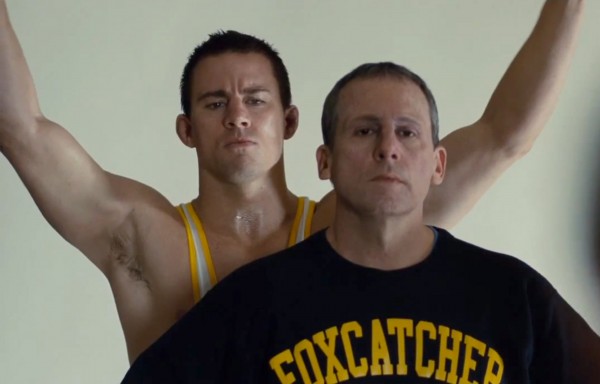
John Eleuthère Du Pont was of the wealthiest men in the world. He was an ornithologist, a philatelist, a purchaser of military weapons (including a tank), a wrestling fan who set up a luxurious training facility for the US Olympic team, and a murderer who died in prison in 2010. Steve Carell, almost unrecognizable, does a better job of erasing himself than of creating a different character. He has a hawkish nose, a set of small, inbred-looking teeth, a clenched posture, and the aristocratic delivery of a prep school graduate used to deference from everyone but his mother. But he is never able to make it all into anything but a cipher. Director Bennett Miller (“Capote,” “Moneyball”) and screenwriters Dan Futterman and E. Max Frye wisely stay away from simple explanations and Lifetime Made-for TV-style histrionics.  Miller’s pallette is drab and his presentation is spare, in contrast to the opulence of the Du Pont estate and the training facility. But the film overcorrects, as though underplaying and long, silent stretches without even a musical score can somehow convey seriousness and import.

It begins promisingly as we see Olympic gold medalist Mark Schultz (a somber Channing Tatum) stumbling his way through a talk to some bored schoolkids about character and America, and then waiting awkwardly for his pay, $20. And one of the best scenes of the year is his practice session with his brother, best (and only) friend, and coach, David Schultz (Mark Ruffalo), also a gold medalist. There is enormous tenderness in David’s touch as he pushes on Mark’s arms to stretch him, and even as it seamlessly turns into a wrestling match that eloquently conveys intimacy, trust, dependence, and some competition as well.


Mark gets a call from some Du Pont factotum, inviting him to come to Delaware to meet John on his luxurious estate, called Foxcatcher because of the fox hunting history of the Du Ponts, a rare family that has been wealthy since the earliest days of American history.

On the surface, John conveys an easy noblesse oblige as he introduces himself, and Mark is nowhere near worldly enough to see the arrogance and instability under the surface.  Mark has been listening to coaches all his life.  When John says he likes to be called “Eagle,” Mark sees leadership. When John says he wants to help Mark be the best in the world, Mark sees a chance for something he did not let himself realize he wanted, a chance to be more independent.  And independence is what John is looking for, too.  He is an adult dependent in many ways on his mother, bitter about her focus on horses and her obvious feelings for him, somewhere between indifference and contempt.

John builds a lavish training facility (in real life for more sports than just wrestling).  “Foxcatcher” is emblazoned everywhere.  The athletes are polite, even respectful, but no one thinks John has anything but money to contribute.  Mark loves being seen as special and gets caught up in John’s decadent lifestyle.  But then John, who has the attention span of a mayfly, decides he needs to bring Dave in, too.  Dave’s lack of interest only makes him more determined.  Soon, Dave and his wife and children are at Foxcatcher.  Mark is resentful.  John is increasingly unstable and there is no one there to stop him until it is too late.  When it’s over, he is affectless.  The problem is, too much of the movie is as well.

Parents should know that this film has tense and disturbing confrontations, some violence including murder, strong language, drinking, and drugs

Family discussion: What was John hoping to achieve by sponsoring wrestlers? How did he feel about John? How did he feel about Dave? Why?

If you like this, try: “Capote” and “Reversal of Fortune”

Related Tags:


Based on a true story Crime Drama Sports

Rosewater

Posted on November 16, 2014 at 11:04 pm

B+
Lowest Recommended Age: High School
MPAA Rating: Rated R for language including some crude references, and violent content
Profanity: Strong and crude language
Alcohol/ Drugs: Drinking
Violence/ Scariness: Riots and brutal attacks on rioters and rebels, torture
Diversity Issues: A theme of the movie
Date Released to Theaters: November 14, 2014
Copyright 2014 Open Road Films

First-time writer/director Jon Stewart has made a remarkably assured film about the imprisonment and torture of Iranian journalist Maziar Bahari It is an absorbing drama that is at the same time the story of a very specific individual and a thoughtful consideration of contemporary geopolitics that avoids stereotypes or jingoism. This not only makes it a better story; it elevates the level of discourse without preachiness.

Bahari (a superb Gael Garcia Bernal) was working for Newsweek when he returned to Iran to cover the election in 2009. He knew the dangers of posing a threat to the government in Iran. His father and sister both died in prison as accused enemies of two different regimes. And now, as he filmed the protests over the disputed election victory of Mahmoud Ahmadinejad and the “Dish University” maintained by dissidents, he knows he is putting himself and his subjects and sources at risk. It is possible he does not consider the risks posed by his decision to be interviewed by “The Daily Show,” where he jokes about being a spy.

He is asleep at his mother’s home when officials arrive to take him to prison.  It is disturbing and shocking that he is neither disturbed or shocked.  While his mother (Shohreh Aghdashloo) bravely snaps at the man who orders her to wear a headscarf, Bahari is calm and polite.

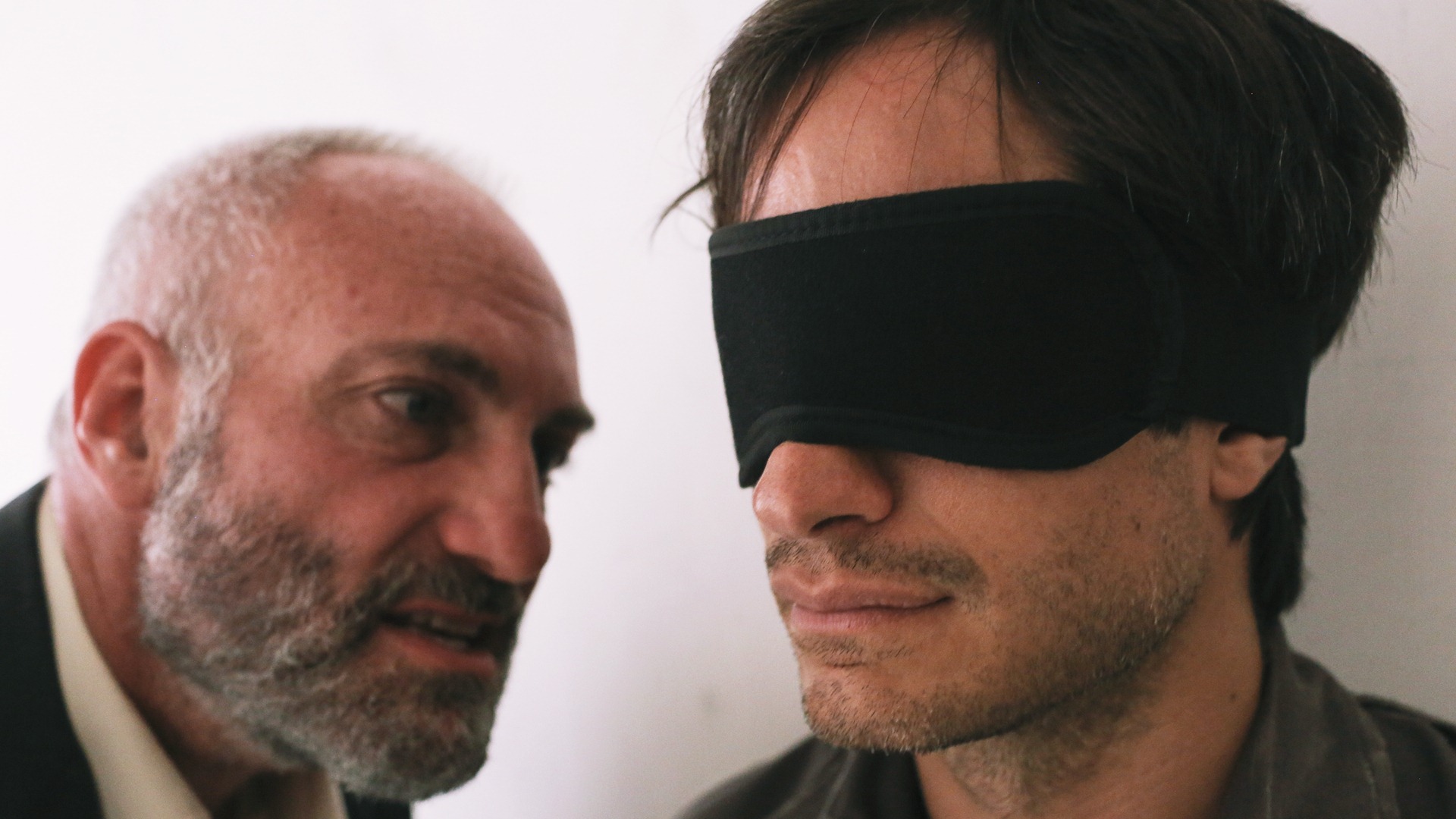
Stewart wants us to understand the pressure that Bahari’s interrogator (Danish actor Kim Bodnia) is under. Stewart shrewdly introduces us to the man who smells of rose water as he is on the phone to his family, and showing us that he is just one link in a chain of oppression and bureaucracy. And he is not afraid to use cinematic touches to show us what is going on in Bahari’s mind. We see a face reflected on the walls as he walks through the streets. Later, in prison, he has conversations with his father and sister. They seem real to us, but they are not hallucinations. They are just visual embodiments of Bahari’s thought processes or fantasies has the weeks in solitary confinement turn into months, with no contact from the outside world. These memories of his family members who were also imprisoned help him stay strong. They even help him briefly outsmart Rosewater, as he fabricates a series of sexual encounters to describe in questioning, his “specialist” (interrogator) listening in horrified fascination, Bahari having, for once, the upper hand.

Stewart wisely also keeps us confined with Bahari, not telling us more than he knows about efforts to get him out of prison. When we finally see archival footage of then-Secretary of State Hillary Clinton talking about the importance of having him freed, we share his sense of relief that the world knows what is going on and cares about it. The other prisoners have no such support. And yet, Stewart finds a way to end on an image of hope that circles back to origins of the film itself. In moving out from behind the “Daily Show” desk, he is inviting us, as he has and as Bahari has, to shift from observer to participant.

Parents should know that this film includes some mature material: riots, abuse and torture (not graphic), some sexual references, and some strong language.

Family discussion: In what way did Maziar use his imprisoners’ weakness? What were their most effective tactics and what were his?

If you like this, try: “Z” and “Beaufort” and Bahari’s book, Rosewater: A Family’s Story of Love, Captivity, and Survival

Related Tags:


Based on a book Based on a true story Drama Movies -- format War

Beyond the Lights

Posted on November 13, 2014 at 5:55 pm

Copyright 2104 Relativity Media

“Beyond the Lights” is a welcome return to the grand traditions of movie romance, with sizzling chemistry between gorgeous, fabulously charismatic stars Gugu Mbatha-Raw and Nate Parker. And it also has some very astute insights about family, ambition, and the pressure put on young women, especially those in the performing arts, to present themselves as sexually provocative and available.

Minnie Driver plays Macy Jean, a ruthlessly ambitious stage mother who sees her talented young daughter, Noni, as her ticket out of poverty and powerlessness. We first see them at a singing competition when Noni is a little girl (India Jean-Jacques). Her performance of Nina Simone’s “Blackbird” gets her a trophy that her mother smashes to the ground because she did not come in first. Then Noni is grown up (Mbatha-Raw), singing and dancing in a steamy music video, featuring a successful rapper named Kid Culprit (Richard Colson Baker, aka Machine Gun Kelly). Macy Jean is pushing Noni hard to do whatever it takes to become a star, and she is on the brink of a breakthrough, with an upcoming television appearance that should launch her into superstardom.
But in the midst of all of this sound and fury, Noni feels lost.  The image her mother has created for her is so overpowering that she does not know who she is anymore.  She is a singer with a million-dollar voice, but she is also a person who feels that it belongs to someone else, that she is lost somewhere beneath the glitter and fakery.  Alone in her hotel room, she goes out the window and sits on the ledge, contemplating allowing herself to just fall off.

She is rescued by a cop assigned to her security detail.  His name is Kaz (Parker) and he grabs her hand and looks into her eyes.  He says “I see you.”  And she believes he does.

Of course, the incident is spun for the press.  “We’re selling fantasy here, and suicide ain’t sexy.”  Noni jokes about the risks of combining champagne and stilettos and poses with her handsome savior.  But Kaz did see Noni.  He saw her the way she wanted to be seen.  And she saw him, too.

Kaz has a demanding parent, too, a father (Danny Glover) who wants him to run for office, and knows that Noni is not first lady material.

Writer-director Gina Prince-Bythewood (“Love and Basketball”) keeps the love story glamorous but never soapy, through the subtle, moving performances by Mbatha Raw and Parker, and a script that respects the characters, with thoughtful details and easy humor.  In the very beginning, Macy Jean is frantic because she does not know how to handle her biracial child’s hair.  Later, Noni is wearing a purple-streaked weave for her music video.  And when she begins to be happy again, she frees her hair as she finds her true voice.  Prince-Bythewood’s confidence in her own voice as much a pleasure of this film as the love story and the star power, which add up to the best date movie of the year.

Parents should know that this film includes very provocative sexual imagery and musical performances with very skimpy clothing, sexual references and situations, strong and crude language, attempted suicide, and tense family confrontations.

Family discussion:  What does it mean to “do small things in a great way?”  How did Noni and Kaz help each other? Why did being on the brink of great success was Noni in despair?  What can we do to protect girls from the overwhelming focus on appearance?

If you like this, try: “The Rose,” “The Bodyguard,” “Lady Sings the Blues,” “Dreamgirls,” “Love Me or Leave Me,” “Gypsy,” and “Mahogany”

Related Tags:


Date movie Drama Gender and Diversity Race and Diversity Romance

Dumb and Dumber To

Posted on November 13, 2014 at 5:52 pm

Copyright 2014 Universal

A poorly timed cameo appearance by Honey Boo-Boo’s sexual predator-consorting Mama June is dumb.  Making a sequel 11 years after the original “Dumb and Dumber” and the best-forgotten prequel “Dumb and Dumberer: When Harry Met Lloyd” is dumber.  Too. Jeff Daniels and Jim Carrey do their best and clearly enjoy themselves, but 20 years after the original, it just isn’t as funny.  It feels like those late-era Three Stooges comedies, past the Shemp era, even past Joe Besser, with Curly Joe.  As Lloyd (Carrey) says, comedy is all about timing.  And this one is too late.

Factor this into your assessment of this review.  The movie relies heavily on the viewer’s familiarity with and affection for the original, which I do not share.  Also, I do not find jokes about stupidity funny, don’t care much for slapstick, and I am not a fan of potty humor.  If any of the following appeals to you, then by all means buy a ticket: naming a character after a crude sexual act, a snot bubble, feeding someone with fingers that have just been up someone’s butt, changing an adult diaper,  holding a bag of urine with one’s teeth, jokes about lobotomies and shock treatments, a cat ingesting meth and swinging from a chandelier, slicing off a portion of the male anatomy, giving a young girl having her first period a cork, an elderly lady in a nursing home tricking a man into sexual touching (when he removes his hand, there’s dust on it!), potentially inscestuous thoughts, and a character who confuses lepers and leprechauns.

Like the first one, this is a road movie.  Harry (Daniels) says he needs a new kidney, so he has to find a donor who is a match.  His parents inform him that he was adopted.  Someone else might have picked up on the fact that they are Asian, but of course that never occurred to our heroes.  But Harry finds out that he has a daughter who herself was adopted by a Nobel-winning scientist.  When Lloyd takes one look at her photo, she imprints on him like Renesmee on Jacob, setting us up for a little potential incest joke later on, only exceeded in its inanity by the discovery that our heroes are not exactly clear on what makes babies.

So Harry and Lloyd set out to find this girl and see if she will donate a kidney.  She is representing her father at an event where he is to receive an award, and he has given her a package with his latest discovery to turn over to charity for the good of humanity.  His wife Adele is planning to kill him and get the package back so she and her lover can sell the discovery and live happily ever after on the millions he tells her it is worth.

Carrey’s choices are always fascinating, even when the movie is at its grossest and most disgusting.  He has a ferocity and fearlessness and a sheer joy in committing to the character that rises above the lazy material.  Kathleen Turner, as the character with the filthy name, still has that magnificent husky voice and acerbic delivery.  It is too bad that one of the jokes is about how she is a “Titanic whore.”  Rob Riggle shows up not once, but twice,  as identical twins.  Even though he does not have much to do other than appear in some bizarre disguises and one really atrocious haircut, the movie picks up when he’s on screen.

I did appreciate a welcome (if gentle) parody of the TED Talks.  And I admit that I laughed three times, which were pretty much the only three jokes that were not about bodily functions or substituting faux outrageousness for humor.  It can be funny to be politically incorrect.  But political incorrectness is not itself funny.  There is a lot of great comedy in dumb characters.  But not when the script is as dumb as they are. To.

Parents should know that this movie has material that would receive an R rating if it were not a comedy.  The movie includes strong and crude language, drinking and drugs, extremely vulgar sexual references, extensive bodily function humor, brief nudity, and fantasy/comic violence including a murder plot, guns, poison, and ninjas.

Family discussion:  How does this movie compare to the original?

If you like this try: “Stuck on You” and “Shallow Hal,” from the same writers/directors

Related Tags:


Comedy Scene After the Credits