The Middleburg Film Festival has surpassed itself again with a stunning line-up that includes some of the fall and winter season’s most anticipated and awards-likely films, including Tom Hanks as Mr. Rogers in “A Beautiful Day in the Neighborhood” and Martin Scorsese’s epic crime drama “The Irishman” with Al Pacino, Robert De Niro, Joe Pesci, and Harvey Keitel. Also on the schedule: Noah Baumbach’s “Marriage Story” with Scarlett Johansson and Adam Driver, Cynthia Erivo as Harriet Tubman in “Harriet,” Edward Norton’s “Motherless Brooklyn,” based on the acclaimed novel, and Adam Driver in “The Report,” based on the true and very timely story of the Congressional investigation into torture of US prisoners.
As Joaquin Phoenix’s “Joker” comes to the screen this week, we take a look at previous incarnations of Batman’s most popular villain:
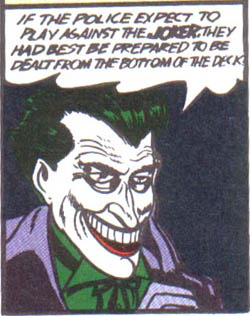
Copyright DC Comics 1940
1. The Joker made his debut as a serial killer whose poison left victims with a gruesome rictus “grin” in the very first Batman comic, created by Bob Kane, Bill Finger, and Jerry Robinson. He was originally intended to be killed off, but the editor at DC liked him and he appeared in nine of the first twelve Batman issues.
2. Cesar Romero played Joker in the campy 1960’s television series.
3. My personal favorite — Jack Nicholson played Joker in the Tim Burton “Batman” movie opposite Michael Keaton.
4. Heath Ledger won a posthumous Oscar for his Joker, in the Christopher Nolan Dark Knight movie with Christian Bale.
5. I’m not a fan of Jared Leto’s Joker in “Suicide Squad,” but you have to admire his commitment.
6. The great Mark Hamill provides the creepy laugh and voice of the Joker in the animated series.
7. And now Joaquin Phoenix takes over in the first film to make Joker the lead character (we only glimpse future Batman Bruce Wayne as a young boy).
Rated PG-13 for substance abuse, thematic content, some strong language, and smoking
Profanity:
Some strong language, one f-word
Alcohol/ Drugs:
Substance abuse including pills and alcohol
Violence/ Scariness:
Medical/addiction issues
Diversity Issues:
None
Date Released to Theaters:
September 27, 2019
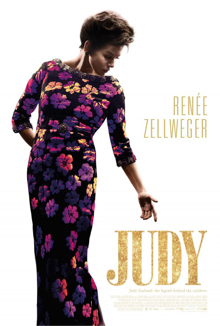
Copyright 2019 Roadside Attractions
On YouTube you can find a clip from Judy Garland’s 1963 variety television series where she sings “The Christmas Song” (the one that begins with the chestnuts roasting on an open fire) with its co-writer, Mel Torme. It is a very festive scene, and you can glimpse Garland’s three children, Liza Minnelli and Lorna and Joey Luft. It has an intimate, natural feeling and we can see that Garland is genuinely fond of Torme, who was creating all of the specialty musical material for her show. You can also see Garland’s impressive musicianship as she joins the duet, every note, beat, impeccable. And then comes a small mistake. We all know the lyrics by heart: “And every mother’s child is gonna spy /To see if reindeer really know how to fly.” But instead of “reindeer,” Judy Garland cannot help singing a word she has been singing since she was a teenager. She sings, “if rainbows really know how to fly.”
Everything covered in “Judy,” about the last months of Garland’s life, is evident in that brief clip, her mesmerizing, once-to-a-planet talent, even after the years of drinking and drug use, her fierce love for her children and dedication to keeping them near her, and the haunting memories of her early years of stardom and abuse. And there is one more thing, which is what takes Renee Zellweger from an impersonation to a performance and is the film’s most significant insight. We see how Garland, who tells us she first sang in public at age 2, is always, always, always treating the people around her as an audience. She is always wooing, pleasing, flirting, even pleading. In one charming scene, as she entertains Joey and Lorna to cheer them up that she has to leave them with their father while she takes a job in London, singing at a club called Talk of the Town.
Her appearance there is still legendary. Some nights she was everything her fans adored her for — the ultimate in talent, showmanship, and pure star power. Some nights were catastrophic, the portrait of total decompensating collapse. Some nights she never made it on stage.
In this retelling, the story is simplified to this: Garland was exploited, isolated, and abused as a child performer, constantly nagged about her weight, fed pills to keep her from eating and then, when those kept her awake, given more pills to put her to sleep. The money disappeared, so she had to keep working when all she wanted to do was stay with her children. As it begins, with a flashback, we see Louis B. Mayer present the teenaged Garland with the eternal choice faced by Achilles. Does she want a happy but quiet life or does she want to be important and known by millions? Standing on the yellow brick road in the set for “The Wizard of Oz,” she chooses the only option she has ever known: stardom. And, this movie suggests, the chaos that resulted was inevitable.
There are too many flashbacks, perhaps included for the current generation, who may not know the details of Garland’s story. Certainly, though, they are familiar with the idea that celebrities often have traumatic and unstable lives, and the flashbacks add very little. The present day (in the world of the film) scenes of Garland’s last romance and last performances are not especially dramatic or insightful, though there are some clever lines (a doctor asks if she takes anything for depression and Garland answers: “Four husbands”) and some touching scenes, including one where she impulsively spends the evening with a pair of fans, eating eggs and singing at their piano. That scene suggests the conflict between the unquenchable need for an audience and the hope of home and peace and family.
What there is here is Zellweger’s total immersion in the performance, as with Garland too often herself, so vital and impossible to look away from that it transcends the limits of the material she outshines.
Parents should know that this film includes substance abuse — liquor and pills — and pills being given to a teenager, child custody issues, and some strong language.
Family discussion: How did Judy Garland’s childhood experiences determine her adult choices? Could anyone have helped her?
If you like this, try: the films of Judy Garland, especially “The Wizard of Oz,” “Easter Parade,” and “A Star is Born” and a story similar to this one, “Film Stars Don’t Die in Liverpool”
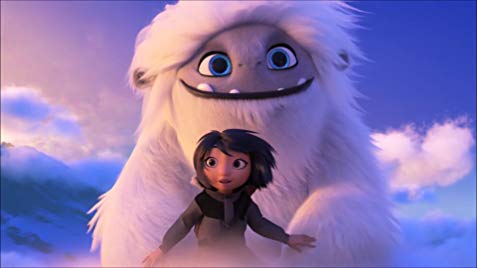
Copyright 2019 Dreamworks/PearlI’m not sure what the fascination is with animated films for kids about mythical big furry primates, but “Abominable” is the third animated film in a year about the animal we call the Yeti or Sasquatch or Bigfoot. If you’re only going to see one, I’d suggest “Smallfoot” or “Missing Link,” but “Abominable” is good, too. It is not as imaginative visually or narratively as the others, but it is a nice family film with some lovely visuals and appealing characters.
Yi (Chloe Bennet) lives with her mother and grandmother, who worry about her because she has become distant and uncommunicative since the death of her father. She leaves the apartment most of the day, won’t eat dinner with her family, and refuses to play the violin for her mother. They do not know that she spends time in a makeshift tent she has set up on the roof of her building and plays her father’s violin.
At the same time a yeti has escaped from a facility owned by the very wealthy Mr. Burnish (Eddie Izzard), an elderly rare animal collector who has been looking for a yeti since he glimpsed them as a young man. No one believed him then and he has never gotten over the humiliation of being laughed at. He wants to be able to prove that he was telling the truth. He has a small army of SWAT-team-like security guards and he has hired an animal specialist named Dr. Zara (Sarah Paulson) to assist him.
When the Yeti lands on Yi’s rooftop retreat, she realizes quickly that he (apparently a he) is not scary; he just wants to go home, which he identifies by pointing to a billboard image of Mount Everest. So, Yi dubs him Everest, and soon she is on her way to take him there, accompanied by her neighbors, the selfie-taking, keep-my-kicks-immaculate Jin (Tenzing Norgay Trainor) and his neglected young basketball-loving cousin Peng (Albert Tsai). On the way to Everest with Everest, as they try to evade Burnish and Zara and overcome the obstacles of the terrain, they will learn a lot about themselves and each other, and appreciate what they left behind.
The Chinese settings, both urban and rural, add a lot of visual interest and it is satisfying to watch Yi find something outside herself to care for, and see how that helps her process her grief and start to reach out to others. Jin’s realization of his superficiality and selfishness is more formulaic and Peng, Everest, and Burnish are one-dimensional, well, maybe one and a half. The action scenes are dynamic, especially the use of drones, and nicely balance the tension with the humor, as the group is chased by giant blueberries and wafting on a giant dandelion. But the storyline, soundtrack songs, and lessons learned are predictable — Yi watches koi fish swimming upstream and is inspired to be persistent, and, like Dorothy, Yi learns that there’s no place like home. These are unquestionably good lessons, but they have been and will be taught with more imagination and less formula in the future.
Parents should know that this film includes cartoon-style action and peril, grief over death of a parent, and brief potty/bodily function humor.
Family discussion: Why didn’t Yi want to be home with her family? Why did Burnish change his mind? What does the word “abominable” mean? What would you do if you met Everest?
If you like this, try: the “Madagascar” movies and “Smallfoot”
Franklin Leonard is Disrupting Hollywood Gatekeepers with The Blacklist
Posted on September 26, 2019 at 10:07 am
Franklin Leonard had a job in Hollywood reading scripts to find suitable projects to move forward. Fifteen years ago, he sent around an anonymous email to other people with the same job asking them for the best scripts they had, promising to send anyone who contributed the consolidated list. He got some good scripts, he sent what he called “The Black List” around to the participants, and went back to work.
Copyright 2016 The Black List
It went viral. It is now an established annual list, and scripts on the list have now gone on to not just be produced but to receive over 200 Oscar nominations and make over $25 billion at the box office. The last eight best picture Oscars went to scripts featured on a previous Black List, as well as ten of the last 20 screenwriting Oscars. Scripts on the list have included “Slumdog Millionaire,” “Arrival,” “Argo,” “Spotlight,” and “Hell or High Water.” A Harvard Business School study found that scripts on the list were two times more likely to be produced and made 90% more in box office than scripts not on the list.
The Black List is now a website where aspiring screenwriters can upload their scripts, get feedback, and maybe even be discovered by a production company.
Leonard appeared this week at the beautiful new Washington DC screening room of the Motion Picture Association of America to talk about the Black List. He told one story about a script uploaded to the site that prompted a call inquiring about Arabic language rights. The film was first made in Arabic, which led to support for making it in English. And, Leonard pointed out, the screenwriter still lives, as he did when he was writing the script, in Georgia. He did not need to go to Los Angeles to get his movie made. Leonard calls it “a system that allows the industry as a whole to capture its good taste.” He described the “conventional wisdom” approach in Hollywood as “all convention and no wisdom.” This means perpetuation of the same stories and characters, generally ones that look and act like the studio executives themselves. Leonard also talked about disrupting the agents and agencies. “They overestimate the way in which they are indispensable.” The Black List is doing to the Hollywood gatekeepers what companies like eBay, Uber, and Airbnb have done to their industries.
Most important, though, Leonard made it clear that the way to get a script made into a movie is to write an excellent script. Don’t say, “Well, that terrible movie got made and my script is better than that.” Write the best script you can, understand that your first script is probably not movie-ready, get a lot of feedback, make revisions, and then upload it to The Black List and maybe you’ll get a call.