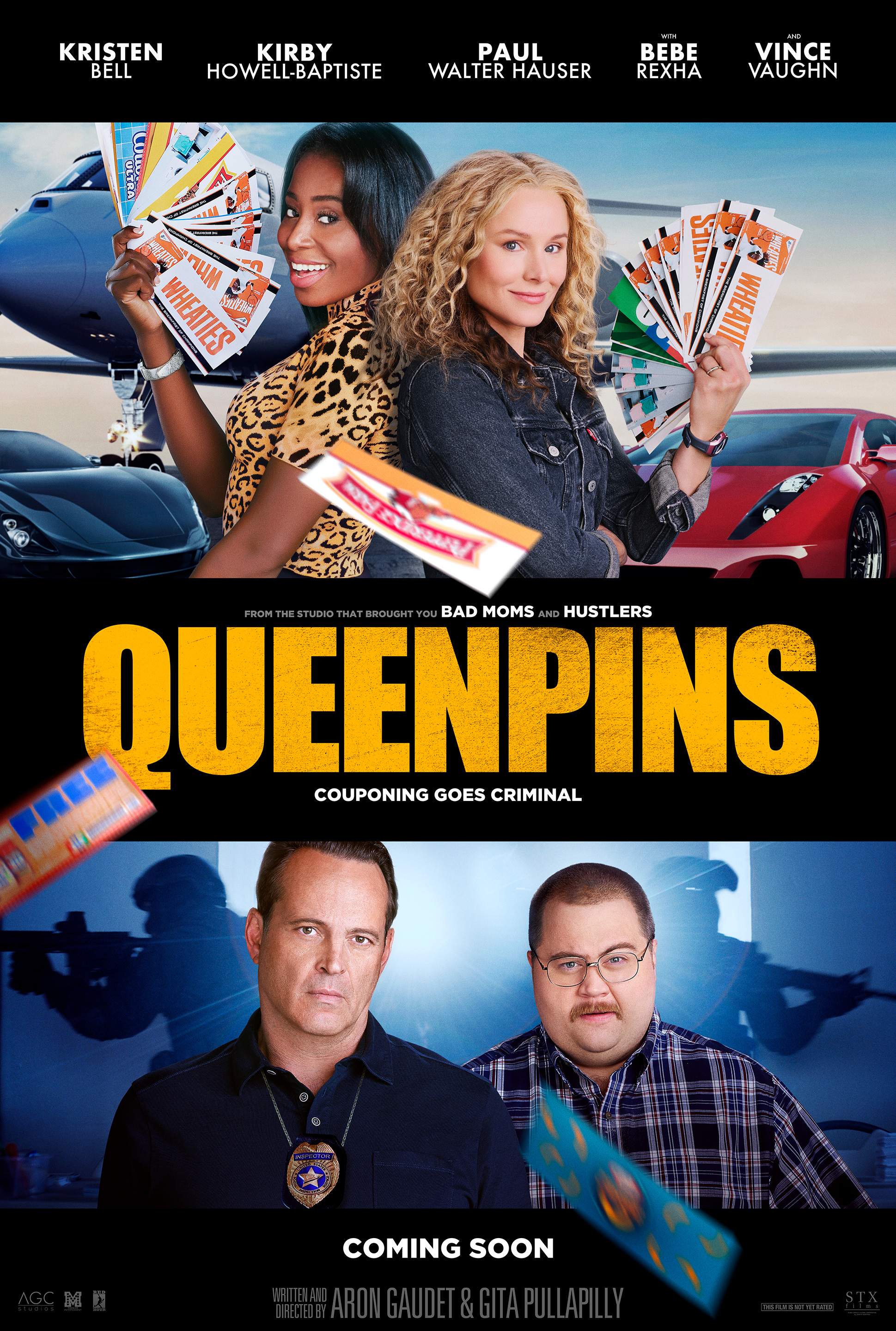
The crime comedy “Queenpins” is based on the true “pink collar crime” story of three Arizona women who masterminded a $40 million fraud based on grocery store coupons. Yes, coupons. It may sound silly and trivial, but coupons are like money. If you can buy a coupon for a free box of detergent or diapers for a tenth of the purchase price, you have stolen that item from the company that makes it and you have paid a criminal to help you do it. The movie is light-hearted, if not quite aspirational. But the reality is grubbier.
Robin Ramirez, Amiko Fountain, and Marilyn Johnson sold counterfeit coupons for products from more than 40 companies. The ring used a series of twelve different bank accounts to house their money. One account had more than $2 million. When they were arrested, they had $40 million in coupons and authorities later estimated that the coupon ring cost corporations hundreds of millions of dollars in profit.
Unlike the story in the movie, which has a postal inspector played by Vince Vaughn and a private security “loss prevention officer” played by Paul Walter Hauser tracking down the perpetrators, it was Proctor and Gamble who initially uncovered the fraud and the Phoenix police department who ran the investigation, led by Officer Sara Garza and Sergeant Dave Lake, assisted by The Maricopa County Attorney’s Office the private company Coupon Information Corporation, and the FBI Internet Crimes Unit. The County of Maricopa was also able to seize over $2,000,000 in assets, which included cash, guns, luxury cars, a speed boat, properties, and high end recreational vehicles. Ramirez was sentenced to two years in jail. Johnson and Fountain, who cooperated with law enforcement, were sentenced to probation. The three were also ordered to pay (partial) restitution: $1,288,682 to cover P&G’s losses.
On Labor Day pay tribute to workers, especially those who have worked for better conditions for everyone and the essential workers who have kept us going through the pandemic. These movies can help us understand their challenges and their contributions.Copyright 1979 20th Century Fox
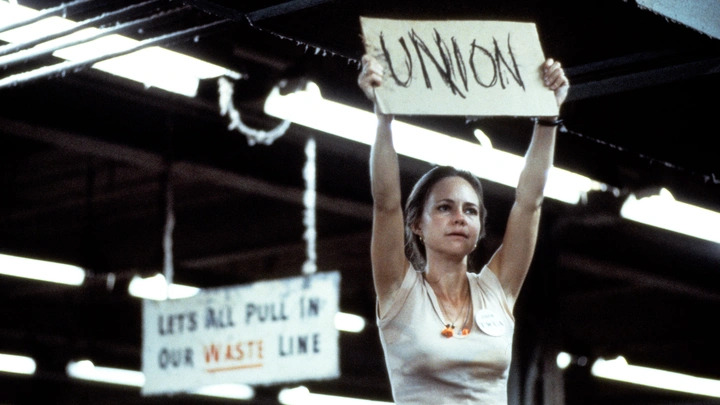
Sally Field won an Oscar for “Norma Rae,” a real-life story about a courageous woman who helped mill workers form a union. It was inspired by Crystal Lee Sutton, a courageous advocate for workers’ rights.
Doris Day plays a union worker who falls for a new guy in management but doesn’t lose sight of the seven and a half cent raise the workers are bargaining for in the rollicking musical, “The Pajama Game.”
“10PM-Midnight: Working the Night Shift” is the story of the people who keep things going while the rest of us are asleep.
“Lifelines in the Lockdown” is a CBS News documentary from the early days of the pandemic about essential workers.
“Salt of the Earth” was inspired by an actual miners’ strike against the Empire Zinc Co. and the cast includes real-life miners who were involved in the strike
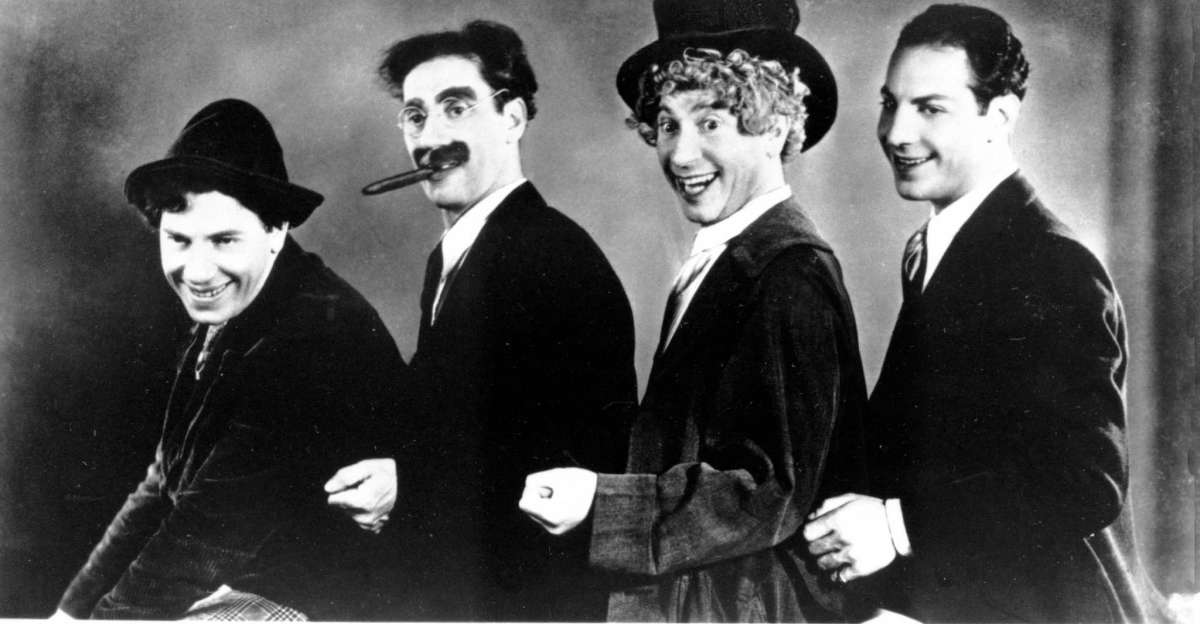
All fans of classic films and film comedy will appreciate The Marx Brothers Council, an outstanding podcast devoted to Groucho, Chico, Harpo, and sometimes Zeppo Marx. A great episode to begin with is this one, including a fascinating interview with Hanna Mira, who shows Marx Brothers and other classic films to her students at a juvenile detention facility. The old black and white films from the era of these boys’ great-grandfathers could hardly be more distant from their experience, and yet they love them. She tells their stories with such empathy, humanity, and enthusiasm we almost wish we could be in her classroom.
Rated PG-13 for some strong language and thematic elements
Profanity:
Some strong language
Alcohol/ Drugs:
None
Violence/ Scariness:
Terrorist attack, tragic loss of life and injury, tense and emotional confrontations
Diversity Issues:
Class issues are a theme in the movie
Date Released to Theaters:
August 27, 2021
Copyright 2021 NetflixWhat is life worth? Who gets to decide? Most of us prefer not to think about it. For a few of us, mostly lawyers, insurers, and those in government, it is their job. I had that job for a while when I was in the government, looking at questions like: “Should we prohibit a particular pesticide if it will reduce the incidence of cancer by two people every year but increase the price of a bushel of berries by $1.00?” Law and society have been very inconsistent, spending far more in emergencies than on prevention.
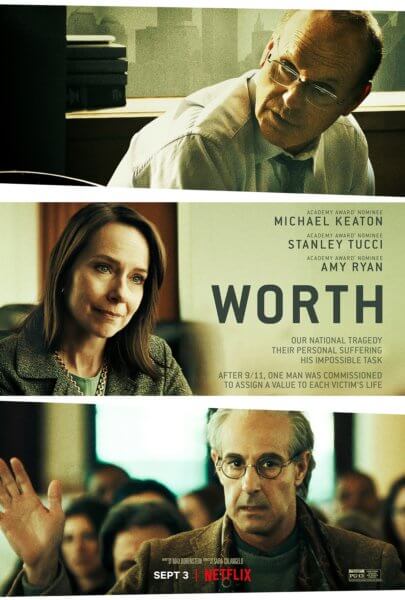
Lawyer Ken Feinberg has made the job of assigning monetary value to human life his career. He comes into the most traumatic and tragic cases of incalculable loss, Agent Orange, asbestos, the financial meltdown, and tries to decide how much money to pay to compensate the injured and the survivors. Twenty years ago, it was Feinberg and his colleague Camille Biros who were called upon to determine how much money would be paid by the taxpayers to the families of those killed or injured on 9/11. Feinberg’s book about these cases has been turned into a film, with Michael Keaton as Feinberg, Amy Ryan as Biros, and Stanley Tucci as Charles G. Wolf, who challenged the original settlement proposal.
The film takes some dramatic license with the real story but it is all in service of making the abstract issues real, concrete, and meaningful, as well as protecting the privacy of some of the people involved. We first see Feinberg as a man of integrity and culture (he really loves opera, but not the new-fangled stuff), a bit formal and old-fashioned. He does not use a computer and he dictates a note to one of his children, emphasizing the importance of being on time, that until the “love, Dad” signature could be a letter to opposing counsel. But he skillfully negotiates himself into the position of Special Master with three disarming points. He foregoes any payment. He mentions that no one else wants the job. And he points out that if he fails, the Republicans can blame him for being a Democrat.
The dollar amount is not intended to compensate the families for their grief or for their loss. There is not enough money in the world to do that, and no way to value one individual more than another. It is based only on the value (“present value” in economic terms) of their future earnings. On that basis, a clerical worker’s family would get less than a stockbroker’s family.
Most of the survivors understand that. But Fienberg and Biros learn that for these shocked, grieving families, being heard is as important as being paid. And they learn that an algorithm based on the age and earning potential of the person who died and the applicable lows of inheritance may reach a result that does not meet anyone’s standards for fairness. Broadway star Laura Benanti makes an indelible impression as the widow of a fire fighter who went back into the building because he wanted to save people. Ryan is brilliant as always in a role of quiet power. She can say more by listening than many actors can by talking. And Keaton, who has constantly surprised us with his range, gives one of his best performances.
The eternal conundrum of the law is finding a balance between the fairness of a clear, consistent rule and the fairness of individual, discretionary judgment. This movie illustrates that wrenching dilemma in the most compelling terms, with much of the focus on the shell-shocked survivors whose grief is only eased by being given a chance to talk about them, to make sure that the people they loved for their very individual characteristics is not seen by those in charge of estimating the value of their lives see them as more than data points to plug into a formula. Money to pay the bills provides some comfort. But being heard provides solace, and this film is as much a tribute to those we lost as to those who tried to give them some small element of restorative justice.
Parents should know that this film includes very sad stories from the families and survivors of a terrorist attack and some footage of the aftermath. There is some strong language.
Family discussion: Who should decide what a life is worth? What was wrong with the way Ken Feinberg conducted the original meeting? Is it possible to create just rules that allow for all legitimate exceptions? Were the fund’s payments “fair?”
If you like this, try: Feinberg’s book and movies like “Metal of Honor” and “United 93” and read articles like this one and this one.
References to the stresses of international adoption
Diversity Issues:
A theme of he movie
Date Released to Theaters:
August 28, 2021
Copyright 2021 Discovery+Sometimes everything comes down to a struggle between order and chaos. Lily Hevesh’s constructions made of dominoes are both, in the tradition of Tibetan monks making intricate sand Mandelas and then wiping them away, or artist Andy Goldsworthy making art from ice knowing it will melt. She spends hours, even days assembling her dominos so that the audience, in person or through her popular YouTube channel, can watch them fall down. This film gives us a chance to see the story behind the scenes of her colorful kinetic creations, with over a billion views, and to ponder all of the elements that make the assembly of thousands of dominoes the place where she feels safest and most herself.
Lily Hevesh was born in China and made available for adoption there, likely due to the country’s one-child policy. Her mother tells us she had some abandonment issues as a young child. When she was very young, she discovered a deep love for creating extended, complex designs with dominoes, and then knocking them down. When she arrived at Rensselaer Polytechnic institute as a freshman, no one knew that she was an internationally renowned “domino artist,” and the only one at the top level who was female. Her nom de domino is Hevesh5, the five standing for her family, her parents and two siblings.
This documentary follows Hevesh as she makes the difficult decision to drop out of college to follow her dream and as that dream unfolds, not with the precision and predictability of what she calls “beautifully intricate chain reactions.” But that’s the difference between dominos and dreams. Hevesh’s biggest dream is to have her own line of brightly colored plastic dominoes that meet her exacting specifications for better stability, texture, and satisfying clink when they get knocked over.
There really is something mesmerizing about watching hundreds of thousands of precisely placed plastic pieces fall down. And Hevesh’s designs are undeniably works of both art and engineering, some of them including Rube Goldberg-style contraptions. Her work comes to the attention of social media and Hollywood, and we see a gigantic installation she does for Jimmy Fallon and her red carpet appearance for “Collateral Beauty,” where she created an on-screen domino set-up for star Will Smith. (In an interview with me, the screenwriter for that film compared the dominoes to Buddhist mandalas.)
Director Jeremy Workman is unobtrusive, letting Lily tell her own story, letting her show us her passion, dedication, and vulnerability. Her work is stunning. But the more important message of the film is that each of us should find something that inspires and centers us as much as dominoes do for Hevesh5.
Parents should know that this film includes discussion of international adoption and the impact it has on a child who might feel abandoned. We also see Lily Hevesh dealing with stress.
Family discussion: Why do you think Lily loves dominoes so much? Which is your favorite of her installations? Why do people like to see them fall down?
If you like this, try: Lily Hevesh’s videos on YouTube — and try to make your own build and collapse installation.