The Fantastic Four: First Steps

The Fantastic Four: First Steps

Posted on July 22, 2025 at 12:19 pm

B +
Lowest Recommended Age: Middle School
MPAA Rating: Rated PG-13 for action/violence and some language
Profanity: Brief mild language
Alcohol/ Drugs: None
Violence/ Scariness: Extended comic book/action-style peril and violence, some graphic images
Diversity Issues: None
Date Released to Theaters: July 25, 2025

Four seems to be the magic number. After three unsatisfactory tries at getting Marvel’s cosmic ray-enhanced superheroes on screen, Marvel Studios got it right, gorgeously produced, well cast, gracefully relegating the origin story to a few “archival” clips, and putting our quartet and us right in the middle of the action.

It is set in a fantasy version of the 1960s, inspired by the visual style, not the history or pop culture. In the first scene, Reed is looking for iodine, the painful antiseptic used for minor cuts in the 50s, and Sue Storm uses something that was not invented in our reality until the 1980s. There is a Calder mobile in their headquarters living room and the men we see in the outdoor scenes all wear hats, so handsome this movie just might bring back the fedora. The production design from “Loki’s” Kasra Farahani is dazzling and endlessly inviting, a heightened version of a mid-century concept of the future. The cerulean blue and white accents of the retro F4 uniforms designed by Alexandra Byrne (“Guardians of the Galaxy”) place us in a time and a world that is like but not the same as ours.

Copyright 2025 Marvel Studios

The Four are Reed Richards (Pedro Pascal), a brilliant scientist whose body stretches, his wife Sue (Vanessa Kirby) who has the power of invisibility, including creating invisible shields, Sue’s impetuous and very single brother Johnny (Joseph Quinn), who can burst into flames and fly, and Ben Grimm, known as The Thing (Ebon Moss-Bachrach), who looks like he is made from mountain rock and is very, very strong.

As the movie begins, the world is celebrating them as heroes and protectors. It has been four years since the space expedition exposed them to the cosmic rays, they have defeated or, in the case of the subterranean Mole Man (Paul Walter Hauser), negotiated a peace agreement, and established a United Nations-type organization called the Future Foundation.

The superheroes and the people they protect believe F4 and their adorable robot, Herbie, will always keep them safe. And then they face their biggest and most terrifying challenge. Sue is pregnant. While Reed and Sue know that the molecular changes from the cosmic rays may affect the baby, they believe, with some reassurance from Sue’s ability to make her abdomen invisible so they can see the fetus, the baby will be fine.

Big and terrifying challenge #2: the Silver Surfer (Julia Garner) arrives to announce that Earth is about to be consumed by Galactus (Ralph Ineson), a planet devourer. F4 tracks the Silver Surfer to find Galactus, confident they can defeat him. And this leads to the first Marvel action sequence that features a very pregnant superhero. Galactus offers them a terrible choice, and when they refuse, the people on earth quickly go from fans to haters.

The film moves briskly, with one of the shortest run times in the MCU, under two hours. But it creates a fully-realized world, with small details like the Mole Man’s dad jokes, Ben Grimm’s “beard” and copy of 50s classic child care bible Dr. Spock, and a sweet brief appearance by Natasha Lyonne as the teacher of students who are big fans of The Thing. Fans will enjoy some glimpses of popular villains from the comic books. Director Matt Shakman (the similarly retro fantasies “Game of Thrones” and “Wandavision” and “The Great”) understands that the action scenes and the family dynamic are central to the storyline and he has fun with scale when Galactus arrives. While the stakes are dire, he stays away from gratuitous carnage. The film has good-natured humor, impressive special effects, some tender moments, and even a light gloss of commentary on what we expect from our heroes, and how we approach moral dilemmas and life-threatening challenges. I’m iffy about one twist, but overall, this is a film that respects comic book characters and what we love about them.

Parents should know that this movie features extended comic book/action-style peril and violence, with some scary creatures and disturbing and graphic images. There are mild references to reproductive biology and a woman goes into labor (discreetly filmed). Characters use some mild language.

Family discussion: Philosopher Jeremy Bentham argued that all decisions should be based on the greatest good for the largest number of people. How does that idea appear in this film and do you agree? What do you think will happen to Franklin? What is the law of levers and how do you see it around you?

If you like this, try: “Superman,” The Fantastic Four comics, and maybe just for fun watch the earlier films so you can compare them.

NOTE: Stay through the credits for one extra scene indicating where the story is going and, at the very end, a nostalgic moment.

Related Tags:


Action/Adventure Fantasy IMAX movie review Movies -- format Movies -- Reviews Remake Scene After the Credits Series/Sequel Superhero
Materialists

Materialists

Posted on June 15, 2025 at 12:42 pm

B-
Lowest Recommended Age: High School
MPAA Rating: Rated R for brief sexual material and language
Profanity: Some strong language
Alcohol/ Drugs: Drinking, smoking
Violence/ Scariness: None
Diversity Issues: None
Date Released to Theaters: June 13, 2025

Writer/director Celine Song has followed up her auspicious debut film, “Past Lives,” with another story about a woman torn between two men, with one who represents her past. In “Past Lives,” the other was her present; in “Materialists” the other represents a future she imagines for herself.

This film is less successful because it never fully integrates the ideas and the characters. Even three of the world’s most charismatic and talented performers cannot manage to make the characters come to life. There are some well-chosen songs on the soundtrack and some provocative ideas. But the tone is inconsistent and the treatment superficial. The themes are worth exploring but are always just out of reach.

Dakota Johnson plays Lucy, a matchmaker to wealthy New Yorkers who are used to buying bespoke and think they can give her a list of “must haves” covering everything from education and bank account to height, hairline, and regular churchgoing. They give her a checklist but she almost always responds by promising them love.

Lucy herself is resolutely single, five years after breaking up with her aspiring actor boyfriend John (Chris Evans), she is working at a company called ADORE, doing what she says is the only job she has ever been good at. Early in the film, she is being celebrated for the wedding of two people she brought together, her ninth successful match. 

At that wedding, the bride is having a meltdown over whether to go through with it. Lucy calms her down with a very pragmatic discussion of what she needs from the relationship. We will see that Lucy is more than pragmatic; she is, per the title, a materialist. After the wedding goes off successfully, Lucy meets the groom’s brother at the singles’ table. He is Harry (Pedro Pascal), deemed in the lexicon of the matchmaker world, a “unicorn,” because he “checks all the boxes,” handsome, tall, charming, interested in marriage, and very, very rich. He is instantly drawn to Lucy, even after she tells him that her only criterion for a husband is mind-blowing wealth, and that she will only date someone if she is certain it will lead to marriage.

Also at the wedding, though, is John, who is working as a cater-waiter. They have a cordial, even borderline affectionate, conversation and he drives her home in the same beater car he had when they were together. 

So the central conflict here is not just between two men, but between two lives, two versions of herself. And around her are people making choices and experiencing the consequences that affect the way Lucy thinks about her own choices. 

This is where the film runs into difficulties. We are told (not shown) about the characters’ feelings. Harry and Lucy have a series of dinner dates in beautiful, luxurious settings, but all they ever talk about is whether Lucy wants or should want to date him. There’s never even the most basic movie shorthand for falling in love, some kind of connection through their pasts or their interests. A crucial conversation and turning point in their relationship is too superficial, even for a seemingly superficial subject. While we get a flashback showing us how strains of not having enough money and the more significant strains of different ideas led Lucy and John to break up, there is nothing in their interactions to demonstrate a shared understanding.

More than once in the film, characters talk about feeling valued or worthless. What makes people feel valued by themselves or others, is tantalizingly raised, but frustratingly sketched. 

The movie begins with a couple apparently from the bronze age as a (very fictionalized) symbol of the origins of romance. We see several of ADORE’s clients explaining their unrealistic and, in some cases, selfish expectations in a match. These scenes end up more distracting than pointed. A tragic match leads to the film’s strongest performance (Zoe Winters as Lucy’s client) but it is off-kilter with the rest of the story. Lucy actually does very little for her clients, Neve suggesting, for example, that they might want to focus less on how they want to be loved than on how they want to love.

The issues Song wants to address are deep; the way they are addressed is thin. But the actors are very charismatic and appealing and the settings are (mostly) enticingly luxurious.

Parents should know that this film includes drinking, smoking, and strong language. There are sexual references and non-explicit situations. 

Family discussion: Was Lucy helping her clients? She says it is the only thing she is good at. How does she define “good?” Will that change? What similarities do you observe in the relationships between people who value each other? 

If you like this, try: “How to Marry a Millionaire,” “Hitch,” and “Past Lives”

Related Tags:


movie review Movies -- format Movies -- Reviews Romance
Gladiator II

Gladiator II

Posted on November 20, 2024 at 6:25 pm

B-
Lowest Recommended Age: Mature High Schooler
MPAA Rating: Rated R for strong bloody violence
Profanity: Fierce language
Violence/ Scariness: Extended, intense, and graphic violence, swords, animal attacks, characters injured and killed, disturbing images
Date Released to Theaters: November 22, 2024
Date Released to DVD: January 22, 2025
This image has an empty alt attribute; its file name is GLADIATOR-2-121124-MCDGLTW_PA010.jpg-1024x768.webp
Gladiator II copyright 2024 Paramount

“Gladiator II” looks magnificent. Denzel Washington effortlessly steals every scene he is in and all but winks at us to show how much he is enjoying it. But the script is weak and too repetitive , the movie is too long, and the fight scenes, no matter how staged, just get numbing after a while. When I saw it, the audience was so disconnected from the storyline that they laughed at an admittedly corny reveal that was clearly a turning point that puts one of the main characters in danger.

For those who still remember the details of 2000’s Oscar-winning “Gladiator,” starring Russell Crowe, this film takes place a generation later, with only one returning main character aside from a couple of brief flashbacks and Derek Jacobi in a few scenes as a member of the political elite.

Connie Nelson is back as Lucilla, the royal daughter of the idealistic Emperor Marcus Aurelius, who was murdered by his son and her brother in the first film. She is now married to Rome’s top soldier, Marcus Acacius (Pedro Pascal).

We get a few minutes of blissful farm life in a remote village before the Roman navy arrives to take it over and the farmer and his beautiful and beloved wife have to suit up as soldiers. We know what happens to peaceful farmers and beautiful, beloved wives in these kinds of movies. Indeed, this is pretty much a replay of the first “Gladiator,” except this time the beautiful wife is also a fierce soldier. No big difference, though, because she gets killed off to fuel what we will later hear is the farmer’s biggest asset as an arena fighter, not strength or skill but rage.

That assessment of the farmer (Mescal) comes from Macrinus (Washington), who runs the gladiator program, wears only the finest glam. He is a trusted purveyor of news and rumors to everyone in Rome, especially Geta (Joseph Quinn of “Stranger Things”) and Caracalla (Fred Hechinger of “Thelma”), the decadent young emperor-brothers who whine and lounge around in white face make-up except when they are enjoying the bloody battles in the colosseum. When the farmer-turned fighter says what he wants is a chance to cut off Acacius’ head, Macrinus tells him he will have it, and his freedom, too, if he succeeds in the arena.

Paul Mescal and Pedro Pascal are two of the most charismatic, versatile, and talented actors in movies. Mescal can make a smile convey more than a page of dialogue or 15 minutes of backstory. Pascal has unmatchable comic timing. The one-dimensional characters they play do not give them a chance to show us their best. Instead, they have distractingly bulked up, like Popeye after the spinach. They look great in those Roman skirts, especially in the fight scenes, but even they cannot make the wooden dialogue and awkward plot twists work.

So much for the plot. Some people may want to make parallels between the fall of Rome and some of today’s headlines, but it won’t get you very far. I’m not going to give away the not-much-of-a-twist, which is in the trailer, so if you don’t want to know, don’t peek. In fact, you might do better to watch the without sound (you’d miss the score but you’d also miss the sounds of bones crunching and blood spurting). The dialogue is clunky and the storyline is hackneyed. The fans who come for the spectacle and pageantry will do fine, though, as director Ridley Scott and production designer Arthur Max make all of the long shots very impressive. Those who are there for the fight scenes will appreciate the variety — swords, of course, and attacks by crazed monkeys, sharks, and a rhino.

For me, though, it started to feel more like a game than a story and much too long.

Parents should know that this film has extended, very graphic violence with many characters injured and killed and many, many disturbing bloody images and sounds including decapitation. Characters drink alcohol and use drugs. A character essentially commits suicide. There is a reference to venereal disease.

Family discussion: Was rage the gladiator’s most valuable quality? How were the gladiator and the general alike?

If you like this, try: “Gladiator” with Russell Crowe

Related Tags:


Action/Adventure Drama DVD/Blu-Ray Epic/Historical Movies -- format Movies -- Reviews Series/Sequel VOD and Streaming
The Wild Robot

The Wild Robot

Posted on September 25, 2024 at 5:31 pm

B +
Lowest Recommended Age: Kindergarten - 3rd Grade
MPAA Rating: Rated PG for thematic elements, action, and peril
Profanity: Some schoolyard language
Alcohol/ Drugs: None
Violence/ Scariness: Sci-ff/cartoon style violence, shooting, off-screen deaths including death of a parent and a mentor
Diversity Issues: A theme of the movie
Date Released to Theaters: September 26, 2024
Copyright 2024 Dreamworks

A plane delivering high-tech equipment flies into a storm and a crate falls out, landing on an island inhabited only by animals. Inside the crate is a super-intelligent, ultra-capable robot programmed to complete any task a human might require. The contrast between the natural world of the plants and animals and the metal and programming of the robot is the premise for this story, based on the book series by Peter Brown, told with humor and heart by specialist in “opposites attract” stories director Chris Sanders (“How to Train Your Dragon,” “Lilo & Stitch.”

On one side, fur, feathers, and scales. On the other side, metal and code. The robot, identified by the corporation that created it, is called ROZZUM unit 7134, is a kind of souped-up Swiss Army knife. One of the movie’s greatest pleasures is the way its infinitely adaptable parts and appendages are deployed. Nothing in the robot’s programming has prepared it for the island. But it is capable of learning and adjusting to its environment, so after failure to get a satisfying answer to questions like, “Are you my client?” and “Do you need assistance?” she (we will use that pronoun because the robot has the sweet voice of Oscar-winner Lupita Nyong’o, takes the local next step. She sits down and observes her new environment to learn how to communicate with her fellow inhabitants, which enables us to hear what they have to say, thanks to the brilliant voice work of Pedro Pascal as a fox named Fink, Bill Nighy as a goose named Longneck, Ving Rhames as a falcon named Thunderbolt, Mark Hamill as a bear named Thorn, and Catherine O’Hara, hilarious as always, as Pinktail, a mother opossum covered with her babies.

Roz (as she will ultimately be called) could hardly be more poorly fashioned for this environment. It is funny to see her expect the animals to feel rewarded when she follows her programing by giving them stickers, promotional material for the company that made her, followed by a burst of confetti, even more out of place in the lush natural world than she does. The animals at first consider her a monster.

The early scenes about their unfitness for each other leads organically to interest, understanding, respect, and ultimately a very heartwarming sense of family. A turning point is Roz’s rescue of an orphaned goose egg, left alone after an accident and stolen by Fink for a meal. Roz does not understand what it means to care for the egg, and then, when it hatches and the little gosling imprints on Roz as its mother, she has a task at last: to teach the bird to eat, swim, and fly, so that it can be ready to migrate before it gets too cold. “I do not have the programming to be a mother,” Roz says. “No one does,” Pinktail correctly observes.

Roz develops what can only be described as feelings for the little goose, named Brightbill (Kit Connor). She loses some components and breaks down a bit, from pristine and shiny to scuffed and mossy, with a prosthetic calf made from a log.Is she mirroring what she sees around her? Is she creating the programming necessary to give a child a sense of security and the knowledge he is special to someone? Or is there some way for a machine to develop a soul? Or is it just a reflection of all of the damage to her mechanics? Possibly all of the above. But it is a smaller reach than one might think from being programmed to be of service to placing meaning and purpose on that imperative.

A lot more happens, including some parent-child estrangement (adolescents!) and a lot for Brightbill to learn from his fellow geese, as well as Fink becoming less “fox-y” and all of the animals learning to help each other. The action scenes are dynamic and involving but it is the gentleness of the lessons the characters learn about kindness that will make this film an endearing family favorite.

Parents should know that there is some sci-fi-style shooting. A character is killed off-screen sacrificing himself to save others and a character’s family is discreetly killed in an accident. Another character appears to have been eaten but is not. Characters use some schoolyard language.

Family discussion: What was the most important thing Roz learned and how did she learn it? If you had a Roz, what would you ask her to do? Do you think we will have machines like that?

If you like this, try: the books, and “The Iron Giant” and “Wall-E

Related Tags:


Action/Adventure Animation Based on a book Fantasy movie review Movies -- format Movies -- Reviews Scene After the Credits Science-Fiction Talking animals
The Unbearable Weight of Massive Talent

The Unbearable Weight of Massive Talent

Posted on April 21, 2022 at 5:50 pm

B +
Lowest Recommended Age: Mature High Schooler
Profanity: Very strong language, crude sexual references
Alcohol/ Drugs: Alcohol and drug use
Violence/ Scariness: Extended acton-style peril and violence, characters injured and killed
Diversity Issues: None
Date Released to Theaters: April 15, 2022

copyright Lionsgate 2022
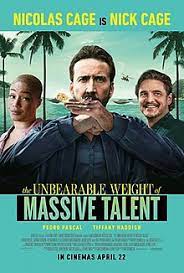
I’m not sure what it says about where we are in history that 2022 has become the year of movie meta-verses but, oh, forget it, “The Unbearable Weight of Massive Talent” is a total hoot, and hilarious fun on every one of its meta-levels.

Oscar-winning actor Nicolas Cage is played by….Oscar-winning actor Nicolas Cage as a heightened (and lessened) version of himself, the best. and by that I mean most committed version of that since John Malkovich in “Being John Malkovich.” The movie version of Nicolas Cage has all of his credits, a dozen of which are amusingly referenced throughout the film. And the movie version plays on news reports of Cage’s sometimes-volatile personal and financial life, with a second Nicolas Cage playing the younger version of himself and with the situation that set up the film. Movie Nicolas Cage (just referred to as Cage from now on) loses out on a big role in a film and is locked out of his hotel room for failure to pay. His 16-year-old daughter is barely speaking to him because he is so self-involved. His agent (Neil Patrick Harris) tells him he has been offered a million dollars to attend a birthday party in Mallorca. He reluctantly accepts.

At first, he something of a diva, insulting his host, Javi (a sublimely unhinged performance by Pedro Pascal). Surprisingly, it turns out that Javi is something of a kindred spirit, almost as in love with cinematic story-telling as he is. Javi’s unabashed fanship is also a solace for Cage’s bruised ego. Perhaps less surprisingly, in fact most predictably, like everyone else who strives for an encounter with a movie star, Javi has written a script.

This is when the CIA shows up (Tiffany Haddish and Ike Barinholtz). Javi is an international arms dealer and they think he has kidnapped the Spanish President’s daughter. They cannot get into Javi’s compound, so they want Cage to spy for them.

The story works on many levels, as the kind of buddy story Javi wants to write, as the kind of action story they conclude they can get financing for, and above all as a knowing comedy with many references to Cage’s wide-ranging oeuvre, from “Cross 2” to “Guarding Tess,” “The Wicker Man” to “Con Air,” “Face-Off,” and “The Rock,” and to over-arching issues of the way movies tell stories and the way movies get made. Of all the Cage movies it nods to, the most foundational one is “Adaptation.,” itself a meta-movie about cinematic story-telling (and a lot of other themes), with Cage playing a version of the movie’s screenwriter and talking to himself, or close to himself, because he plays twins.

And like that film it is is very funny. Cage and Pascal have terrific chemistry and are clearly having a blast. Sharon Horgan is terrific as Cage’s ex-wife, but Barinholtz and Haddish are under-used and the mayhem is not always as effectively handled as it should be to work as action or as commentary on action. Or maybe it is commentary on the silliness of action. By that time, there are so many layers you are likely to have found at least two or three to enjoy.

Parents should know that the movie has very strong language and crude sexual references, alcohol and drug use, and extended and intense peril and violence, with many characters injured and killed.

Family discussion: Why did Nicolas Cage want to spoof himself this way? What do you learn from his conversations with his younger self? Why was it hard for him to connect to his daughter?

If you like this, try: Some of the movies referred to in this one like “Con Air,” “The Rock,” and “National Treasure” and “JCVD” with Jean-Claude van Damme spoofing himself and his films

Related Tags:


Action/Adventure Comedy movie review Movies -- format Movies -- Reviews Satire
THE MOVIE MOM® is a registered trademark of Nell Minow. Use of the mark without express consent from Nell Minow constitutes trademark infringement and unfair competition in violation of federal and state laws. All material © Nell Minow 1995-2025, all rights reserved, and no use or republication is permitted without explicit permission. This site hosts Nell Minow’s Movie Mom® archive, with material that originally appeared on Yahoo! Movies, Beliefnet, and other sources. Much of her new material can be found at Rogerebert.com, Huffington Post, and WheretoWatch. Her books include The Movie Mom’s Guide to Family Movies and 101 Must-See Movie Moments, and she can be heard each week on radio stations across the country.

Website Designed by Max LaZebnik