A Monster Calls by Patrick Ness, inspired by the late Siobhan Dowd, is the story of a boy whose mother is critically ill. He feels utterly isolated. His father has a new family. His grandmother is cold and unsympathetic. The sympathy of his teachers just makes him feel worse. And then one day, a monster calls, a monster with stories to tell. The film stars Liam Neeson, Felicity Jones, and Sigourney Weaver.
“What does AEY stand for?” a newly hired employee asks Efraim Diveroli (Jonah Hill). “You mean morally?” No, he just wants to know what the initials represent, though the answer is the same: nothing. And, as it turns out, asking the question and correcting Efraim’s mistake get him fired. AEY “stands for” making money, no questions asked. That will be the basis for great success, until it is also the basis for catastrophe.
We this know right from the beginning, when we see Efraim’s partner David Packouz (Miles Teller) released from the trunk of a car and beaten up at gunpoint by some very evil-looking masked guys. In Albania. And then we go back in time to see how David, a college drop-out now on his seventh job, working as a massage therapist, and smoking a lot of weed, met up with Efraim, an old friend from middle school, and joined him at AEY, a company that sold equipment to the Pentagon.
It was 2008. The United States was fighting two wars and outsourcing pretty much everything. If it costs more than $17,000 to outfit each soldier, that means someone has to sell them all that gear. The Bush administration got into trouble for dealing exclusively with “Dick Cheney’s friends” and was under pressure to give some of that procurement business to small companies. And Efraim, a high school dropout, had mastered the art of constantly scrolling through the website that was essentially the government’s wish list and bidding on contracts so small they were beneath the notice of enormous government contractors who sell tanks and planes. “All the money is made between the lines,” Efraim says. He tells David that while big companies go for the pie, they can make plenty of money from the crumbs. David, bored and worried about money for his pregnant girlfriend, signs on.
At first it works. They make tons of money. But buying and selling guns puts them in contact with some untrustworthy and violent people. And a little bit of success makes them eligible to go beyond the crumbs. An international arms dealer who is barred from selling to the US because he is on a watch list (producer Bradley Cooper) offers them a deal too good to pass up on ammunition they can sell to the Pentagon at a huge mark-up. But Efraim and David are very good at the details when it comes to making the pitch; not very good at the details when it comes to delivering the product. This is a business school case study in failure of operations and execution. And in the failures of government procurement.
Director and co-screenwriter Todd Phillips is clearly trying to make the kind of shift from raunchy, slob comedies (“Old School,” “The Hangover”) to sharp, trenchant satire that Adam McKay did with “The Big Short.” And Jonah Hill, looking disturbingly puffy and pasty, clearly wants to play the Leo role instead of the Jonah Hill role in his own “Wolf of Wall Street.” Both get partway there. Hill clearly enjoys being the trigger-happy hotshot who can brashly invite a girl to skip ahead to the third date for $1000 instead of his usual role as either the dumb shlub or the smart shlub. Phillips does a good job in laying out the parameters of the story, making it clear how the window of opportunity opened for AEY and Efraim and David were in the right place at the right time. There are even chapter headings for each section, foreshadowing telling comments we will hear, from “God bless Dick Cheney’s America” to “That sounds illegal.”
He also lays out a classic Hollywood movie structure: set-up, early triumph, hubris, wipeout. There are some fine moments, like the surreal use of identical actors (or CGI) as the Pentagon officials who sign off on the deal. But Phillips’ control of tone and character is uncertain and he relies too much on songs (“Fortunate Son,” “Time in a Bottle”) to carry the story.
Parents should know that this film includes wartime and crime-related peril and violence including automatic weapons, war profiteering, constant very strong language, crude and explicit sexual references, non-explicit situations, drinking, and drugs.
Family discussion: When and why did David and Efraim make different choices? What was their biggest mistake? Were they appropriately punished?
Rated PG-13 for sequences of violence and disturbing images
Profanity:
None
Alcohol/ Drugs:
Some social drinking
Violence/ Scariness:
Intense and sometimes graphic peril and violence including battle scenes, crucifixions, abuse, and accidents, characters injured and killed
Diversity Issues:
A theme of the movie
Date Released to Theaters:
August 19, 2016
Copyright 2016 Paramount Lew Wallace’s 1880 book, Ben-Hur: A Tale of the Christ, had a revolutionary idea in a spiritual setting. The story of a minor, fictional character at the time of the crucifixion was the first to try to illuminate epic themes through the depiction of a character who was not a participant. Indeed, the title character was hardly aware of the monumental events going on around him. He was too busy dealing with his own personal crises like being enslaved and having his mother and sister contract leprosy. Wallace’s book became the top seller of the century. And then it became a play, two silent films, a Best Picture Oscar winner tied for first place for the most Academy Awards, plus two animated versions and a television miniseries.
Now Roma Downey and Mark Burnett, following the enormous success of their “Bible,” “A.D” and “Son of God” know the genre well and have remade the grand but dated three hour and thirty-seven minute epic. Their version is brisker, not just in the overall running time of just over two hours but in the more contemporary quick cuts and trimmed storyline. It is also more explicitly religious. While earlier versions suggested the presence of Jesus but did not include his face or voice, he is more explicitly involved in the storyline here, portrayed by Brazilian actor Rodrigo Santoro.
As in all of the earlier versions, it is the story of Judah Ben-Hur (Jack Huston), a Jewish prince who is wrongly accused of a hostile act against the Roman invaders and sold into slavery. In this version the Roman Messala (Toby Kebbell) is more than a close friend; he is Judah’s adopted brother. They are devoted to one another but also deeply competitive.
Messala, in love with Judah’s sister, joins the Roman army in hopes of achieving enough wealth and status to be considered worthy of her. When he returns to Jerusalem, Judah is married to Esther (Nazanin Boniadi). Messala and Judah agree to find a way for the local population to live peacefully under Roman occupation. But a rebel hiding in Judah’s house kills one of the Roman officers and Judah is blamed. Messala refuses to protect him or his family. Judah becomes a galley slave, spending five years chained to an oar on a Roman naval ship.
When the ship is sunk, he escapes. An African named Ilderim (Morgan Freeman) gives him a chance to win back his freedom by competing in a chariot race. And that, after all, is what everyone remembers about “Ben-Hur.” Director Timur Bekmambetov is known for action scenes with tremendous vitality and he more than delivers with the chariot race, which is thrillingly dynamic. The naval battle scenes are also exciting. The screenplay has some clunky dialog and awkward transitions, but Huston is always engaged and engaging and balances the intensity of the action scenes with an inspiring message of forgiveness. The movie is true to the story that has endured in its various versions for more than a century.
Parents should know that this film includes intense and sometimes graphic peril and violence with many characters injured and killed, battle scenes, whipping, abuse, crucifixions, some disturbing images, brief non-explicit sexual situation and mild sexual references.
Family discussion: What changed Ben-Hur’s mind about Messala? Was Ben-Hur right to try to make peace with the Romans? What did Pilate mean when he said, “They’re Romans now?”
If you like this, try; “Risen” and the 1959 version of “Ben-Hur”
Rated PG for thematic elements, scary images, action and peril
Profanity:
None
Alcohol/ Drugs:
None
Violence/ Scariness:
Monsters, peril, sad offscreen deaths
Diversity Issues:
None
Date Released to Theaters:
August 19, 2016
Date Released to DVD:
November 20, 2016
Amazon.com ASIN:
B01KMKM4TW
Copyright 2016 Focus
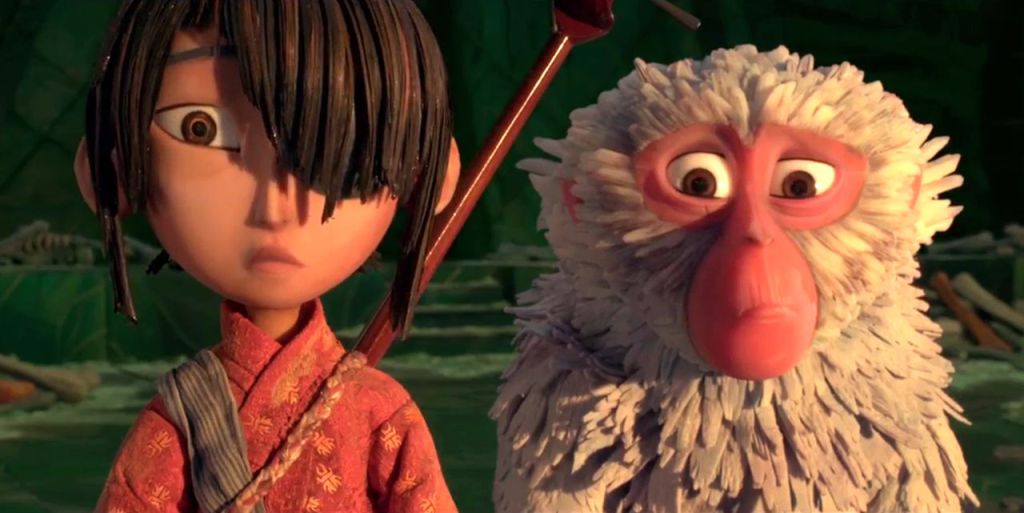
LAIKA Studios’ fourth film, “Kubo and the Two Strings,” is a fable of exquisite beauty and meaning, gorgeously produced in the most painstaking of all forms of filmmaking, stop-motion animation. They are the modern-day equivalent of the monks who labored for years on each page of illuminated manuscripts.
Every detail in every frame and every element of the story, set in a magical version of ancient Japan, reflects the simple profundity of the ancient and contemporary Japanese art that inspired it. LAIKA’s last film, “The Boxtrolls,” was set in a cluttered, sooty, steampunkish imaginary Victorian London, and the studio’s motto was “no square corners, no straight lines.” This time it went in the opposite direction, with the muted palette and spare, carefully balanced settings of Japanese woodblock prints and the sharp lines and perfect corners of origami.
One of the hardest elements to get right in stop-motion is water, because it is impossible to control it frame to frame. In “Boxtrolls,” the studio’s greatest technical triumph was an elaborate set-up for a brief scene in which a character touched standing water and created some ripples. LAIKA loves to challenge itself, and so this film starts with a storm at sea. A woman we will learn is Kubo’s mother is desperately trying to stay upright on a tiny boat. We know she is escaping someone or something, but we are not sure yet what or who it is. And we do not learn until she is washed up on the shore, exhausted and hurt, that she is not alone. In her backpack, there is a baby. It is Kubo.
Like Harry Potter, Kubo had a father who died trying to protect him from a danger so great that Kubo bears a wound. One of his eyes is gone. Kubo’s mother survived, but she used all of her magic to save him and now she is frail, forgetful, and inconsolable.
When we next see them, he is about 11, and has been caring for her all his life. Each day, he makes her food and feeds her. And then he walks from their home in a cave on top of a cliff into the nearest town, where he tells stories in the market. He has the power to bring origami characters to life to act out thrilling tales of the great samurai warrior Hanzo. The townspeople love his stories, which always end with a cliffhanger, and they toss him coins.
The community has an annual Obon festival, where they light lanterns and remember the dead. Kubo wants to go, so he violates his mother’s rule about never being out after dark. And the danger she protected him from years ago comes after him in the form of his mother’s two spooky sisters, both voiced by Rooney Mara and both wearing implacable-expression white masks and terrifying swoopy capes made of black feathers.
Kubo’s mother has just enough magic left to save him one more time. And then she is gone, and Kubo finds himself on a journey, accompanied by the live version of the small monkey charm he always carried in his pocket. He and Monkey (Charlize Theron) set off to find the three pieces of Hanzo’s armor that he will need to fight the sisters and their father, who wants Kubo’s other eye. Along the way they meet a samurai who has been cursed and turned into a giant beetle (Matthew McConaughey). And they meet and fight three different monsters, a giant skeleton, an underwater garden of eyes, and an enormous, floating, reticulated moon serpent, each giving Kubo a chance to discover his courage and power.
This is a gorgeous, epic adventure with grandeur, scope, and spectacular settings, every bit of it wonderfully imaginative. It reflects LAIKA’s own adventurous spirit in taking on narrative and technical challenges as daunting as that faced by any hero. Who else would try to create a stop-motion battle under water? Or take on, in a family movie, a quest that encompasses themes of family, story, courage, loss, destiny, and meaning? LAIKA understands that the most enduring fairy tales are not afraid to deal with darkness because that is the only way to understand its true message, here delivered in a breathtaking conclusion, of tenderness and forgiveness.
Parents should know that this film includes fantasy-style peril and violence with monsters and magic, and sad deaths of parents.
Family discussion: Why did Kubo answer his grandfather’s questions the way he did? Why didn’t Monkey tell Kubo where she came from? Why did the two strings make a difference?
If you like this, try: “Coraline,” “Paranorman,” and “The Boxtrolls”