
Trailer: “The Drop” with James Gandolfini and Tom Hardy
Posted on June 22, 2014 at 11:10 pm
James Gandolfini’s last performance in is “The Drop,” with Tom Hardy and Noomi Rapace. Here’s the trailer:
Posted on June 22, 2014 at 11:10 pm
James Gandolfini’s last performance in is “The Drop,” with Tom Hardy and Noomi Rapace. Here’s the trailer:
Posted on June 22, 2014 at 4:14 pm
Posted on June 19, 2014 at 6:00 pm
Winston Churchill famously said that history is written by the victors. In movie terms, that means that when you see the names of just two of the original Four Seasons listed as the film’s producers, it is clear we are going to get their side of the story.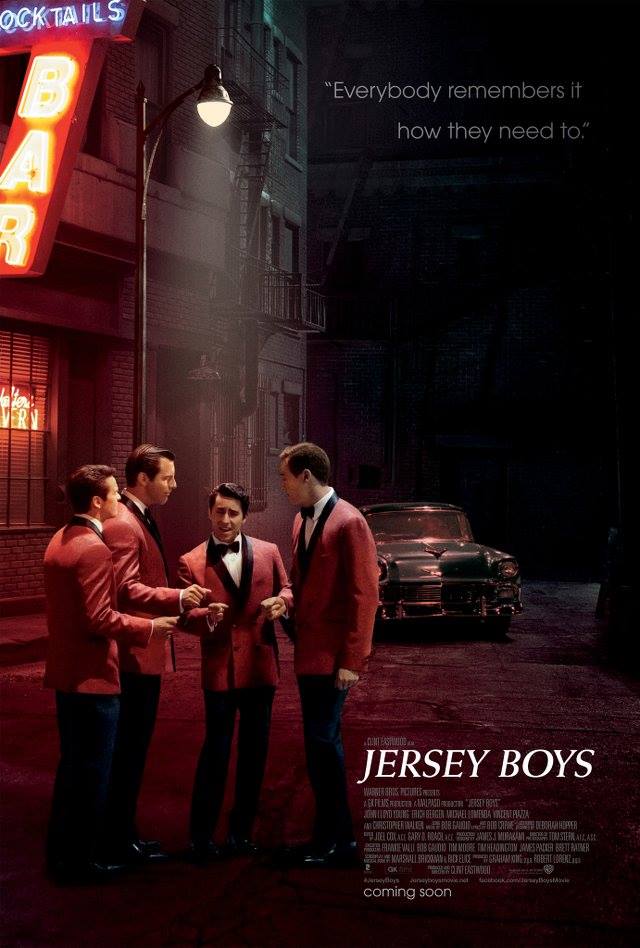
This film, like the Tony Award-winning musical, is the “VH1 Behind the Music”-style story of four guys from the scrappy streets of New Jersey who grow up with only three possible career paths: the military, the mob, and somehow achieving fame. The first two have a high risk of getting killed. The last seems unobtainable. But the four guys, brought together in part by a fifth guy who took the fame option, Oscar-winner Joe Pesci (played in the film by Joseph Russo), became one of the most successful pop acts of all time, with number one hits through the 60’s-70’s.
Clint Eastwood, a composer himself, who made a fine musical biopic about Charlie Parker (“Bird”), has taken on this story, beautifully performed, but too focused on the lives of the group’s members, with very little about what it was that made them stars, or even what the music meant to them aside from a way to get out of New Jersey and support their families.
Tony Award-winner John Lloyd Young plays the undisputed star of The Four Seasons, Frankie Valli, whose pure-toned, remarkably elastic three-octave range was the pure aural joy amidst the sweet harmonies of the Four Seasons sound. It was that voice that persuaded 15-year-old Bob Gaudio (Erich Bergen), already the composer of a hit single (“Who Wears Short Shorts”), to join the group. A handshake deal between Gaudio and Valli continues to this day.
Eastwood and cinematographer Tom Stern give the movie a bleached-out look that gives the skin tones of the cast the consistency of putty. This is intended to express the grittiness of the New Jersey community, but it just looks drab. And it undermines the points that Eastwood and the Jersey boys themselves try to make about their rough-and-tumble environment when the kindly cop knows everyone in the community so well he remembers Frankie’s curfew. Even the mob boss (a deliciously droll performance by Christopher Walken) is so cute and cuddly that he cries openly when Frankie sings a sentimental number. And he’s there to step in when another mob guy is less understanding.
The predictable temptations and stresses of life on the road are predictably laid before us. Some day, I hope someone will make a movie about a famous guy that won’t have the screaming fight with the wife about how he’s never home. This is not that film. And there are the struggles for leadership, the poor judgment with money, also resolved the Jersey way. We briefly see decisions that led to iconic details. After several other names, the group picked “The Four Seasons” from a sign at a bowling alley that would not hire them to perform. “Big Girls Don’t Cry” came from a Billy Wilder movie they saw on television. But we never get a real sense of the era, of how they fit into the culture musically, how they interacted with the fans, how they were affected by experiencing the world outside of New Jersey.
It is absorbing, largely because of excellent performances by all four of the Jersey Boys, but uneven, largely because the script assumes that we will be as fascinated with the relationships of the four men as they are themselves. At the end, Frankie says that for him the high point was finding their sound, just four guys harmonizing under a street light. That’s a moment we never get to experience. The only time we feel their pleasure in performing is in what has to be seen as the curtain call number, an odd piece of theatricality that, after two and a half hours of running time, finally shows us what made the Four Seasons so thrilling to experience.
Parents should know that this film has very strong language including crude sexual references, a non-explicit sexual situation, smoking, drinking, off-screen drug abuse, and references to mob activity.
Family discussion: Why does Frankie take responsibility for what Tony did? Why did he leave his daughter with her mother? What do you think was their high point and why did Frankie pick the one he did?
If you like this, try: other musician biopics like “Ray” and “Walk the Line” and the music of the Four Seasons. And to get a glimpse of Frankie Valli today, look for him in a small role in Rob Reiner’s “And So It Goes” with Michael Douglas and Diane Keaton.
Posted on June 19, 2014 at 6:00 pm
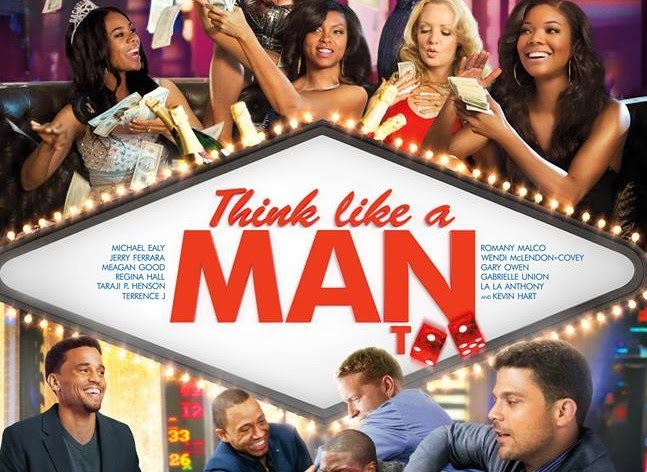 A romantic comedy based on Steve Harvey’s book of advice for women about relationships
Not that there’s anything wrong with that. After all, seeing pretty people do silly things so they can kiss and make up is always a good reason to go to a movie. And these are some of Hollywood’s most appealing performers.
In the first film, a group of buddies with a regular basketball game find themselves flummoxed by a bevy of beauties who read Steve Harvey’s book for tips on dealing with players, mama’s boys, and perpetual adolescents. The happily ever after ending has now led to a proposal and the whole group is going to Las Vegas for separate wild pre-nuptial parties followed by the wedding itself. When the groom-to-be assures his bride that everything will be perfect and nothing can possibly go wrong, we know that nothing will be perfect and everything will go wrong in the most humiliating way possible until we find our way to another happy ending with a possible opening for #3, which I hereby predict will involve a baby or two.
Would-be chef Dom (Michael Ealy) and corporate powerhouse Lauren (Taraji P. Henson) are deeply in love but struggling with job opportunities in different cities that they are afraid to tell one another. Mya (Meagan Good) is not happy to run into stories about the wild past of “Zeke the Freak” (Romany Malco). Kristen (Gabrielle Union) wants to get pregnant as quickly as possible and that puts a lot of pressure on Jeremy (Jerry Ferrara).
But the development that has the biggest impact on the film is the one that happened off-screen. Since the first one was released, Kevin Hart has become a box office powerhouse with a concert film in 2013 and two enormously successful comedies already in 2014 (About Last Night and Ride Along). This is most likely the reason that he takes up so much more of “Too” than he did in the first one. And since is a very loud guy, he seems to take up even more than he does, too often with all the appeal of a buzzing mosquito.
The entire premise of the first film is jettisoned, along with any aspirations beyond silly fun. It takes Cedric (Hart) far too long to figure out that he has mistakenly booked himself into a room that costs ten times what he thinks, because every time there is any possibility to mitigate the damages of whatever he has gotten himself into, he blusters like a bantam rooster to block any kind of reality check from the other characters. And this is close to the movie’s most plausible plotline. Even Lucy and Ethel could not make us believe that anyone cares whether the boys or the girls have a wilder pre-nuptial party. Director Tim Story throws in every possible signifier of movie fun, from a makeover (“Bridesmaids'” Wendy McLendon-Covey) to a dance number (okay, the girls’ dancing to Bell Biv DeVoe’s irresistible “Poison” is a treat) and the ever-popular night in the pokey plus the completely superfluous addition of a couple of cute white guys (Adam Brody and “About a Boy’s” David Walton.
The cast is clearly just here to have a good time, and the audience will, too.
Parents should know that this film includes some strong language including crude sexual references and humor, sexual situations, strippers, drinking and drunkenness, and drug use, along with a lot of foolish Las Vegas behavior.
Family discussion: What were the groups trying to accomplish in their pre-nuptial parties? Which couple has the strongest relationship?
If you like this, try: the first film and “About Last Night” (rated R), also featuring Hart, Ealy, and Hall.
Posted on June 19, 2014 at 5:47 pm
A-| Lowest Recommended Age: | High School |
| MPAA Rating: | Not rated |
| Profanity: | Strong language |
| Alcohol/ Drugs: | Drinking, drugs |
| Violence/ Scariness: | Pervasive psychological horror and some violence |
| Diversity Issues: | None |
| Date Released to Theaters: | June 20, 2014 |
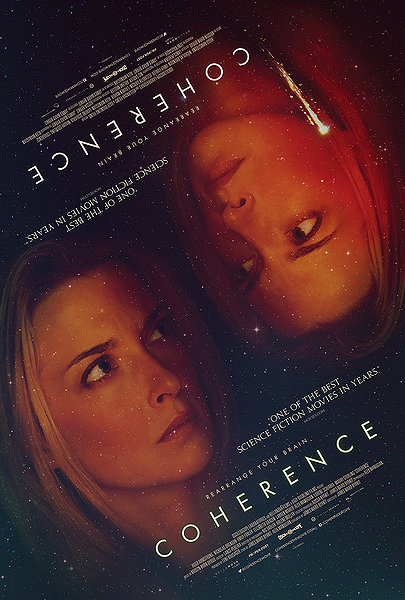 Seriously, don’t read this review until after you’ve seen the movie. The less you know, the more you will enjoy this nifty thriller, which craftily makes the most of its micro-budget to maximize a deliciously mind-bending story. As in all great thrillers, the scary stuff is not what’s on the outside, but what the stuff on the outside does to the stuff in the inside, meaning not just the inside of the characters but the inside of the audience.
James Ward Byrkit, who wrote “Rango” and created the visual design for the “Pirates of the Caribbean” movies (all with Gore Verbinski), wanted to take some time away from seven-figure-budget blockbusters and create something small and intimate. He literally shot it in his living room, with a cast of vaguely familiar looking but under the radar actors. As the movie begins, eight friends are getting together for a dinner party. We get some sense of the relationships and some tensions as they gather. They engage in routine dinner party chat, mentioning in passing some news about a comet due to pass overhead along with the usual updates and gossip. And then the phones stop working. And then the lights stop working. And then someone says he’d better go outside to find out what is happening. And we’ve all seen enough movies to know that this is probably not a great idea.
What happens next is not a plot twist but a plot Rubik’s Cube, an ingeniously plotted infinite regression of meta-realities. To say any more would be to spoil the movie’s best surprises.
Parents should know that this is a psychological thriller with a pervasive sense of dread and some violence. Characters drink and use drugs and there is strong language.
Family discussion: What decision do you wish you could go back and do over?
If you like this, try: “Identity”