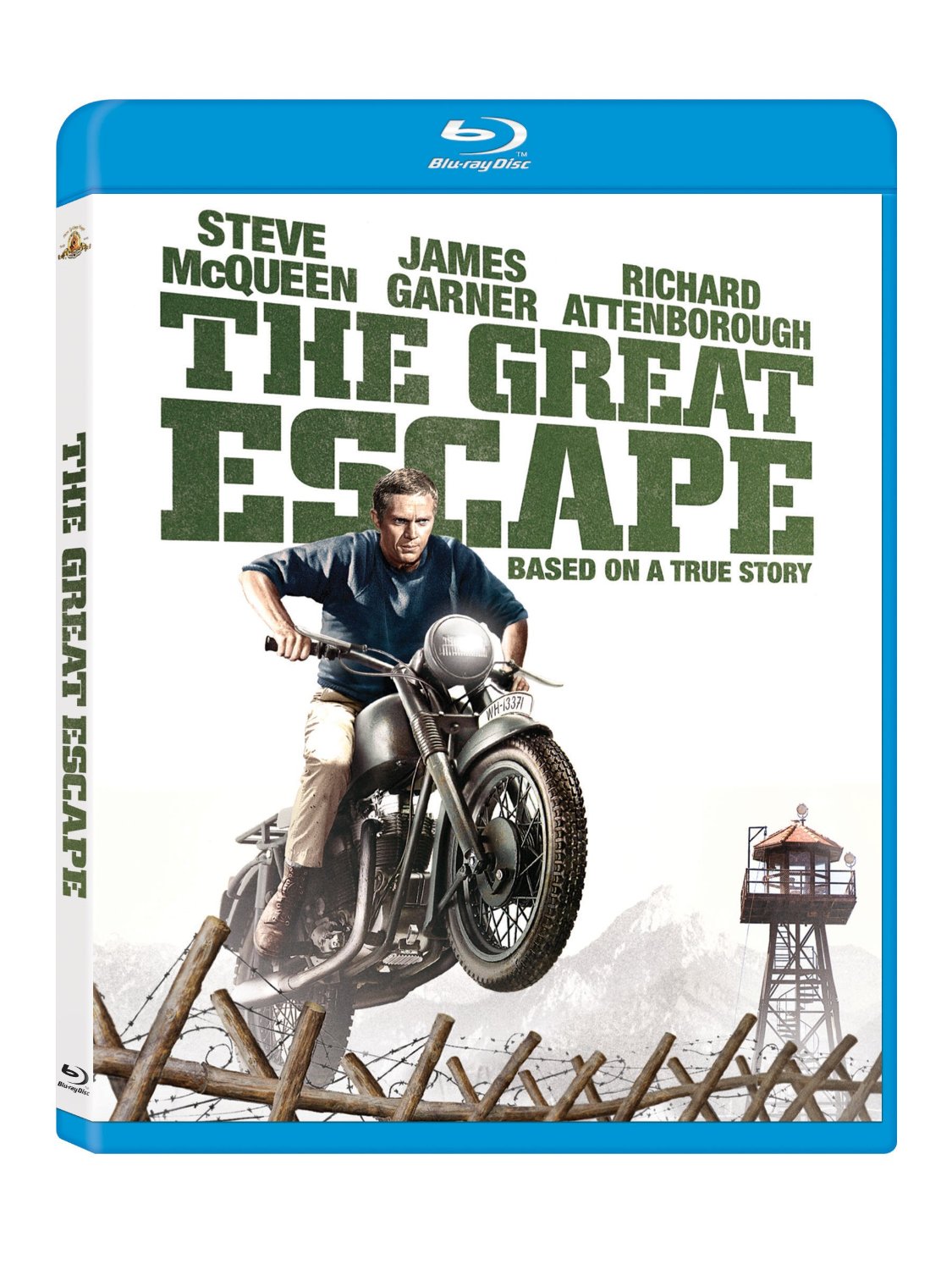
The Great Escape

Posted on December 13, 2002 at 5:17 am

A+
Lowest Recommended Age: Middle School
MPAA Rating: Not rated
Profanity: None
Alcohol/ Drugs: Some drinking, smoking
Violence/ Scariness: Very tense moments, characters in peril and many killed
Diversity Issues: People from a variety of backgrounds and countries work together toward a common goal
Date Released to Theaters: 1963
Date Released to DVD: May 7, 2013
Amazon.com ASIN: B00BN3DUVE

great escape

In honor of the Blu-Ray release of this classic film, it is the Pick of the Week – and I am delighted that I have one Blu-Ray to give away.  Send me an email at moviemom@moviemom.com with Escape in the subject line.  I will pick a winner at random on May 15.  Don’t forget your address!  (US addresses only.)

Towards the end of WWII, the Germans built a special high-security prison camp for Allied prisoners with a record of escape attempts. This is the true story of the extraordinary courage and ingenuity of the men imprisoned there, and of their plans for the greatest escape ever. As the British ranking officer explains, when the camp commandant urges him to relax and “sit out the war as comfortably as possible,” his duty is to escape, or, if escape is impossible, to force the enemy to use as many resources as possible to contain them.

Each man contributes his expertise. There are “tunnel kings” to dig the three tunnels, a “forger king” (Donald Pleasence) to forge the papers the soldiers will need when they escape, a “scrounger” (James Garner) to beg, borrow, steal, or obtain through blackmail the materials they need, and others who work as tailors and manufacturers. An American who is something of a loner, Hilts (Steve McQueen) becomes the “cooler king” for his long stints in solitary confinement, as a result of his independent escape attempts. When “Big X” (Richard Attenborough), the British officer who supervises the escape, asks Hilts to go through the tunnel to get information about the area surrounding the camp, and then allow himself to be recaptured, so he can let them know what he has found, he refuses. But when his friend is killed trying to escape, his spirit broken by the camp, Hilts changes his mind.

Seventy-five of the prisoners are able to escape before the tunnel is discovered. The Germans track almost all of them down, and fifty are killed, including Big X. It is to “the fifty” that the film is dedicated.

As in “Stalag 17” and many other films about prison camp, the prisoners in this story must adapt to the direst of circumstances, and they choose differing approaches. Hilts adapts by working on his own, or with one partner, while others work on a massive group escape. Ives and Danny begin to unravel under the stress, not so much a “choice” as an involuntary response.

Unlike other prison camp movies, this one does not dwell on disputes between prisoners or on the deprivations of the prison camp, which seems almost comfortable. It is about the professionalism, courage, resourcefulness, teamwork, and loyalty of every one of the prisoners.

As in a traditional “heist” film, the story focuses on defining a problem and then solving it. They examine the restrictions imposed by their conditions, change the ones they can, and adapt to the ones they cannot. They must also adapt quickly and calmly when the plan does not go as they expected.

The story gives us an exceptional example of teamwork and loyalty. Note the way that the prisoners protect each other. When Danny (Charles Bronson) cannot take it any more and wants to escape on his own, his friend talks him out of it. When the Forger goes blind, Big X wants to leave him behind, for his own protection. But the Scrounger promises to take care of him.

Point out to kids what factors do — and do not — go into the prisoners’ calculations and strategy. Big X is cautioned not to allow his personal wish for revenge determine their strategy. But pride (in the sense of morale) is permitted to be considered. When asked “Have you thought of what it might cost?” he answers, “I’ve thought of the humiliation if we just tamely submit — knuckle under and crawl.” They also consider the risk of failure, to the extent they can. At the end, when the Scrounger asks whether the escape was worth the price, the best the British Commander can do is answer truthfully, “It depends on your point of view.”

Note: The  screenplay was co-written by blockbuster novelist James Clavell (Tai-Pei, Shogun). His own experiences as a prisoner of war in a Japanese prison camp are the subject of “King Rat.” The outstanding musical score is by Elmer Bernstein (“The Magnificent Seven” and “To Kill a Mockingbird”). Richard Attenborough, who played Big X, became a director in the late 1960s of films such as “Gandhi” and “Shadowlands.” He continues to appear as a performer, and played Dr. Hammond in “Jurassic Park” and Kris Kringle in the 1994 version of “Miracle on 34th Street.”

Family discussion: Why are the experts called “kings”?  What makes Hilts change his mind about getting the information they want? Who was right about taking the Forger out through the tunnel, Big X or the Scrounger? Given the results of their action in this story, should officers who have been taken prisoner feel duty-bound to try to escape?

If you like this, try: “Stalag 17” and “King Rat”


Related Tags:


Based on a true story Classic Drama DVD/Blu-Ray Pick of the Week War

Enigma

Posted on December 13, 2002 at 5:17 am

One of the most important contributions to the Allied victory in World War II was a code-breaking operation that was so secret it was not revealed until 30 years later. Their deciphering of the Enigma code developed by the Germans shortened the war by as much as a year.

This is the story of the people who worked at a huge and historic estate called Bletchley to unlock the unlockable. They had to solve a puzzle considered impenetrable because it was so complex that it could never have been decoded by the human brain. What the Germans never anticipated was that the British would think up the beginnings of the modern day computer and develop a “thinking machine” to sort through billions of complex computations and find the equivalent of a needle buried in one of millions of haystacks.

The essentials of the story are true, but the characters in the movie are fictional. As he did with “Shakespeare in Love,” screenwriter/playwright Tom Stoppard brilliantly interweaves the real and the imaginary to illuminate not only his characters’ era but our own.

The central figure in this story is Tom Jericho (Dougray Scott), a brilliant mathematician with a stunning grasp of numerical relationships. His grasp of human relationships is a little shaky, however. When we first meet him, he is returning to Bletchley after a breakdown. He was shattered by a brief, overwhelming affair with Claire (Saffron Burrows), a co-worker who seduced and then abandoned him. His superiors do not want him back, but he may be their best hope for breaking the German’s new code, the Shark, before a group of U-boats meet up with American convoys carrying desperately needed supplies.

The reason the Germans are using a new code is that they found out that the British had broken the Enigma. Meanwhile, Claire has disappeared. Figuring out where she is and whether there is a connection between her disappearance and the leak to the Germans is a puzzle that is as important to Tom as decoding the Shark.

He teams up with Claire’s roommate Hester (Kate Winslet) to find out what happened to Claire. As they search for clues, they are watched by Wigram (Jeremy Northern), a sleek secret agent investigating Tom and his team to see if one of them is a traitor.

Stoppard is fascinated with puzzles, wordplay, secrets, and stories within stories, all of which lend themselves very well to the Bletchley code-breakers. The movie brilliantly depicts the desperate atmosphere and heart-breaking dedication of the people who knew that their success – or failure – could do more to determine the outcome of the war than a thousand soldiers with guns.

The performances are excellent, particularly Northern, whose single syllable on entering Tom’s room, “Bliss!” gives us his character’s history from tony prep school through too many compromises. He is a man who has had to sacrifice what he once thought of as honor to serve a greater cause, has had to betray in order to be loyal, and has had to keep too many secrets. Winslet’s only failing is her entirely unsuccessful effort to look dowdy. But she and Scott are marvelous at showing us something we seldom see in movies, really smart people using their intelligence.

Parents should know that the movie has some sexual references and situations (brief nudity). Claire seduces just about every man she meets. There are some very tense scenes, including graphic images of slaughtered bodies in a mass grave.

The movie raises a number of moral dilemmas that are well worth discussion. When it becomes clear that there is no way to save the American supply ships in time, the code-breakers debate whether it is right to use what they know about the ships’ positions to help them calculate the keys to break the code. What are the best arguments for each side? Who was right? The characters lie and there are a number of betrayals in the movie – more than some members of the audience may be able to sort through on the first viewing – and it is worth talking about how people decide whom to trust and how much evidence they need before they change their minds.

Families who enjoy this movie should read about the real key figure at Bletchley, the truly enigmatic Alan Turing. His artificial intelligence test is still the standard used today.

Families who enjoy this movie will also enjoy reading Between Silk and Cyanide, a wonderfully entertaining memoir by Leo Marks, who worked on creating codes during this era. (Fans of 84 Charing Cross Road will enjoy the fact that Leo Marks is the son of man who owned the bookstore at that address.) The complicated issues of uneasy alliances and tragic choices are explored in Kurt Vonnegut’s classic novel, Mother Night. You can also see an exciting but highly fictionalized version of the capture of the Enigma machine (in real life, it was the Brits, not the Americans) in U-571.

Related Tags:


Based on a true story Drama Epic/Historical Spies War

Mr. Smith Goes to Washington

Posted on December 13, 2002 at 5:17 am

Plot: Naive Jefferson Smith (Jimmy Stewart) is sent to Washington to serve the remaining term of a Senator who has died. The governor (Guy Kibbee), and businessman Jim Taylor (Edward Arnold) believe that Smith, the leader of a Boy Scouts-type organization called the Boy Rangers, will do whatever he is told by senior senator Joseph Paine (Claude Rains), a friend of his late father, who was an idealistic newspaper editor. Paine approves of the appointment: “A young patriot turned loose in our nation’s capital — I can handle him.”

At first, Smith is such a hopeless rube that he is an embarassment. The cynical press ridicules him. He is daunted by jaded staffers Diz Moore (Thomas Mitchell) and Saunders (Jean Arthur), and reduced to stumbling incoherence by Paine’s sophisticated daughter (Astrid Allwyn). But a visit to the Lincoln memorial reminds him of what he hopes to accomplish, and he returns to the Senate to promote his dream, a national camp for boys. Saunders begins to soften when he tells her what he believes: “Liberty is too precious a thing to be buried in books.” She acknowledges her own idealistic roots as the daughter of a doctor who treated patients who could not pay, that idealism now buried under the practicality that resulted from her having to go to work at 16 because her family had no money. “Why don’t you go home?” she asks. “You’re halfway decent.”

Saunders warns him that Paine is corrupt, that he is promoting unnecessary legislation that will benefit Taylor. Smith goes to see Paine, and is crushed to learn that Saunders was right. Paine tries to explain that it is just a compromise. “It’s a question of give and take – – you have to play by the rules — compromise — you have to leave your ideals outside the door with your rubbers.” Smith promises to expose Paine, but Paine moves quickly and makes it appear that it is Smith who is corrupt. He presents a forged deed showing that Smith is the owner of the land for the proposed camp, and will therefore profit from the legislation.

Smith is ready to quit, but Saunders explains that he can filibuster — take the floor of the Senate and keep speaking — while his mother and friends get out the real story. While Smith holds the floor, his Boy Rangers print up and try to distribute their own newspaper. But Taylor’s henchmen stop them. After speaking for 23 hours, Smith sees that all of the letters and telegrams are against him. He looks over at Paine. “I guess this is just another lost cause, Mr. Paine. All you people don’t know about the lost causes. Mr. Paine does. He said once that they were the only causes worth fighting for. And he fought for them once, for the only reason that any man ever fights for them. Because of just one plain simple rule, ‘Love thy neighbor.’ And in this world today, full of hatred, a man who knows that one rule has a great trust.”

He vows to go on, but collapses from fatigue. Paine, overwhelmed with shame, runs into the cloakroom and tries to kill himself, confessing that he was the one who was corrupt.

Discussion: Frank Capra was to movies what Norman Rockwell was to illustration; he gave us a vision of our national identity that never ignored the challenges we face, although it was idealistic about our ability to meet them. This movie, made on the brink of World War II, was criticized for its portrayal of dishonesty and cynicism in Washington. But ultimately, it was recognized for the very patriotic and loyal statement that it is.

Questions for Kids:

· Paine tells Smith he has to learn to compromise. Is that wrong? How could Smith tell that this was not compromise, but corruption?

· Watch the scene where the press meets the new Senator for the first time.

· People today often criticize the press for being unfair or too mean to politicians. Do you think they were unfair? Were they too mean? Why does the press like to make fun of politicians?

· What makes Saunders change her mind about Smith?

Connections: It is hard to imagine a time when Jimmy Stewart was not a major star, but this is the movie that made him one. He was a perfect choice for the shy young idealist. Capra selected cowboy actor Harry Carey to play the Vice President, who presides over the Senate during Smith’s filibuster. His look of weatherbeaten integrity perfectly suited the part, and contrasted well with Rains’ suave urbanity.

Activities: Those families who visit the Washington locations featured in the movie, the Lincoln Memorial and the U.S. Capitol building, might also want to stop by the local Planet Hollywood, which features the desk Smith stood at during his filibuster, autographed by Stewart. Those who can’t get to Washington might enjoy taking a look at today’s Congressional proceedings on C-SPAN and comparing them to those portrayed in the movie.

Related Tags:


Drama Epic/Historical

The Gunfighter

Posted on December 13, 2002 at 5:17 am

Plot: Jimmy Ringo (Gregory Peck) is the fastest gun who ever lived, which makes him a target for every young man who wants to prove himself. On his way to Cayenne, Ringo stops in a bar. A “young squirt” taunts him, and Ringo makes every possible effort to placate him, finally asking the young man’s friends to make him stop, but finally he pulls his gun on Ringo, who kills him. Even though everyone saw that it was in self- defense, the witnesses tell him to move on. The dead man had three brothers, and “they won’t care who drew first.”

The three brothers come after Ringo, but he is waiting for them, and he takes their guns and sends their horses back to town, telling them to go back on foot. But he knows that they will probably follow him instead, and that once he gets to Cayenne, he will only have a brief time to do what he has in mind.

He gets to Cayenne, and is surprised and pleased to find his old friend Mark Strett (Millard Mitchell) as the sheriff. Mark tells him he will have to leave; even though Ringo does not want any trouble, and has not committed any crimes, trouble will come looking for him, as there are too many young men who will risk everything to be able to claim the credit for killing Ringo. Ringo wants to see his wife Peggy and their child. Mark knows where they are but won’t say. He does agree to ask Peggy if she will see Ringo, and tells Ringo to stay put, under the care of the sympathetic bartender (Karl Malden).

Ringo stays quietly in the corner. But every one of the boys in town plays hookey to peer in at him through the saloon window. And the local “squirt,” hot-headed Hunt Bromley (Skip Homier), comes after him. Ringo scares him off with a bluff. But Jerry is across the street with a rifle pointed out the window, sure that Ringo must be the one who killed his son. And the three brothers have found horses and guns and are approaching fast.

Peggy at first refuses to see him. She finally agrees, and when he says he wants to settle down in a place where no one knows him, she says if he can do that for a year, she will join him. He spends some time with his son, and prepares to leave, happy at the thought of his new life. But Hunt is waiting for him, and shoots him in the back.

As Ringo dies, he says that he drew first. He doesn’t want Hunt hanged. He wants him to suffer as he has suffered, knowing that wherever he goes, there will be someone who wants to be known as the man who shot the man who shot Ringo.

Discussion: This is really a Western version of the story of King Midas. Ringo’s wish came true, but at a terrible price. There was a time when he could think of nothing finer, nothing manlier, than being known as the fastest gun in the West. We see a glimmer of that again, when he asks what Jimmy (who does not know that Ringo is his father) thinks of him. When he hears that Jimmy admires Wyatt Earp, he can’t help telling the boy that he is far tougher than Earp. Yet now Ringo is tired. He knows that every moment he will have to watch for someone trying to kill him (as happens throughout this movie), and that someday someone will be a little less tired (or, as happens, a little less honorable) than he is.

It provides a good opportunity for a discussion of notions of manhood and courage, along the lines of the moving speech by Charles Bronson in “The Magnificent Seven.” Ringo would trade all of his fame for the chance to live with his family, as shown most poignantly when he shares a drink with a young rancher. Ringo is more successful with his intelligence than his speed — he is able to avoid shoot-outs with the brothers, with Jerry, and in the first encounter with Hunt. He arranges to have money paid to Peggy without giving away their connection, and thinks of a plausible reason to tell Jimmy why he wanted to see him so that he doesn’t have to tell him the truth. His innate decency and sense of justice are shown in his dealings with Jerry, his dreams for a life with Peggy, and especially in the scene in which he talks to the ladies of the town, when they do not know who he is. His pleasure in being able to have a moment’s interaction with people who are not either terrified, angry, or trying to shoot him is very moving.

This is also a good movie about the consequences of our choices. There are so many movies about redemption and triumph that it is automatically branded an “adult western” when a gunfighter doesn’t shoot the bad guy and ride off into the sunset. Unlike Alan in “The Petrified Forest,” who dies to help someone else, or Butch Cassidy and the Sundance Kid , whose death at the end of the movie only brightens their legend, Ringo chooses to tarnish his legend as he dies, to curse Hunt to the same fate that he suffered, and possibly also to give little boys and young squirts less reason to try to be like him.

Questions for Kids:

· Why does every town have a “young squirt” who wants to prove he is faster than Ringo?

· Why doesn’t Mark carry a gun?

· Why does Ringo insist that he drew on Hunt?

· Why was Mark able to get away and start over, when Ringo and Buck were not?

· Why does Peggy call herself Mrs. Ringo at the end?

Connections: One of the three brothers who come after Ringo was played by Alan Hale, Jr., who went on to play the Captain in the television show “Gilligan’s Island,” and was the son of Alan Hale, Little John in “The Adventures of Robin Hood.”

Compare Ringo’s final decision to the one made by Jimmy Cagney in “Angels with Dirty Faces.” A tough criminal on death row, he is asked by his lifelong friend, a priest, to go to his death a coward, so that the boys who look up to him will not want to follow his example.

Related Tags:


Not specified

Frailty

Posted on December 13, 2002 at 5:17 am

Many great horror movies deal with families; that is where we are all most sensitive. This uneven film exploits that vulnerability but is ultimately unsatisfying.

The film opens on a dark and stormy night; Fenton Meiks, (Matthew McConaughey) a troubled-looking young man, has walked into the Texas offices of the FBI. He claims to know the identity of a serial killer, known as “God’s Hands” and he wants to tell his story.

As the story unfolds in flashback, Fenton describes growing up with his widower father (Bill Paxton) and younger brother Adam. It’s a generally happy household; Fenton and Adam are close, and kind to one another, and their father clearly cares for them both. Bill Paxton’s Dad character is convincing as a working-class guy with enough love and discipline to bring up his two boys alone, which makes his subsequent transformation very disturbing.

One night, he gets the boys out of bed to declare that an angel has brought him a vision. They’re living in the End Times, and God has selected the family for a special mission, to seek out and destroy demons, who are moving among humans in the last days. The demons look like ordinary humans, but Dad knows the difference — he says that he receives their names from heaven, and can see their sins at the moment he dispatches them by touching them with his hands. He uses a divinely selected ax and a lead pipe to perform the actual “destruction” of the demons.

Adam, the younger and more pious of the brothers, believes what his father tells him and immediately throws himself into the role of divinely appointed avenger. Fenton, older, keeps his doubts secret until his father actually drags home a bound woman and then executes her in front of his children.

Fenton is horrified, but forced to take an increasingly active role in the “demon” hunting. His initial rebellion against the new family business is handled by his father firmly, but lovingly. His dad has no doubts but realizes how difficult it is for his son to accept his new role in the universe. Nevertheless, as Fenton resists more and more, his father takes increasingly stern action, eventually locking his son in the cellar, to pray for a vision.

The genuinely horrifying premise of this film is undercut by its ham-handed writing, which makes the plot even less plausible. The dialogue is full of wooden homilies like “The truth is pretty unbelievable sometimes,” which Matthew McConaughey’s character drawls just before spilling the beans to the FBI. The dialogue is unintentionally funny at a number of points, especially when Bill Paxton is carefully delivering exposition on his insane plot. What is supposed to be a chilling matter-of-fact tone sounds more like a cold reading of the script.

This is not to say that the film is not frightening. The “destructions” are horrifying. The fact that we do not see the worst leaves the graphic details up to our imaginations. The scenes of Fenton locked in the cellar are extremely harrowing. But the most disturbing aspect of the plot is that the murders take place in front of the young sons, and committed by a beloved father. As Alfred Hitchcock said of the death of a child in an early film of his, “It was an abuse of cinematic power.” For a film as empty as “Frailty,” there is simply no excuse.

Many children will be disturbed by the spectacle of a loving father going crazy and becoming a homicidal maniac, and the consequences for the family. There are a number of shocking and tense moments among all the schlock.

Families seeing this film will want to discuss both Adam and Fenton’s reaction to their father’s revelations. What would you do if your father or mother told you they were commanded by God to kill the guilty? An especially troubling aspect of the movie implies that the father’s visions are real, and that God has actually selected a number of people to kill specific evildoers with an ax. Families of any faith will want to discuss the difference between the movie’s depiction and real-world religion.

Families who enjoyed this film will want to see “Psycho”, “The Brood,” “Carrie” and “Unbreakable”, four excellent films with similar themes.

Related Tags:


Horror
THE MOVIE MOM® is a registered trademark of Nell Minow. Use of the mark without express consent from Nell Minow constitutes trademark infringement and unfair competition in violation of federal and state laws. All material © Nell Minow 1995-2026, all rights reserved, and no use or republication is permitted without explicit permission. This site hosts Nell Minow’s Movie Mom® archive, with material that originally appeared on Yahoo! Movies, Beliefnet, and other sources. Much of her new material can be found at Rogerebert.com, Huffington Post, and WheretoWatch. Her books include The Movie Mom’s Guide to Family Movies and 101 Must-See Movie Moments, and she can be heard each week on radio stations across the country.

Website Designed by Max LaZebnik