Blinded by the Light

Blinded by the Light

Posted on August 15, 2019 at 5:35 pm

A-
Lowest Recommended Age: Middle School
MPAA Rating: Rated PG-13 for thematic material and language including some ethnic slurs
Profanity: Some strong language including racist terms
Alcohol/ Drugs: None
Violence/ Scariness: Some peril, racist attacks
Diversity Issues: A theme of the movie
Date Released to Theaters: August 16, 2019
Date Released to DVD: November 18, 2019

Copyright 2019 Warner Brothers
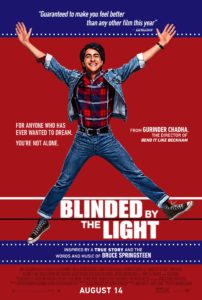
If we’re lucky, some time in August, as the big blockbusters of July taper off, we get a heartwarming little indie film to brighten the end of the summer. This year we are very lucky. The film is “Blinded by the Light,” set in Thatcher-era England, where the teenage son of Pakistani immigrants heard a song that seemed to explain the world to him. More than that, it explained him to himself. The song was by someone who was not British, Pakistani, or a teenager, but to Sarfraz Manzoor, New Jersey rocker Bruce Springsteen understood him better than anyone he knew.

Around the same time, Gurinder Chadha, the daughter of Indian immigrants in England, was also listening to Springsteen. Manzoor became a journalist whose memoir about his love for Springsteen (Greetings from Bury Park) then inspired Chadha, the director of films like “Bend It Like Beckham,” to make it into a movie.

The character based on Manzoor is Javed (newcomer Viveik Kalra), who dreams of being a writer. He writes poems that he does not share with anyone, even his sympathetic teacher (Hayley Atwell). The world around him seems bleak, unforgiving, and uncaring. An anti-immigration white supremacist group called the National Front is organizing protests and Javed and his family are subjected to harassment and racist graffiti. Javed’s father is strict, holding on to traditions as he is anxious about a lack of control when he is unable to support the family. His son’s sensitivity and inclination to assimilate into English culture makes him even more anxious. Javed’s mother is sympathetic but she has to work around the clock as a seamstress to earn money and does not want to put more pressure on her husband by challenging him. Javed has one friend who shares his love of music, but his freedom and ease only sharpens Javed’s sense of himself as isolated and ineffectual.

At school he meets a Sikh classmate named Roops (Aaron Phagura) who gives him a Springsteen CD. Chadha’s endearingly cinematic depiction of Javed’s reaction to the songs — the words as much as the music — beautifully conveys the jubilant, visceral reaction to truly connecting with another person, whether it is Gene Kelly splashing in puddles to celebrate falling in love or just knowing that somewhere in the world there is someone who has seen into your deepest secret heart and understands and accepts you. For Javed, who cannot fit into his father’s notion of who he should be but is not exactly sure who he will be instead, Bruce shows him the transformational power of putting feelings into words and music. A voice that means the world to him brings him closer to trusting his own voice.

As in “Bend it Like Beckham,” Chadha’s gift for kinetic storytelling reflects the turbulent emotion of the young protagonists. There are so many lovely details and moments — Rob Brydon (of “The Trip” movies) as the Springsteen-loving father of Javed’s friend, Javed’s discovery that his sister has found her own way to be herself, and of course a sweet romance, complete with a musical number that Gene Kelly himself would appreciate. Most important, the movie shows us that the feelings and the issues Bruce was singing about in the 70’s that spoke to Manzoor in the 80’s are still powerfully speaking to us today. Just as Springsteen let Manzoor know that his feelings were real and valid and understood and could be expressed, so Manzoor and Chadha tell us that with this lovely film.

Parents should know that this film includes racist language and attacks, some strong language, family tensions, mild sexual references, and kissing.

Family discussion: What was it about Springsteen’s music that made it so meaningful to Javed? How did listening to the music give him courage? What music is meaningful to you?

If you like this, try: “Bend it like Beckham” from the same director, and the music and autobiography of Bruce Springsteen


Related Tags:


Based on a book Based on a true story Drama DVD/Blu-Ray movie review Movies -- format Race and Diversity Romance Stories about Teens Trailers, Previews, and Clips
Where’d You Go Bernadette

Where’d You Go Bernadette

Posted on August 14, 2019 at 5:44 pm

B-
Lowest Recommended Age: Middle School
MPAA Rating: Rated PG-13 for some strong language and drug material
Profanity: Some strong language
Alcohol/ Drugs: Social drinking
Violence/ Scariness: Family stress and loss, reference to serious illness of a child and miscarriages
Diversity Issues: None
Date Released to Theaters: August 16, 2019
Date Released to DVD: December 2, 2019

Copyright 2019 Annapurna Pictures
The screen adaptation of Maria Semple’s charming book, Where’d You Go Bernadette is…less charming, though perfectly pleasant in a late summer comfort food kind of way. Semple, a sharp and witty writer for television (“Mad About You,” “90210,””Arrested Development”) moved from LA to Seattle and her sense of dislocation inspired the book, with a sharp take on the crunchy, self-consciously wholesome culture of the Pacific Northwest in contrast to the glossier, smugger world of Los Angeles. Note the title, a question without a question mark. And in this version, the question mark-less question is for no discernible reason, answered at the very beginning, followed by most of the film as a flashback.

Missing the epistolary format of the book, which allows us to follow much of the storyline through the characters’ voices, the sharpness is softened in Richard Linklater’s film. Cate Blanchett plays Bernadette, a devoted mother of Bee (newcomer Emma Nelson). Clinically, she might be classified as struggling with depression or anxiety or agoraphobia, but as we will learn, the behavior that is un-social and non-productive is her way of responding to devastating personal and professional loss. She does not want to talk to anyone, except maybe Bee, with whom she has an easy, natural connection. Bernadette loves her husband, Elgy (Billy Crudup), but he has a demanding job at Microsoft, the reason for their move to Seattle, and is not around much. Bernadette ran from personal and professional loss by devoting herself to Bee. But now Bee will be going away to boarding school and she has nowhere to run.

Bernadette is an architect, but her house is a mess of unfinished repairs. When she spots a bump under the carpet that turns out to be a blackberry bush sprout from beneath the house, instead of pulling it up by the roots she neatly scores the carpet to bend the corners back and staple them to the floor so the bush can keep growing. She has contempt for the moms at Bee’s school who go on about their compost heaps. She refers to them as “gnats” and she is not above some passive aggression, including allowing one to create a lot of damage.

Elgy’s new assistant there is Soo-Lin (Zoe Chao), one of the gnats, who loves to gossip about how weird Bernadette is with Audrey (Kristen Wiig), one of those “Big Little Lies”-type school moms who likes to run everything, talks about her perfect life a lot, and has very strong views on how everyone should behave.

Bee reminds her parents that they rashly promised her a wish if she got perfect grades all through middle school. Her wish is a trip to Antarctica. Bernadette wants to give Bee her dream, but for someone who can barely leave the house, it is an insurmountable challenge — until other challenges of staying home become even more insurmountable.

This is disappointingly one-dimensional work from one of the world’s most talented and versatile directors, Richard Linklater. Instead of the innovative, perceptive work we saw in “Boyhood,” the “Before” series, “School of Rock,” “Waking Life,” “Bernie,” and “Everybody Wants Some!!” “Where’d You Go Bernadette” has all the depth of the Charlene song “I’ve Never Been to Me.”

Parents should know that this film has some strong language, some mayhem, some mild peril, and some discussion of miscarriages and serious medical conditions.

Family discussion: Why didn’t Bernadette tell her family where she was going? What problems are you good at solving?

If you like this, try: “The Secret Life of Walter Mitty,” also starring Wiig.

Related Tags:


Based on a book Comedy Drama DVD/Blu-Ray movie review Movies -- format
Dora and the Lost City of Gold

Dora and the Lost City of Gold

Posted on August 8, 2019 at 5:48 pm

B
Lowest Recommended Age: Kindergarten - 3rd Grade
MPAA Rating: Rated PG for action and some impolite humor
Profanity: Some schoolyard language ("freakin' awesome")
Alcohol/ Drugs: Hallucinogenic pollen
Violence/ Scariness: Extended action-style peril and violence, no one hurt
Diversity Issues: Diverse characters
Date Released to Theaters: August 8, 2019
Date Released to DVD: November 18, 2019

Copyright 2019 Nickelodeon
Six year old Dora and her cousin and best friend Diego are enjoying their dinner in Dora’s home in the rainforest. Dora thinks the food is “delicioso!” She turns to the screen and asks us in the audience: “Can you say delicioso?” Her father (“Ant-Man’s” Michael Pena) looks confused about who she’s talking to, but reassures her mother, “She’ll grow out of it.”

This is how Dora and the Lost City of Gold, the new live-action movie inspired by the animated series “Dora the Explorer” lets us know that its Dora, is a bit more grown-up than the Dora the Explorer we know from Nickelodeon. Following the prologue, a farewell dinner with Diego as he leaves for the United States, Dora is a 16-year-old (wide-eyed Isabella Moner, still rocking Dora’s headband and backpack, still the cheerful, curious, adventuresome girl with the monkey sidekick and the handy backpack. Her parents send her to stay with Diego’s family while they search for a legendary lost city filled with gold called Parapata.

Like Cady in “Mean Girls” and Mimi-Siku in “Jungle 2 Jungle,” Dora approaches her first experience in what some people think of as civilization as an amateur anthropologist. For Diego (Jeff Wahlberg), like many teenagers, feels like high school is “a horrible nightmare” and “a matter of life or death,” death, in his view, being noticed or embarrassed in any way. He tells Dora to be cool” and “keep a low profile.” He pleads with her, “For one day, stop being you.” “Is this to fit in with the indigenous people?” she asks.

Dora is not cool and she is incapable of keeping a low profile. In fact, the opposite of a low profile. She is seen as a threat by the school’s ambitious top student, Sammie (Madeleine Madden), the kind of girl who comes to a “come as a star” costume party as Justice Ruth Bader Ginsburg. Dora also befriends a picked-on science buff named Randy (Nicholas Combe), and she happily does a dorky dance at a school party.

On a school field trip to a natural history museum, Diego, Randy, Sammie, and Dora are teamed up for a scavenger hunt. As they look through the museum’s basement, they are kidnapped and flown to the jungle, where a bunch of bad guys want to use Dora to find her parents, and, through them, find the lost city of gold. Dora’s parents explain in the first scene in the movie that they are explorers, not treasure hunters. The bad guys are not about hunting treasure; they want to steal it. They are looters, not explorers. For Dora’s parents, “the discovery of new places is the treasure.”

The teens are rescued by Alejandro (Eugenio Derbez), who explains that he is a professor friend of Dora’s parents. The teens and Alejandro race toward the lost city, trying to get there before the bad guys, with many challenges, adventures, and “jungle puzzles” — and a hallucinogenic pollen-induced cartoon sequence — along the way.

As a junior-sized “Indiana Jones,” this movie does pretty well, with adventures pitched at the right level for the 7-14 crowd. The script, co-written by Nicholas Stoller (“The Muppets,” “The Five Year Engagement”) and Matthew Robinson (“Monster Trucks”) has a buoyant sense of fun and a heroine whose greatest act of courage may be the way she accepts herself and those around her.

There has been a bit of controversy about this film following a review that seemed confused about the idea of aging up the cartoon character, suggesting there was something wrong about her portrayal. But this Dora, charmingly played by Moner, is not supposed to be a hormonal teenager. She is a child’s aspirational vision of an older child, someone who has more knowledge, ability, independence, and strength. And it is great to have a movie about a teenager where the resolution does not depend on her being attractive to a boy. Which is not to say that there is no boy-girl emotion in the film; it just isn’t the point, which is just right for its audience. “Dora and the Lost City of Gold” is an exciting adventure with a boots-wearing monkey, a thief of a fox (watch for a funny PSA-style disclaimer at the beginning), and a heroine whose integrity, spirit, kindness, and curiosity about the world should inspire people of all ages.

Parents should know that this movie includes extended peril and mild action and violence (no one hurt), some potty humor, and some schoolyard language. The characters inhale some hallucinogenic pollen and there is a teen kiss.

Family discussion: Why doesn’t Dora follow Diego’s advice in school? Why does Sammie change her mind about Dora? What would you like to explore?

If you like this, try: the “Dora the Explorer” series and “Gold Diggers: The Secret of Bear Mountain”

Related Tags:


Action/Adventure Based on a television show DVD/Blu-Ray movie review Movies -- format Stories about Teens
The Peanut Butter Falcon

The Peanut Butter Falcon

Posted on August 8, 2019 at 5:38 pm

B +
Lowest Recommended Age: Middle School
MPAA Rating: Rated PG-13 for thematic content, language throughout, some violence and smoking
Profanity: Strong language
Alcohol/ Drugs: Drinking, smoking
Violence/ Scariness: Some peril and violence, character injured
Diversity Issues: A theme of the movie
Date Released to Theaters: August 9, 2019
Date Released to DVD: November 11, 2019

Copyright 2019 Roadside Attractions
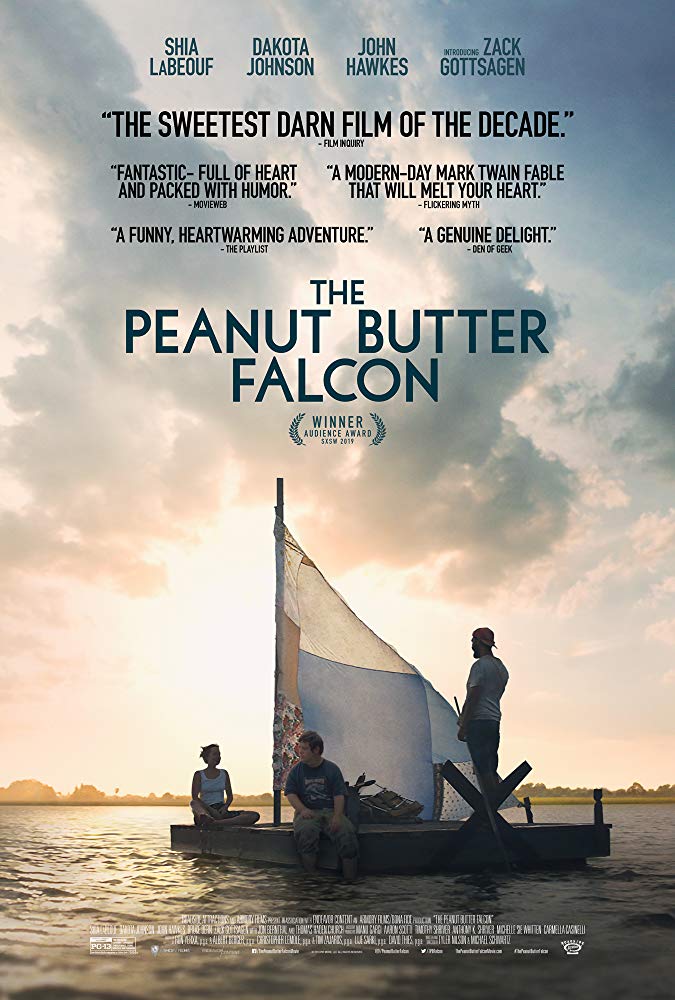
The story behind the making of “The Peanut Butter Falcon” is as sweet and inspiring as the one on the screen. Tyler Nilson and Michael Schwartz met ZacK Gottsagen when they were working at an arts program for people with disabilities. Gottsagen, who has has Down syndrome, told them he wanted to be an actor, and asked them to write a movie for him. So they checked some books about screenwriting out of the library and came up with this script, which is not just about a character based on Gottsagen, but about their community of the Outer Banks of North Carolina. The sense of place (though it was filmed in Georgia) is as important to the film as the characters on an unexpected journey.

It is remarkably assured for a first film, with an excellent supporting cast of talented pros and superb cinematography and music choices. The genuine affection and — especially — the respect Nilson and Schwartz have for the real-life Zack and the character he plays keep this story from being condescending or sugary.

Gottsagen plays a character also named Zack, a young man with no family and no resources who has been placed by Virginia authorities in the only facility they could find for him, a nursing home for the elderly. His roommate there is a retired engineer named Carl (Bruce Dern), who helps him escape, after watching Zack’s VHS tape of his favorite wrestler, the Salt Water Redneck for the zillionth time. Zack wants to be a wrestler, and his dream is to get to the Salt Water Redneck’s training facility in Florida. This is not one of those “there is none so cognitively impaired as those who will not think” movies.

Importantly, Zack is not a narrative convenience for the other characters to learn lessons and feel better about themselves. Zack (the character) is a real person with some limitations but a cheerful disposition and a true heart. His view of the world is as constrained by the restricted environment he was put in as by his cognitive ability. “The state has to put you somewhere and this happens to be that place,” he is told. You do not have to have a PhD to know that does not make much sense. And you don’t have to do higher math or be able to explain the metaphors in Moby Dick to know that people want to be with friends and follow their dreams. This movie is very much his story and he is very much at the heart of it.

The nursing home administrator does not want to report Zack’s escape to the police, so he sends a sympathetic aide (Dakota Johnson as Eleanor) to find him. Zack’s lack of planning (he escapes wearing nothing but underpants and has no money) helps in a way because he is seen as vulnerable and non-threatening. Tyler (Shia LeBoeuf) is a tidewater fisherman who has fallen on hard times, in part due to his bitterness and grief and guilt over the death of his brother (Jon Bernthal, glimpsed in wordless flashbacks). His own poor judgment escalates a fight with another fisherman (John Hawkes), who comes after him. Tyler does his best to avoid taking responsibility for Zack, but gives in when he sees how much Zack needs help. On the road, they have adventures, encounter interesting people, and begin to first trust and then like one another.

One of the highlights of the film is when they meet a blind man who insists on baptizing Zach. Tyler refuses, saying he prefers baptism by fire. It is presented with sincerity and a delicate lyricism that helps elevate the folkloric tone, as does the exceptional soundtrack and the exquisite cinematography, all of which set the tone for the satisfying conclusion.

Parents should know that this movie has some peril and violence, including arson, shooting, and an attack with a tire iron and an off-screen fatal car accident. There is some strong language, a character runs around in underwear, drinking and drunkenness, and a kiss.

Family discussion: What made Tyler change his mind about helping Zack? Why did the Saltwater Redneck encourage Zack to fight? What will happen next?

If you like this, try: “Little Miss Sunshine” (rated R) from the same producers, “Where Hope Grows,” and “Up Syndrome”

Related Tags:


Comedy Disabilities and Different Abilities Drama DVD/Blu-Ray movie review Movies -- format
Amazing Grace

Amazing Grace

Posted on August 4, 2019 at 2:12 pm

A
Lowest Recommended Age: All Ages
MPAA Rating: G
Profanity: None
Alcohol/ Drugs: None
Violence/ Scariness: None
Diversity Issues: None
Date Released to Theaters: April 5, 2019
Date Released to DVD: August 5, 2019

Copyright 2019 Neon
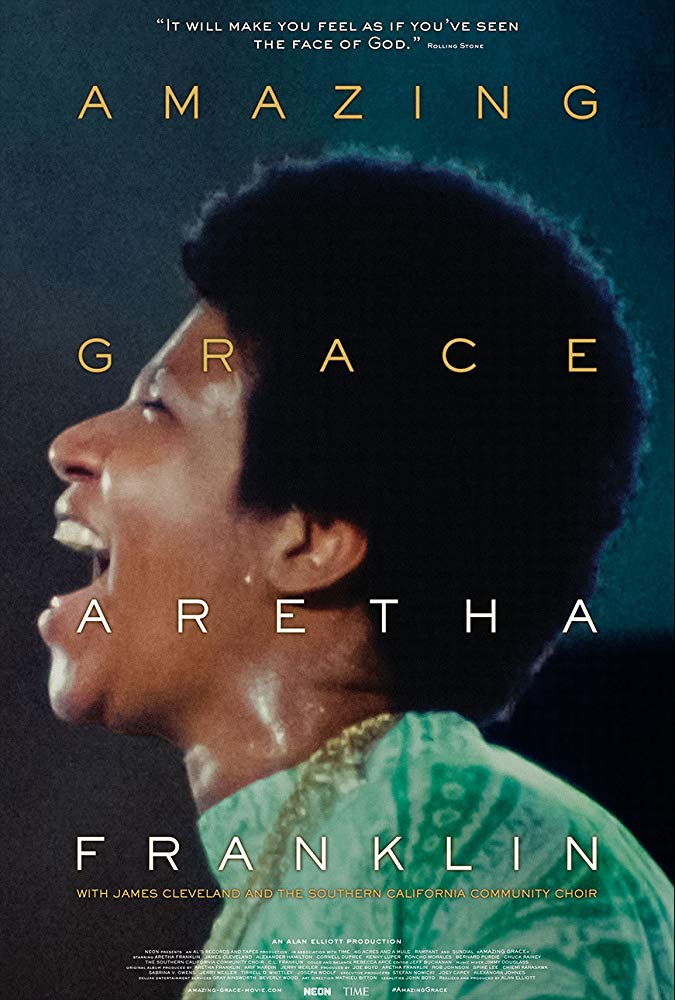
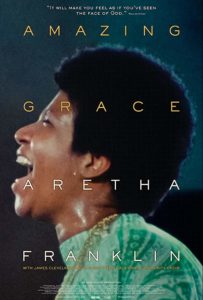
Amazing Grace” is 87 minutes of pure joy. No matter who you are, any one of any age, race, or religion, this film of a 1972 recording session in a small church in Los Angeles, will lift your spirit to the sky. Aretha Franklin, still in her 20’s and one of the top recording artists in the world, returns to the music of her youth to record what is still the number one gospel album of all time. A young filmmaker named Sidney Pollack was there to record it. But for a number of reasons, including an audio track that was not in sync with the visual, it was never shown to audiences.

Now it is here. Ms. Franklin barely says a word. Her father does, though, as does another preacher, James Cleveland. Other than that, it is just music, one of the greatest voices in history singing the church music she grew up with, accompanied by a choir led by Alexander Hamilton (that is his name), whose conducting is a movie of its own.

Watch her raise the roof.

Related Tags:


Documentary DVD/Blu-Ray Musical
THE MOVIE MOM® is a registered trademark of Nell Minow. Use of the mark without express consent from Nell Minow constitutes trademark infringement and unfair competition in violation of federal and state laws. All material © Nell Minow 1995-2026, all rights reserved, and no use or republication is permitted without explicit permission. This site hosts Nell Minow’s Movie Mom® archive, with material that originally appeared on Yahoo! Movies, Beliefnet, and other sources. Much of her new material can be found at Rogerebert.com, Huffington Post, and WheretoWatch. Her books include The Movie Mom’s Guide to Family Movies and 101 Must-See Movie Moments, and she can be heard each week on radio stations across the country.

Website Designed by Max LaZebnik