As we celebrate the birthday of Martin Luther King, every family should take time to talk about this great American leader and hero of the Civil Rights Movement. There are outstanding films and other resources for all ages.
I highly recommend the magnificent movie Boycott, starring Jeffrey Wright as Dr. King. And every family should study the history of the Montgomery bus boycott that changed the world.
The Long Walk Home, starring Whoopi Goldberg and Sissy Spacek, makes clear that the boycott was a reminder to black and white women of their rights and opportunities — and risk of change.
Citizen King is a PBS documentary with archival footage of Dr. King and his colleagues. Martin Luther King Jr. I Have a Dream has his famous speech in full, still one of the most powerful moments in the history of oratory and one of the most meaningful moments in the history of freedom.
In honor of my DVD Pick of the Week, Lee Daniels’ The Butler, I’m giving away a copy of the book that inspired it, the true story of Eugene Allen, the man who served as a White House butler. The Washington Post’s Wil Haygood first found Allen as Barack Obama was about to be sworn in as the first African-American President. With a foreword by the Academy Award nominated director Lee Daniels, The Butler not only explores Allen’s life and service to eight American Presidents, from Truman to Reagan, but also includes an essay that explores the history of black images on celluloid and in Hollywood, and fifty-seven pictures of Eugene Allen, his family, the presidents he served, and the remarkable cast of the movie.
For your chance to win a copy, send me an email at moviemom@moviemom.com with Butler in the subject line and tell me which White House moment you would like to have witnessed. Don’t forget your address! (US addresses only.) I’ll choose a winner at random on January 19. Good luck!
Interview: James Udel Takes Us Behind the Scenes in The Film Crew of Hollywood
Posted on January 13, 2014 at 3:59 pm
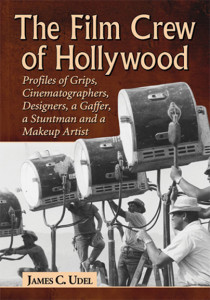
James Udel is the author of a magnificent new book, The Film Crew of Hollywood: Profiles of Grips, Cinematographers, Designers, a Gaffer, a Stuntman and a Makeup Artist. He goes behind the scenes, interviewing ten people who created movie magic from 1950-85 in films starring everyone from Steve McQueen and Jerry Lewis to Tom Hanks and Roman Polanski. This book provides a celebratory back story to the production of classic films such as “Little Big Man,” “Chinatown,” “One Flew Over the Cuckoo’s Nest,” “King Kong,” “The Searchers,” “Bullitt,” “Catch-22,” and “The Hustler.” I was thrilled to get a chance to talk to him about the unsung heroes who do not care about credit or fame — their only concern is telling the story.
I love to hear about the crew — these are people with extraordinary talent, artistry, and skill. But what impresses me most about them is their passion for solving problems.
These people are largely unsung, unappreciated, unless they get to the head of their department.
If they do everything perfectly, nobody notices because they’re paying attention to what the characters are doing. If they make one mistake, though, everybody is distracted by it.
There isn’t a single craft that I can say, on the movie set or a TV show, that I don’t have some interest in or some desire to know a little bit more about. If you’ve ever been in a room with ten other individuals and tried to work in a committee to get anything done, we all know what that requires. Now imagine multiplying that and you now have 100 people, plus actors, in a room, and we’re all going to work on the same idea of making Tom Hanks look great and let him do his thing and walk 12 feet, say 32 words, and then we’re going to cut. For three and a half minutes, 100 people are absolutely focused, every ounce of their body, on making that shot as good as they possibly can. And that’s what we do, over and over and over and over again, all day long, until the hours add up to days and the days to weeks and weeks to months and months to years.
Tell me how this book came about.
I was working on a movie called “Being John Malkovich” in 1997, and really cutting to the chase, I was hurt at that time. I had some soul-searching to do, because I still really needed to be involved, as I do now, with making movies. Some friends of mine suggested I go out to the Motion Picture Home, and I did, and I fell in love with all these great old folks out there, the original people who did those movies from 1950 on. Started to think, “This stuff’s golden; I’d really like to write this for somebody or get this idea out there.”
After a documentary was kind of shuffled to the side, I started writing a column for Below the Line Magazine under the banner of “Footnotes,” which I’d pitched to them. That was doing interviews with some of the original grips that I worked with from my union, and then from other unions around town, different crafts, and then putting those stories into a human form so I could tell people just how much of an individual’s life was given to making motion pictures, and how much of their early life lent itself to being able to do this. There’s always a formula to it. It’s really interesting how no matter what somebody does, by the time they get to L.A. or movie making, they have all these skills that come together to make it happen.
One of your interviews was about the Steve McQueen movie, “Le Mans.”
I interviewed a man named Gaylin P. Schultz, who was a key grip extraordinaire, and he worked for the Mirisch Brothers, going back a ways. They came to him and said they’re going to do this movie “Le Mans.” It was Steve McQueen’s baby, and he wanted to be seen doing his own driving at excessive speeds, with no stunt doubles for the most part. They wanted to actually film this race with a major movie star in it. Now, this had never been done before. The French Racing Commission at first said, “No, no, you’re not getting anywhere near this thing.”
But Steve McQueen and a bunch of other people prevailed, and they actually let Gaylin Schultz become part of the pit crew, and he designed specialized cameras and rigs that could literally float the camera one inch off the ground at 170 miles an hour. He devised camera mounts that could put the camera inside of the racecars with Steve McQueen, so that there was no denying that this was the guy driving the car. Every bolt had to be safetied, every nut had to be countersunk. Literally, Gaylin put on a suit and worked as part of the pit crew, and instead of changing the film magazines out, they swapped out entire cameras with quick release bolts and a pneumatic gun. So it looked exactly like everybody else, what they were doing when you see a race car being worked on, except that he was swapping cameras out.
Gaylin, being a genius of a mechanical engineer, had to work with the racecar drivers to get the balance of these rigs specifically lined up so that they wouldn’t create vehicles that couldn’t be controlled. At first, he told me the guys were a little bit leery of him because he had these extended camera mounts that were six feet off of some of the cars. Some of the drivers really dug him and they trusted him, and once they saw this stuff go around the track a few times and none of the bolts fell off, they started to trust him.
Steve McQueen was always the magic quotient to when you’re getting a film like this made. If you can look at it today and think of who else out there could get a movie like this made today, it would have to be somebody huge, like Tom Cruise or somebody like that.
I’m sure that Steve McQueen had some credibility with the drivers because he really knew something about driving.
Absolutely. Everybody understood that McQueen was this guy. And interestingly enough, Gaylin met Steve McQueen while doing “The Thomas Crown Affair.” Another incredible film, right? Gaylin was putting a rig on a very rare Ferrari, and McQueen was behind him, watching him, and he didn’t know it, watching him work – and he was working delicately, trying not to leave a single mark on the car, which he did. At the end of him putting this camera on the car, McQueen looked at him and said, “My goodness, man. You’re an artist, Gaylin. Here, I’m Steve McQueen.” And a friendship was started that from there on out.
Sometimes the crew has to have courage to disagree with the director or producer, don’t they?
In a creative situation, as you know, there’s always discussions. You can call them disagreements, but depending upon how you state your point, other people may or may not listen to you. Daniel C. Striepeke, who was a makeup guy that I interviewed, was working on a mustache for Robert Redford. That was going to be very specific. The director had an idea of what he wanted, and Striepeke and the other guys had an idea of what they wanted, and ultimately, when he grew the mustache and they did the tests, they decided upon it, and Redford decided upon which mustache they were going to use. It was a big deal. Three weeks after the movie came out, Striepeke is walking down Sunset Strip, and almost every guy has a Robert Redford mustache. So he calls the director up and said, “Hey, by the way, old boy, I hate to tell you, but have you stuck your head out the window today?” That was an argument that was absolutely won, pitched and won, and then later reinforced.
What surprised you the most in doing those interviews?
What surprised me the most is how connected every one of these 10 people were. And I picked icons. If you go down the list, these men were all at the top of their game when they played. What I was surprised about was the depth of concentrated life experience that went into making the skill level of each of these folks that came into the mix. If you look at a guy like Carl Manoogian, who was Jerry Lewis’s right hand man, Carl, Lewis and most of these people came out of World War II. They were the greatest generation of filmmakers, and they were the folks that won the war. So when they came back stateside, they were looking for occupations, and they weren’t scared of anything because they had already faced the Depression and World War II. So Hollywood didn’t frighten them very much.
You look at a guy like Carl Manoogian, he was the right hand men of Jerry Lewis, doing movies like “Cinderfella,” “Who’s Minding the Store?,” “Nutty Professor,” you name it, and Jerry wouldn’t do a movie without him. And what was surprising is that movie stars and directors and people who are really, really good at what they do making movies always latch onto these amazing icon crew members, and they all have a home of their own, either with a group of directors or an actor or two. They nurture this relationship, and it’s a trusting relationship that nobody out there knows about. It’s a trust relationship with those actresses and actors that it’s far beyond anything most people would understand.
Gene LeBell, for instance, he was raised at the Olympic Auditorium. His father was a famous surgeon in Hollywood in the 1930s, died of a broken neck of a freak accident while on the beach. Gene was from a very wealthy family, and then his mother had to send him to California Military School. So Gene LeBell, who missed his dad horribly – he was the love of his life – was crying a lot when he first got there, and a couple of bullies picked on him. The first thing he did was he wrestled one of them to the ground and put him on a headlock and choked him out. Gene was only six when it happened. And he became a world famous wrestler – and he’s the nicest man you’ve ever met in the world. He doesn’t have a violent bone in his body for real. But this was something that happened to him; he went to hide in the stables after getting in trouble for fighting with the bullies, and an old Cossack who was in charge of the horses took pity on him and taught him how to ride bareback. Twenty years later, he gets a job riding bareback in the movies. That kind of stuff. When he was 12, his mother asked him to change the bulbs at the Olympic Auditorium because the regular maintenance guy hadn’t come in, so Gene was up climbing 50 feet up on these catwalks, changing lights out. He said it made him feel like a grownup, to be able to help his mom.
I think if there’s anything that you can derive from each of these interviews, it’s a level of passion for the art and craft that is undeniable.
Amy Poehler and Tina Fey stole the show again in their second year as hosts of the first big awards show of the season, The Golden Globes. The Hollywood Foreign Press Association’s 72nd award ceremony spread the wealth, with several of the big movies of the year taking home awards. Some of their best lines were pointed jokes about women in Hollywood. “There are still parts in Hollywood for Meryl Streeps over 60.” “For Dallas Buyers Club, Matthew McConaughey…lost 45 pounds, or what actresses call being in a movie.” “Gravity…a story of how George Clooney would rather float away into space and die than spend one more minute with a woman his own age.”
They made fun of Martin Scorsese’s love of three-hour movie running times: “We’re going to get this done in three hours, or as Martin Scorsese calls it, Act One.” And of new sources of nominated series, suggesting that Netflix may find itself eclipsed “in a couple of years when SnapChat is up here accepting best drama.” They then wisely disappeared for most of the rest of the show, as they did last year, only returning a couple of times for very funny moments, especially when Poehler pretended to be Fey’s truculent teenage son, “Mr. Golden Globes,” and when she was in the audience having Bono rub her shoulders. It was nice to see her get an award, too.
The most surprising acceptance speech was probably Jacqueline Bisset’s rambling remarks, but I loved her conclusion: “If you want to look good, forgive everyone. It’s the best beauty treatment.” Most unexpected was probably the best actor and best comedy series awards for newcomer “Brooklyn Nine Nine.”
The best presenter was Robert Downey, Jr., utterly gracious. Instead of reading the teleprompter — or stalling because the teleprompter failed, like Jonah Hill, he said something lovely and personal about each of the nominees. Emma Thompson came out with her shoes in one hand and a martini in the other and still nailed it. Emma Stone, as always, was marvelous in presenting the DeMille award to Woody Allen, and Diane Keaton was graceful and heartfelt in accepting it for him. I appreciated Christoph Waltz, especially his pronunciation of the names of the half-German Michael Fassbender and the German Daniel Brühl. But the best presenters were the real-life inspirations for the title character in “Philomena,” who gently reminded everyone of the other women who lost their babies to forced adoptions and the man portrayed by Brühl in “Rush,” Nikki Lauda.
Michael Douglas, who gave a layered, sensitive performance as Liberace in “Beyond the Candelabra,” was less appalling in accepting his award than he was with his frat boy humor at the Emmys. But both he and Jared Leto, accepting a best supporting actor award for playing a trans woman in “Dallas Buyers Club” decided to be crude rather than demonstrate the grace and humanity they showed us on screen.
The shambling pile of a hairstyle of the winner for best score, Alex Ebert for “All is Lost,” seemed to have been inspired by Jennifer Lawrence’s character in “American Hustle.”
Worst dress: Julia Roberts — did she wear her husband’s shirt under that thing? Loveliest dresses: the maternity red carpet gowns won by Kerry Washington, Olivia Wilde, and Drew Barrymore
And my advice to all of the nominees next year and for any awards show ever: Prepare a speech! It doesn’t make you look modest to get up there and say you didn’t prepare anything because you didn’t think you were going to win. It makes you look sloppy. We know you love your “team,” your manager, your publicist, your agent. We know your cast was “amazing” and you feel “blessed.” But we in the audience deserve something better.
And the Golden Globes went to:
Film
BEST PICTURE: DRAMA
12 Years a Slave
BEST PICTURE: COMEDY OR MUSICAL
American Hustle
BEST DIRECTOR
Alfonso Cuaron, Gravity
BEST ACTRESS: DRAMA
Cate Blanchett, Blue Jasmine
BEST ACTOR: DRAMA
Matthew McConaughey, Dallas Buyers Club
BEST ACTRESS: COMEDY OR MUSICAL
Amy Adams, American Hustle
BEST ACTOR: COMEDY OR MUSICAL
Leonardo DiCaprio, The Wolf of Wall Street
BEST SUPPORTING ACTRESS
Jennifer Lawrence, American Hustle
BEST SUPPORTING ACTOR
Jared Leto, Dallas Buyers Club
BEST FOREIGN LANGUAGE FILM
The Great Beauty
BEST ANIMATED FEATURE FILM
Frozen
BEST SCREENPLAY
Spike Jonze, Her
BEST ORIGINAL SCORE
Alex Ebert, All Is Lost
BEST ORIGINAL SONG
“Ordinary Love” (Mandela: Long Walk To Freedom)
Television
Best Television Series – Drama
Breaking Bad
Best Television Series – Comedy Or Musical
Brooklyn Nine-Nine
Best Mini-Series Or Motion Picture Made for Television
Behind The Candelabra
Best Performance by an Actress In A Television Series – Comedy Or Musical
Amy Poehler, Parks and Recreation
Best Performance by an Actor In A Television Series – Comedy Or Musical
Andy Samberg, Brooklyn Nine Nine
Best Performance by an Actor in a Television Series – Drama
Bryan Cranston, Breaking Bad
Best Performance by an Actress In A Television Series – Drama
Robin Wright, House of Cards
Best Performance by an Actor in a Mini-Series or a Motion Picture Made for Television
Michael Douglas, Behind The Candelabra
Best Performance by an Actress in a Mini-Series or a Motion Picture Made for Television
Elizabeth Moss, Top of the Lake
Best Performance by an Actress in a Supporting Role in a Series, Mini-Series or Motion Picture Made for Television
Jacqueline Bisset, Dancing On The Edge
Best Performance by an Actor in a Supporting Role in a Series, Mini-Series or Motion Picture Made for Television
Jon Voight, Ray Donovan
I Liked the Cute Older Couple in the Swiffer Commercials But I LOVE This New Couple
Posted on January 12, 2014 at 6:07 pm
The 90-year-old lovebirds Morty and Lee are adorable, but this new couple, the Rukavinas, is even more heartwarming. Zack Rukavina is from South Dakota. He lost part of his arm to cancer. If he looks familiar, you may have seen him as a veteran in an episode of Switched at Birth. He has also appeared on Damages, Parenthood,Client List and others. He even proposed to his wife Afi on television.



 , I’m giving away a copy of the book that inspired it, the true story of Eugene Allen, the man who served as a White House butler. The Washington Post’s Wil Haygood first found Allen as Barack Obama was about to be sworn in as the first African-American President. With a foreword by the Academy Award nominated director Lee Daniels, The Butler not only explores Allen’s life and service to eight American Presidents, from Truman to Reagan, but also includes an essay that explores the history of black images on celluloid and in Hollywood, and fifty-seven pictures of Eugene Allen, his family, the presidents he served, and the remarkable cast of the movie.
 . He goes behind the scenes, interviewing ten people who created movie magic from 1950-85 in films starring everyone from Steve McQueen and Jerry Lewis to Tom Hanks and Roman Polanski. This book provides a celebratory back story to the production of classic films such as “Little Big Man,” “Chinatown,” “One Flew Over the Cuckoo’s Nest,” “King Kong,” “The Searchers,” “Bullitt,” “Catch-22,” and “The Hustler.” I was thrilled to get a chance to talk to him about the unsung heroes who do not care about credit or fame — their only concern is telling the story.