Nell Minow has been reviewing movies online as The Movie Mom since 1995, with over 3000 published reviews. Her books include 101 Must-See Movie Moments and The Movie Mom's Guide to Family Movies, and she appears on radio stations each week to talk about new releases in theaters and on DVD/Blu-Ray/streaming. Mastodon NOTE: Purchases from my links to Amazon pay me a small fee, usually well under one dollar.
Rotten Tomatoes: How Digital Media is Changing Movie Criticism
Posted on March 29, 2018 at 8:41 am
Rotten Tomatoes has a fascinating and very insightful essay about online movie critics. Citing the 1990 essay by Richard Corliss decrying the devolution of movie critics due to television, Rosemarie Alejandrino, the inaugural USC Annenberg-Rotten Tomatoes Digital Innovation and Entertainment Criticism fellow, describes the scope of online critics and their connection to their audiences.
Across multimedia platforms — particularly online video and podcasts — a new class of critics has arisen, made up of people who view the world of film and entertainment criticism through a digital lens. Some don’t consider themselves critics at all. This new breed of content creators isn’t looking to compete with traditional print critics; in fact, they exist side-by-side in the same cinesphere, often using written reviews as a jumping off point for their discussions.
Where these video and audio critics are taking us represents an exciting chapter in the evolving narrative of film criticism. The ability to pause and zoom allows a crafty YouTuber to dive into a scene’s shot construction in minute detail. Access to streaming services lets a critic watch a movie over and over as to not miss a detail while dissecting the plot for easter eggs and hidden gems. The rise in podcasts and longform audio platforms connects the critic to the listener in an intimate setting, as if you’re listening in on a conversation between friends who love (or hate) a film as much as you do.
The key culture-shifting component of new media film criticism is the critics’ relationship with their audience.
Rated PG-13 for sequences of sci-fi action violence, bloody images, some suggestive material, partial nudity and language
Profanity:
Brief strong language, one f-word
Alcohol/ Drugs:
None
Violence/ Scariness:
Extended sci-fi/fantasy peril and violence, real and virtual weapons, chases, and explosions, arson, characters injured and killed
Diversity Issues:
None
Date Released to Theaters:
March 30, 2018
Date Released to DVD:
July 23, 2018
Copyright Warner Brothers 2018
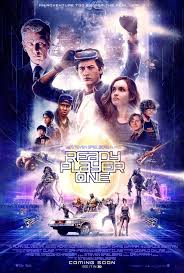
You know that one perfect high note in the A-Ha song, “Take on Me?” The goosebumpy bliss of it? “Ready Player One,” with endless callbacks to the era of A-Ha, is that note as a movie, set in the future, in love with the past, and uncannily right of this exact moment. There could be no better director than Steven Spielberg to take on this movie about a virtual game filled with the cultural touchstones of the 1980’s, a decade he helped define for the generation who will now be taking their children to this film and re-entering their own childhoods. We are all Marty McFly, now, going back to the future in a Delorean.
Spielberg is as good as anyone has ever been at the craft of cinematic storytelling, and there has never been a story more suited to that craft than this one, based on the book by first-time author Ernest Cline, who co-scripted and co-produced, and who admits that his world view was in large part formed by the Spielberg movies he watched as a kid in the 1980’s. There is a lot of nostalgia in the film, but also themes that could have come from today’s news: the role of technology as a distraction and as an invasion of privacy and underminer of democracy and the idea of teenagers saving the world.
It is Columbus, Ohio, 2045, when “people have stopped trying to fix problems and are just trying to outlive them.” The world is a bleak and broken place and most people spend most of their time escaping reality via a massive, enthralling online world called The Oasis, invented by James Halliday (Mark Rylance) a shy, obsessive genius who is a combination of Steve Jobs, Bill Gates, Mark Zuckerberg, Walt Disney, and Willy Wonka. “They come for all the things they can do,” we hear, “but stay for all the things they can be.” Players can design their own avatar personas any way they want — with antlers or wings, beautiful or ugly, super-powerful, purple, any age, gender, or species.
Five years before this story begins, Halliday died, leaving his half-trillion dollar empire and sole control of The Oasis to whomever was the first to discover the “Easter egg”* hidden in the game, which required agility, puzzle-solving, and a comprehensive knowledge of Halliday’s life and the popular culture he immersed himself in as a child in the 1980’s.
In five years, no one has even found the first of the three keys that lead to the egg. Many people have given up. Those still seeking it are called “gunters” (egg hunters). Wade Watts (“Mud’s” Tye Sheridan) is a teenage orphan living with his aunt and her latest in a series of abusive boyfriends in what is essentially a vertical trailer park called The Stacks. The film’s opening scene is brilliantly designed, as the camera pans down a dingy, jerrybuilt column of shabby capsules, showing each occupant caught up in a different virtual reality scenario, from boxing to pole dancing, with just one woman growing real-life flowers, the only person who even notices that Wade is there.
Wade signs into The Oasis, using haptic** gloves and a virtual reality eyepiece, for yet another try at crossing a virtual version of a Manhattan bridge guarded by King Kong. His avatar is Parzival***, who drives a Delorean, and he has an online friend, an enormous, mechanically-gifted man named Aech (I won’t reveal the voice performer to avoid spoilers). And he is intrigued by a female avatar named Art3mis (again, no spoilers) who rides the red motorcycle from the Akira video game. While Parzival and Art3mis both insist they will not “clan up” (team up with other players, they end up forming an alliance that includes two other avatars, Sho and Daito.
The Nolan Sorrento (Ben Mendelsohn) is head of the rival online company, Innovative Online Industries, and he wants to be the one to find the egg so he can make a lot of money selling ads (he has determined the exact number of ads that can bombard users “before inducing seizures,” he crisply informs his staff) and charging for access. IOI has hundreds of researchers and gamers trying to find the egg. And it operates “Loyalty Centers,” essentially debtors prisons, where those who owe the company money have to work it off under brutal and impossibly Sissiphusian conditions.
Wade has to locate three keys and solve clues involving not just logic and intense research but empathy, clues that turn out to be wisely selected by Halliday, Willie Wonka-style, to find the right person to take over the Oasis. Spielberg himself has to locate three keys as a filmmaker and does so with as much grace, heart, and integrity as Wade, his own avatar through the story. The copper key is the game level, the action scenes and the next-level special effects, including the chase across the Manhattan bridge and a stunning set piece inside the Stanley Kubrick movie, The Shining, repurposed here with bravura wit and skill. The jade key is the nostalgia, with dozens, perhaps hundreds of 80’s references, from the iconic and enduring to the obscure and forgotten. It is not, as is too often the case, shortcuts to play into the audience’s emotions, but deployed, again, with consummate wit and skill as commentary, as surprise, and as a reminder of our connections to the pop culture that first excited and engaged us. And the crystal key, well, it has been said often that the theme of all Spielberg movies is finding your way home. Wade is a 21st century Dorothy in Oz or Alice in Wonderland — or David in “WarGames,” exploring a land of infinite magic and wonder — and danger — but learning that there’s no place like home.
*The use of the term “Easter egg” to describe secret features originates from the 1979 video game Adventure for the Atari 2600 game console, programmed by employee Warren Robinett.
**They make it possible for the wearer to “feel” or “touch” virtual characters and objects.
***Named for one of King Arthur’s knights, who devoted his life to the search for the Holy Grail.
Parents should know that this film includes extended real world and virtual peril and violence including chases, explosions, weapons, murder, brief crude humor, some sexual references, brief strong language
Family discussion: What would your avatar be in the Oasis and why? Why would people stop trying to fix problems? What would Sorrento do with the Oasis and how would users respond?
If you like this, try: The book by Ernest Cline and movies that this one refers to, including “The Shining,” “The Iron Giant,” and “Back to the Future”
The First of What Will Probably Be Many “Ready Player One” Reference Guides
Posted on March 26, 2018 at 1:50 pm
Ernest Cline’s book, Ready Player One, takes place in the future but its main character is as enmeshed in the past as he is in the video game puzzle created by the mysterious man who is something between Steve Jobs, Bill Gates, Mark Zuckerberg, and whoever invented Grand Theft Auto. The book and movie are filled with references to the pop culture of the 1980’s and there are likely to be many critics and fans examining every frame to find them all. Rotten Tomatoes kicks it off, from “Saturday Night Fever” to “Terminator,” “Iron Giant,” “Say Anything,” and the original “Mad Max.” Of course “Ready Player One” director Steven Spielberg was himself responsible for many of the iconic pop culture moments of the 1980’s.
There are tons of nods to and cameos from Spielberg’s big blockbuster hits, especially the one about the dinos. The Spielberg gems come thick and fast and pretty early in the pic — so eyes out. It all makes a bunch of sense, given that the filmmakers had to secure the rights for every easter egg they use here. And it has us imagining a Spielberg-directed Ready Player One sequel, full of easter eggs referencing the original Spielberg-directed Ready Player One: Our pop-culture–loving minds were just blown.
I am honored once again to participate in Rogerebert.com’s annual women writers week, and will post a link when my review of Andie MacDowell’s “Love After Love” is published. Be sure to read the opening comments from Chaz Ebert, explaining the origins of this tradition five years ago and how it seems especially apt and powerful now.
I have always firmly believed that being introduced to diverse critical voices and opinions in the arts affects how we see the world but also has a profound influence on how we begin to heal it. It is our responsibility as publishers and editors to lift up those voices that seek to nurture and educate and unite us. This week at RogerEbert.com, those voices will be the voices of women.
Rated PG-13 for thematic elements and some violent images
Profanity:
Some strong language
Alcohol/ Drugs:
None
Violence/ Scariness:
Dog and human peril and violence, murder, sad death of parents, child injured badly, medical procedures, starvation and disease, skeletons, some disturbing images
Diversity Issues:
Issue of white American as the only one who takes on the villain
Date Released to Theaters:
March 23, 2018
Date Released to DVD:
July 16, 2018
Copyright 20th Century Fox 2018
Say the title out loud. “Isle of Dogs” = “I love dogs,” get it? Even a three-word title of a Wes Anderson movie is a bit of a puzzle box. Anderson is the Joseph Cornell of filmmakers, with every item on screen and even those tucked away and not seen by the audience, every note on the soundtrack, meticulously assembled. It makes sense that this film is set in a fictional version of Japan because his movies are cinematic Bento boxes. Anderson’s most ardent fans love the understated drama and endless unpacking of detail and think there is a deeper meaning in the weirdness. I am less persuaded that there is always a deeper meaning, but I enjoy the singular peculiarity of his storytelling.
Like my favorite Anderson movie, “Fantastic Mr. Fox,” “Isle of Dogs” is a story of talking animals told via stop-motion animation. This is a vastly more ambitious undertaking, based on an original story by Anderson with frequent collaborators Roman Coppola, Jason Schwartzman, and Kunichi Nomura, who appeared in Anderson’s “Grand Budapest Hotel” and also served as a casting director for this film and provided the voice for the movie’s bad guy.
Anderson’s intricate vision makes for exceptional world-building, and in this film he imagines a Japan 20 years from now, when political and environmental decay has progressed significantly but is seen as normal by the population. Mayor Kobayashi (Nomura) is the mayor of the (fictional) coastal metropolis called Megasaki City. He persuades the population that dogs are a pestilential force, bringing disease (“snout fever” and “dog flu”) to the city, and decrees that all dogs, even the beloved guard dog of his adopted son Atari (Koyu Rankin), must be deported to a nearby “island” made up of trash. The starving, diseased, homesick dogs have a bleak existence on the island. And then Atari arrives, in an airplane, in search of his beloved Spots. And a teenage American exchange student (Greta Gerwig) starts to investigate, with one of those old-school evidence walls covered with clues linked together by red yarn. Anderson’s worst and most tone-deaf choice here is to make the one white, American human character the only one with any integrity and ability to resolve the crimes against the dogs and community.
As in all Anderson films, the human characters deliver their lines in deadpan even while experiencing cataclysmic loss, urgent action, or ardent emotion. What some audiences experience as whimsical, charming, and witty, others see as cloying, twee, or claustrophobic. But he is a marvel at world-building and here, as in “Fantastic Mr. Fox,” where the entire film is essentially a set of dollhouses over which he has complete control, he is at his best. The settings in this film are an astonishing achievement of imagination and skill, from the tears welling up in the eyes of a dog to the intricacy of the machinery. If he ever devotes as much attention to the humanity of his characters as he does to the brilliance of his props, he will no longer be admired primarily for his singular aesthetic vision but for his characters and stories.
Parents should know that this film includes diseased and starving animals, children and adults in peril, murder, death of parents, child injured badly, dog fights with animals injured and killed, skeletons, some disturbing images including surgery, brief strong language, and references to dogs mating.
Family discussion: Why were the dogs banned? Why was it important for them to vote on big decisions?
If you like this, try: “Fantastic Mr. Fox” and “Kubo and the Two Strings”