
Clip: Dan Stevens Plays Charles Dickens “The Man Who Invented Christmas”
Posted on November 10, 2017 at 6:00 am
Posted on November 10, 2017 at 6:00 am
Posted on November 9, 2017 at 9:28 pm
B +| Lowest Recommended Age: | Mature High Schooler |
| MPAA Rating: | Rated R for language throughout including some sexual references |
| Profanity: | Very strong and crude language |
| Alcohol/ Drugs: | Drinking and alcohol abuse, smoking, references to drug abuse |
| Violence/ Scariness: | Themes of military service in wartime, sad deaths offscreen |
| Diversity Issues: | Diverse characters |
| Date Released to Theaters: | November 10, 2017 |
| Date Released to DVD: | January 29, 2018 |
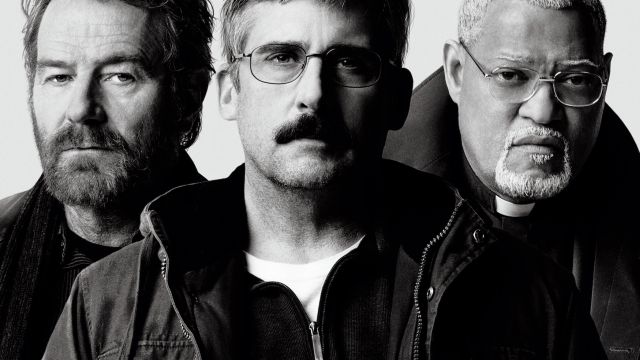
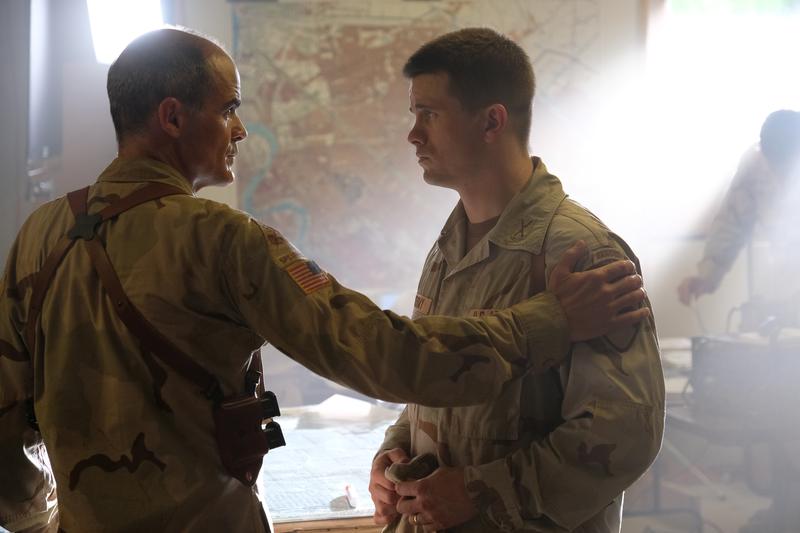
Three of the best actors in the world give immense depth and humanity to characters who might so easily have been caricatures in “Last Flag Flying,” about three veterans on a sad personal mission. It’s got a backstory that might be worth a movie of its own. “The Last Detail,” based on the book by Darryl Ponicsan, starred Jack Nicholson and Otis Young as Marines ordered to escort a naive teenaged sailor (Randy Quaid) to serve an eight-year prison sentence for a trivial offense. It was a critical and commercial success due to Nicholson’s performance and a picaresque tone that suited the era. 4 years later, another Ponicsan book about three military men (now long retired from service) on a sad journey with some comic detours comes to the screen, directed by Richard Linklater (“Boyhood”). It is not a sequel, though some of the characters have the same names and some similar histories.
It is 2003. A man carrying a manilla envelope walks into a dodgy little dive bar and orders a beer. The bartender barely glances at him, in the midst of a one-sided conversation with the bar’s only other customer, a regular. “You don’t remember me, do you?” asks the man with the envelope. The bartender, who is also the owner of the bar, takes a good look. “Doc!” he crows. “No one has called me that in years.” Doc is Larry Shepherd (Steve Carell) and the man behind the bar is Sal Nealon (Bryan Cranston). They eat pizza, talk about old times, and fall asleep in a booth. The next day, Larry takes Sal to a church, where the Reverend Richard Mueller (Laurence Fishburne) is conducting services. The men have not seen each other in decades, but they served together in Vietnam, Nealon and Mueller in the Marines and Shepherd in the Navy.
Mueller is not especially happy to see friends from the days when he was known as Mueller the Mauler, but he invites them to dinner at his home with his wife, Ruth (a splendid Deanna Reed-Foster, warm and wise). It is there that Shepherd explains why he wanted to find them. His son has been killed in action and he wants Mueller and Nealon to accompany him to the funeral. Nealon goes because he wants to do something different. Mueller goes, reluctantly, because he wants to be of service. “They represent a dark period in my life,” he tells Ruth, “a very dark period.” “And you represent God,” she replies.
And so the odyssey begins, with many adventures along the way, and, as Linklater does so well (the “Before” trilogy, “Waking Life”), many wide-ranging conversations, here including discussions of the past and present, the newish technology of the cell phone, sex, sleep, race, order, chaos, war, lies, choices, and consequences. Accompanying them for part of the trip is a Marine who was a close friend of Shepherd’s son (J. Quinton Johnson of “Everybody Wants Some!!!” excellent).
Near the end, Linklater gives us two scenes showing that what might have seemed episodic and slight was deliberate, thoughtful, and meaningful. It is his actors’ respect for the flawed characters they play and Linklater’s own respect for their choices, challenges, and regrets, that show us what we ask of the people who go to war on the other side of the planet because someone thought it would keep us safe, and what we owe them as well.
Parents should know that this film includes very strong and crude language, drinking, smoking, references to drug abuse, references to wartime violence, and very crude sexual references including prostitution.
Family discussion: What should they have told Mrs. Hightower? Why did Larry want to bring his son home? Who would you call for a journey like that one?
If you like this, try: “The Last Detail” and “Taking Chance”
Posted on November 9, 2017 at 5:54 pm
B| Lowest Recommended Age: | Middle School |
| MPAA Rating: | Rated PG-13 for violence and thematic elements |
| Profanity: | Some mild language |
| Alcohol/ Drugs: | Drinking, smoking, drugs |
| Violence/ Scariness: | Plot concerns a murder, references to kidnapping and murder of a child, suicide, miscarriage, gun, knife, scuffle |
| Diversity Issues: | Diverse characters, racism is raised as an issue |
| Date Released to Theaters: | November 10, 2017 |
| Date Released to DVD: | February 27, 2018 |
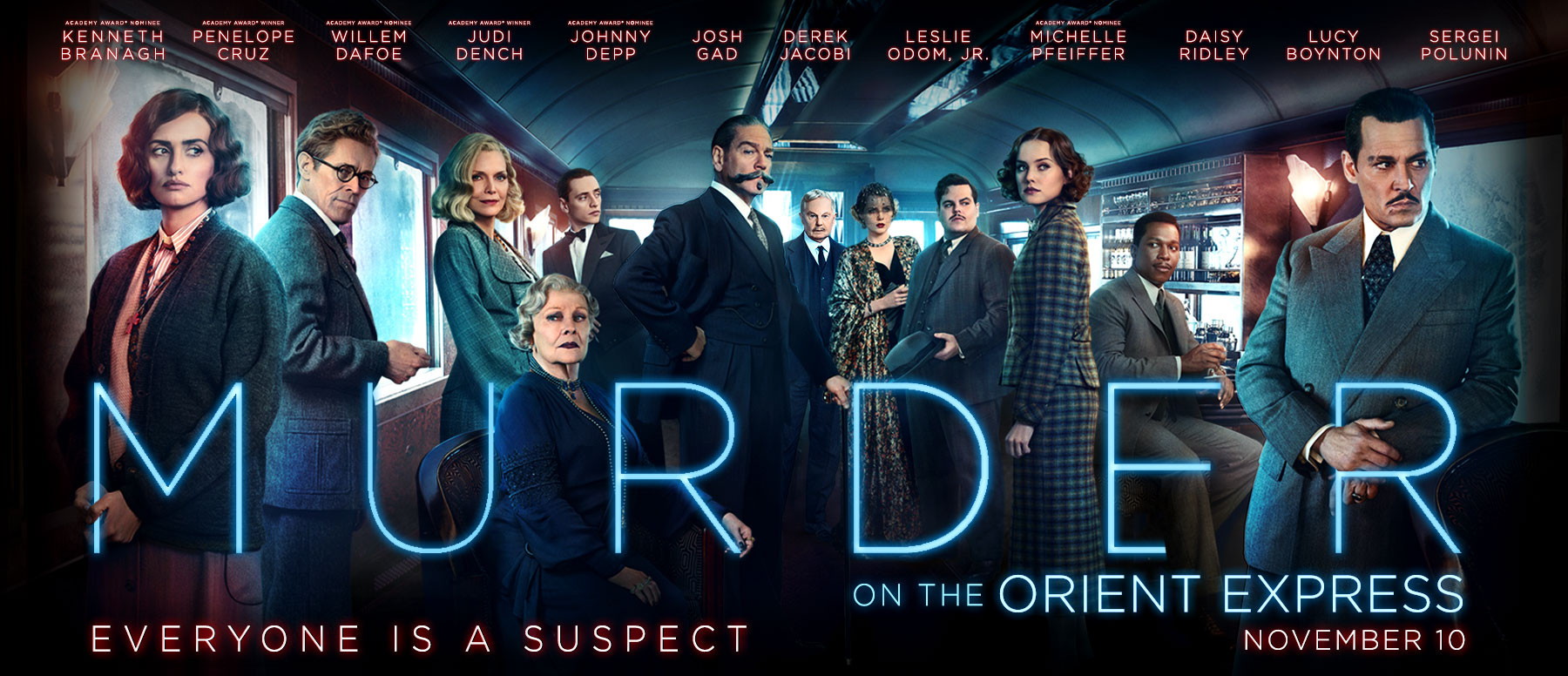
One of Agatha Christie’s most beloved mysteries has returned to the screen with another all-star remake of “Murder on the Orient Express,” this time starring Sir Kenneth Branagh, who also directed, as the brilliant Belgian detective Hercule Poirot. It does not have the lush glamour of the 1974 original, directed by Sidney Lumet, and the tone is uneven, but the tricky puzzle is still fun to try to solve, for those who have not read the book or seen the earlier film, and the international cast makes it entertaining.
We first see Poirot in Jerusalem by the Wailing Wall, one of the most sacred locations in the world. It is before WWII and Israel is not yet a state. A priceless relic has been stolen and the suspects, as Poirot notes, are right out of the set-up for a joke: a rabbi, an imam, and a priest. Poirot neatly solves the crime and even more neatly blocks the culprit’s attempt to flee. He explains that he is what decades later would be called obsessive-compulsive, so aware of patterns that he becomes deeply distressed when they are not symmetrical. He even refuses to eat two boiled eggs because they don’t match. But what causes him enormous anxiety in life turns out to be ideal for solving crime. “The imperfections stand out,” he explains. “It makes most of life unbearable but it is useful in the detection of crime.”
When he says he is going to take a nice long train ride and relax with a book by Dickens, we know he will soon be solving another mystery. As his friend, a handsome but louche train company official, says, a train combines three things: boredom, anonymity, and a gentle rocking motion, and that can lead to all kinds of fascinating possibilities.
Of course, in order to have a mystery, we have to have suspects and clues, so much of the film is taken up with introducing us to the cast of characters, a very international group, as one might expect on a train from Istanbul to Paris. It includes a friendly governess (“Star Wars'” Daisy Ridley as Mary Debenham), a British doctor of African heritage (“Hamilton’s” Leslie Odom Jr. as Dr. Arbuthnot), a professor (Willem Dafoe), an elderly countess (Dame Judi Dench), an Italian-American car dealer (Manuel Garcia-Rulfo), and a shy missionary (Penelope Cruz).
Some additions to the storyline are more distracting than illuminating. More seriously, they take away from our chance to get to know the very large cast of characters and that takes away from the sense of mystery and the stakes of the outcome. Shifts in tone give the film a disquieting inconsistency and flashy camera moves, like an extended shot looking down at the characters’ heads, serve no purpose except to make us wonder what they are supposed to be doing. Poirot is famously proud of his mustache, and so any depiction of the character must have some impressive facial hair. Branagh’s is close to farcical, making us wonder whether it merited or required its own trailer on set. One thing we know about Christie and her famous creations — they always knew exactly where they wanted us to be. This movie does not.
Parents should know that this film contains peril and violence including murder, references to kidnapping and murder of a child, suicide, miscarriage, gun, knife, scuffle, drinking, smoking, drugs, sexual references including prostitute, some racist comments, and some mild language.
Family discussion: Did Poirot make the right choice? What were the most important clues? What can you learn from him about observing significant details?
If you like this try: the original version with Albert Finney and other movies based on Agatha Christie stories like “Death on the Nile”
Posted on November 9, 2017 at 4:58 pm
National Geographic’s new series “The Long Road Home” is based on the best-selling book by journalist Martha Raddatz about soldiers sent to Iraq on a peacekeeping mission in 2004 who were ambushed on a day that came to be known as “Black Sunday.” The series is powerful, inspiring, and deeply moving as it lets us into the lives of those who were there and their families. In an interview, Raddatz talked about how she got the story, what she learned, and what she hopes the series, premiering as we prepare to observe Veterans’ Day, will teach us about the people who risk their lives — and give their lives — for our freedom and for each other.
The news footage from Vietnam on the news every night played a significant role in eroding the support for the war. We do not see that kind of coverage of what our troops are doing in Iraq and Afghanistan.
We did in the beginning. It was it was on all the time and take it from me because I was covering it. But it hasn’t been more recently and never in this way, in the way we tell this story about U.S. soldiers and their families and particularly families. It’s a really realistic, really raw, really warts and all, very nuanced look at war, if you can imagine nuanced war, this has got it.
What does nuance mean when you’re talking about war?
These aren’t a bunch of action figures. There is lots of breaking down doors and things like that. But they’re also very distinct people, regular people, real people. These are not Navy SEALs. These are not elite forces. These are soldiers who went over there thinking they were involved in a peacekeeping mission and found themselves ambushed and the other men in the battalion who reached out to rescue them in whatever vehicles they could find. Some of them are still serving on active duty, and I can’t remember a time when a series has portrayed soldiers still on active duty.
Was that an impediment to you in reporting on the story? Were there a lot of restrictions on what the soldiers were allowed to talk about?
They shared everything they possibly could with me. And one of the most remarkable things about this series is that the Army gave it its blessing and cooperated with us. They allowed us to shoot on base and build a 12 acre set with 85 buildings.
I think in so many ways right now Americans are ready to see this. And the Army is ready to see this. The Army is ready to say, “This is what we did and this is how we fought. This is where we went into places where we were totally unprepared for what was to come.” They saw everything before we shot it, including scenes with anti-war protesters. There’s an entire episode about a soldier who became a very outspoken war protester. So that is the kind of eye-opening experience you have with this series.
We see very clearly in the series that this is a war that’s being fought in the streets and in people’s homes.
It’s about as hand to hand combat as you can get. You look each other in the eye. There are some remarkably intimate scenes with soldiers facing down an enemy.
What have you learned about courage through reporting and telling this story?
Sometimes the people who are most courageous are the ones you never expect to be. You cannot predict it. But I also learned that courage is defined in different ways. It’s not always the ways you think. When we walk into a situation sometimes it takes a little while to find the courage to find that leadership or to find that bravery that keeps them going. Everyone finds it in a different way. And again some people don’t. And that’s the kind of broad spectrum you have.
Why was it important for you to talk to the families as well as the soldiers who were directly involved?
It’s the soldiers who told me to go talk to family because they said, “If you think it’s bad for us you should see the families and what they went through and what they have to experience and just not knowing.” The soldiers know what’s happening; they know what’s coming next. Those families just have to wait and their courage and their bravery every day, starting with that day of the ambush and years that follow this unit is I think really eye-opening for people. One of the wives would not drive into the garage behind the house without driving by the front of her house first just to make sure there was not a car up there that was going to notify her of her husband’s death.
Your work has been in television. What could you do in a book and now in a series re-creating the events that you cannot do in television news?
When I first began reporting on the story, we never had was any video. From the descriptions from the soldiers and the survivors of that battle we can see it come to life in the miniseries. It is the first time I’ve seen that come alive.
What is it that you want people to talk about with their families after they watch this show?
I want people to talk about the cost of war and to understand what it means to go to war. I want people to think about their responsibility to be informed and to have a voice to vote to do whatever it is that involves them in those life and death choices because fewer than one percent of our country serves in the military. Ninety nine percent do not. And the very least people who do not serve can do is understand the consequences.
Posted on November 8, 2017 at 8:47 pm
A year ago today, film crews across the country followed Americans as they voted and worked to get others to vote, as they wrote the news and watched the news, as they explained what issues mattered most to them and why, and as they participated in our quadrennial, Constitutionally-mandated Presidential election process. Pretty much everyone, Trump and Clinton supporters alike, optimists, pessimists, experts and amateurs, thought that Hillary Clinton was going to win. Pretty much everyone was surprised by the results. A new documentary, “11/8/16” brings those stories together.
Though we know the outcome, it is a gripping story, frustrating, sometimes sad, but ultimately very hopeful in the level of engagement, passion for progress, and willingness to work for change shown in almost every community.