
Scholastic is Selling Coal Power — to Children

Posted on May 11, 2011 at 2:34 pm

The Campaign for a Commercial-Free Childhood reports that esteemed publisher Scholastic is sending out “teaching materials” to schools that amounts to a commercial for coal power.  The coal industry, through the American Coal Foundation, has hired Scholastic to produce The United States of Energy, sent to tens of thousands of 4th grade classrooms around the country.  CCFC says:

Teachers are told that the curriculum aligns with national standards because it teaches children the advantages and disadvantages of different types of energy.  But while the lessons do extol the advantages of coal, they fail to mention a single disadvantage.  Nothing about the Appalachian mountains chopped down to get at coal seams.  Nothing about the poisons released when coal is burned.  Nothing about the fact that burning coal is the single biggest contributor to human-created greenhouse gases.

Schools should teach fully and honestly about coal and other forms of energy.  However, the materials produced by Scholastic are not genuinely educational; they are industry PR.

With budget cuts and inadequate resources, it is tempting to take advantage of these kinds of “free” materials created with industry support.  But schools should not present commercial material as a part of the curriculum — unless it is to teach children how to separate advocacy from objective, balanced information.  To protest this slanted information masquerading as a book and degradation of the Scholastic imprint, write to Scholastic CEO Richard Robinson.

Related Tags:


Advertising Books Elementary School Marketing to Kids Understanding Media and Pop Culture

7.5 Million Underage Facebook Users — New Report

Posted on May 10, 2011 at 10:30 am

Of the 20 million minors who actively used Facebook in the past year, 7.5 million of them were younger than 13, according to projections from Consumer Reports’ latest State of the Net survey.  Facebook’s terms of service require users to be at least 13 years old.

Also among this group of minors using Facebook, more than 5 million were 10 and under.  Consumer Reports survey found that their accounts were largely unsupervised by their parents, exposing them to malware or serious threats such as predators or bullies.  It is not only the underage users who are at risk. Children’s unsafe use of Facebook can expose the data on their parents’ computers and smart phones to abuse via identity theft and other privacy violations.

The report on Internet security, which includes the full survey results and advice for parents of Facebook users, is featured in the June issue of Consumer Reports and on www.ConsumerReports.org.

Social media is just one of the many ways consumers expose themselves and make themselves vulnerable to becoming a victim of identity theft or having to replace their computer. Earlier this year, Consumer Reports surveyed 2,089 online households nationwide and found that one-third had experienced a malicious software infection in the previous year. Consumer Reports estimates that malware cost consumers $2.3 billion last year and forced them to replace 1.3 millions PCs.

Consumer Reports recommends:

Being Social but Safe

  • Monitor a child’s account. Parents should join their children’s circle of friends on Facebook.  If that’s not feasible with an older teenager, keep tabs on them through their friends or siblings, as did 18 percent of parents surveyed who had 13- to 17-year olds on Facebook. Parents should delete a pre-teen’s account or ask Facebook to do so by using its “report an underage child” form.
  • Utilize privacy controls. Roughly one in five active adult Facebook users said they hadn’t utilized Facebook’s privacy controls, making them more vulnerable to threats. Facebook’s privacy controls may not prevent every breach but they help. Users should set everything they can to be accessible only to those on their friends list. Enabling a public search allows users’ profile picture, friends list, activities and more to be visible online outside of Facebook.
  • Turn off Instant Personalization. Facebook has been adding sites to its Instant Personalization feature, which automatically links accounts to user-review sites such as TripAdvisor (travel) and Yelp (local businesses). Users who don’t wish to share what cities they have visited with their Facebook friends via TripAdvisor should disable Instant Personalization, which is turned on by default.
  • Use apps with caution. Even though Facebook says in its privacy policy that it doesn’t share identifiable information with advertisers without permission, connecting with an app or website allows access to general information. Users should check the list of apps they are using and define the settings for each one listed. Decide what information the app can access, when possible, or perhaps eliminate the app altogether. Also, users should limit access to their information that is available to apps that friends use.

Protecting a Mobile Phone

  • Use a password or PIN. The easiest way to protect data against loss is with a personal identification number (PIN) or password on a phone. Most cell and smart phones have an option to do so under settings or security options. Consumer Reports’ survey found that only about 20 percent of mobile phone owners using their phones in potentially risky ways such as storing sensitive data had taken this precaution.
  • Take advantage of security services. Many smart-phone makers offer free security services such as over-the-air backup, remote phone locating, remote phone locking, and erasing of data and account information. There’s software available that allows users to lock the phone or erase data remotely. Users who don’t need the phone’s GPS feature should disable it.
  • Use caution when downloading apps. Only download apps from recognized sources.  Make sure many others have already used it and read reviews before downloading it.  Also, scrutinize the permissions an app requests. If any seem questionable, such as a request to track location when there’s no obvious need for the app to do so, don’t download the app.


Related Tags:


Internet, Gaming, Podcasts, and Apps Parenting Tweens
Half a Century of the ‘Vast Wasteland’

Half a Century of the ‘Vast Wasteland’

Posted on May 9, 2011 at 2:48 pm

Fifty years ago today, my dad, Newton Minow, the 35-year old Chairman of the Federal Communications Commission, spoke to the National Association of Broadcasters.  What he said was so ground-breaking and so resonant that it has been included in many collections of the best speeches of the 20th century.  It has also been used as an LSAT question, a “Who Wants to Be a Millionaire” answer, and, most memorably, as the inspiration for the name of the sinking ship on Gilligan’s Island.

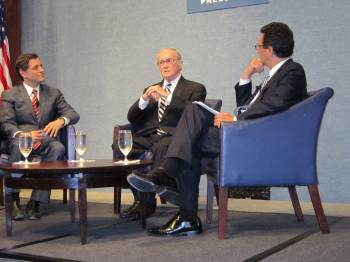
Tonight, Dad will appear at the National Press Club with the current Chairman of the FCC, Julius Genachowski, to talk about the impact of the speech, the stunning revolution in media and technology over the past five decades, and what lies ahead.  If you’re not able to come, you can watch “From Wasteland to Broadband” on C-SPAN. 

Some tributes and commentaries on the anniversary:

Virginia Heffernan in the New York Times: Television’s Curse was Its Blessing

James Warren’s interview with Dad for the Chicago News Cooperative: Never Mind the ‘Vast Wasteland’ — Newton Minow Has More to Say

Bob Lerhman in Politico: Minow’s Whale of a Speech

Katie O’Brien on WBEZ: Is Television Still a Vast Wasteland?

James Fallows in The Atlantic: Worth Watching — Newton Minow 50 Years Later

Tony Mauro in Legal Times: 50 Years Later, Minow Reflects on ‘Vast Wasteland’ Speech

Jess Bravin in the Wall Street Journal: Vast Wasteland: Marking the 50th Anniversary

On the Media

KPCC

And my dad’s own views about the NAB conference and what happened afterward.

I am very, very proud of my wonderful parents, who have not only devoted their lives to healing the world, from the most individual, personal attention to the most monumental change (Dad helped to create and currently co-chairs the system of Presidential debates), but who set an example for my sisters and me of integrity, fairness, and dedication to family that will always inspire us to do better.

(more…)

Related Tags:


Commentary Television Understanding Media and Pop Culture

‘My Girl’ Grows Up — Anna Chlumksy in a New DC Satire

Posted on May 6, 2011 at 3:56 pm

Slate’s Jessica Grose has a terrific interview with the wonderful Anna Chlumsky, child star of the 1991 classic “My Girl.”  Chlumsky took time away from acting to finish school and work as an editor before returning to star in this week’s Hallmark Channel movie Three Weeks, Three Kids and in the upcoming HBO series “VEEP,” from “In the Loop” writer/director Armando Iannucci.  She will play the chief of staff to a U.S. Vice President (Julia Louis-Dreyfus).  The interview is well worth reading — she is smart and funny and has some great stories.  And I love her answer to the question about whether Iannucci’s view is that politics is futile:

I agree that there’s a sense of “nobody’s a hero,” so there’s a futility in that sense. Does it mean that it’s a bad thing? I don’t know. Is just is. VEEP is going to be like that. Nobody’s safe. I get so bored when this person’s bad and this person’s good. My first litmus test when I see a piece or read a piece is: Is someone feeding me answers or did I leave with questions? That’s for me the only way to make an excellent piece.

It’s good to have her back!


Related Tags:


Actors Television
THE MOVIE MOM® is a registered trademark of Nell Minow. Use of the mark without express consent from Nell Minow constitutes trademark infringement and unfair competition in violation of federal and state laws. All material © Nell Minow 1995-2026, all rights reserved, and no use or republication is permitted without explicit permission. This site hosts Nell Minow’s Movie Mom® archive, with material that originally appeared on Yahoo! Movies, Beliefnet, and other sources. Much of her new material can be found at Rogerebert.com, Huffington Post, and WheretoWatch. Her books include The Movie Mom’s Guide to Family Movies and 101 Must-See Movie Moments, and she can be heard each week on radio stations across the country.

Website Designed by Max LaZebnik