This is the second movie based on the wildly popular series of Diary of a Wimpy Kid books by Jeff Kinney. Last year, in Diary of a Wimpy Kid, we saw Greg Heffley (Zachary Gordon) begin the agonizing experience of middle school. This movie opens with Greg and his best friend Rowley (Robert Capron) starting their second year in middle school, convinced that everything is going to be different. They have learned from their experiences and torments of their first year, and now begin their second year all grown up and sophisticated.
It doesn’t take them long to discover that an entirely new catalog of horrors is awaiting them. They’re all here: the embarrassment in front of the pretty new girl in class, the embarrassment in the school cafeteria, the embarrassment at the hands of bullies after school at the skating rink, the embarrassment caused by that suspiciously located stain on your pants, the embarrassment from the over protective mother, the embarrassment from the intercepted note in class, the embarrassment from mistakenly walking into the wrong restroom…it’s hard to think of a single childhood humiliation that has been omitted from this comprehensive inventory. Many of these situations are divided by age group. Greg is hounded by his three-year-old brother who just wants to play with the bigger boys, while Greg in turn hounds his older brother Rodrick (Devon Bostick) because Greg is curious about what goes on at “high school parties.” All of the kids in turn had situations with their parents, and a different set of issues with grandparents living at a home for seniors.
Halfway through this movie, Rodrick hisses to Greg, “You’re my brother, but you’ll never be my friend.” And yet, there is progress. Gradually, Greg forms alliances with family members. He and his brother protect each other. He and his mother reach understandings and enter into pacts. This is not just a repeat of the first year of middle school after all.
Kinney does a good job of remembering and portraying these childhood traumas. School children will laugh and groan in recognition of these misfortunes and will take heart from the fact that Greg somehow
manages to survive them all. Adults may cringe at some long dormant feelings, re-awakened by this movie, and feel more sympathy for the burdens of their school aged children. (more…)
We miss the performers who left us too soon almost as though we knew them.
In a new book, Phil Hall and Rory Leighton Aronsky ask What If They Lived?, with essays about stars and almost-stars from the silent era to the present, with biographical details, career assessments, and fascinating glimpses of projects they might have completed if they had lived longer. Hall was kind enough to answer my questions.
Q: How did this book come about?
Phil Hall: I always wondered what would have become of the great stars that died too young. If you see James Dean in “Giant” or Marilyn Monroe in “The Misfits,” it is difficult not to rue that there would be no further performances from its iconic stars – but if fate was kinder, could they have topped what they already created? The idea for the book percolated for years, but my attempts to get a publisher interested in the project were in vain. For whatever reason, many publishers did not think this was a good idea. Fortunately, BearManor Media, the publisher of my last book – The History of Independent Cinema – was convinced that this had potential. Rory Leighton Aronsky joined me as the co-author on the project, and here we are!
Q: Do you have a favorite of the stars that you wrote about?
Phil Hall: The biggest surprise for me was Jayne Mansfield. Many people have dismissed her as a second-rate Marilyn Monroe imitator that audiences rejected. In fact, she was an extremely talented comic actress and her films were popular. Unfortunately, her studio, 20th Century Fox, found it more profitable to loan her out to cheapo production companies for crummy movies rather than build star vehicles around her. That wrecked her film career. But she could have worked steadily without being a movie star. In the mid-1960s, she sold out New York’s Copacabana at a time when nightclubs were considered passe. I also found a clip of Mansfield appearing as a “mystery guest” on the TV show “What’s My Line.” She received the most thunderous audience response imaginable when she came on stage – and this was two years before her death in a 1967 automobile accident.
Q: Some of the performers you wrote about died as big stars, but some died before they achieved all they were capable of. Which of the stars you wrote about do you think would have surprised audiences the most by showing more than anyone knew they were capable of?
Phil Hall: By the time of his death, Robert Walker was on the cusp of showing a depth of versatility that was not present in many of his films. Walker spent most of the 1940s playing a light leading man or a stolid military type. In his last two films, “Strangers on a Train” and “My Son John,” he showed that he was capable of handling dark, complex dramatic roles. This would have opened a new avenue of career possibilities, and he think that could have enjoyed a long and successful career.
Q: You write about stars like James Dean and Marilyn Monroe who continue to be modern-day icons and others like Judy Tyler and Evelyn Preer who are hardly remembered. Why do some stars remain so present in our culture and others do not?
Phil Hall: A lot of it depends on their output. Judy Tyler had a solid career in television and theater, but she only made two films – and only one, “Jailhouse Rock,” is remembered today. The bulk of Evelyn Preer’s cinematic output came in the all-black “race films” produced by Oscar Micheaux, but most of these films are considered lost. A great deal of public recognition also rests on the role of film critics and scholars in defining the popular cinema culture. For example, Larry Semon was a very popular star of comedy films in the 1920s, but very few contemporary critics or scholars are willing to champion in his cause. And, in some cases, we remember the stars because of off-screen tragedies rather than on-screen triumphs: Roscoe Arbuckle, Thelma Todd and Sharon Tate are the most prominent examples. But the beauty of cinema is the ability to preserve a performance forever, with the hope that future generations will come to re-evaluate a star’s personality and talent. I would say that there is a greater popular appreciation of Dorothy Dandridge and Jayne Mansfield today, due in large part to critics, scholars and fan revisiting their performances and recognizing their value to the film culture.
Q: Is there one uncompleted project you wrote about that you most wish could have been made?
Phil Hall: Laird Cregar was supposed to do a Broadway version of Shakespeare’s “Henry VIII,” but he died before the production could take shape. I cannot imagine a better actor to play the monarch, and he could have easily made it into a signature role that could have been taken to the film or television screen.
Q: Your profiles of each of the stars are insightful and evocative. How did you do your research?
Phil Hall: By reading too many books, magazines and websites, and by having conversations with experts who knew more about the subject than I could. For example, online film critic John J. Puccio is also an expert on classical music, and he provided invaluable opinions regarding Mario Lanza’s future potential, while rock music writer Ricky Flake helped me speculate on the future that Elvis Presley never had.
Q: Why do you think Judy Garland would have focused on concerts rather than movies if she had lived?
Phil Hall: I think there would be a combination of factors. First, there was a lack of quality roles for women of Garland’s age and personality. Second, Garland had a reputation for being (for lack of a better word) difficult, and many producers were not eager to take that risk. Third, there was the same problem that kept Montgomery Clift away from films: getting insurance for the star. Garland’s health problems were front-page news for years, and her presence in a film would have jacked up the budget in order to cover her insurance.
Q: Some of the people you wrote about had their careers limited by racism, sexism, or homophobia. Did that influence your ideas about what would have been possible for them if they had lived until more tolerant times?
Phil Hall: It did, because the contemporary concept of tolerance was a fairly recent development. We cannot create an alternative universe for the past where these talented people could have flourished without the restrictions that limited their careers. At the same time, we have to take into consideration another discriminatory concept: ageism. Hollywood is an industry that in constantly on the search for young new faces – good parts for people in their forties or older are difficult to come by, especially for women. What roles would exist for a 50-year-old Marilyn Monroe? It would be like that lyric from Stephen Sondheim’s “Follies”: “First you’re another sloe-eyed vamp. Then someone’s mother, then you’re camp.”
Elizabeth Taylor, who exemplified grace, beauty, and stardom, has died at age 79. In an era of reality show “celebrities” and fame that lasts not 15 minutes but 15 seconds, Elizabeth Taylor reminds us of what it meant to truly be a star. She will be remembered for her flamboyant, headline-grabbing personal life — the eight marriages to seven men, the tempestuous romance with Richard Burton, the jewelry, her kindness to troubled performers like Montgomery Clift and Michael Jackson, her tireless work against AIDS. But it is her work that truly endures, from her performances as a child in “Lassie Come Home,” “Jane Eyre,” and “National Velvet” to her Oscar-winning role in “Who’s Afraid of Virginia Woolf.”
I will have a more complete tribute soon. For now, just a moment to mourn her passing. May her memory be a blessing.
Interview: Tom McCarthy and Alex Shaffer of ‘Win Win’
Posted on March 23, 2011 at 8:00 am
Copyright Searchlight 2011
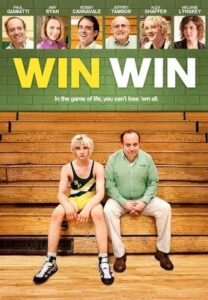
Tom McCarthy has appeared as an actor in movies like “Duplicity” and “Baby Mama” but he is now better known for his writing and directing the acclaimed films “The Station Agent,” the Oscar-winning “Spotlight,” and “The Visitor.” His film “Win Win,” stars newcomer Alex Shaffer as a teenage wrestling champ who ends up staying with a lawyer/coach played by Paul Giamatti when his grandfather, who is in the early stages of dementia, is placed by Giamatti’s character into a nursing home. I spoke to both of them about wrestling, writing, what it feels like to be good at both, and doing whatever it takes.
I don’t know much about wrestling so I was surprised by how fast you moved.
TM: Especially the lighter weights. They are really exciting. The lighter weights it’s just wicked to watch. That match that I went to at your school – even the refs couldn’t keep up.
AS: Over 130 or 140 it’s more about strength.
One of the key moments in the film has Paul Giamatti’s character asking your character, Kyle, what it feels like to be that good at something. Kyle says it feels like being in control. Is that how it feels?
AS: For Kyle, for me it just feels good to be that good. It’s a very comforting feeling.
TM: That would have been a good answer for Kyle, too.
What makes you feel that good?
TM: I like being immersed in work. I like it when I’m in a sweet spot in the work. When I’m writing I have a ritual or a regimen and I get really lost in it, get out of my own head and follow an idea, or a story, or a character. I really like being in that space.
What was the beginning of the idea of this movie for you?
TM: I have this mental folder that I drop things into and when they feel like they’re of the same world I start to put together the movie. It certainly was the wrestling at the beginning. I called Joe , my co-writer, and said, “Have you ever seen a movie about high school wrestling?” We started to joke about our own bad experiences and then talked about the good ones, the world in general, how unique a world it was, looking back on it 20 years later.
And the other idea was about where we are in society, the title, “Win Win,” like “Oh, you can have a mortgage and pay nothing and a car and put no money down” and we all believed it for a while. Oh, that’s great, why wouldn’t you do that! It will cost nothing! The other idea that aligned with that thought was that we are polarized in society. The bad bankers did bad things – but those people are our neighbors. We ride the train, the bus with them. They’re not bad people; they just made some bad choices.
So wrestling with that part of our human condition – we all have that aptitude, to so surprisingly and sometimes shockingly bad things in certain scenarios. Mike is confronted with that and that I felt very interested in. It’s not enough to say, “I have a family, I have a good job, I’m a good person.” That is not an excuse or a guarantee. That I found interesting.
Alex, you went from doing something that you knew very well and were very good at to something that was completely new to you, and you were surrounded by some of the most experienced and talented actors in movies. What was that like for you?
AS: I wasn’t nervous because it was something I didn’t care about that much. Sorry, Tom! Halfways, no more like one-third of the way through, I began to think, “I really want to do good. I like this guy, I don’t want to ruin the movie for him.”
TM: I think that’s a good way to go into it! I think that’s a problem for a lot of actors who go into an audition wanting it so badly, they sabotage themselves because they’re so anxious. I think when I stopped caring about acting quite so much, when I got more involved in writing and directing, either I’m right for it or not, I started getting more jobs.
How did you like being a blonde for the filming?
AS: I was a blonde before the filming.
TM: He came to us like that!
AS: It wasn’t my idea for the movie. Our team before we wrestled Phillipsburg, not every year but when the team’s good, we want to psych them out, so that year the whole team bleached our hair blonde.
I thought it was very funny that Amy Ryan’s character Jackie called you Eminem.
TM: We got a studio note about that: “Emeneim, isn’t he a little bit past now?” I don’t think Jackie’s cutting edge! And besides, now he won the Grammy!



 , with essays about stars and almost-stars from the silent era to the present, with biographical details, career assessments, and fascinating glimpses of projects they might have completed if they had lived longer. Hall was kind enough to answer my questions.
 – was convinced that this had potential. Rory Leighton Aronsky joined me as the co-author on the project, and here we are!