Beliefnet’s “How Spiritual is Your Family” quiz made me think of these movie families, among the very few on screen who are unabashedly spiritual.
1. The Blind Side Based on a true story, this movie makes it clear that a wealthy white family’s decision to adopt a homeless black teenager was not an impulse but was strongly grounded in a deep religious conviction.
2. The Friendly Persuasion is a rare movie that grapples with a loving family’s challenges in applying religious principles to difficult and complicated circumstances but with a supportive community. It is an even rarer movie that shows a character praying for guidance.
3. The Sound of Music a postulate brings not just music and warmth to a motherless family, but also the strength of her faith.
4. Fiddler on the Roof We see the family’s connection to their Jewish traditions and faith and to each other in the way they work to apply God’s laws and in their Sabbath rituals.
5. Not Easily Broken A young couple finds that it takes three to make their marriage work — the husband, the wife, and God.
Interview: Conor McPherson and Ciarán Hinds of ‘The Eclipse’
Posted on March 25, 2010 at 7:00 am
“The Eclipse” is a ghost story for grown-ups, which means that it is story first, ghost second. It is an Irish film about Michael (Ciarán Hinds) a recent widower with two children, who is volunteering at a local literary festival. Two of the festival guests are the arrogant, self-centered Nicholas (Aidan Quinn), a novelist, and the sensitive Lena (Iben Hjejle), author of a popular non-fiction book about ghosts.
I spoke to Hinds and writer/director Conor McPherson about the film. What do people ask you most about the film?
CM: They want to know exactly what was going on, to answer the questions the movie leaves unanswered. Yes, Americans are very concrete, very literal. We want everything explained.
CM: When people are out of their comfort zone, it’s more dramatic, more prone to have more entertaining experiences, get into fights. That’s the dramatic instinct, to move people out of what they know and make them deal with it. In theater it’s all through dialogue in traditional plays. In movies, it’s so lovely, you can show him putting dishes in the dishwasher and everybody just knows what’s going on, that his wife is gone and he has to do everything. You still tell some things with dialogue in scenes but we’ve taken some away…
CH: Pared it away, really.
CM: And that’s enough. Film has that magic. You play a quiet person in this film. How do you as an actor convey all you have to about what he is thinking and experiencing?
CH: He’s just a guy like anybody. We’re all ordinary in a way. We can all be hurt. We can all be unbalanced. We all have feelings. Life can treat us harshly, even shockingly sometimes. He has minor pretensions but he is a woodwork teacher. He works with his hands. He is a practical man. But though he is doing his best with his wife gone he is out of his depth a bit apart from the grief. He’s a real person but you bring elements of emotion to a heightened situation. He just wants to survive and take care. I loved his interaction with his kids. It felt very real. The frustration and the need to convey a sense that he is in control.
CH: When Lena says she is sorry to hear about his wife he responds, “It was terrible for the kids.” He knows he hasn’t grieved enough but he has to keep a lid on it for the kids. In the end, in the story, he is allowed to let it all out and properly to grieve. Do you find that now, like Lena in the film, people want to come and tell you their own ghost stories?
CM: At the first screening last April in New York, it turned into a sort of heavy session with people talking about how they lost people and the film made that feeling come back. It’s probably the last thing you think about when you’re making a film is other people’s problems. You’re thinking about your problem, which is making the movie. But you do have a responsibility. You can’t mess around with people’s emotions.
CH: You find people genuinely relating to something or a truth they felt, and that is what you aspire to. Do you believe in ghosts?
CM: Yes I do, but I don’t know what they are. I don’t think I’ve ever seen one. But if someone said to me, “Last night I saw the ghost of my sibling” or whatever, I wouldn’t say, “That’s impossible,” I’d say, “What was that like?”
CH: I don’t disbelieve.
CM: There’s a very old tradition in Ireland, and as an island at the edge of Europe, for thousands of years with no one knowing what was beyond there, I wonder if a sense of the beyond was internalized into the Irish psyche. We’re very quick to accept the supernatural. And I think Catholicism took root very quickly in Ireland because it’s a very superstitious religion, the holy ghost, the holy spirit, it has a goddess, very visual, the music. For me, philosophically, we don’t know anything anyway. We have this short little life we have to somehow try to get a grip on without understanding anything about the nature of time or existence or the universe or God or infinity. We’re just here for a brief moment and we open up these little eyes and go “What is this?” and then we’re gone! I love stories that frame that: This is what life is about — you don’t have a clue.
Interview: Dean DeBlois and Chris Sanders of ‘How to Train Your Dragon’
Posted on March 24, 2010 at 3:59 pm
Dean DeBlois and Chris Sanders are the writer-directors behind one of the best family films of the year, “How to Train Your Dragon.” It was a very great pleasure to talk with them about adapting the popular books and the movies they love most.
One of the great pleasures of this film is the fabulously imaginative assortment of dragons. Were they based on research into legends about dragons or did you start from scratch?
DD: The well-spring of the dragons who are in the film started in the book, of course, but really it was Nico Marlet, who also did designs for Kung Fu Panda. We have seven dragons in the movie, five of which are his designs. He has piles of drawings in his room, no kidding, about two feet thick of other dragons that he drew. It’s endless. We realized we had an opportunity in this movie to do something that had not been done before — not just multiple breeds of dragons but individual personalities.
Each new dragon turned all my thoughts on what a dragon was upside down.
DD: Each of them was based on animals we recognize in the animal kingdom. For example the gronkles, the big, fat, dump-truck-like dragon, was based on the walrus and has walrus-type behavior, lying around in packs and being lazy and grumpy. And then the nadders, the blue ones with the yellow spikes, they’re very parrot-like, and they have bird-like actions. Toothless is very feline. But he has dog in him, too. He’s based in part on the black panther, so he has mammalian qualities to him. One of the characters has two heads and is very snake-like and slithery. So every one of them had an animal reference to it, and that influenced its behavior both in personality and movement.
Did you have to think about the physics of the way they moved?
CS: There are links to the larger world that we wanted to create for this film. The believability factor was the most important thing. They have to move and breathe as if they’re really alive. It’s important that they not come across as too cartoony because then we would lose the emotional weight in the film. We wanted people to really believe in this world. Even though the designs are really fanciful, they move and breathe as though they’re really alive. They adhere to a strict set of rules. They never break or shatter that illusion.
The voice talent is terrific. But your Vikings (Gerard Butler and Craig Ferguson) have Scottish accents!
DD: It’s a conceit. It’s silly and admittedly flawed, but here it is: growing up in North America, I was in Canada, I had a lot of friends whose parents sounded like they came from somewhere else. There’s always a remnant of the mother tongue in the older generation. When we came on the film, they’d already cast people with very American voices and then they had Gerard Butler. We had to cast someone to be Gerard’s best friend and the confidante to Hiccup. We thought, we’ve already got this Scottish voice in place, and we could just flesh out the rest of the older generation with Scottish accents and then the next generation could have their own assimilated accent.
CS: Gerard really loved it when we encouraged him to be himself. The only casting that we did was Craig Ferguson and he happens to be Gerard’s really good friend and they happen to have the same accent. Craig Ferguson is completely at ease in front of a microphone. It’s funny because Gerard Butler is really funny off-mic, constantly goofing around and talking about pranks, amusing himself. And then when he’s on mic, well, his character is called Stoick. He was a little jealous — “Why is Craig getting all the funny lines?” But Craig, off-mic, was the opposite. He’s so funny when you have the mic running, and then when you stop, he’s actually a serious guy.
I was also thrilled to see that you have three disabled characters. You rarely see that in movies, especially disabled characters who have full personalities and experiences and are not just there to be disabled.
DD: Definitely we brought to the mix the ending, for many reasons. We wanted to give it a little bit of weight, believability, and peril. The satisfying quality of the ending would be generic if he did not come out of it so that he and Toothless can complete each other.
How did you go about adapting the book? You made some big changes.
CS: The main reason Dean and I were asked to come into the film was to “age it up,” giving it a little more weight, more adventure, and one of the very first decisions we made was that in the book there were elements of humans and dragons being in a symbiotic relationship but also elements of humans and dragons being at war. We decided it had to be one or the other. We made the decision that they were mortal enemies, which made it possible for Hiccup to take the greatest risk possible by befriending one. It allowed us to have Hiccup live this double life in the second act. At night he’s repairing a dragon and learning to ride a dragon. By day he is learning to fight one. This is not going to last. This has to get discovered. Everything else came from that.
DD: It’s fun that by the end he gets everything he wanted but he no longer wants it. The attention he’d rather avoid by then.
What movies are your favorites?
CS: Both of us are huge fans of a movie we referenced in this one, The Black Stallion. The scene on the beach is our homage.
DD: What really worked for us was the young protagonist. I love characters that are young and relatable in their childhood but also have adult qualities and are in over their heads in a world of fantasy, like “Escape from Witch Mountain,” “Watcher in the Woods,” and even “E.T.”
The movie is very rich, very exciting, but also exceptionally well-paced and satisfying.
CS: A lot of movies do not have much in the second act, but we really had one packed with events. But it is also important to have moments when the characters are quiet. There are three moments in the film where we let the camera and the acting and the music tell the story.
I liked the fact that he is really an engineer, a problem-solver. And he doesn’t get it right away.
DD: In the concept of the book Hiccup was much younger and they collect eggs and teach the dragons to do tricks. We kept the spirit of the runt Viking who changes the world but we had to give him a dragon who could be ferocious and at the same time cuddly. We thought he’s a nuisance, he’s the bane of the Viking community. He is made an apprentice to get him out of the way but in the shop he learns to compensate for what he doesn’t have. We combined this organic form with early mechanics.
CS: He also discovers that he has to operate it. He is only really himself when they’re together.
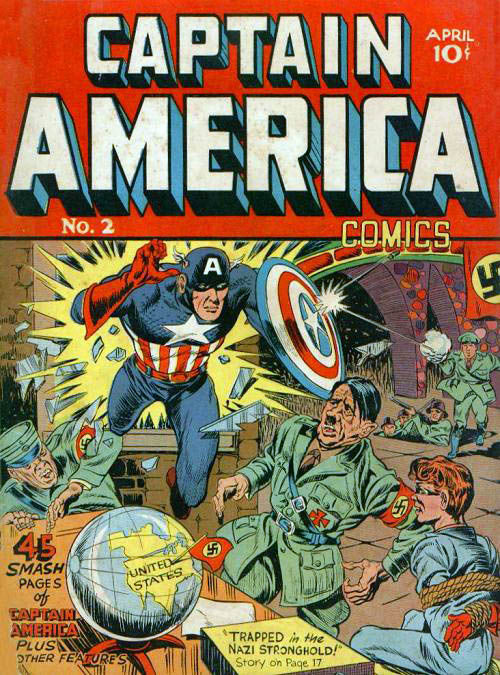
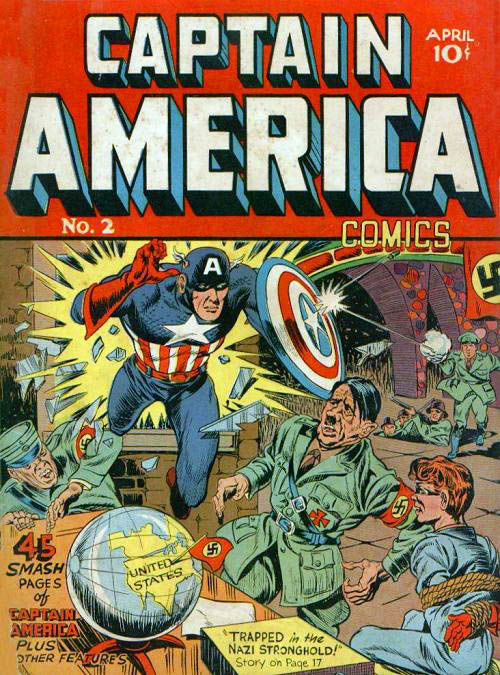
This week’s announcement that Chris Evans (“The Fantastic Four”) will star in a new “Captain America” movie makes this the right moment to think about the history and meaning of the character. Never as iconic and popular as Superman or Batman, Captain America’s status has risen and fallen according to the political sentiments of the era. Unsurprisingly, he first appeared at a time of the most vibrant patriotism, the beginning of WWII. The character was Steve Rogers, a sickly young man who was given an experimental Super-Soldier Serum and “Vita-Ray” treatment that made him very strong and healthy in order to aid the United States war effort. His costume was inspired by the American flag. He has no superpowers but he carries a red, white, and blue indestructible shield. Captain America was often portrayed as fighting for the Allies and he was Marvel’s most popular hero during the war.
But his popularity waned in the Cold War era. His explicit Americanism did not fit either the complacence and materialism of the 1950’s or the Cold War concerns. He disappeared from comics until 1964. Interestingly, a character who appeared to be Captain America was featured in a comic book story starring the Fantastic Four’s Johnny Storm (also played by Evans on screen). But that character turned out to be a villain in disguise. The unabashed pro-Americanism of the character did not fit well with the turbulence of the 1960’s and Captain America himself became so disillusioned with the government following Watergate that he took on another persona for a while. In another episode he led a protest against government oppression of superheroes that was a commentary on infringement of civil rights. The character has had many different iterations and the Steve Rogers alter ego has died and been brought back and been in suspended animation and been brought back as the Captain America identity has shifted as well for a while being taken over by Roger’s one-time sidekick. There is also a black Captain America named Isaiah Bradley, whose origin was explicitly inspired by the real-life Tuskegee experiments. He was injected with the serum before Rogers.
Chris Evans was one of the best things about the uneven “Fantastic Four” movies and I look forward to seeing where he takes this character.
My beloved spoke, and said unto me: ‘Rise up, my love, my fair one, and come away. For, lo, the winter is past, the rain is over and gone; The flowers appear on the earth; the time of singing is come, and the voice of the turtle is heard in our land; The fig-tree putteth forth her green figs, and the vines in blossom give forth their fragrance. Song of Solomon
Daffodils that come before the swallow dares and take the winds of March with beauty. Shakespeare, A Winter’s Tale
in Just-
spring when the world is mud-
luscious …
when the world is puddle-wonderful E. E. Cummings
Happy spring!
These movies celebrate the return of longer days, milder breezes, and a sense of promise and renewal.
1. Seven Brides for Seven Brothers Bachelor mountain men brothers capture young women from the town one winter so they can marry them. An avalanche blocks off the pass and keeps their families from coming after them. But the women are furious and banish the men to the barn — until spring thaw, when everyone comes outside to enjoy the weather and sing Johnny Mercer’s lyrics: “Oh, the barnyard is busy in a regular tizzy, And the obvious reason is because of the season. Ma Nature’s lyrical, with her yearly miracle. Spring, Spring, Spring.”
2. The Secret Garden There are three excellent versions of this classic book about the sour orphan and her ailing cousin who are both made whole and healthy when they find a locked garden and bring it back to life. My favorite is the British miniseries, which is the closest to the text, but I love them all.
3. State Fair The only Rodgers and Hammerstein show written directly for the screen takes place at the end of the summer, but it has one of the greatest songs ever written about spring, the Oscar-winning “It Might as Well Be Spring.” The lovely Jeanne Crain sings, “I am starry eyed and vaguely discontented, like a nightingale without a song to sing, O why should I have spring fever, when it isn’t even spring.”
4. Random Harvest One of the sweetest love stories in the movies is about a merry young woman who falls for a man who has lost his memory. They get married and are very happy until he regains his memory and goes back to his old life, no longer able to remember her or their life together. A lot more happens over many years, and the final scene takes place by the lilacs on a spring day that shows us — and the couple — all we need to know about renewal.
5. Where the Boys Are Four girls leave their snowy college campus for spring break in Fort Lauderdale, Florida. It was considered very racy back in 1960 for its discussion of premarital sex (including one character who pays a very heavy penalty for having sex with a boy she barely knows) but is something of an artifact these days. Still the performances by Dolores Hart (who later became a nun), Jim Hutton, and Paula Prentiss and the themes of finding a way to balance intimacy and self-respect still hold up.
6. Bambi “Nearly everybody gets twitter-patted in the springtime,” says the owl in this animated Disney classic about the young fawn. The spring scenes are among the most enchanting in a woodland story about young animals growing up. (NOTE: some scary scenes including a forest fire and a hunter who shoots the deer)
7. Spring, Summer, Fall, Winter… and Spring An isolated Buddhist monastery sits on a quiet lake in the middle of a forest, where one monk and his very young apprentice live a life of quiet prayer and contemplation. The film takes us through the seasons of the younger man’s life, from childhood through old age, with the final spring as a time of renewal, the now-old monk teaching his own young apprentice about life’s cycles and interconnections.
8. The Four Seasons Alan Alda wrote and directed a film that takes four couples through a year to the music of Vivaldi. It begins with a spring trip to the country, when they cook an elaborate dinner and plan the rest of their trips together for the rest of the year. But one couple breaks up and the husband wants to bring his new young girlfriend, it leads to some mid-life questions about meaning, trust, and loyalty. Alda’s wise script and sensitive direction and outstanding performances from Carol Burnett, Len Cariou, Jack Weston, and Rita Moreno make this one of the best films ever about grown-up friendship.
9. “It Happens Every Spring” Ray Milland stars in a sweet fantasy about a baseball-loving professor who invents a chemical that acts as a wood repellent. He realizes that if he rubs a little on a baseball glove, it makes him the greatest pitcher in the world because the bats cannot connect with the ball. Written by the author of “Miracle on 34th Street,” this is a gentle fairy tale with some of Hollywood’s greatest character actors among the players and a hark back to an era before steroid scandals and superstar salaries.
10. The First of May This modest little gem is the story of a boy named Cory (“Cougar Town’s” Dan Byrd) who runs off one spring to join the circus. It is a sweet, episodic story with many magical moments, including delightful backstage glimpses of life in the big top. Co-stars include the brilliant Julie Harris and Mickey Rooney and Cory even gets some batting advice from Joe DiMaggio, who appears as himself. Families of all kinds will respond to this story about people who triumph over a series of obstacles to create a family for themselves.




 Bachelor mountain men brothers capture young women from the town one winter so they can marry them. An avalanche blocks off the pass and keeps their families from coming after them. But the women are furious and banish the men to the barn — until spring thaw, when everyone comes outside to enjoy the weather and sing Johnny Mercer’s lyrics: “Oh, the barnyard is busy in a regular tizzy, And the obvious reason is because of the season. Ma Nature’s lyrical, with her yearly miracle. Spring, Spring, Spring.”
 The only Rodgers and Hammerstein show written directly for the screen takes place at the end of the summer, but it has one of the greatest songs ever written about spring, the Oscar-winning “It Might as Well Be Spring.” The lovely Jeanne Crain sings, “I am starry eyed and vaguely discontented, like a nightingale without a song to sing, O why should I have spring fever, when it isn’t even spring.”
 One of the sweetest love stories in the movies is about a merry young woman who falls for a man who has lost his memory. They get married and are very happy until he regains his memory and goes back to his old life, no longer able to remember her or their life together. A lot more happens over many years, and the final scene takes place by the lilacs on a spring day that shows us — and the couple — all we need to know about renewal.
 Four girls leave their snowy college campus for spring break in Fort Lauderdale, Florida. It was considered very racy back in 1960 for its discussion of premarital sex (including one character who pays a very heavy penalty for having sex with a boy she barely knows) but is something of an artifact these days. Still the performances by Dolores Hart (who later became a nun), Jim Hutton, and Paula Prentiss and the themes of finding a way to balance intimacy and self-respect still hold up.
 “Nearly everybody gets twitter-patted in the springtime,” says the owl in this animated Disney classic about the young fawn. The spring scenes are among the most enchanting in a woodland story about young animals growing up. (NOTE: some scary scenes including a forest fire and a hunter who shoots the deer)
 An isolated Buddhist monastery sits on a quiet lake in the middle of a forest, where one monk and his very young apprentice live a life of quiet prayer and contemplation. The film takes us through the seasons of the younger man’s life, from childhood through old age, with the final spring as a time of renewal, the now-old monk teaching his own young apprentice about life’s cycles and interconnections.
 Alan Alda wrote and directed a film that takes four couples through a year to the music of Vivaldi. It begins with a spring trip to the country, when they cook an elaborate dinner and plan the rest of their trips together for the rest of the year. But one couple breaks up and the husband wants to bring his new young girlfriend, it leads to some mid-life questions about meaning, trust, and loyalty. Alda’s wise script and sensitive direction and outstanding performances from Carol Burnett, Len Cariou, Jack Weston, and Rita Moreno make this one of the best films ever about grown-up friendship.