Ghosts, some scary surprises, child labor and abuse
Diversity Issues:
None
Date Released to Theaters:
November 22, 2017
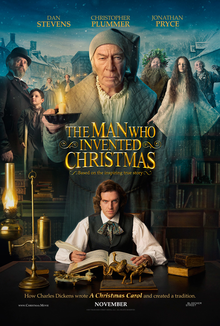
Copyright 2017 Bleeker StreetCharles Dickens’ A Christmas Carol is as much a part of the holiday as Santa Claus and decorating the tree. It was written in just six weeks and the entire first printing was sold out in five days. There are innumerable performance versions, plays, audio, and movies, even operas. It has not just become a part of Christmas celebrations; it has influenced them as well, as we see from “The Man Who Invented Christmas,” based on the best-selling book by Les Sanford.
The story is so deeply embedded in our culture that it is difficult to recognize how revolutionary it is. The idea of time travel was considered an enormous innovation in Mark Twain’s A Connecticut Yankee in King Arthur’s Court, published more than 40 years later, but Dickens had Scrooge go back in time to see his past. It is based on the idea that a man could change and would want to change based on an honest look at his childhood trauma and choices made over the years, half a century before Freud. “The Man Who Invented Christmas” gives us a sometimes light-hearted but always warm-hearted look at the man who created Ebenezer Scrooge and the Ghosts of Christmas Past, Present, and Future. We see how the story came together based on what Dickens saw and felt and how writing the story helped him to understand and reconcile his own past.
Dickens (Dan Stevens of “Downton Abbey” and “Beauty and the Beast”) is one of the most critically acclaimed and popular authors in the world, touring America to cheering audiences. Or he was, until he had three flops in a row, just as bills are mounting for renovations on his house, his wife tells him their fifth child is on the way, and his charming but feckless and irresponsible parents arrive for a visit. He desperately needs money, but worries that he is completely out of ideas. His hand remains poised over the paper, its only mark a blob of ink that drops from the feather pen to reproach him because no words are appearing.
It is always difficult to portray the work of a writer because it is all internal and you run the risk of boring the audience with scenes of someone sitting at a desk. Director Bharat Nalluri, working from a script by Susan Coyne, wisely takes our hero out into the world and we have the pleasure of seeing the hyper-alertness artists bring to the world. Whether it is jotting down the name of the waiter (Marley), eavesdropping on the new maid telling ghost stories to his children, watching his young nephew, whose leg is in a brace, or listening to complaints about the poor from a wealthy man exiting the theater, Dickens is constantly creating his characters from life. And when he conjures them up, he makes them real for himself before he makes them real to the reader. Christopher Plummer first appears as a lone mourner at a burial, sharply reminding the clergyman that he isn’t paying by the hour so there’s no reason to drag out his remarks. And then he reappears in Dickens’ wonderfully vivid imagination as Scrooge.
This is not the gritty, grimy Victorian world we have seen in many films, including those based on Dickens’ books. Nalluri echoes the magic lantern shows Dickens’ father enchanted him with as a child in the glowing colors of wintry London. As he did in “Miss Pettigrew Lives for a Day,” he shows a deft skill in moving a large, colorful cast in and out of the story, maintaining a slightly heightened, romantic, but still grounded tone. Stevens holds the center together ably, often on the edge of being frantic but with a joy in storytelling. One especially sweet scene has him delighting his children with the same imagination that continues to thrill audiences and makes this lightly fictionalized peek at him filled with charm and delight.
Parents should know that this movie includes some mild language, mention of pregnancy, drinking and drunkenness, and some child labor and abuse and bullying.
Family discussion: What people and situations around you can inspire your stories? Why did he change his mind about his father? Whose burden can you lighten?
If you like this, try: the many films of the story, especially the Muppet, Mr. Magoo, Alastair Sim, and MGM versions.
Rated PG for thematic elements including bullying, and some mild language
Profanity:
Some schoolyard language
Alcohol/ Drugs:
None
Violence/ Scariness:
Some bullying and peril
Diversity Issues:
A theme of the movie
Date Released to Theaters:
November 17, 2017
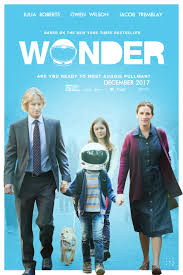
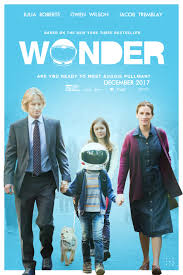
Copyright 2017 LionsgateWonder is more than a book — it is a movement. R.J. Palacio’s book, Wonder, and its follow-ups, including Auggie & Me, have become hugely popular with middle schoolers and their teachers. That is because it is not a story about disability, even though its hero is a 10-year-old with craniofacial deformity who is starting school for the first time after 27 surgeries. It is a story about friendship, family, and above all, kindness. As the 5th grade teacher writes on the blackboard, “When given the choice between being right and being kind, choose kind.”
Auggie (“Room’s” Jacob Tremblay) lives with his loving parents (Julia Roberts and Owen Wilson), his devoted older sister Via (for Olivia) (Izabela Vidovic), and their dog in a comfortable New York brownstone. With medical treatment to help him see and hear, Auggie’s face is misshapen and scarred. School principal Mr. Tushman (Mandy Patinkin) tries to put Auggie at ease by joking about his name (everyone has something people make fun of) and recruiting three students to give him a tour of the building before school starts. Scholarship student and all-around boy next door Jack (Noah Jupe), self-centered but not mean Charlotte (Elle McKinnon), and nice-to-grownups-but-a-bully-to-anyone-who-makes-him-uncomfortable Julian (Bryce Gheisar) show him around, alternating between rude questions and pretending he’s not there.
And then school begins. Palacio has taken the most fraught period of life, when friendships are most vital and the tiniest panic about not fitting in can be devastating and heightens it even more by creating an extreme case. Auggie has already triumphed over his disability, which he barely notices. It is triumphing over middle school that is the near-impossible challenge. Palacio and this film understand that it is this time above all, with so many volcanic physical, emotional, and cognitive changes, it seems so desperately important to fit in, to seem, in the narrowest terms, “normal.” And, unfortunately, because they are still so young, it can seem that the best way to do that is to call attention to the ways that other kids are less normal than they are.
So, anyone who’s ever been in middle school will understand why Auggie comes home after the first day and cuts off his padewan braid, not with a light saber because he’s been made a Jedi knight but with his sister’s scissors because kids made fun of him at school. And that doesn’t even have anything to do with his face.
That comes later. The kids spread a rumor, even though none of them really believe it, that touching Auggie will give you “the plague.” And then Auggie does two things that made Julian lash out even more. He is smart in school. And he becomes friends with Jack and then some of the other kids, too, including Summer, a popular girl who joins Auggie’s table in the cafeteria not because she feels sorry for him but because she correctly senses that he is nicer than the catty girls she had been sitting with.
There are setbacks, as when Auggie’s favorite holiday, Halloween, where he gets to look like everyone else, means that he has a chance to overhear what people say when they think he’s not around.
What elevates this film, though, is its recognition that kindness begins with empathy. By leaving Auggie’s point of view to let us know what is going on with some of the other characters, we understand more about why they behave the way they do. Via tells us what even her parents do not know, that it is difficult to be the sibling of a child with a problem, and that the most difficult part is feeling that there’s no space left for any problems from anyone else. When she is abandoned by her closest friend, we think we understand, until we get to see things from the friend’s perspective as well.
Director Stephen Chbosky (writer/director of another story about young friends, “The Perks of Being a Wallflower” and screenwriter for another movie about a character feared for his looks, “Beauty and the Beast”) has made a wise, warm-hearted film that is a balm for troubled times. It also just happens to have one of the most beautiful performances of the year by Julia Roberts, who wanted to be in the film after she read the book to her children. Look at her face as she sees that Auggie is bringing a friend home for the first time. It contains so much love, relief, surprise, and effort to contain all of that and more it serves as a one-minute master class in screen acting.
“I’m an ordinary kid,” Auggie tells us. “I just don’t look ordinary.” This is a movie that might look ordinary but is a quiet gem of insight and inspiration.
Translation: Story deals with challenges faced by a boy with craniofacial deformity attending school for the first time, bullying, some scuffles, mild schoolyard language
Family discussion: What can you do to choose kindness? How do you know when it is time to be right and when it is time to be kind? Why did Jack make fun of Auggie? Why did Summer sit with Auggie?
If you like this, try: Auggie & Me, the book by Wonder author R.J. Palacio that expands the story
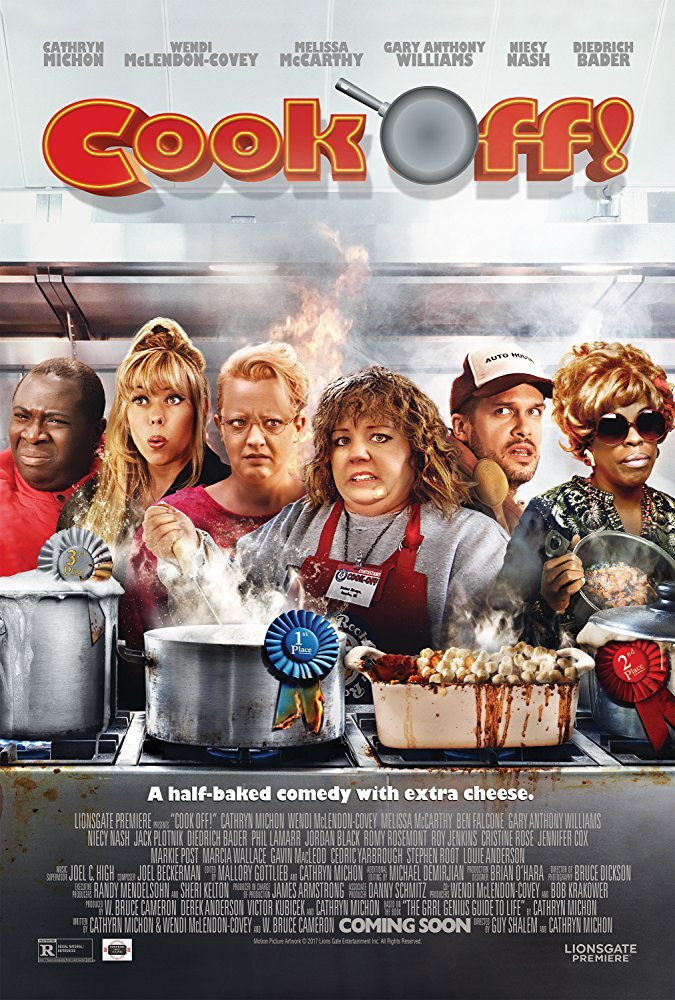
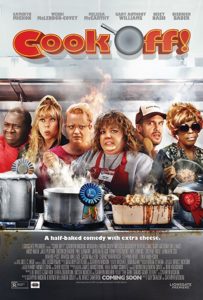
Copyright 2017 LionsgateTake one “British Baking Show” and add a cup of Christopher Guest improvised mockumentary, a lot of processed food products, a gallon of ambition, romantic complications, sibling rivalry, and a muffin-head-wearing mascot, and let it marinate for a decade and you’ve got “Cook-Off,” a very funny movie made ten years ago but just now being released in theaters. Its stars include Melissa McCarthy, Niecy Nash, Diedrich Bader, and the late Marcia Wallace. It has all the ingredients for a tasty little entertainment.
Like Christopher Guest’s “Best in Show,” this is a story about middle-class Americans passionately seeking to outdo each other, with a gallery of brilliant improv actors making small fights into a cutthroat competition. It takes place at a Pillsbury Bake-Off-style cooking contest with co-screenwriters Cathryn Michon and Wendi McLendon-Covey playing sisters Sharon and Pauline Solfest, who work together selling sex toys to married Lutheran women at home but have both qualified for the competition. Sharon (Michon), whose many different hairpieces are a hoot, is outgoing and outspoken, engaged to Lars Hagerbakke (Gary Anthony Williams), who is a bit confused about his identity, in part because he is a black man adopted by a white Swedish family. Her sister Pauline (McLendon-Covey) is withdrawn and shy, but don’t count out her creamed corn.
Also in the competition are Ladybug Briggs (Niecy Nash), the wheelchair-confined mother of a part-time preacher, the very, very pregnant Patty (Romy Rosemount), and the first-ever male contestant (Dietrich Bader), who just happens to be engaged to a former contestant who, after making it to the finals three times, is no longer eligible to compete, raising questions about the legitimacy of her fiance’s entry. Amber Strang (McCarthy with her real-life husband Ben Falcone) arrives too late but wear everyone down with their elaborate explanations and get to compete as well. And a hard-driving realtor is the Mama Rose of the competition, pushing her daughter like she’s selling a house. Meanwhile, Gavin McLeod and Marcia Wallace play themselves as the celebrity judges and the sponsor’s mascot, the guy with the muffin head, is wandering around contributing to the sense of happy (at least for us in the audience if not the characters) chaos.
Parents should know that this film includes strong language, some crude sexual references and drinking.
Family discussion: Which contestant were you rooting for? What’s your signature dish?
If you like this, try: “Best in Show” and “Waiting for Guffman”
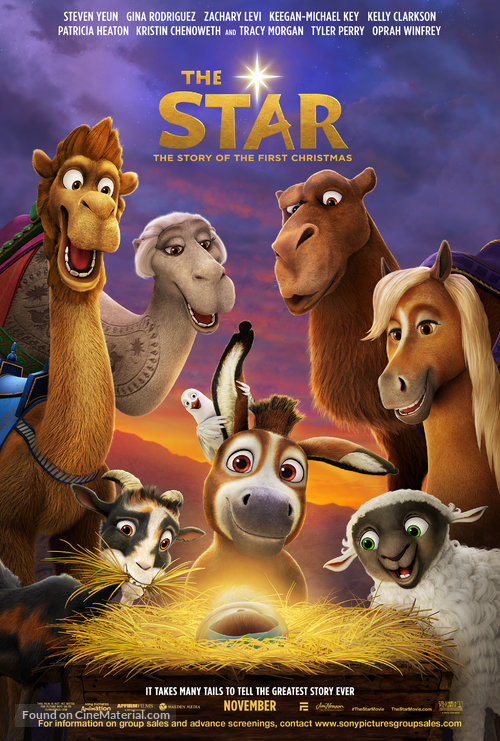
Copyright 2018 Sony Pictures AnimationSometimes a little part of a big story helps us see the big story more clearly. And so in “The Star,” we get to witness the Nativity through the eyes of a little donkey named Bo (Steven Yeun), and the friends he meets along the way as he helps Mary (Gina Rodriguez) and Joseph (Zachary Levi) on the way to Bethlehem.
Bo is stuck going around in circles in Nazareth — literally — yoked to a miller’s grinding wheel, his only view the rear end of the old-timer donkey in front of him (Kris Kristofferson). Through the window of the mill he glimpses the big world outside, and he dreams of doing something important, with a lot of pomp and splendor, and wants to escape so he can join the caravan of the king. Bo finally does escape, with some help from his best friend, a dove named Dave (Keegan-Michael Key). He hides out with the newlywed Mary, who welcomes him kindly and treats his injured leg, and then he ends up going with Mary and Joseph to Bethlehem.
Meanwhile, shepherds are watching the star, King Herod (Christopher Plummer) is sending a formidable soldier with two attack dogs (Ving Rhames and Gabriel Iglesias) to find the baby and make sure nobody threatens his right to the throne.
First-time feature director Timothy Reckart brings a background in stop-motion animation to give the look of this film exceptional depth and texture. The action and chase scenes as Bo tries to keep away first from the miller and later from Herod’s soldier show an astute appreciation for physical space and a real gift for making the most of it. The movie’s visual panache is enhanced by delightful voice talent from a widely diverse cast, including the camels of the three kings, voiced by Tyler Perry, Tracey Morgan, and Oprah Winfrey, Kristin Chenoweth as an excitable rodent, and “Saturday Night Live’s” Aidy Bryant as Ruth, a warm-hearted sheep who strays from her flock to follow the star. The stand-out is Key, whose high spirits show us that Dave the dove can be funny but most of all, he is a true friend.
Reckart also handles the tone very well, shifting seamlessly from gentle comedy to PG-friendly action without ever being disrespectful of or neglecting the movie’s main themes. The focus may be on Bo, but it is his experiences with Mary and Joseph that transform him.
Parents should know that this movie includes some peril and violence, brief potty humor, and reference to the virgin birth and pregnancy.
Family discussion: What did Bo learn about being important? Why didn’t Ruth stay with the flock?
Interview: RJ Palacio and Stephen Chbosky on “Wonder”
Posted on November 13, 2017 at 5:26 pm
Copyright 2017 Lionsgate
R.J. Palacio’s book Wonder is more than a best-seller — it is a movement. Middle-schoolers and their families love the story of Auggie, a 10-year-old with facial deformity who for the first time attends school in 5th grade. It is not a story about triumphing over disability; Auggie has more than triumphed when the movie begins. It is instead a heightened exploration of universal themes. In middle school, the moment when people are most acutely aware of differences and most excruciatingly anxious about fitting in, a boy who is very different arrives. The book and the movie it inspired are about family and friendship and, above all, the importance of choosing to be kind. The movie opens November 17, 2017.
In an interview, Palacio and the film’s director, Stephen Chbosky talked about what kindness means to them and why it is so important to include not just Auggie’s point of view but the other characters’ as well.
RJ, as you’ve spoken to kids in schools, what have they told you about the impact that this book has had on their lives and the choices that they make?
RJP: I’ve spoken to probably hundreds of schools at this point and thousands of kids. It’s very gratifying and very moving to hear ten year olds and eleven year olds come up to you and say, “I want to be a better person after reading this book.” You think, “Well, you’re ten years old and you’re probably an amazing person already,” but to hear them say that is so moving. I tend to be an optimist in life and I tend to believe that there is an inherent goodness in most people. Kids to me have this wonderful urgent and earnest willingness to be noble. I think our job as parents and as educators and as teachers is to tap into that inherent wanting to be noble. I don’t know if they would call it nobility but I see it that way.
Most kids just really want to get along. They want to make other people feel better. They’re mischievous sometimes and sometimes, yes, they border into cruelty sometimes just because they’re feeling like they want to be funny or they’re navigating these uncharted waters. They haven’t had a lot of practice at being a fully realized human being yet and then as they’re growing up, when they’re ten or eleven it’s really kind of the first time that they’re actually exploring the power that they have to reach out and be friends with people and what being an enemy means. So they’re discovering all of this and as parents we can guide them a little bit. At that age what’s happening sometimes is that parents tend to step back a little bit and think, “Well, she doesn’t listen to me anymore, she’s twelve years old,’ but my feeling is that they’re still listening at that age. Maybe when they’re sixteen or seventeen they stop listening but at twelve or thirteen they might pretend that they’re not but they’re still listening.
SC: Let me jump in for a second here and add something to that because I think it’s very profound. We all know Lord of the Flies, where kids left on their own become brutal. How many times have you heard an adult say “Kids can be cruel?” Well, kids can also be kind and there is ample proof of both and yet for whatever reason adults on some level like to emphasize how cruel kids can be. I’ll tell you a quick personal story. I have not thought of this in thirty years but I just thought of it right now. When I was in fifth grade we started to work on public speaking in school and so we would have to stand in front of the class. One kid per morning would have to lead the assembly. This girl every time it was her turn she cried uncontrollably because she was so frightened of standing in front of us all. You would think that if kids are cruel (and let’s go with that premise for a second) we would be so mean to this girl. Every month (I’m actually kind of getting choked up remembering this) we would root for her. It didn’t matter who you were. We were all: “Come on Betsy, you can do it this time” and on the last day her voice was quaking but she didn’t cry. I never forgot it…I’m having a moment right now, remembering it. That’s what kindness can do.
The story itself is extremely kind in exploring the perspectives of different characters, including Auggie’s older sister, Via, something you’ve continued, RJ, in a book called Auggie and Me. Why is that important?
RJ: In order to tell Auggie’s story from a 360° point of view, for us to understand the impact that he had on his community, on his friends, on the school, I had to leave his head and I had to go into different perspectives. His sister was the first one that I really wanted to explore. I just figured here is a girl who was fiercely protective of her brother, she’s a good girl but as just a matter of fact she has to be by necessity the one that’s overlooked a little bit in her family. She’s sort of like a self-cleaning oven. She’s self-sufficient. The parents don’t have to spend a lot of time worrying about her. They can spend most of their time worrying about her little brother who actually needs them to worry him. So I thought going to the different perspectives was a really good way of telling Auggie’s story but also having people understand that everybody’s got a story to tell. Everybody has something about ourselves that we can change or that we worry about. I wanted kids to realize that maybe Auggie’s difference is the most obvious but every single character and every single person you meet has something that they think makes them different and each has to carry their own little challenges and little burdens. We just might not be able to see them as clearly.
The story really is about friendship, set in a time when friendships become so vital and so fraught.
SC: We all know that when you’re young your friends become become your family more than in any other time in life. So it amplifies what an act of kindness can mean. When you are a kid you are much more vulnerable and so everything becomes more important and everything sounds a little louder and everything hurts a little deeper and I think that’s what’s so powerful about RJ’s story.
What does kindness mean to you?
RJ: I think of kindness as sort of a compilation of several different words — compassion, empathy, tolerance, love, forgiveness. It’s all of those things mashed up into one word which is kindness. It’s something that makes us human in a way that nothing else, though it is so hard to achieve kindness sometimes. It’s one of the most gratifying things in the world to receive and when you receive kindness from someone you’re that much more predisposed to give kindness to someone else. It’s one of the very few things that can actually spread. It’s infectious and it can grow. We’re living in times where kindness itself is almost becoming politicized and being seen as a sign of weakness when to me it’s a sign of strength. The ability to be kind to those who are not empowered or who are being ostracized or being ridiculed or being bullied takes courage.
The “precept” Auggie’s teacher gives the class quotes Wayne Dyer, who said, “When given the choice between being right or being kind, choose kind.” But sometimes being right is important, too, isn’t it?Absolutely, yes, and it is a fine line. That’s why I always say it takes a lot of courage to be kind because being right is important too but I think it takes a lot of heart be able to discern when it’s really important to just kind of stay true to your gut about what is needed in life.
Given the choice we should all aspire to have both and to win hearts and minds. Whatever it is you do professionally or personally with your family, with your friends or your colleagues we all have the power we all have the capacity to some degree to affect change around us so that the choice doesn’t need to be made.
Julia Roberts is so good in this film. The look on her face when Auggie first has a friend who wants to come over has so many emotions at once. What is it like to direct her?
It’s like being Michael Phelps’ swimming coach. She is so good at what she does and she can convey every emotion at the drop of a dime, she can change her approach on the drop of a dime, too. Any director will tell you there are two performances; one is the one that the audience gets to see because you’re cutting the best moments together and you’re finding the tone and you’re finding the pacing and the music and everything else, and there’s everything else that you that you left out. She never had a bad take, she was generous to her co-stars, she made everybody better (especially me) and I can’t say enough about her as an artist or a person. Every take was perfect no matter how many ways we tried it.