Ender’s Game

Posted on November 1, 2013 at 6:35 pm

endersgame

Director Gavin Hood (“Tsotsi”) has skillfully adapted the Nebula and Hugo award-winning novel about a boy who leads an interplanetary battle against insect-like aliens, doing justice both to the fun of the sci-fi action and to the seriousness of the book’s themes.   The story has been adapted for film — Ender is several years older in the film than in the book and an extended and astonishingly prescient subplot about his siblings writing something resembling blogs and becoming highly influential political commentators has been dropped.  But it is very true to the spirit of the book and its characters and with special effects technology vastly beyond what was possible when the book was written, spectacularly realizes some of the book’s most thrillingly imaginative passages.

A memorable scene in Kevin Smith’s “Clerks” has its two slacker heroes arguing about one of the most rousing moments in the history of film, the destruction of the planet-destroying Death Star in the original “Star Wars.”  Randall points out that while the Jedi and the audience are cheering the explosion, they are overlooking the fact that the Death Star, still under construction, was not staffed with military but with independent contractors, who are at least arguably innocent bystanders in the conflict and unarmed.  In the middle of a raunchy comedy there is suddenly a more nuanced moral sensibility than is exhibited in the the usual big-budget sci-fi extravaganzas.

That is what makes the Ender’s Game series by Orson Scott Card so compelling.  The original book has been a worldwide best-seller for more than 20 years.  Like “Star Wars,” “The Matrix,” and other YA favorites, it is the story of a “chosen one” of extraordinary skill who takes on the oppressive and vastly powerful but corrupt enemy, and it is filled with exciting action.  But it also engages directly, thoughtfully, and sometimes provocatively with profound questions that are even more apt today than they were in the 1980’s: Should we sacrifice the interests of one person to benefit the rest of the world?   Should we stage a pre-emptive attack by an enemy that is not currently demonstrating aggressive behavior?  What is more important, the ability to win a battle or the ability to feel compassion or empathy?

The setting is at a time in the future when earth has successfully defended itself against an attack by an insect-like race of aliens called Formics and disparagingly referred to by humans as Buggers.  The effects of the war against the Formic were devastating, and the entire resources of the world have been turned to just one goal — seeing out the Formics and destroying them to make sure that they can never return to attack the humans.  They have determined that only a child has the reflexes, flexibility, and singleness of purpose to lead that attack.

All children are fitted to monitoring devices so that the military can see how they behave and find the likeliest candidates for military training.  Couples are strictly limited to no more than two children.  The Wiggins family is permitted a rare third because their son and daughter, while not suitable for training, show extraordinary ability.  The third is Ender Wiggins (“Hugo’s” Asa Butterfield in a considered performance of great dignity and focus), whose deliberate but savage attack on a school bully brings him to the attention of the commander in charge of training, Colonel Hyrum Graff (Harrison Ford, returning to space for the first time since the “Star Wars” trilogy).  Ender is brought to a space station for a series of training exercises called “games.”

A disagreement between Graff and Major Gwen Anderson (Viola Davis, once again speaking on behalf of humanity) is one of the film’s clearest statements of the moral conflict it lays out.  Anderson wants the training to do what is best for Ender.  Graff wants it to do what is best for humanity, and if that means inflicting the kind of trauma and encouraging the kind of brutality that will make Ender a better commander, he is willing to make that trade-off.  Of course it is out of the question to consult Ender or his parents.  Card wisely makes it clear that there are two questions here.  One is whether the ends ever justify the means.  The other is who should decide what ends or means to consider.

The games are fascinatingly constructed and the battles in the weightless chamber with freeze-ray weapons are absorbing and immersive.  It gets more exciting when a new teacher with a fabled history and an impressive Maori face tattoo (Ben Kingsley) takes over.  The climactic battle is as dramatic as we hope, but it is a remarkable twist and a surprising coda that bring depth and meaning to the story.


NOTE: In real life, author Card has demonstrated hateful homophobic bigotry that has led some people to call for a boycott of the film.  Here is my view: I believe that the principles of courage, integrity, compassion, empathy, and service to others that “Ender’s Game” promotes are essential values.  While I regret that the author’s ugly and bigoted statements show that he himself is still struggling to learn the lessons of his book, I agree with the poet Don Marquis that “an idea is not responsible for the people who believe in it.” The best of his vision should be shared with young people in the hopes that the next generation will transcend some of the biases of the previous ones.

Parents should know that this film includes extended sci-fi violence and peril with characters injured and killed, themes of interplanetary genocide, brief mild language, theme of child soldiers and moral conflicts, and bullies.

Family discussion: What does it mean to win “the right way”? Was Graff or Anderson right about the best way to treat Ender?

If you like this try: The book and its sequels by Orson Scott Card and the “Star Wars” movies starring Harrison Ford.
Related Tags:


Action/Adventure Based on a book Science-Fiction Stories about Teens

12 Years a Slave

Posted on October 17, 2013 at 6:15 pm

A-
Lowest Recommended Age: Mature High Schooler
MPAA Rating: Rated R for violence/cruelty, some nudity and brief sexuality
Profanity: Constant use of racial epithets, sexual references
Alcohol/ Drugs: Drinking and drunkenness
Violence/ Scariness: Intense and disturbing violence including rape, murder, whipping, and abuse, disturbing and graphic images
Diversity Issues: A theme of the movie
Date Released to Theaters: October 18, 2013
Date Released to DVD: March 3, 2014
Amazon.com ASIN: B00G4Q3NDA

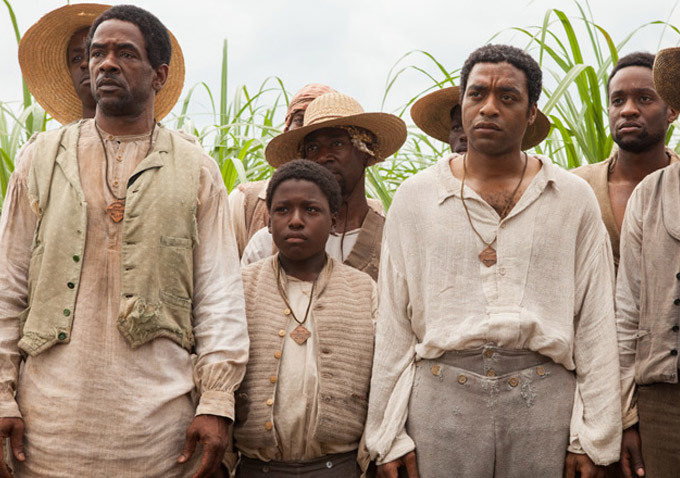
12-years-a-slave-2Watching “12 Years a Slave” is a shattering experience. It shatters any remaining illusions of gracious, chivalrous, Southern plantation life in the pre-Civil War era.  They were based on the late 19th century myth-making from the children of slave-owners in a toxic effort to disguise the reality that the South was fighting to preserve a system of virulent racism fueled by the economics of plantation life. It shatters cherished notions of the first principles underlying the founding of this country.  The man who wrote the revolutionary words that “all men are created equal” was a part of this atrocity. It shatters all previous depictions of slavery.  By comparison they seem cartoonish and fraudulent, from “Gone With the Wind” to “Django Unchained,” more about the time they were made than the time they depicted. And, like all great films, it shatters our previous notions of what was possible on screen, with performances so vivid and compelling they seem to break through every boundary, between us and them, between then and now, between actor and audience. In one audacious moment, Solomon Northrup (Chiwetel Ejiofor), a free man sold into slavery, looks into the distance, eyes filled with ineffable suffering and loss, and then turns to face us, looking into the eyes of those who are looking at him, bringing us further into his world.

This is different because it is a rare story of pre-Civil War South told from a black person’s point of view. It is based on Northrup’s book, written after he returned to his family.  It is the story of slavery from a man who experienced it, and who knew what it was like to live as a black man who was not just free but better educated and more successful than most people of any race in his community. In that sense, it is a story told from inside the system of our country’s greatest shame.  In another sense, it is presented by outsiders, director Steve McQueen (British) and stars Ejiofor (the British son of Nigerian immigrants) and Lupita Nyong’o (born in Mexico, raised in Kenya, educated in the US).  They tell us Northrup’s story — and ours — without being tied to the way we prefer to tell ourselves what our history is and means.

Northrup is a successful musician, happily married with two adored children and respected by both white and black members of his community in New York State.  He accepts a job playing with some circus performers (Scoot McNairy and “SNL’s” Taran Killem) in Washington, D.C., where slavery is legal.  They drug him and sell him to a slave dealer (Paul Giamatti).  Without his papers, he cannot prove he is a free man.  Soon he is renamed Pratt and transported to Louisiana, where he is sold first to a comparatively benevolent man (Benedict Cumberbatch), but then, when he gets into a fight with the overseer (an oily Paul Dano), he is re-sold to a brutal man who prides himself on being an n-word-breaker (Michael Fassbender).  Northrup loses more than his family, his liberty, his name, and his freedom.  He loses his very self; he is told early on that if the white people know he can read and write, it will create more trouble for him.  Indeed, when he tries to be helpful by suggesting a better system for transporting the crop, he earns the gratitude of his master but incurs the jealousy of the white boss.  The only way to survive is to pretend to be the sub-human the owners need them to be to continue to hold onto their bigotry.

This movie makes clear the poisonous, psychotic twisted mind that can accept or even justify the idea that one person can buy and sell another.  Over and over, we see the slaveholders at the same time acknowledging and denying the humanity of the people they think they own.  A female slave sobs because her children have been sold and she will never see them again.  The woman of the plantation, briefly sympathetic, says, “Poor woman.”  But then, immediately after, “Your children will soon be forgotten.”  Slaves are included in family worship services (though not seated with the family).  But their souls are never acknowledged; they are categorized as livestock.

There are terrible beatings.  There is torture and rape.  Slave children run and play, laughing, ignoring the man who is almost choking to death as punishment. There are property identification chains slaves must wear if they go off the property, like something between a hall pass and a dog tag.  There is a slave who has made her peace with what she has done to get better treatment — and with what she now does to other slaves.

Instead of the lush orchestral score usually underlying period films or the melancholy flute and drum usually heard in Civil War films, Hans Zimmer has created spare, edgy music that is bleak without being maudlin.  McQueen’s approach is sure and direct and the script by John Ridley is ably structured and thoughtful.  Nyong’o’s gives performance of exquisite grace and heart-wrenching dignity.  But the center of the story is Northrup.  Ejiofor is sure to get an Oscar nomination for a performance of unparalleled depth and eloquence.

Parents should know that this film includes very graphic and disturbing images of slavery, with rape, murder, and abuse, brutal whipping and atrocities, nudity, sexual references and situations, constant racial epithets, drinking and drunkenness.

Family discussion: What was the significance of the early scene in Mr. Parker’s store?  How does this story differ from other movie depictions of the pre-Civil War South?  Why did Northrup join in the singing of “Roll, Jordan, Roll?”

If you like this, try: book by Solomon Northrup, “Amistad,” American Experience: The Abolitionists, and Roots

Related Tags:


Based on a book Based on a true story Drama DVD/Blu-Ray Pick of the Week Epic/Historical

Carrie

Posted on October 17, 2013 at 5:50 pm

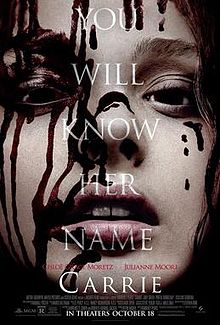
The remake of “Carrie” is not a bad movie; it’s just a completely unnecessary one.  The 1976 original is a horror classic, directed by Brian de Palma and the first film based on a novel by Stephen King, just 26 years old when he sold the rights for $2500.  Both of its stars were nominated for Oscars, almost unheard of for a genre film, and it is number 46 on the American Film Institute’s list of the top 100 thrillers.Carrie poster

The idea of updating the story of the bullied high school girl to the era of Facebook and YouTube had some intriguing possibilities, especially directed by Kimberly Peirce, whose extraordinary “Boys Don’t Cry” had an insightful authenticity in the portrayal of young people who felt like outsiders.  But there is nothing especially timely, revealing, or surprising in this remake.  The performances are not up to the level of the original and even the special effects do not seem much better than those in the version that came out when Gerald Ford was President.

Less than a moment into the film, we are already immersed in blood.  We hear screams and we see a Bible.  Margaret White (Julianne Moore) is in bed, the sheets all bloody, moaning and praying.  She thinks she is dying and she thinks it is because she is being punished.  But the pains she feels are contractions and she is shocked to find a baby emerging from her.  At first, she wants to kill her new daughter with her sewing shears.  But she loves the newborn too much to hurt her and, as we learn, she sees the baby as another chance for her to be pure, to be kept safe from the predations of sin and the devil.

We then see Margaret’s daughter, Carrie (Chloë Grace Moretz of “Kick-Ass” and “Let Me In”), a shy, repressed, somewhat backward senior in high school and ignored or insulted by the other girls.  She gets her period for the first time in the locker room after PE and becomes hysterical.  Like her mother, she has no idea what is going on with her body and she thinks she is dying.  The other girls are horrified that she is so ignorant and make fun of her, throwing tampons and sanitary napkins at her.  Chris, the ringleader (Portia Doubleday) gets it all on her cell phone camera and uploads it to YouTube.

Margaret seems to think that if she had been able to keep Carrie “pure” she never would have gone through puberty.  She locks Carrie in a small closet under the stairs and tells her to stay in there and pray.

But puberty seems to have unlocked some special powers in Carrie, powers that seem tied to her emotions.  As she sits in the principal’s office, his water cooler bubbles and then explodes. Carrie gets books on miracles and telekinesis from the library and begins to see what she can do and how much she can control.  For the first time, she begins to sense some independence and to rebel against her mother.

Sue (Gabriella Wilde) feels guilty about her role in making fun of Carrie and asks her boyfriend, Tommy (Ansel Elgort, soon to be seen in both “Divergent” and ‘The Fault in Our Stars”) to invite Carrie to the prom.  She says no at first, but then accepts, and his kindness and courtesy make her feel appreciated for the first time.  Until….

And that’s the thing.  Everyone knows what happens at the prom.  It is one of the most famous images in cinematic history.  This replay adds nothing new.

Moretz is a thoughtful and serious young actor, but she is better at playing a precociously sophisticated and capable character like Hit Girl or even the friend of the Wimpy Kid than she is at trying to show us the innocent and vulnerable Carrie.  More at fault is the script, which fails to provide a consistent emotional truth for the character. Like the Hulk, her powers are rooted in fury.  King, even in his 20’s, knew how satisfying that would be for everyone who has been picked on (that is everyone), and Moretz is at her best when enjoying the sense of righteous revenge.  To make the movie work, though, that would need to be balanced by an underlying sense of the character that is never there.  The same goes for Margaret. In 2013, the thoughts of a religious fanatic open up some possibilities worth exploring but Peirce is more interested in re-creating the original than updating it.

Parents should know that this film has extensive and graphic peril and violence with many characters brutally killed, disturbing and bloody images, sexual references and situations involving teenagers, a graphic childbirth scene, teen drinking, and strong language.

Family discussion:  Why were the girls so mean to Carrie?  How has bullying changed since the story was first written?  How did Carrie feel about her powers and why?

If you like this, try: the original film and some of the other Stephen King adaptations like “The Shining” and “Sleepwalkers”

Related Tags:


Based on a book High School Horror Remake Stories about Teens Thriller

The Snow Queen

Posted on October 10, 2013 at 5:00 pm

C-
Lowest Recommended Age: Kindergarten - 3rd Grade
MPAA Rating: Rated PG
Profanity: NOne
Alcohol/ Drugs: None
Violence/ Scariness: Fairy tale and fantasy peril and violence, guns, fire, parents killed
Diversity Issues: Strong female heroine and villains
Date Released to Theaters: October 6, 2013

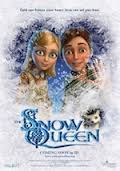
It may be a coincidence that a Russian animation studio decided to make a movie based on the Hans Christian Andersen fairy tale of the Snow Queen at the same time as Disney’s big-budget feature, “Frozen,” inspired by the same source. But it is probably not a coincidence that the low-budget, low-quality Russian version got distribution in the United States as it would otherwise not have attracted any interest beyond the straight-to-DVD bin. Russia, which once produced animation of exquisite beauty and storytelling, shows with this film that it can churn out uninspired, dull animation just like everyone else. The visuals are poorly conceived, with characters that are hardly more expressive than Weebles apart from the cleavage that is the most notable feature of at least three of the female characters. The vocal performances are uninspired and uninvolving. And the one effect that words, a 360 degree swoop-around, is relentlessly overused. The script is muddled and dull.  Plus, there are fart jokes.snow queen

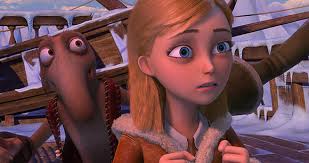
This version of the story has a little girl named Gerda (Jessica Strauss) in search of her brother just as The Snow Queen (Cindy Robinson) has sent her troll (Douglas Erholtz, trying to sound like a Borscht belt comic) to find her.  The Snow Queen has frozen the world.  Gerda’s brother is her captive.  And Gerda may have some sort of secret power to conquer the Snow Queen, having to do with a mirror that reveals the true self.

snow queen gerdaGerda and the troll have various PG encounters along the way that all seem to be half-heartedly designed to teach lessons about cooperation, bullying, and family.  There’s a king with squabbling children, a lady who grows fragrance-less flowers in a hothouse, and a pirate captain and her daughter.  The flat affect of the vocal performances and bland expressionlessness of the characters has a soporific quality.  Both seem…frozen.

Parents should know that this film has fairy tale/fantasy peril and violence, with guns, fire, and pirates.  Parents are killed.

Family discussion:  How did being bullied affect the girl with special powers?  How were Gerda and the pirate girl alike?  What made the flowers smell?

If you like this, try: “The Fool of the World and the Flying Ship”


Related Tags:


Animation Based on a book Fantasy Movies -- format Remake Stories About Kids Talking animals

Contest: Halloween Story Collection from Scholastic Storybook Treasures

Posted on October 8, 2013 at 3:55 pm

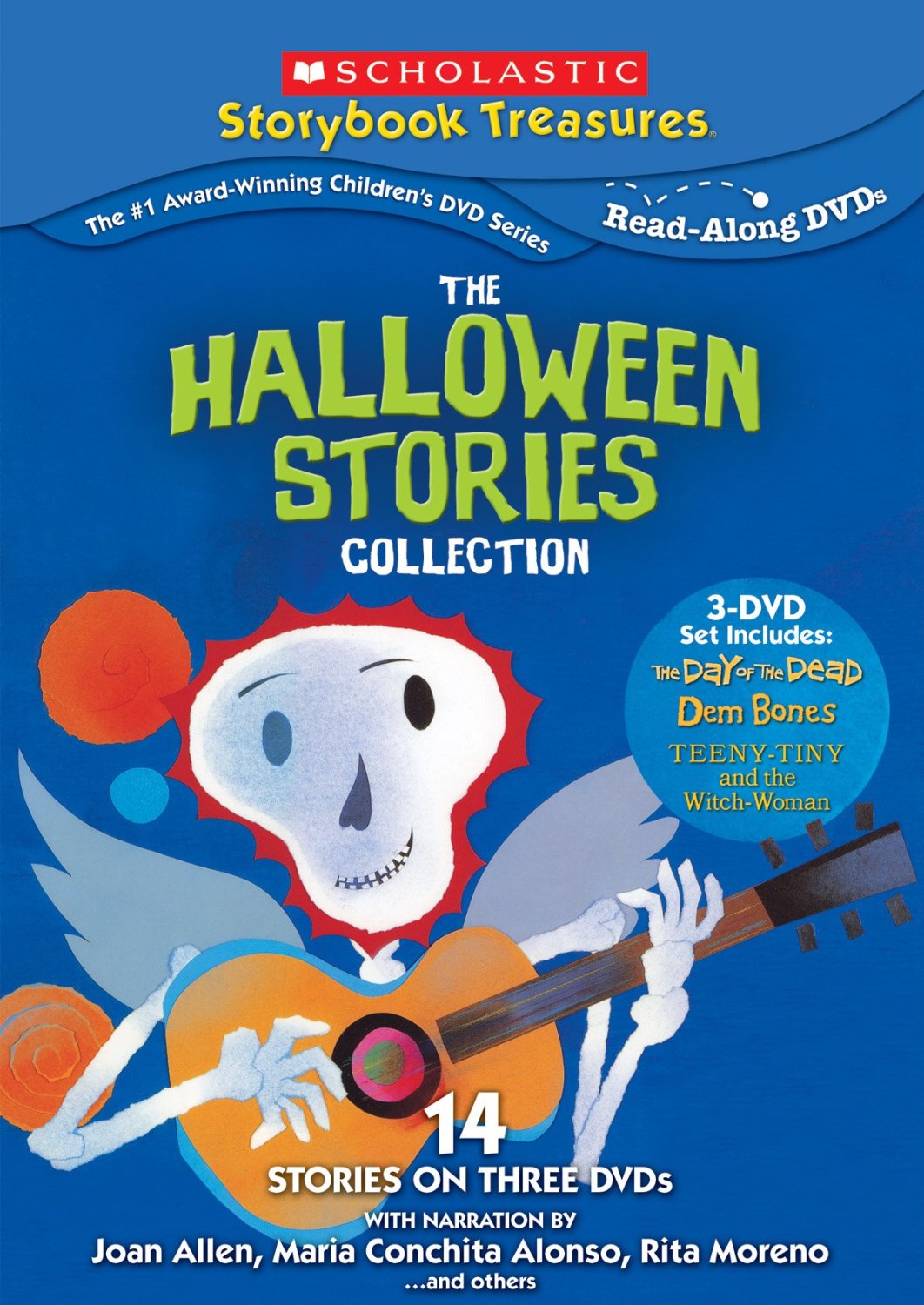
halloween storiesMy very favorite series for kids has a wonderful new collection for Halloween and I have three to give away! Enjoy the ghoulish pleasures and scary delights and ghostly giggles of stories like The Little Old Lady Who Was Not Afraid of Anything, Kitten’s First Full Moon, Dem Bones, and The Boy With Two Shadows.

If you’d like to win this Halloween treat, send me an email at moviemom@moviemom.com with Halloween in the subject line and tell me your best Halloween costume. Don’t forget your address! (US addresses only.) I’ll pick a winner at random on lucky October 13!

Related Tags:


Animation Based on a book Contests and Giveaways Early Readers Elementary School Movie Mom’s Top Picks for Families Preschoolers
THE MOVIE MOM® is a registered trademark of Nell Minow. Use of the mark without express consent from Nell Minow constitutes trademark infringement and unfair competition in violation of federal and state laws. All material © Nell Minow 1995-2026, all rights reserved, and no use or republication is permitted without explicit permission. This site hosts Nell Minow’s Movie Mom® archive, with material that originally appeared on Yahoo! Movies, Beliefnet, and other sources. Much of her new material can be found at Rogerebert.com, Huffington Post, and WheretoWatch. Her books include The Movie Mom’s Guide to Family Movies and 101 Must-See Movie Moments, and she can be heard each week on radio stations across the country.

Website Designed by Max LaZebnik