A Beautiful Day in the Neighborhood

A Beautiful Day in the Neighborhood

Posted on November 21, 2019 at 5:16 pm

A-
Lowest Recommended Age: Middle School
MPAA Rating: Rated PG for some strong thematic material, a brief fight, and some mild language
Profanity: Some mild language
Alcohol/ Drugs: References to substance abuse, drinking and drunkenness
Violence/ Scariness: Scuffles, punch, illness, sad death of a parent
Diversity Issues: None
Date Released to Theaters: November 21, 2019
Date Released to DVD: February 17, 2020

Copyright TriStar Pictures 2019
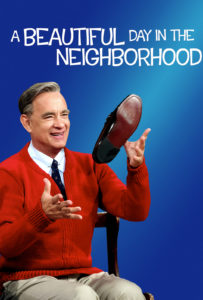
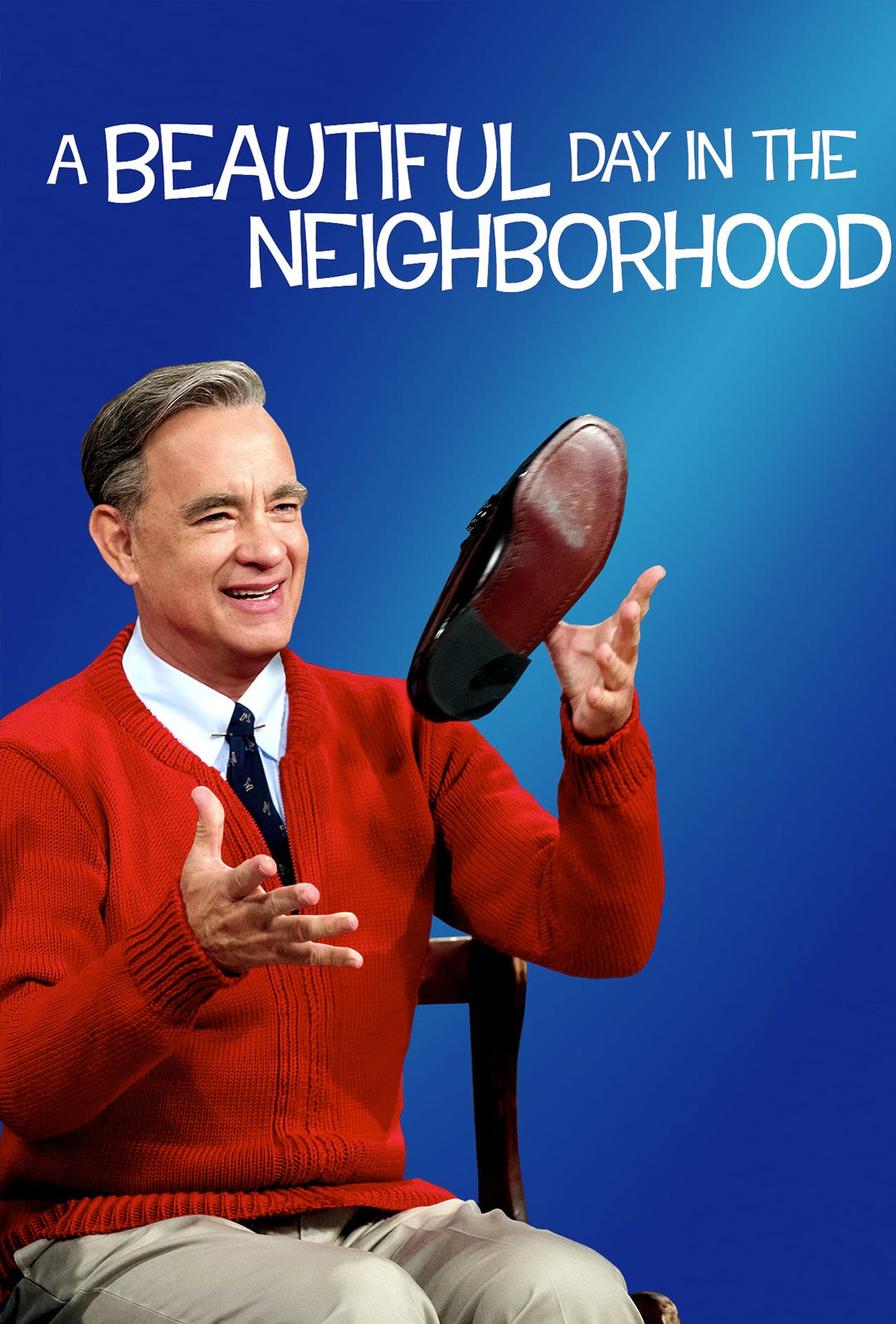
The documentary Won’t You Be My Neighbor is about Fred Rogers, the creator and star of the long-running PBS series Mr. Rogers’ Neighborhood. “A Beautiful Day in the Neighborhood,” with Tom Hanks as Fred Rogers, is about us. It is the very essence of heart-warming and inspiring. Anyone who watches it will be moved — and is almost guaranteed to be a kinder, happier, more open-hearted person at the end of the film. Rogers liked to ask people to think for a minute, a real sixty-second minute, about those who “loved us into being.” “A Beautiful Day in the Neighborhood” asks us that question, literally and in a deeply soul-searching way. And if we are honest, one of the people who comes to our minds will be Fred Rogers himself.

So, Rogers is not the story here. Instead, it is about the impact he had on one troubled adult, and what that means about and for each of us.

Based on the true story of journalist Tom Junod, who interviewed Rogers for a 1998 profile in Esquire, this film, by Micah Fitzerman-Blue and Noah Harpster and directed by Marielle Heller (“Can You Ever Forgive Me?” “The Diary of a Teenage Girl”), is about how the experience of interviewing, or, rather, attempting to interview Fred Rogers was transformational in the life of the reporter (here called Lloyd and played by Matthew Rhys).

Lloyd is a new father struggling with unresolved feelings of abandonment and anger at his own father (Chris Cooper). He is a hard-hitting, skeptical, investigative journalist, not accustomed to or comfortable with assignments to write fluffy features about the hosts of television shows for children. He is assigned to write about Mr. Rogers for the “heroes” issue of Esquire. But he is not someone who takes easily to the idea of heroes. Is his inclination to expose what prominent or influential people want to hide based in part on the father who let him down? Perhaps. But is that the right approach to Mr. Rogers? “Don’t ruin my childhood,” his wife warns. And when he asks Mr. Rogers about how he differs from the character he plays on television, the gentle clergyman-turned-unlikely-television-star genuinely does not understand the question. He cannot be anything other than what he is.

More important, he has a “compulsive intimacy” that prompted him to ask questions far more insightful and meaningful than the ones Lloyd was asking him to answer for the article.

Director Marielle Heller and screenwriters Micah Fitzerman-Blue and Noah Harpster bring a lovely delicacy and an almost fairy tale quality to the story. At times it seems we are watching an episode of the series and then we see that the “real world” and the world of the show blend together — both the “real” home where Mr. Rogers changes into his cardigan and sneakers and feeds the fish and the “imaginary” world of the kingdom of Make Believe. Just as all of the characters on the show represent parts of Fred Rogers’ personality, the heart of the movie is integrating all of its worlds and emotions.

A story relies on some kind of change experienced by the main character. He or she has to lose something or learn something or complete something. Mr. Rogers was already so evolved that trying to make him the main character of a feature film would not have worked. So wisely the story here is about the effect Mr. Rogers had on one troubled soul, helping him to lose something, to learn something, and to complete something. And in doing so, it helps us locate some of the compulsive intimacy that makes Mr. Rogers’ viewers into friends who feel accepted, understood, and very lucky to be in his neighborhood.

NOTE: Look carefully at the other customers in the scene set in a Chinese restaurant, when Mr. Rogers and Lloyd are eating together. They are the real-life friends and family of Mr. Rogers, including his wife Joanne (played by Maryann Plunkett in the film) and his producer Bill Isler (played by Enrico Colantoni).

Parents should know that this movie includes frank depiction of family dysfunction with an adult son still resentful and angry about his father’s abandonment, drinking and drunkenness, a scuffle, terminal illness, and some mild language.

Family discussion: How would you answer Mr. Rogers’ questions? What did Lloyd learn from him?

If you like this, try; the documentary “Won’t You Be My Neighbor?” and the episodes of “Mr. Roger’s Neighborhood” and my interview with the journalist whose article inspired the film and the men who wrote the screenplay.


Related Tags:


Based on a true story Drama DVD/Blu-Ray Family Issues movie review Movies -- format
Charlize Theron, Jay Roach, Charles Randolph on Bombshell, and Speaking Up About Sexual Harassment at FOX News

Charlize Theron, Jay Roach, Charles Randolph on Bombshell, and Speaking Up About Sexual Harassment at FOX News

Posted on November 14, 2019 at 12:11 pm

Last night, a powerhouse Washington D.C. audience got an early look at one of this winter’s biggest and best movies, “Bombshell,” based on the true story of the sexual harassment complaints that caused a seismic shake-up at the most powerful media company in the world. The title is clever, referring to the “bombshell” anchors of Fox News, selected for their beauty as well as their credentials as journalists, and the “bombshell” disclosures of abuse that led to the departure of the company’s top talent, including the founder of FOX News, the late Roger Ailes and their top-rated broadcaster, Bill O’Reilly.
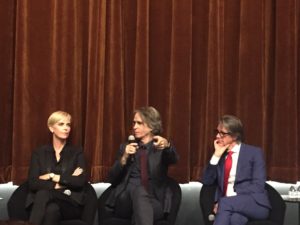
Following the screening at the spectacular new Washington DC office of the MPAA, CNN’s Dana Bash interviewed producer and star Charlize Theron, who plays Megyn Kelly in the film, director Jay Roach, and screenwriter Charles Randolph. Some highlights:

Copyright Nell Minow 2019

Randolph described himself as “the least woke man in the room,” subject to “the masculine instinct to minimize” the experiences of women, which itself causes great harm — the “refusal to acknowledge the importance of these events in women’s lives is devastating.” But “how is that helping the world? And so, he told us the the reason he wanted to tell this story: “Sexual harassment has to stop. And this has such interesting characters. They are not earnestly passive, as we see too often in “good” characters. They are filled with quirks, contradictions, internal conflicts. My parents are FOX News people. These are characters they can relate to, laugh at, laugh with, fully identify with and respect.”

Roach also comes from a “Fox News family,” he said. “This could cross over. Even my mom and my aunts could connect to this because they know them. When this story happened, we were all talking about it but I did not hear my family talking about it. The women in this film did not call themselves feminists; it is a great predicament for a story.”

Theron on taking on the role: “This film began before the Harvey Weinstein/#meetoo/Time’s Up movement. In a way, it is the origin story. But this was already a part of my life as it has been for every woman. Producing the film was easier than playing Megyn. And in some ways, playing Aileen Wuornos in ‘Monster’ was easier, because everyone knows Megyn’s face, voice, gestures so well. It took a little time for me to put my personal feelings aside. Megyn says some things I don’t agree with and some that rub me the wrong way. We have different views on a lot of stuff, but the only way to do this job is to remove yourself from those judgments and come from an empathetic place, to find the emotional arc of the story and not hide yourself away from the thorns. It’s easy to do a heroic person who does everything right and the audience immediately likes them. But it is more interesting to take a conflicted person who has a moment to do something right, not fluffy nice and cozy. We are complicated as people and the characters should be, too.” The same goes for those in the story who are not the heroes. “The harasser you most have to worry about is not the guy twirling his mustache.”

“It’s the belittling factor,” Theron said. “We’ve always been able to wrap our heads around the violent injuries. But this is also incredibly damaging. You carry this stuff, adding more weight to the luggage you never get rid of.”

Related Tags:


Based on a true story Behind the Scenes Gender and Diversity Movies for Grown-Ups
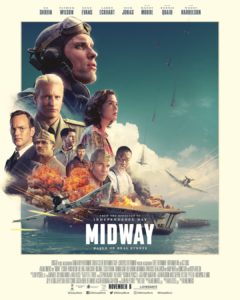
Midway

Midway

Posted on November 7, 2019 at 5:40 pm

B +
Lowest Recommended Age: High School
MPAA Rating: Rated PG-13 for sequences of war violence and related images, language and smoking
Profanity: Some strong language
Alcohol/ Drugs: Smoking
Violence/ Scariness: War-related peril and violence, characters injured and killed, guns, bombs, aerial battles, some disturbing images
Diversity Issues: Portrayal of historic events reflects the era's attitudes
Date Released to Theaters: November 7, 2019
Date Released to DVD: February 17, 2020
Copyright 2019 Summit Entertainment

The shocking attack on Pearl Harbor by the Japanese in December 1941 was not just a devastating loss, the “day that will live in infamy,” as President Roosevelt said. It was a humiliating failure of our intelligence operation. We were not prepared for war with Japan in terms of personnel, weapons, or planes. And we continued to suffer brutal defeats in the first months. If America could not start to win some battles, Japan would begin to invade our west coast.

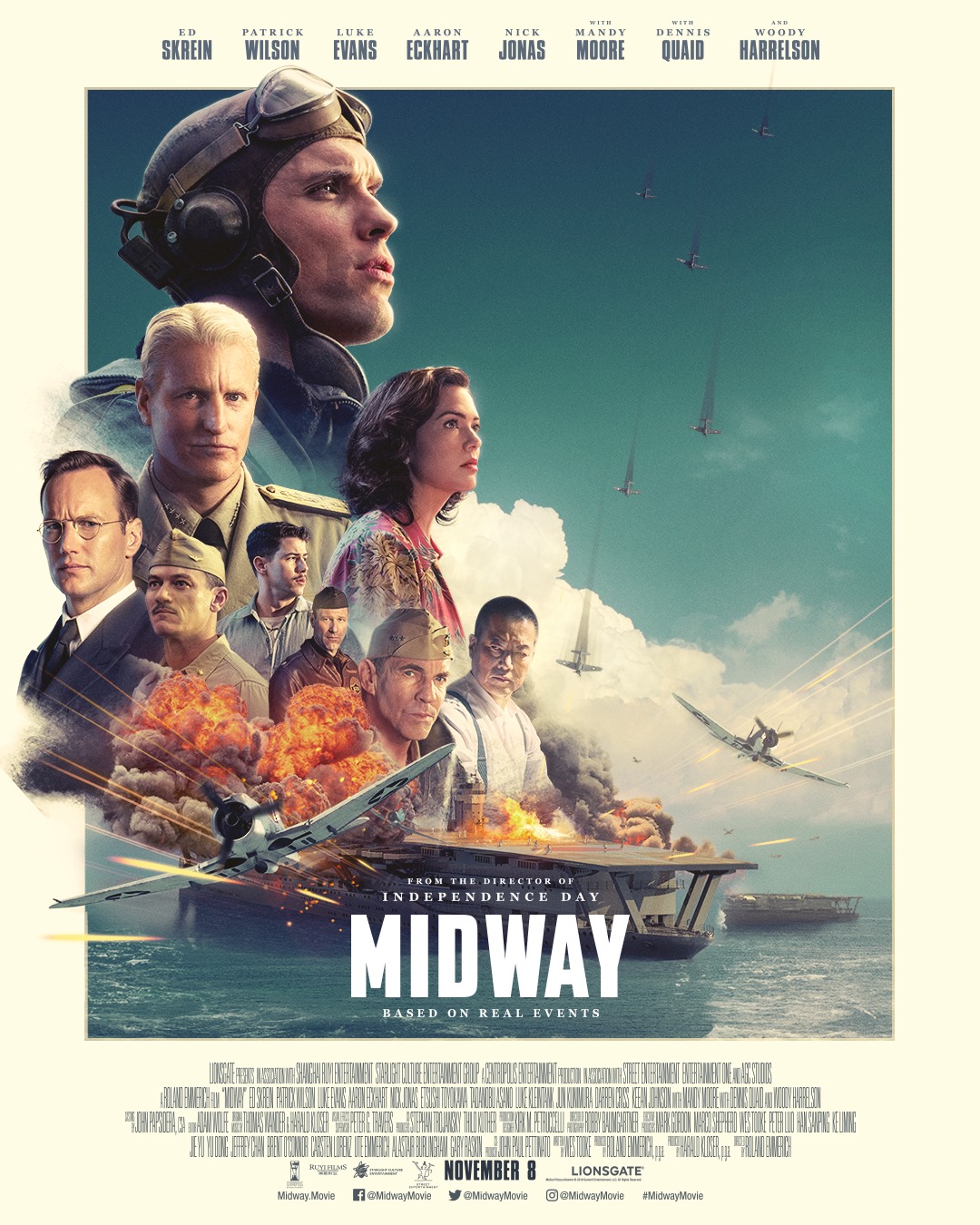
Six months later, the three-day battle of Midway was a critically important victory for the United States. From June 3-6, 1942, American forces gave Japan its first significant defeat of the war, the result of strategy, tactics, better intelligence, and, most of all, the unimaginable dedication and honor of the Greatest Generation. This re-telling of the story has the bombast we expect from director Roland Emmerich, but the stirring story and appealing characters make it a worthy tribute for Veteran’s Day weekend.

In Midway, creenwriter Wes Tooke (television’s “Colony”) balances the big picture battles and tactical overlay with the stories of a small group of real-life heroes. At the heart of the story is Dick Best (Ed Skrein) as the cocky pilot who shuts off the engine before landing on an aircraft carrier, just for practice. His wife Anne (Mandy Moore) is as tough as he is. If this movie had been made in the 80’s, Best would have been played by Tom Cruise. If it had been made in the 40’s, it would have been Clark Gable. Skrein makes Best the quintessential American hero, cool under pressure, confident, a bit of a cowboy. Luke Kleintank plays Earle Dickenson, the first Naval pilot to be awarded three Navy Crosses. If this were made in the 1940’s, his character would be played by Spencer Tracy.

Roland Emmerich knows how to make the battle scenes tense and exciting. He shows us just how fragile and vulnerable the planes were; it feels like they’re up in the air in an orange crate. He shows us how all the pieces came together, including the quirky code-breaker Joseph Rochefort (Brennan Brown) and Edwin Layton (Patrick Wilson), who had served in Japan, and whose warnings were ignored. Bull Halsey (Dennis Quaid) struggled with excruciatingly painful illness as he became America’s most acclaimed fighting admiral. Mandy Moore as Ann Best shows us the spirit of the home front. And Nick Jonas will break your heart as a machinist captured by the Japanese.

We look back at history and we cannot help taking it all for granted. Movies like this remind us how close we came to disaster and how many lives were lost to keep us safe.

Parents should know that this film includes WWII battle footage with bombs, explosions, fire, and guns. Characters are injured and killed.

Family discussion: Why is this film dedicated to the military on both sides of the Midway battle?  How were Best and Dickenson different and how were each one’s strengths reflected in their choices?

If you like this, try: Books: The Battle of Midway, by Craig L. Symonds, and The Flying Guns: Cockpit Record of a Naval Pilot from Pearl Harbor Through Midway, by Earle Dickenson, played by Luke Kleintank in the film. There is also a 1976 film starring Charlton Heston and Henry Fonda.

Related Tags:


Based on a true story Drama DVD/Blu-Ray movie review Movies -- format War
Harriet

Harriet

Posted on October 31, 2019 at 5:29 pm

B +
Lowest Recommended Age: Middle School
MPAA Rating: Rated PG-13 for thematic content throughout, violent material and language including racial epithets
Profanity: Strong and racist language
Alcohol/ Drugs: Drinking, smoking, drug use
Violence/ Scariness: Intense violence including brutal abuse of enslaved and free people, references to rape, guns, wartime violence
Diversity Issues: A theme of the movie
Date Released to Theaters: November 1, 2019
Date Released to DVD: January 27, 2020
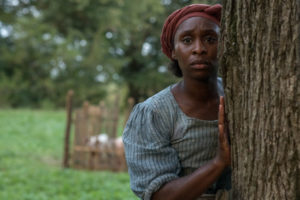
Cynthia Erivo stars as Harriet Tubman in HARRIET, a Focus Features release.
Credit: Glen Wilson / Focus Features

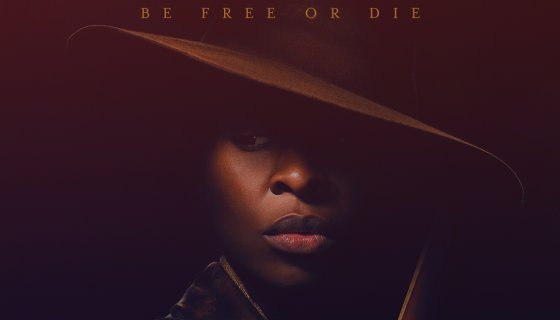
There should have been a movie about Harriet Tubman decades ago. And yet, this moment for “Harriet” is just right, because the story of the woman who led more than 70 enslaved people to freedom and was the first woman to lead an armed expedition for the U.S. Army was made at a time when it could be written and directed by Kasi Lemmons and star Cynthia Erivo, who is nothing less than electrifying in the role.

Harriet Tubman was a name she chose. Born to enslaved parents on a plantation in Maryland, she was called Minty, short for Araminta. Although her family was supposed to have been freed by the terms of the plantation owner’s will, his widow (Jennifer Nettles as Eliza) and son (Joe Alwyn as Gideon) refuse to acknowledge their right to freedom. Minty marries a free man she dearly loves. But when Gideon plans to “sell her down the river” to the Deep South, as he had sold her siblings, Minty decides she has to run away, no matter what the risk. She has no map, and if she did have one she could not read it. What she had was determination, the ability to run fast, the North Star, and an innate sense that helped her to elude her would-be captors.

That innate sense is part of Tubman’s legend. She had some kind of seizure disorder, probably the result of a horrific beating from the plantation owner. She thought it was a connection to God. Whatever it was, she was able to make it to safety in Philadelphia, where she met free black people of culture and accomplishment, including William Still, and Marie (the exquisitely gracious Janelle Monáe), a fictional character inspired by Tubman’s real-life friend. Her choice of a new name and her introduction to the possibilities of freedom are movingly portrayed.

But she cannot rest until her husband can join her. And so, she makes the treacherous trip back. That trip does not turn out as she intended, but it gives her a new purpose; giving other enslaved people a chance to be free.

Erivo is incandescent in the role, one of the great performances of the year in a story that is as vital as history as it is timely.

Parents should know that this is a film about slavery and escape and war, so there is extended peril and violence, including beatings, attacks, and abuse with references to rape. There is a Civil War battle scene. Characters drink and use strong language.

Family discussion: Why did Harriet Tubman choose that name? What name would you choose? Who is most like her today?

If you like this, try: “Glory” and Nate Parker’s “Birth of a Nation”

Related Tags:


Based on a true story DVD/Blu-Ray movie review Movies -- format
The Current War: Director’s Cut

The Current War: Director’s Cut

Posted on October 24, 2019 at 5:35 pm

B +
Lowest Recommended Age: High School
MPAA Rating: Rated PG-13 for some violent content and thematic elements
Profanity: Brief strong language
Alcohol/ Drugs: Alcohol, smoking
Violence/ Scariness: Flashback to Civil War scene with guns, animals and humans electrocuted, discussion of "humane" executions, sad death of wife and mother, tense confrontations
Diversity Issues: Anti-immigrant prejudice
Date Released to Theaters: October 25, 2019
Date Released to DVD: March 30, 2020
Copyright 101 Studios 2019

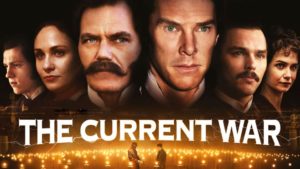
There’a a saying usually attributed to Balzac: “Behind every fortune is a crime.” There is a fairy tale quality to stories of people who have exciting new ideas that change our lives and are rewarded with unimaginable fortunes, from the grad students who created Google to the garage tinkerers who founded Hewlett-Packard and the college dropouts who created Microsoft and Facebook.

But as any business school student knows, it takes more than a brilliant or even a monumentally disruptive idea to create a business. That requires the ability to execute. It is one set of skills to jot down great thoughts in a notebook but another set entirely to bring it all to life. It takes courage, because ordinary people are afraid of anything new and people who are invested in the old ways will try to stop you. And it takes a singular purpose that looks a lot like ruthlessness. That is the story “The Current War,” which is not as much about the inventions that transformed America from being lit by gas lamps and candles to being lit and powered by electricity as it is about the control of those inventions and the fortunes they made.

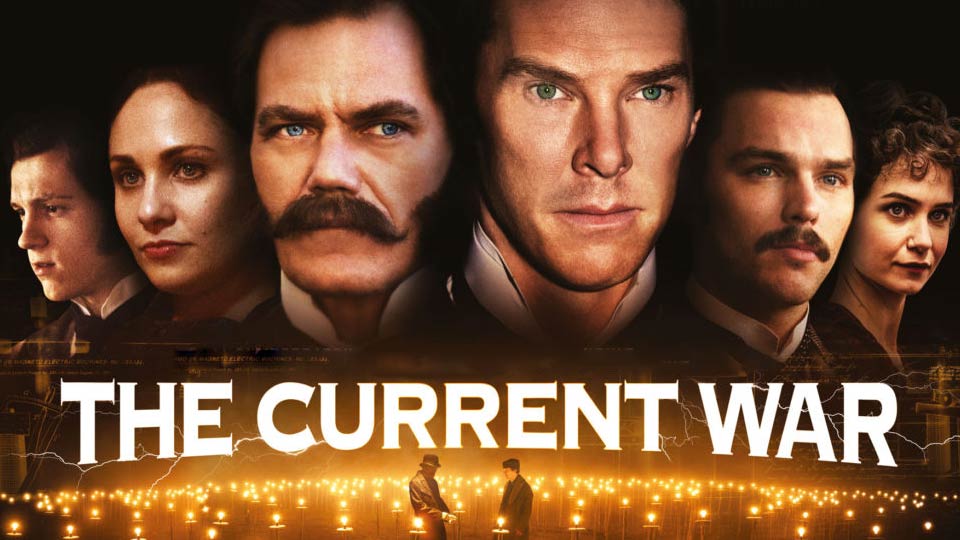
The three major players are America’s greatest inventor, Thomas Alva Edison (Benedict Cumberbatch), entrepreneur and engineer George Westinghouse (Michael Shannon), and visionary Serbian immigrant Nikola Tesla (Nicholas Hoult). Also in the mix is one of the wealthiest men in the world, J.P. Morgan (Matthew McFayden) and the current Spider-Man, Tom Holland, as Edison’s aide Samuel Insull.

At the center of their battle is the fight over what kind of electricity will be used, Edison’s lower voltage direct current, which was safer but more limited in range, and the Tesla/Westinghouse alternating current, which travelled over longer distances, was powerful enough to fuel machinery as well as light bulbs, but was also more dangerous, potentially fatal. (Now you know what AC/DC means and how the Australian rock group got its name and why their first album was named High Voltage.)

Director Alfonso Gomez-Rejon avoids the too-often stuffy quality of prestige historical dramas with refreshingly dynamic camerawork from DP Chung-hoon Chung (“The Handmaiden,” “Stoker”) and editing by Justin Krohn and David Trachtenberg. The opening shots are as striking as any you’d find in an art-house or superhero movie, blowing the dust off of the idea that movies set in the past have to be stodgy to be taken seriously. The script by Michael Mitnick packs a lot of developments and details into the story, from the illness of Edison’s wife to the conflicts (and jealousy) between the talent and the money to the shifting loyalties and various strategic maneuvers (legal and illegal), some as complex as the engineering specs for the various contraptions. One fascinating detour reminds us that as soon as new technology is invented, someone will try to figure out a way to use it to kill people (it was still so new there was no word for electrocution). Another reminds us of the connection between the characters on screen and the very technology we use to tell their story.

“The Current War: Director’s Cut” places the human drama in the midst of cultural and technological shifts and shows us how they affect and are affected by each other. Vivid, compelling characters, smart, witty dialogue, and a cherry-on-the-top ending making this film not just enjoyable, but, yes, illuminating.

NOTE: The official title of this film includes the words “Director’s Cut” because after it premiered at the Toronto Film Festival its release was put on hold because Harvey Weinstein (the distributor) was caught up in the #metoo accusations. The version shown at the festival was re-cut by Weinstein and director Alfonso Gomez-Rejon was not happy with that version. Martin Scorsese came on as a producer to make sure he was able to release the version he wanted.

Parents should know that this film include the sad illness and death of wife and mother, offscreen murder and execution, electrocutions of people and animals, Civil War scenes with shooting, and some strong language.

Family discussion: What is a bigger factor in success — having the best idea or being able to put it into practice — or wanting to win above all? What is Edison’s most important invention? Why did Elon Musk name his company Tesla?

If you like this, try: two biopics about Edison, “Young Tom Edison” with Mickey Rooney and “Edison the Man” with Spencer Tracy

Related Tags:


Based on a true story Drama DVD/Blu-Ray Epic/Historical Movies -- format
THE MOVIE MOM® is a registered trademark of Nell Minow. Use of the mark without express consent from Nell Minow constitutes trademark infringement and unfair competition in violation of federal and state laws. All material © Nell Minow 1995-2026, all rights reserved, and no use or republication is permitted without explicit permission. This site hosts Nell Minow’s Movie Mom® archive, with material that originally appeared on Yahoo! Movies, Beliefnet, and other sources. Much of her new material can be found at Rogerebert.com, Huffington Post, and WheretoWatch. Her books include The Movie Mom’s Guide to Family Movies and 101 Must-See Movie Moments, and she can be heard each week on radio stations across the country.

Website Designed by Max LaZebnik