Bombshell

Bombshell

Posted on December 12, 2019 at 5:38 pm

B +
Lowest Recommended Age: Mature High Schooler
MPAA Rating: Rated R for sexual material and language throughout
Profanity: Very strong and crude language
Alcohol/ Drugs: None
Violence/ Scariness: Sexual pressure and harassment
Diversity Issues: A theme of the movie
Date Released to Theaters: December 13, 2019
Date Released to DVD: March 9, 2020

Copyright 2019 Lionsgate
The word “bombshell” works both ways as the title of this film based on the true story of the #metoo moment that rocked the powerful leadership of Fox News and brought down its visionary founder Roger Ailes. “Bombshell” means a very attractive woman (check out the Jean Harlow movie of the same name, about a gorgeous movie star, and the documentary of the same name, about Hedy Lamar). And “bombshell” also means a shocking piece of news. Both are equally apt.

Those who watched “The Loudest Voice in the Room” on Showtime know that Ailes transformed the news media by creating a network that had two important innovations: gorgeous women in revealing clothes delivering news stories slanted toward white people who think their victimhood has been overlooked. As an executive puts it in this film, “You have to adopt the mentality of an Irish street cop. The world is a bad place. People are lazy morons. Minorities are criminals. Sex is sick, but interesting. Ask yourself, ‘What would scare my grandmother, or p— off my grandfather?’ And that’s a Fox story.”

The story is almost operatic in scope and drama and director Jay Roach and screenwriter Charles Randolph (“The Big Short”) hit the tone just right, the heightened urgency of the newsroom, the millions of small and devastatingly large compromises at the top of the media food chain.

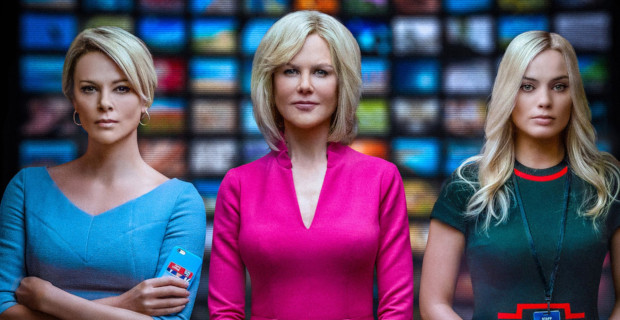
The performances are sizzling. Gretchen Carlson (Nicole Kidman) is a fading star at FOX, relegated to off-peak programs. (I could not help thinking of this performance as a bookend with Kidman’s “To Die For,” with Kidman as a woman who was willing to do anything, including sexual favors and murder, to get a job on TV news.) Megyn Kelly (Charlize Theron) is a rising star, and as this movie begins, she is horrified to find herself in the middle of a story as then-candidate Donald Trump makes ugly and crude accusations because she surprised him by asking him to comment on some of his insults to women (“You’ve called women you don’t like fat pigs, dogs, slobs and disgusting animals”) in an on-air interview. Margot Robbie plays Kayla, a fictional character based on the ambitious lower-level staff and what those who asked Ailes for on-camera opportunities were expected to do to show their “loyalty.”

Some early critics of the film object to the women being portrayed as feminist heroines. But they are not portrayed as feminist heroines; on the contrary. They’re not fighting courageously for justice like Norma Rae or Erin Brockovich. They are carefully calibrating how much abuse, how many humiliations, how much indignity they are willing to trade for the professional opportunities they want, even when it means ignoring abuse of other women. Answer: a lot. Ultimately, there is a limit, though, and watching each character locate that line is what makes this movie smart and engrossing. For Carlson, it is being fired. For Kayla, it is a painful realization after the fact, and after someone else has taken the almost unthinkably daunting step of going first. And the stakes are clear. “Once you go public, no one will hire you,” Carlson is told. Her post-lawsuit career has focused on sexual harassment issues either because she now recognizes the importance of the issue or because she cannot get any other job. The week of the film’s release she wrote an op-ed in The New York Times calling on Fox to withdraw the non-disclosure agreement she had to sign in order to settle her case. It’s unlikely, but if they do, maybe we’ll get another movie out of it.

The focus here is on Kelly. It is one thing to burn your bridges after you have been fired and have nothing to lose, but it is entirely another for a woman near the top of her profession who says, “I’m not a feminist; I’m a lawyer,” who does not want to be the story, who is in cutthroat competition with the other beautiful blondes and not one to raise a fist and proclaim that sisterhood is powerful. What will it take to get her to speak out and what price will she pay for saying something? Kelly is a complicated character and the way her dilemma is presented here is complicated and nuanced, more directed toward nods of recognition than standing ovations. Her career has been rocky (except for financially) since her decision to acknowledge the abuse, which makes this a cautionary tale that does not make the prospect of feminist heroine-ing look very appealing.

What is even more fascinating here is the setting. Is Fox a news organization as it has traditionally been understood? We get glimpses of other Fox personalities, including Bill O’Reilly, who left Fox following his own #metoo abuses. The way the organization responds to Carlson’s claims — handing out “Team Roger” t-shirts before any investigation even though it is generally known why there’s a lock on his door and a separate entrance to his office — says something about whether “loyalty” is more important than the truth, to them and to us.

Parents should know that this film is based on the real life #metoo upheavals at FOX News, with explicit discussions and some depiction of sexual harassment, abuse, and predation, and very strong language.

Family discussion: Why did the three women respond differently? How has coming forward affected their careers? What is the best way to prevent abuse by people in power?

If you like this, try: “The Loudest Voice” miniseries and “The Hunting Ground”

Related Tags:


Based on a true story Drama DVD/Blu-Ray Gender and Diversity Journalism movie review Movies -- Reviews
The Aeronauts

The Aeronauts

Posted on December 5, 2019 at 5:30 pm

B +
Lowest Recommended Age: Middle School
MPAA Rating: Rated PG-13 for some peril and thematic elements
Profanity: Some mild language
Alcohol/ Drugs: None
Violence/ Scariness: Extended peril, character sacrifices himself to save another
Diversity Issues: A theme of the movie (though the real-life character played by Felicity Jones was male)
Date Released to Theaters: December 6, 2019
Copyright 2019 Amazon Studios

Science fiction giant Arthur C. Clarke said, “Any sufficiently advanced technology is indistinguishable from magic.” “The Aeronauts,” based on the true story of early adventurers in meteorology and flight, exists at exactly that point in the middle. The “Theory of Everything” stars Felicity Jones and Eddie Redmayne play balloon pilot Amelia Wren and scientist James Glaisher, and for most of the movie they are up in the sky, marveling at sights and atmospheric conditions no humans have ever experienced before — or trying to survive them.

When they are in the air, it is gorgeous, exciting, and great fun. The visuals are spectacular, and sound designer Andy Kennedy and his team get a special shout-out for the superb audio effects, the exquisite silence, the creaking of the balloon basket, the clinks of the instrumentation. The never-ending series of life-or-death challenges are staged with such urgent vitality we almost feel that we are in the basket with them.

For most of the scenes on the ground, including a number of flashbacks, well, the screenplay never quite slips the surly bonds of earth. It is much better when they are up in the sky, battling the elements.

Wren and her husband piloted balloons until he was killed on one of their flights. Glaisher was a scientist who insisted that weather could be predicted with the help of meteorological data, despite the scorn of the scientific community and lack of support from his father, who is struggling with dementia. Glaisher is finally able to get the money for the balloon and persuades Wren to be the pilot.

Wren is highly theatrical, and Jones is utterly captivating in an early scene as she plays to the crowd, as savvy about showmanship as she is about flying. It is a lot of fun to see the actress who has often been given more subdued or internal characters do everything  — even cartwheels — to charm the crowd. She may appear to be light-hearted and flamboyant, but it is all precisely orchestrated and calculated. She knows what it takes to get the balloon in the air is not just the equipment and fuel but the other fuel, money.

Redmayne’s character is more like the shy, bookish type we’ve seen him play before. But it is fun to see his growing appreciation for both Wren and the adventure.

Those of us who pull down the shade on our airplane windows so we can watch movies on our laptops should take a moment to look outside and imagine what it was like to be the first human beings who saw — and heard — the inside of a cloud. “The Aeronauts” is best at conveying the thrill of that discovery, or, rather, series of discoveries, and the courage and ingenuity that went into getting up there and getting back down as close to safely as possible. It should inspire the audience not just to look out at the clouds but to dream of their own adventures.

NOTE: Rolling Stone did a fact-check to compare the movie to the real story.

Parents should know that this movie includes extended peril with a lot of suspense and some disturbing images. A character sacrifices his life to save someone else.

Family discussion: Why did Amelia change her mind about taking James up in the balloon? Who is most like James and Amelia today?

If you like this, try: “The Theory of Everything” also starring Felicity Jones and Eddie Redmayne, “Those Magnificent Men in Their Flying Machines” and read the book that inspired the film, Falling Upwards: How We Took to the Air

Related Tags:


Action/Adventure Based on a true story Drama Epic/Historical movie review Movies -- format Movies -- Reviews
Dark Waters

Dark Waters

Posted on December 5, 2019 at 5:00 pm

B
Lowest Recommended Age: Middle School
MPAA Rating: Rated PG-13 for thematic content, some disturbing images and strong language
Profanity: Strong language
Alcohol/ Drugs: Alcohol
Violence/ Scariness: Theme of toxic poisoning of a community with some grisly and graphic images
Diversity Issues: None
Date Released to Theaters: December 6, 2019
Date Released to DVD: March 2, 2020

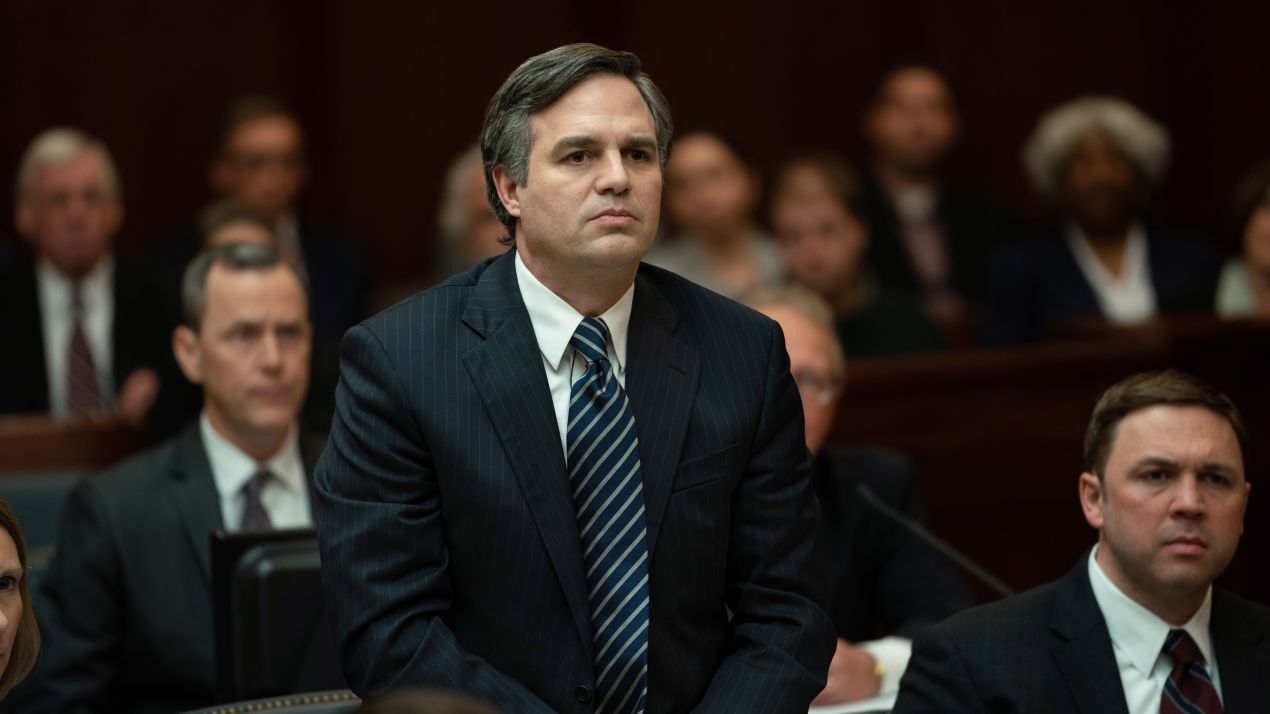
Mark Ruffalo stars as “Robert Bilott” in director Todd Haynes’ DARK WATERS, a Focus Features release. Credit : Mary Cybulski / Focus Features Copyright 2019
Imagine “Erin Brockovich” without the sizzle of the outspoken, miniskirted single mom with the biker boyfriend, and you’ve got “Dark Waters,” with Mark Ruffalo (who also produced) as real-life lawyer Rob Bilott, a lawyer who represented corporate polluters until a West Virginia farmer showed him what the chemicals were doing to his community. The movie is based on a New York Times article called The Lawyer Who Became Dupont’s Worst Nightmare by Nathanial Rich.

Bilott is pretty much the opposite of Erin Brockovich, a quiet, dedicated family man, so stable he is almost inert, who is comfortable representing corporations and thinks — not entirely wrongly — that he is one of the good guys because he is representing them in negotiations with EPA to use taxpayer-funded Superfund money to clean up toxic chemicals that are leeching into the ground and water.

After eight years of working on those cases, he gets a surprise visit from his grandmother’s neighbor, a farmer named Wilbur Tennant (Bill Camp), who speaks with a near-indecipherable West Virginia accent but who is very upset because his animals have weirdly mutated organs and keep dying early. Oh, and his brother died, too, Bilott turns him down, but then, because of his grandmother, he agrees to look into it. He thinks it will be one and done. He’ll write a letter, work his contacts, and get some money to compensate Tennant, then go back to his nice partners and his nice office and his nice life, including Anne Hathaway as his wife who has the usual thankless task for a wife in these films of telling him he is working too hard and neglecting his family and his health.

I love movies about courageous lawyers fighting The Man; movies like that are part of the reason I became a lawyer in the first place. But it is no secret that while fiery courtroom battles are wonderfully dramatic, especially if there are many opportunities to yell “I object!” and even more especially if the cross-examination is so devastating that the bad guy actually confesses. But law — even in court — is not actually like that, and in translating this story to the screen, they made a few mistakes.

First, the legal issues themselves are complicated and arcane. Unless you are a lawyer you don’t want to and don’t need to know why Bilott ends up representing different clients about halfway through, but for the purposes of dramatic storytelling it is confusing and distracting. The same goes for why the chemical in question, used in the creation of the wildly popular no-stick Teflon cookware, was not covered by EPA regulations concerning its production and disposal.

Most significantly, though, Ruffalo and director Todd Haynes have stripped away a significant proportion of what makes their work distinctive in what looks like a mistaken opinion that style is not serious. Haynes, whose early film “Safe” was a provocative, stylish, and very serious drama about chemical exposure, should know that what he can bring to a film like this will only make it more compelling. The same goes for Ruffalo, who has turned the pilot light down low on his considerable charm as a performer. That may work in court; it is not effective on screen.

This is an important story and worth seeing. Its most powerful moment comes near the end, not in the courtroom but in a gas station (check the credits for that actor’s name.) More of that and the movie could have and should have been better.

Parents should know that this film has some very disturbing images showing the consequences of exposure to toxic chemicals, including mutations of humans and animals and some strong language.

Family discussion: What made Bilott change his mind about helping Tennant? Whose job is it to prevent this kind of damage and why wasn’t it done?

If you like this, try: “Erin Brockovich,” “A Civil Action,” and “Promised Land”

Related Tags:


Based on a true story Courtroom DVD/Blu-Ray Environment/Green movie review Movies -- format
The Two Popes

The Two Popes

Posted on November 26, 2019 at 5:01 pm

B +
Lowest Recommended Age: Middle School
MPAA Rating: Rated PG-13 for thematic content and some disturbing violent images
Profanity: None
Alcohol/ Drugs: None
Violence/ Scariness: Images of violence, references to sexual abuse, illness
Diversity Issues: None
Date Released to Theaters: November 27, 2019
Copyright Netflix 2019

Sometimes history is made by groups of people in labs or courtrooms or legislative bodies or battlefields. Sometimes history is made by two people talking to each other quietly. We hear those stories less often. It may be that what makes those changes possible is keeping them secret.

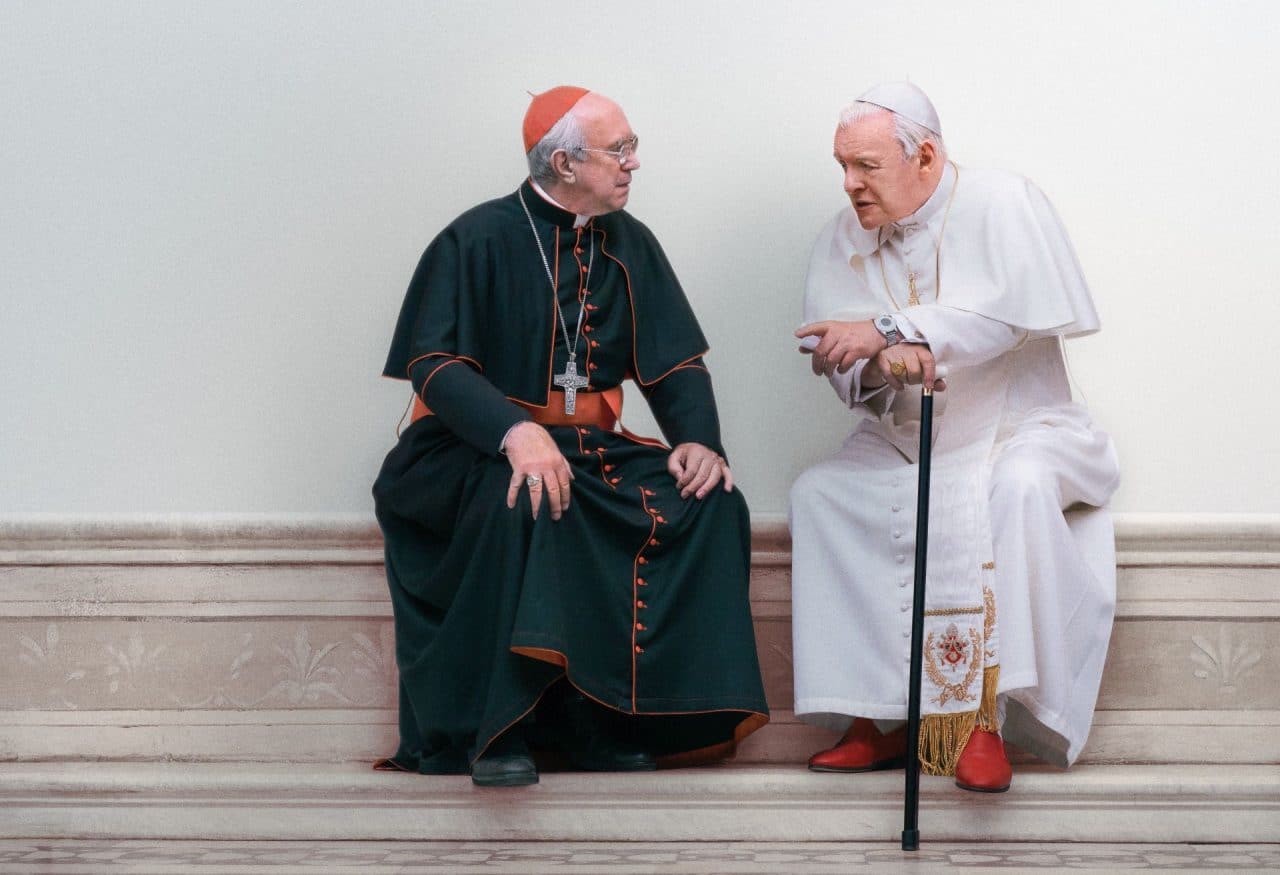
We will never know what really happened when Pope Benedict (Anthony Hopkins) became the first supreme pontiff to resign since 1294, selecting the man who became Pope Francis (Jonathan Pryce) as his successor. Everything about it was surprising. Popes have almost always served until death, and the selection process, gorgeously visualized here, is ancient and mysterious. We see with the rows of scarlet-clad cardinals clicking their bright blue pens to cast their votes and the two smoke options, black to show no decision yet, white to show that the new pope has been chosen. The idea of a pope resigning (creating the new position of emeritus pope) and guiding the selection of his successor was unprecedented (well, we don’t know much about what happened in the 13th century, but it was so long ago that “unprecedented” seems appropriate) and so there was no template to follow.

And yet, as it cannot help but be, it is political. The cardinals are only human. During the 2005 selection process, While many votes went for Cardinal Jorge Mario Bergoglio, he was a long shot. There had never been a Jesuit pope, one from the Americas, one from the Southern Hemisphere. Almost all of the popes have been Italian and all have been from Europe since the Syrian Gregory III, who reigned in the 8th century. And so the one selected was a German cardinal named Joseph Aloisius Ratzinger.

More than geography and religious order separated the two men. Pope Benedict was conservative and traditional. Bergoglio is more liberal, more about Catholicism as a call to compassion and engagement with the community. He lived simply and wanted to return being a parish priest. After a few years, he wanted to retire. He wrote to Pope Benedict to ask for permission but before his letter was received, Pope Benedict wrote to ask him to visit. Bergoglio thinks it is to discuss his retirement. Pope Benedict has another career path in mind.

There are some flashbacks, particularly concerning their deepest regrets and most painful failings. But most of the movie is two of the greatest actors of our time playing two of the most formidable and consequential figures of our time, talking to each other about the most foundational issues of faith and philosophy. Sometimes they are indirect. Sometimes they clash in style and substance. But they always exemplify their commitment to their beliefs with grace and kindness. Pope Benedict plays the piano. Bergoglio orders pizza and Fanta. They develop an understanding and a kind of friendship. It is a pleasure and a privilege to be able to eavesdrop on this conversation, and inspiring, too.

Parents should know that this movie includes references to and brief depictions of historical atrocities and references to sexual abuse by priests.

Family discussion: What were the biggest differences in viewpoint between the two popes? What was more important to Pope Benedict than their differences in interpretation and commitment to tradition?

If you like this, try: the documentaries “Pope Francis: A Man of His Word” and “Hesburgh”

Related Tags:


Based on a true story Drama movie review Movies -- format Movies -- Reviews
A Beautiful Day in the Neighborhood

A Beautiful Day in the Neighborhood

Posted on November 21, 2019 at 5:16 pm

A-
Lowest Recommended Age: Middle School
MPAA Rating: Rated PG for some strong thematic material, a brief fight, and some mild language
Profanity: Some mild language
Alcohol/ Drugs: References to substance abuse, drinking and drunkenness
Violence/ Scariness: Scuffles, punch, illness, sad death of a parent
Diversity Issues: None
Date Released to Theaters: November 21, 2019
Date Released to DVD: February 17, 2020

Copyright TriStar Pictures 2019
The documentary Won’t You Be My Neighbor is about Fred Rogers, the creator and star of the long-running PBS series Mr. Rogers’ Neighborhood. “A Beautiful Day in the Neighborhood,” with Tom Hanks as Fred Rogers, is about us. It is the very essence of heart-warming and inspiring. Anyone who watches it will be moved — and is almost guaranteed to be a kinder, happier, more open-hearted person at the end of the film. Rogers liked to ask people to think for a minute, a real sixty-second minute, about those who “loved us into being.” “A Beautiful Day in the Neighborhood” asks us that question, literally and in a deeply soul-searching way. And if we are honest, one of the people who comes to our minds will be Fred Rogers himself.

So, Rogers is not the story here. Instead, it is about the impact he had on one troubled adult, and what that means about and for each of us.

Based on the true story of journalist Tom Junod, who interviewed Rogers for a 1998 profile in Esquire, this film, by Micah Fitzerman-Blue and Noah Harpster and directed by Marielle Heller (“Can You Ever Forgive Me?” “The Diary of a Teenage Girl”), is about how the experience of interviewing, or, rather, attempting to interview Fred Rogers was transformational in the life of the reporter (here called Lloyd and played by Matthew Rhys).

Lloyd is a new father struggling with unresolved feelings of abandonment and anger at his own father (Chris Cooper). He is a hard-hitting, skeptical, investigative journalist, not accustomed to or comfortable with assignments to write fluffy features about the hosts of television shows for children. He is assigned to write about Mr. Rogers for the “heroes” issue of Esquire. But he is not someone who takes easily to the idea of heroes. Is his inclination to expose what prominent or influential people want to hide based in part on the father who let him down? Perhaps. But is that the right approach to Mr. Rogers? “Don’t ruin my childhood,” his wife warns. And when he asks Mr. Rogers about how he differs from the character he plays on television, the gentle clergyman-turned-unlikely-television-star genuinely does not understand the question. He cannot be anything other than what he is.

More important, he has a “compulsive intimacy” that prompted him to ask questions far more insightful and meaningful than the ones Lloyd was asking him to answer for the article.

Director Marielle Heller and screenwriters Micah Fitzerman-Blue and Noah Harpster bring a lovely delicacy and an almost fairy tale quality to the story. At times it seems we are watching an episode of the series and then we see that the “real world” and the world of the show blend together — both the “real” home where Mr. Rogers changes into his cardigan and sneakers and feeds the fish and the “imaginary” world of the kingdom of Make Believe. Just as all of the characters on the show represent parts of Fred Rogers’ personality, the heart of the movie is integrating all of its worlds and emotions.

A story relies on some kind of change experienced by the main character. He or she has to lose something or learn something or complete something. Mr. Rogers was already so evolved that trying to make him the main character of a feature film would not have worked. So wisely the story here is about the effect Mr. Rogers had on one troubled soul, helping him to lose something, to learn something, and to complete something. And in doing so, it helps us locate some of the compulsive intimacy that makes Mr. Rogers’ viewers into friends who feel accepted, understood, and very lucky to be in his neighborhood.

NOTE: Look carefully at the other customers in the scene set in a Chinese restaurant, when Mr. Rogers and Lloyd are eating together. They are the real-life friends and family of Mr. Rogers, including his wife Joanne (played by Maryann Plunkett in the film) and his producer Bill Isler (played by Enrico Colantoni).

Parents should know that this movie includes frank depiction of family dysfunction with an adult son still resentful and angry about his father’s abandonment, drinking and drunkenness, a scuffle, terminal illness, and some mild language.

Family discussion: How would you answer Mr. Rogers’ questions? What did Lloyd learn from him?

If you like this, try; the documentary “Won’t You Be My Neighbor?” and the episodes of “Mr. Roger’s Neighborhood” and my interview with the journalist whose article inspired the film and the men who wrote the screenplay.

Related Tags:


Based on a true story Drama DVD/Blu-Ray Family Issues movie review Movies -- format
THE MOVIE MOM® is a registered trademark of Nell Minow. Use of the mark without express consent from Nell Minow constitutes trademark infringement and unfair competition in violation of federal and state laws. All material © Nell Minow 1995-2026, all rights reserved, and no use or republication is permitted without explicit permission. This site hosts Nell Minow’s Movie Mom® archive, with material that originally appeared on Yahoo! Movies, Beliefnet, and other sources. Much of her new material can be found at Rogerebert.com, Huffington Post, and WheretoWatch. Her books include The Movie Mom’s Guide to Family Movies and 101 Must-See Movie Moments, and she can be heard each week on radio stations across the country.

Website Designed by Max LaZebnik