Battle of the Sexes

Battle of the Sexes

Posted on September 21, 2017 at 9:53 pm

B +
Lowest Recommended Age: Mature High Schooler
MPAA Rating: Rated PG-13 for some sexual content and partial nudity
Profanity: Some strong language
Alcohol/ Drugs: Drinking, cigarettes
Violence/ Scariness: None
Diversity Issues: A theme of the movie
Date Released to Theaters: September 22, 2017
Date Released to DVD: January 1, 2018
Copyright Fox Searchlight

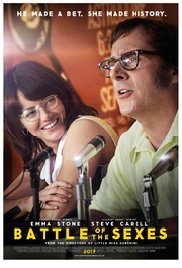
“You’ve come a long way, baby!” was the 1970’s slogan for a cigarette for women. Virginia Slims were marketed as a badge of liberation and sophistication. They had a woman’s slightly naughty-sounding name and a word with a lot of appeal to female consumers (and a suggestion that they would aid in keeping weight down). They had a kicky advertising campaign. And they were the only commercial product willing to sponsor the brand new Women’s Tennis Association, founded by tennis champion Billie Jean King to protest the pay differential in professional tennis, with women making a fraction of the prize money awarded to the men. When they raised the issue, they were told that women’s tennis was not as interesting (even though they sold as many or more tickets at the same price as the tickets to see the men play) and because the men had families to support. It may now seem absurd, or at least off-brand to have a women’s athletic competition sponsored by a cigarette, but probably no more absurd than the argument that “the men’s tennis is more exciting to watch; it’s biology.”

One-time men’s tennis champ Bobby Riggs (Steve Carell) was a bit of a sexist and more than a bit of a showman, and much more than a bit of a gambler. And so he bragged that even in his 50’s he could beat the top-ranked women’s player. Margaret Court accepted the challenge, and he triumphed in a humiliating defeat. And so, Billie Jean King agreed to play him in something between a sporting event and a three ring circus, complete with marching band, scantily dressed cheerleaders in Sugar Daddy outfits, and the ceremonial presentation by King to Riggs of an actual pig.

So, not your usual night on ESPN, which, of course, had not been invented yet. This was front-page news in the midst of the fight for what people were still calling “women’s liberation.” This was consciousness raising whether you liked it or not.

It is especially suitable that this film was directed by a female/male team: Valerie Faris and Jonathan Dayton (“Little Miss Sunshine”). They found the human story, the vulnerability, the drive, the fear, the resolve behind the hoopla and hyperbole, and they have made a film about real people that is moving and, even though we know the outcome of the game, suspenseful.

Bobby Riggs would have been a public feminist if he could make a dollar at it. (A dollar, by the way, is what the original players in King’s Women’s Tennis Association were paid to sign up.) He would cheerfully admit, except possibly to his wealthy wife (Elisabeth Shue), that he was more of a showman and a huckster than an athlete. Billie Jean King was a determined, disciplined athlete at the forefront of the Gloria Steinem era of feminists. She was companionably married to Larry King (not the TV show host), but she was beginning to admit to herself that she was attracted to women. Her hairstylist, Marilyn (Andrea Reisborough), leans in and brushes her hand on Billie Jean’s cheek. The woman who never allowed herself any distractions has met a distraction she cannot ignore.

Faris and Dayton create the environment of the 70’s without any air quotes. The cinematography, the score, the deft use of Howard Cosell’s actual commentary during the match (at one point, he says approvingly that King moves like a man), evoke the era without exaggeration or snottiness. Every performance shines, including Sarah Silverman in the Eve Arden wry sidekick role. The film is generous to all of its characters, even the real and metaphorical pigs.

Parents should know that this film includes sexual references and an explicit situation with some nudity, issues of sexual orientation, some crude language, alcohol, cigarettes, sexism, and homophobia.

Family discussion: What is different today and what hasn’t changed? Why did Billie Jean King decide to play Bobby Riggs?

If you like this, try: Footage of the real King/Riggs game

Related Tags:


Based on a true story DVD/Blu-Ray Pick of the Week Gender and Diversity GLBTQ and Diversity movie review Movies -- format Sports
Stronger

Stronger

Posted on September 21, 2017 at 5:30 pm

B +
Lowest Recommended Age: Mature High Schooler
MPAA Rating: Rated R for language throughout, some graphic injury images, and brief sexuality/nudity
Profanity: Constant very strong language, some crude
Violence/ Scariness: Drinking and drunkenness
Diversity Issues: None
Date Released to Theaters: September 22, 2017

Copyright 2017 Lionsgate
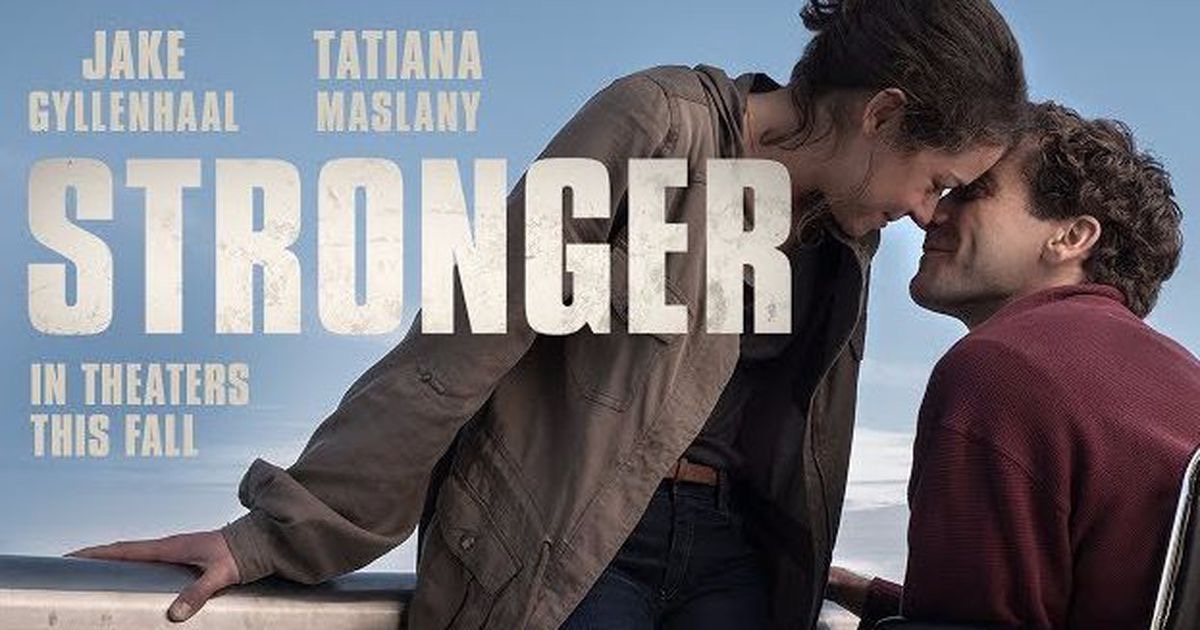
“Stronger.” As in the “Boston Strong” motto that the city claimed and earned following the terrible bombing at the finish line of one of the city’s most cherished annual events, the Boston Marathon. And “stronger” as in what that which does not defeat you makes you. “Stronger” is the real-life story of a man who was in the wrong place at the wrong time and who became a symbol of hope in the midst of wrenching loss. It is also the story of that man’s struggle to acknowledge to himself, his family, and the media the darker reality of his struggles with post-traumatic stress caused by the bombing, the long, slow, painful rehab, and by the pressure put on him by everyone to be a hero.

Imagine you are standing at the finish line of the Boston Marathon to cheer on your estranged girlfriend and then wake up in a hospital bed to the news that your legs are gone. What would be the first thing you would say?

Jeff Bauman (Jake Gyllenhaal), still groggy from the anesthesia, shock and pain, unable to speak because of tubes, gestured for a pen. He wrote three messages. The first asked if the girl he was there to support was all right. She was. He then wrote “Lt. Dan,” as in the Gary Sinise character in “Forrest Gump,” who loses his legs in Vietnam.

And then he wrote: “I saw the bomber.”

Bauman’s description gave law enforcement essential details that helped them track down the Tsarnaev brothers.

Director David Gordon Green and screenwriter John Pollono, working from Bauman’s book are especially good at putting us in Jeff’s world, in the midst of his noisy, hard-drinking, combative, sports-loving, and fiercely loyal family. They travel as a pack.

Jeff’s divorced parents, Patty (Miranda Richardson) and Big Jeff (Clancy Brown), his brother and friends are there for him in the most literal sense, at the hospital. One of the movie’s best scenes is at the hospital just after the surgery, when Jeff’s supervisor from Costco (Danny McCarthy) arrives and they begin to yell at him and each other, partly because they are all frantic and need to let off steam and partly because they are the kind of people who yell a lot. When they discover he is there to provide insurance information and assure Jeff that he still has a job, it is deeply moving.

They are all there again when he returns to his mother’s apartment. They are more concerned about the party to welcome him home and the chance to show him all the letters and packages he has been sent than to consider the logistics of his having to maneuver up a steep staircase. Erin (Tatiana Maslany), who broke up with Jeff just before the marathon, becomes a full-time caretaker. He is under enormous pressure to be the resilient guy who came out of the hospital with a thumbs up sign for the cameras.

Gyllenhaal, who makes some of the most thoughtful and challenging choices of any actor his age, gives a performance of great sensitivity, capturing Jeff’s offhand, offbeat humor as well as his physical and emotional anguish. He shows us the integrity Jeff himself did not understand he had. In another exceptional scene, Jeff does very little talking. He finally agrees to meet Carlos (Carlos Sanz), the man in the cowboy hat who saved his life, and who was included with him in one of the iconic images captured that day. The story Carlos tells is a turning point for Jeff, and it is all in Gyllenhaal’s posture and expressions. There are huge cataclysmic events, but it is in the small details that this film has the most power.

Parents should know that this movie concerns a terrorist bombing with severe injuries and amputation, post-traumatic stress, drinking and drunkenness, nudity, a sexual situation, and constant very strong language.

Family discussion: What do the three comments Jeff wrote tell us about him? What did he learn from Carlos?

If you like this, try: “Patriot’s Day”

Related Tags:


Based on a book Based on a true story DVD/Blu-Ray Illness, Medicine, and Health Care movie review Movies -- format Movies -- Reviews
Rebel in the Rye

Rebel in the Rye

Posted on September 14, 2017 at 5:50 pm

B +
Lowest Recommended Age: High School
MPAA Rating: Rated PG-13 for some language including sexual references, brief violence, and smoking
Profanity: A few strong and crude words
Alcohol/ Drugs: Drinking, smoking
Violence/ Scariness: Wartime violence with disturbing images including holocaust images
Diversity Issues: None
Date Released to Theaters: September 15, 2017
Copyright 2017 IFC

J.D. Salinger had three great losses and three great teachers, and “Rebel in the Rye” is the story of how those all came together to influence the author of one of the most popular and influential novels of the 20th century, The Catcher in the Rye, along with his shorter pieces, a few novellas and stories. Salinger is almost as well known for his decades of seclusion in New Hampshire as he is for his work. Reportedly, after publishing his last story in 1965, he continued to write full-time, but never showed it to anyone or allowed it to be published. It may be that the mystery is a better story than the writing.

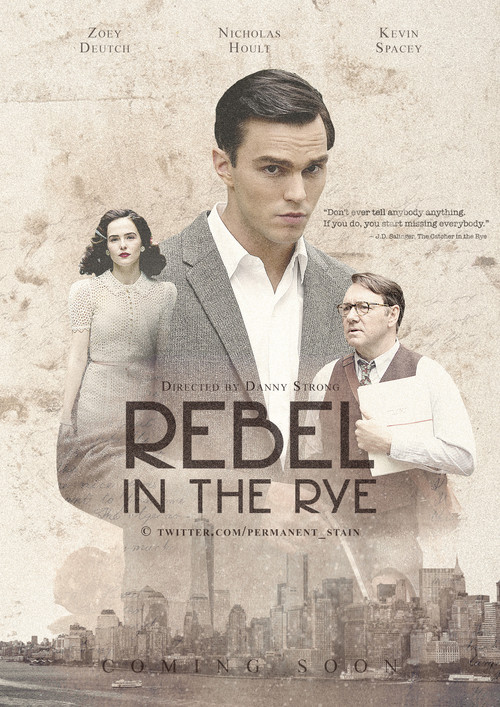
Writer/director Danny Strong (co-creator of “Empire,” screenwriter of the “Mockingjay” films and actor in “Gilmore Girls” and “Buffy”) introduces us to Salinger before all of that happened, young, ambitious, and like Catcher in the Rye‘s Holden Caulfield, a smart aleck who has left or been asked to leave a number of top schools. Nicholas Hoult (“About a Boy,” “Mad Max: Fury Road”) shows us the teenage Salinger, arrogant but insecure, especially arrogant when it came to writing and especially insecure when it came to girls. He meets Oona O’Neill (Zoey Deutch), the daughter of playwright Eugene O’Neill, and they begin to date, though what makes her most attractive to him is her lineage and her admiration for his writing. And, after leaving NYU, he enrolls in Columbia, where he takes a class from the editor of Story Magazine, Whit Burnett (Kevin Spacey). “There is nothing more sacred than stories,” Burnett tells the class. And he advises Salinger not to let his voice overwhelm the story, not to let his ego obstruct the emotional experience of the reader.

Burnett will be Salinger’s most important influence on the content of his stories, suggesting that Holden Caulfield deserves a novel. And O’Neill will be an influence, too, the first of the three great losses, when she leaves him to marry Charlie Chaplin.  Just as he is beginning to make progress as a writer, with his first published work in Burnett’s literary journal, Salinger joins the military in WWII, where he endures great peril and hardship and witnesses some of the worst events in world history, including the landing on Normandy beach and the liberation of a concentration camp.  These traumatic experiences caused great distress for Salinger, what would today be called PTSD (as Salinger movingly described in my favorite of his stories, “For Esme, with Love and Squalor.”  But it was these experiences that gave him the depth and scope to write his sole novel.

Burnett teaches Salinger that publication is incidental; what matters is doing the work of writing.  Salinger’s agent (Sarah Paulson, wry but sympathetic) tells him that “publication is everything” and urges him to “soften” his stories according to the “notes (comments) she gets back from editors.  Salinger, initially refusing to make any changes, finally does and even admits that they made the story better.

But the stress of success becomes too much for him.  “I’m shackled by my own creation,” he says as Catcher is seen as an invitation for readers to come see him.  The last loss and the last teacher are combined in a zen master who advises him to let go of his need for approval.  He moves to New Hampshire and never has anything to do with the literary world again. “If I can dedicate my life to writing and get nothing in return,” he says, “I think I might find happiness.”

Hoult is fine in showing us how Salinger changes, especially the effect of the war.  His scenes with his parents (Hope Davis and Victor Garber) and with the women he is trying to impress are especially effective.  Strong, as a writer himself, well understands the struggle to understand which voices to listen to, whether internal or external, in evaluating the work, and the complexity of needing approval even as we try to transcend that need.  The film evokes the mid-century era without being showy or distracting, and, an even more difficult challenge, explores the life of someone who wanted to be left alone without being exploitive.  Salinger insisted that there will never be a film about Holden Caulfield, and he was right as the value of that book is in the voice of its narrator more than in the incidents it portrays.  This is a better version of a story about someone who wants to catch children to keep them safe, at least in his own mind, or in the stories he will never show.

Parents should know that this film includes wartime violence with disturbing images including holocaust footage, drinking and drunkenness, constant smoking, and sexual references.

Family discussion:  Who was right about writing vs. publishing?  What makes Catcher in the Rye so compelling?  How was Salinger’s wartime experience reflected in his writing?

If you like this, try: the books of JD Salinger


Related Tags:


Based on a true story Biography Drama DVD/Blu-Ray movie review Movies -- format Movies -- Reviews
Crown Heights

Crown Heights

Posted on August 31, 2017 at 5:54 pm

B +
Lowest Recommended Age: High School
MPAA Rating: Rated R for language, some sexuality/nudity and violence
Profanity: Strong language
Alcohol/ Drugs: Some alcohol, drug references
Violence/ Scariness: Peril and violence, murder
Date Released to Theaters: September 1, 2017

Copyright Amazon 2017
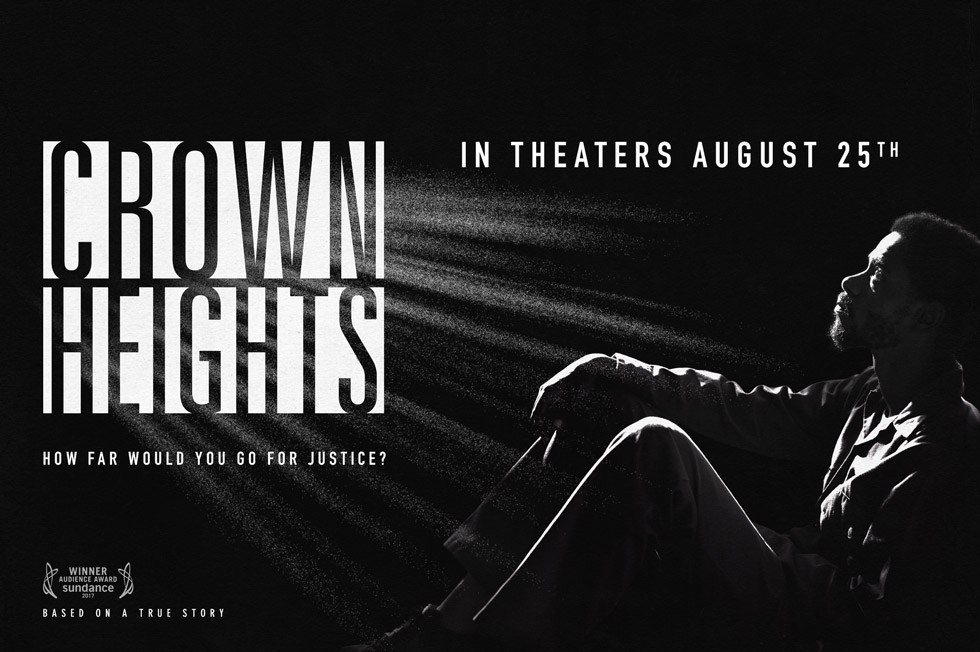
The story of Damon and Pythias has exemplified friendship and loyalty since the time of the ancient Greeks. The story of Colin Warner and Carl King should stand beside it. King spent 21 years working to get Warner released from prison after he was unjustly sentenced for murder. A reporter for “This American Life” told their story, and now it has been adapted for the screen by former NFL player Nnamdi Asomugha, who plays King opposite the extraordinarily gifted LaKeith Stanfield (“Get Out,” “Short Term 12″) as Warner.

The friends met growing up in Trinidad and then reconnected when both emigrated to the Crown Heights neighborhood of Brooklyn. Writer/director Matt Ruskin and Director of Photography Ben Kutchins evoke the lively but volatile and gritty atmosphere of 1980 Brooklyn. Warner is not even in the wrong place at the wrong time. He is nowhere near the spot where an apparent revenge execution-style murder is committed. But the cops are overwhelmed and under a lot of pressure to produce arrests and close cases. Archival footage of Presidents Reagan, Clinton, and George W. Bush promising crackdowns on crime provide context.

It is possible that determination to be fair to as many people as possible costs the film some dramatic momentum, especially as it stretches over decades, with setback after setback and complication after complication, plus the various family stresses, particularly with King as his wife understandably gets frustrated with the time and money he is devoting to Warner instead of their children. But the dignity and sensitivity of the performances by Stanfield and Asomugha hold the story together. But the time King takes a job as a process server in order to better understand what kind of legal help they need, things begin to pick up. A tender romance and a touching expression of forgiveness give the film a quiet power that I hope will not always feel as timely as it does right now.

Parents should knot that this story concerns a wrongful murder conviction and includes peril, violence, abuse, strong language, some sexual references and situations, and some nudity.

Family discussion: Why does this film title refer to the neighborhood, not the people involved? Why didn’t Carl give up? Listen to the story that inspired this film on “This American Life.”

If you like this, try: “Conviction” and “Hurricane”

Related Tags:


Based on a true story Courtroom Crime Drama movie review Movies -- format Movies -- Reviews
The Glass Castle

The Glass Castle

Posted on August 10, 2017 at 5:41 pm

B +
Lowest Recommended Age: High School
MPAA Rating: Rated PG-13 for mature thematic content involving family dysfunction, and for some language and smoking
Profanity: Some strong language
Alcohol/ Drugs: Smoking, alcohol and alcohol abuse
Violence/ Scariness: Domestic violence, child badly burned in a cooking accident, child neglect and endangerment
Diversity Issues: None
Date Released to Theaters: August 11, 2017
Date Released to DVD: November 6, 2017
Copyright 2017 Lionsgate

In her 1986 best-seller, Necessary Losses, author/poet Judith Viorst talks about the beliefs each of us has to give up in order to move forward. The first and in some ways the most difficult is the understanding that our parents are not all-powerful and all-knowing, and that they cannot kiss all of our hurts and troubles away forever. Some of those realizations are worse than others. Most of us, I hope, do not have to give up on the idea that our parents at least want to take care of us and that they do their best. But parents who neglect or abuse their children take away something worse than food and safety; they take a child’s senses of trust and pride.

And so “The Glass Castle,” based on the best-selling memoir by Jeannette Walls, begins with Walls, a sophisticated, elegant, and successful New York journalist (Oscar-winner Brie Larson) on her way home in a cab after dinner in an expensive restaurant with her fiance and his prospective client, seeing her parents dumpster diving. They were homeless.

And so, we go back in time to see her as a very young child, telling her mother, Rose Mary (Naomi Watts) she is hungry. “Would you rather me make you some food that will be gone in an hour or finish this painting that will last forever?” It is a rhetorical question. Young Jeannette (Chandler Head) toddles over to the stove to make herself some hot dogs. But her dress catches on fire and she is badly burned.

When her father, Rex (Woody Harrelson) decides to take her out of the hospital, without doctor permission and without paying. At this point, Jeannette is still young enough to believe everything her parents tell her, like “our home goes wherever we go.” Rex, probably self-medicating for undiagnosed bipolar disorder, was immensely brilliant and charismatic. The glass castle of the title was the home he kept promising to build the family, and he spent years drawing plans for it. Rex and Rose Mary were less and less able to maintain any kind of stability at the same time that the children became more and more aware of what they were entitled to expect and unlikely to get. Instead of excitedly making plans for the castle, they began pleading with him to stop drinking. And then, when he could not, they decided to take responsibility for themselves and each other.

Writer/director Destin Daniel Cretton worked with Larson in the outstanding “Short Term 12,” which also had themes of abuse, damage, and resilience. He is especially good here in dealing with the challenge of three different performers, some quite young, portraying Jeannette and her siblings, maintaining consistency as they grow up, but using the cinematography to help convey the journey from their glowing memories of childhood, believing in their parents’ view of the world as beneath them, to the grittier life of deprivation and uncertainty. The spot where the glass castle was supposed to be built literally becomes a garbage dump.

What’s wisest and most significant is that the film becomes more than the story of survival. It is really only when Jeannette stops being afraid to tell the truth about herself that she is able to accept the best of what Rex and Rose Mary brought to her life. As Walls — and Viorst — might agree, necessary losses are worth the pain when they lead to the freedom that only comes from being true about and to yourself.

Parents should know that this film concerns the neglect and abuse of children, parents with substance abuse and mental illness problems. It includes smoking, drinking and drunkenness, domestic abuse, a child burned in a fire, strong language, and a sexual situation.

Family discussion: Why did Jeanette decide to tell her story? What was she grateful for receiving from her parents? If there was a movie about your family, who would you like to play you?

If you like this, try: “Running with Scissors,” “The Prize Winner of Defiance, Ohio” (another real-life story with Woody Harrelson as a father with a drinking problem), and “Infinitely Polar Bear,” and the book by Walls

Related Tags:


Based on a book Based on a true story Coming of age Drama DVD/Blu-Ray Family Issues movie review Movies -- Reviews
THE MOVIE MOM® is a registered trademark of Nell Minow. Use of the mark without express consent from Nell Minow constitutes trademark infringement and unfair competition in violation of federal and state laws. All material © Nell Minow 1995-2026, all rights reserved, and no use or republication is permitted without explicit permission. This site hosts Nell Minow’s Movie Mom® archive, with material that originally appeared on Yahoo! Movies, Beliefnet, and other sources. Much of her new material can be found at Rogerebert.com, Huffington Post, and WheretoWatch. Her books include The Movie Mom’s Guide to Family Movies and 101 Must-See Movie Moments, and she can be heard each week on radio stations across the country.

Website Designed by Max LaZebnik