Lupita Nyong’o and David Oyelowo star in “Queen of Katwe,” a Disney film based on the true story of a poor girl from Uganda who became a chess champion. It will be in theaters this fall.
Coming to Netflix: The Queen Elizabeth II Story “The Crown”
Posted on May 3, 2016 at 3:54 pm
As Great Britain’s longest-reigning monarch turns 90, “The Crown” focuses on Queen Elizabeth II as a 25-year-old newlywed faced with the daunting prospect of leading the world’s most famous monarchy while forging a relationship with legendary Prime Minister, Sir Winston Churchill. The British Empire is in decline, the political world is in disarray, and a young woman takes the throne….a new era is dawning. Peter Morgan’s masterfully researched scripts reveal the Queen’s private journey behind the public facade with daring frankness. Prepare to be welcomed into the coveted world of power and privilege and behind locked doors in Westminster and Buckingham Palace….the leaders of an empire await.
There was something special about the poor, uneducated Henrietta Lacks, something she could never have suspected. From the description of the book, by Rebecca Smoot:
She was a poor Southern tobacco farmer who worked the same land as her slave ancestors, yet her cells—taken without her knowledge—became one of the most important tools in medicine. The first “immortal” human cells grown in culture, they are still alive today, though she has been dead for more than sixty years. If you could pile all HeLa cells ever grown onto a scale, they’d weigh more than 50 million metric tons—as much as a hundred Empire State Buildings. HeLa cells were vital for developing the polio vaccine; uncovered secrets of cancer, viruses, and the atom bomb’s effects; helped lead to important advances like in vitro fertilization, cloning, and gene mapping; and have been bought and sold by the billions.
Yet Henrietta Lacks remains virtually unknown, buried in an unmarked grave.
Her family knew nothing about this and of course was not paid for the use of her cells. Winfrey’s casting as the daughter suggests the focus will be more on the family and the ethical questions than the science, but I hope both will be covered.
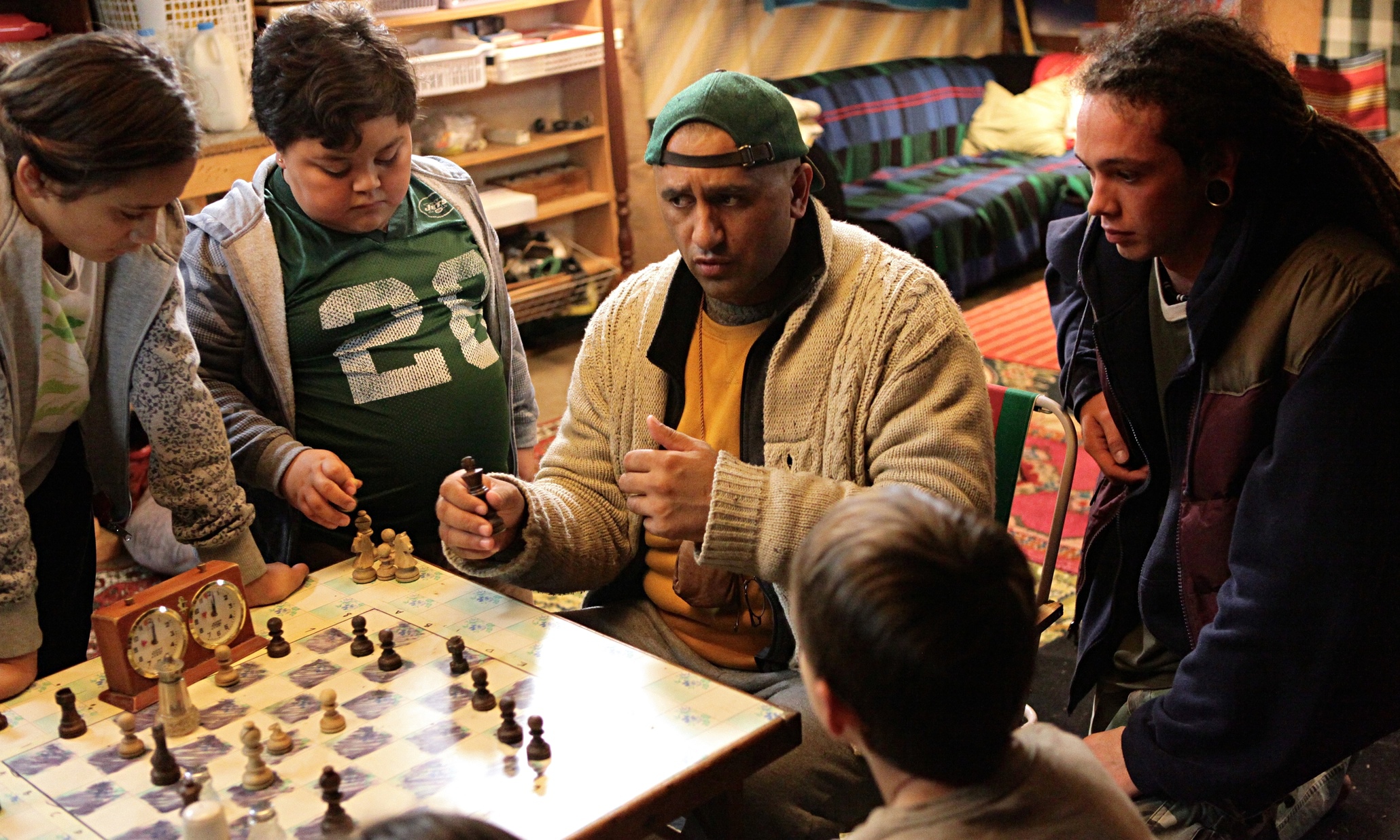
Copyright Broad Green 2016It would be so easy — and so wrong — to make this true story of a Maori chess champion who struggles with mental illness as he teaches underprivileged kids into a safe, simple, saccharine, uplifting story. But writer/director James Napier Robertson, who himself played hundreds of chess games with real-life speed chess champion Genesis Potini, trusts his story and his audience enough to give us a film that is refreshingly messy, even grungy, and therefore much more powerful.
The extraordinary actor Cliff Curtis is renowned for being able to play almost any ethnicity, one reason he was an affecting Jesus in the recent Risen. Here, though, as in “Whale Rider,” he has a chance to play the part of a person of his own ethnic heritage, the speed chess champion Genesis Potini, who had bipolar disorder. Curtis shows us that Genesis is a person first, not a group of symptoms. In a meet, wanting so much for the kids he has trained to have a chance to succeed, he cannot restrain himself from shouting encouragement, and we see how painful it is for him to feel like two people at once, the one who cannot control his impulses and the one who understands what he is putting at risk.
Robertson also gives us an honest, unflinching look at the community where Genesis has come, after being released from the mental hospital with a fistful of pills and the direction to find something to care about. The only place he has to go is the home of his brother, Ariki (Wayne Hapi), and Ariki’s son, Mana (James Rolleston of “Boy”). Ariki is a member of a gang that hangs out, gets high, commits petty and not so petty crimes, and spends a lot of time in not so petty macho posturing. He does not like having Genesis there and soon kicks him out.
Genesis sees a flier for a program that provides enrichment services for needy kids and decides that this will be the purpose that will help him maintain equilibrium. He volunteers — waking the director up in the middle of the night to offer his services, and against his better judgment, the director accepts, warning Genesis that if he shows up, he cannot let the kids down. Genesis impulsively (he does everything impulsively) tells kids who have never seen a chess game before that they will be competing at a big tournament in six weeks. Before they learn how to play, he lets each of them pick a chess man to take home as a totem, and to bring with them every day so that the set can be a team again. It makes them into a team as well. He uses the money Ariki gave him for rent to buy chess sets for the kids and he sleeps outside.
Genesis’ splintered reality and lack of impulse control may be advantages for speed chess. All of the possibilities are laid out before him but that does not make him hesitate. But chess is a game of rules and it provides a certainty, order, and mastery that Genesis and the kids he teaches can hold onto and build on. Mana has to decide whether he will follow his father or his uncle. Genesis has to try to be the man Mana and the kids need. It might get corny but for Robertson’s unaffectedly gritty settings and understanding that modest gains can be enough for checkmate.
Parents should know that this movie includes violence, child abuse, drinking, drugs, mental illness, and extreme poverty. Characters use very strong language.
Family discussion: Why was helping the children so important to Genesis? Why was having Mana in the gang so important to his father?
If you like this, try: “Searching for Bobby Fischer,” “Bobby Fischer Against the World,” and “Endgame”