Trailer: The Obama’s First Date in “Southside With You”
Posted on June 10, 2016 at 8:00 am
When Barack Obama took a summer job at a Chicago law firm after his first year of law school, a recent Harvard Law School graduate named Michelle Robinson was assigned to be his supervisor. He asked her to come with him to a community meeting and she agreed, insisting that it was not a date. But by the end of the day, they saw Spike Lee’s “Do the Right Thing” and shared ice cream — and a kiss. “Southside With You” is the story of that date, opening in August.
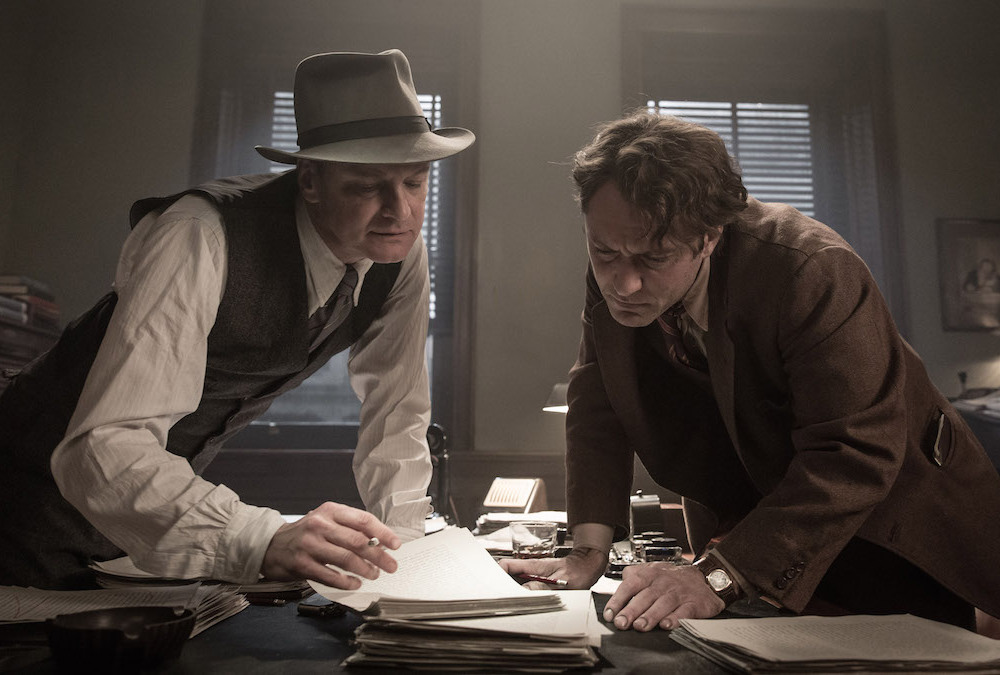
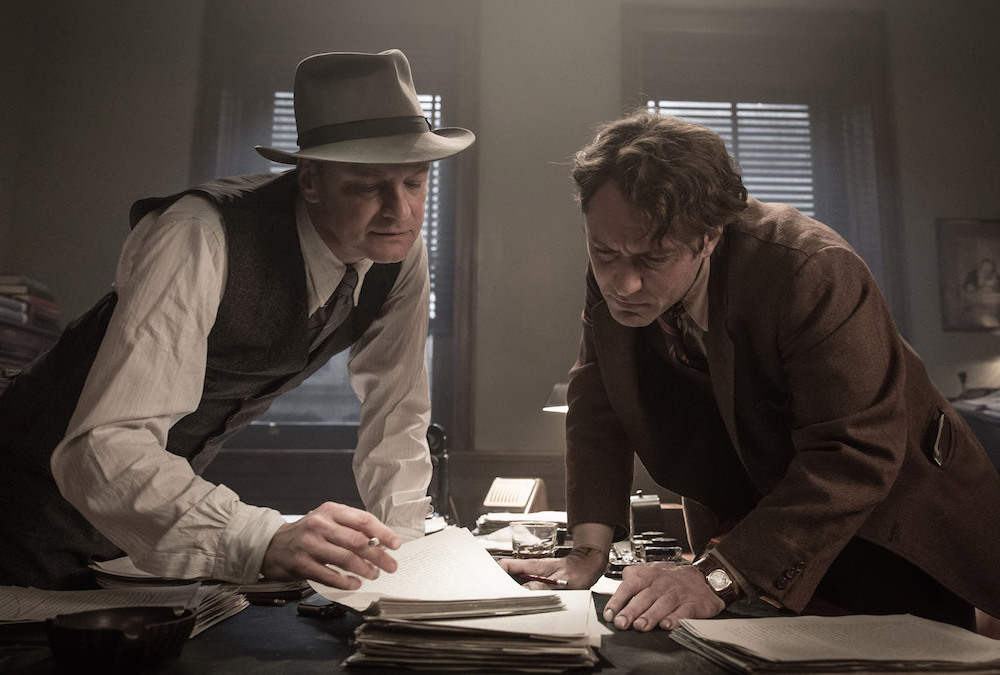
They are legends of 20th century American letters, so renowned a single name suffices: Fitzgerald, Hemingway, Rawlings, Lardner, Wolfe. But there is another name — Maxwell Perkins — who was essential to their work and often advisor and support system for their personal lives as well. A. Scott Berg’s brilliant 1978 biography of Perkins has inspired a film that focuses on the most important relationship of Perkins’ professional life — his work on the first two books by Thomas Wolfe.
Intriguingly, all of the major male roles are taken by British and Australian actors playing Americans, and unsurprisingly they are all superb, never missing an final r or an elongated vowel — or worse — showing off. Colin Firth plays Perkins, a mild-mannered man who loved his family but was most alive as a appreciator of literature — he knew it when he received it as a manuscript and he knew how to trim away the underbrush to make it better. His great skill was seeing the story the writer wanted to tell and doing whatever was necessary to get it into the hands of readers.
After Hemingway’s spare, masculine prose and Fitzgerald’s elegant sentences and impeccable structure, Perkins receives a submission from Wolfe that is vital, poetic, and a veritable avalanche of words. “Please tell me it’s double-spaced,” he says, looking at the pile of paper. “That’s a long paragraph,” Perkins daughter remarks, reading over his shoulder. “It started four pages ago,” her father replies.
Like Michelangelo seeing the statue inside the block of marble, Wolfe sees a novel that preserves Wolfe’s torrential style but prunes away the excess. He reassures Wolfe that he will only “shape it a bit, cut off the top branches.” Wolfe knows it needs pruning. “You don’t know how I struggled to cut the gorgon down.”
And Wolfe (Jude Law), who tells Perkins that not just his books but most of all literature is about the search for a father, responds to Perkins’ utter engagement in service to his story. The relationship between a writer and a great editor is one of the most intimate and fulfilling, something between a gifted psychoanalyst, an inspiring teacher, and a fairy godparent — or, just a parent. Perkins, the father of five daughters (charmingly portrayed), found a spiritual son in the troubled genius, and, as Berg’s book argues, was a genius himself in the way he was able to cull out of him timeless classics.
This sympathetic portrayal acknowledges the devastation that can be wrought by geniuses. We see Wolfe’s troubled relationship and careless dismissal of his supporter and mentor, the set designer Aline Bernstein (Nicole Kidman), who is anguished not because she left her husband and children for the much-younger Wolfe, but because once she was successful at getting him launched, he did not need her anymore. We the devastation that can be felt by them as well, as Fitzgerald (Guy Pearce) struggles to write and to care for his wife, Zelda, who is near-catatonic. But the hero of the story is the man waiting patiently backstage, ready to supply a discreet loan or a helpful suggestion: Don’t name the book Trimalchio in West Egg — how about The Great Gatsby? The quiet dignity and integrity of Firth’s performance is a tribute to all whose art is a life of service.
Parents should know that this film includes drinking and drunkenness, smoking, abusive behavior, some sexual references, mental illness, and a sad death.
Family discussion: What did Perkins see in Wolfe that the other publishers did not? Do you agree with Wolfe’s statement that literature is about the search for fathers? How was that reflected in his relationship with Perkins?
Roots 2016 — Remake of the Classic Series Based on Alex Haley’s Book
Posted on May 25, 2016 at 3:03 pm
The 1977 television miniseries Roots, based on the book by Alex Haley, was one of the foremost cultural events of the decade, watched by millions and discussed by everyone. It followed the story of Haley’s family from the capture of his African ancestor, Kunta Kinte (Levar Burton), who was enslaved and brutally abused. For generations, the family struggles to stay together and to hold onto their culture and history.
A remake of the series begins on May 30, 2016, on the History Channel, and also on Lifetime and A&E. Levar Burton is one of the producers. The cast includes Forest Whitaker as Fiddler, Anna Paquin as Nancy Holt, Jonathan Rhys Meyers as Tom Lea, Anika Noni Rose as Kizzy, Tip “T.I.” Harris as Cyrus, Emayatzy Corinealdi as Belle, Matthew Goode as Dr. William Waller, Mekhi Phifer as Jerusalem, James Purefoy as John Waller, Laurence Fishburne as Alex Haley, and newcomers Regé-Jean Page as Chicken George and Malachi Kirby as Kunta Kinte.
“I think we also think more in terms of the social violence of being separated from your entire genealogy in Africa.”
That is a rift “Roots” tries to highlight, with a new understanding about the real Kunta Kinte, now said to be an educated young man from a prominent, well-to-do family, who lived not in a remote village (as depicted in the 1977 version) but on the shore of a bustling trading post. “He spoke probably four languages,” Mr. Wolper said.
His characterization changed, too: While Mr. Burton’s is a headstrong naïf, the new Kunta is “a little tougher, a little edgier,” Mr. Wolper said, in what he hoped would be a more contemporary spin. Though one of the iconic images of the original was Mr. Burton in shackles, in promotions for this one — “focused thematically more on defiance, resistance and the ability to overcome the shackles of the body,” Mr. Wolper said — Kunta Kinte is shown breaking through his chains.
The new series reflects changes in culture and understanding since 1977, and, like the original, has some important context for contemporary conflicts. The older series is dated in terms of production values and perspective, but it is well worth re-visiting, in part to better understand what has and has not changed.
Lupita Nyong’o and David Oyelowo star in “Queen of Katwe,” a Disney film based on the true story of a poor girl from Uganda who became a chess champion. It will be in theaters this fall.
Coming to Netflix: The Queen Elizabeth II Story “The Crown”
Posted on May 3, 2016 at 3:54 pm
As Great Britain’s longest-reigning monarch turns 90, “The Crown” focuses on Queen Elizabeth II as a 25-year-old newlywed faced with the daunting prospect of leading the world’s most famous monarchy while forging a relationship with legendary Prime Minister, Sir Winston Churchill. The British Empire is in decline, the political world is in disarray, and a young woman takes the throne….a new era is dawning. Peter Morgan’s masterfully researched scripts reveal the Queen’s private journey behind the public facade with daring frankness. Prepare to be welcomed into the coveted world of power and privilege and behind locked doors in Westminster and Buckingham Palace….the leaders of an empire await.