It may not be the most accurate of the more than 200 movies featuring Abraham Lincoln, but this quiet John Ford film is still one of my favorites, especially in the depiction of his tragic love for Anne Rutledge.
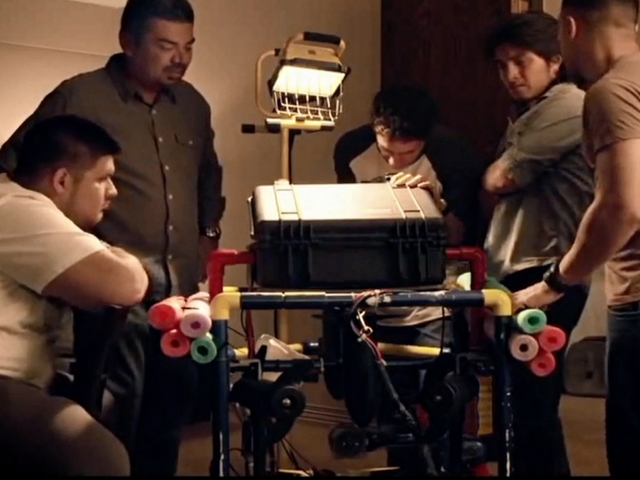
Unlike its robotic superstar, there is not much ingenuity in the storyline. Everything added on, especially the fictionalized backstory for Cameron, is predictable and superfluous and distracting. Lopez is an amiable presence, but these detours reveal his limits as an actor. We want to focus on the students and their robot, to see them solve problems in engineering and teamwork (which is a form of engineering, too). But too much of the running time is devoted to Cameron’s past and his possible romance with a fellow teacher, played by the always-wonderful Marisa Tomei. If she played the coach, this would have been a much better movie. Still, with a storyline like this one, it cannot help being fun to watch.
Cameron is an engineer with a PhD who tells the school’s principal (Jamie Lee Curtis, in a performance of great warmth and wit) he wants a temporary job as a substitute teacher. She notes that he has moved around a lot, but she does not have any alternatives. He agrees to coach the school’s engineering club because he is assured no one will want to join.
Oscar (Carlos PenaVega) shows up with a flier. He is an outstanding JROTC cadet and was crushed to learn that he cannot join the US Military without proof of citizenship. He thinks participating in a NASA-sponsored robotics competition will make it harder to be turned down. Cameron reluctantly agrees to help.
They assemble a team that includes the brain (David Del Rio), the kid who always gets into trouble but is a whiz at mechanics (José Julián), and the muscle (Oscar Javier Gutierrez II) — one problem they cannot engineer around is that someone has to be strong enough to lift their robot. Each has his own challenges. The brain is bullied at school. The troublemaker is under a lot of pressure to take care of his brother. The muscle has to be able to pass a tough oral exam at the competition to show that every member of the team understands the details of the robot. Oscar falls in love with a pretty classmate named Karla (sweetly played by PenaVega’s real-life wife, Alexa), but worries that his illegal status puts her at risk. All of the students are hiding from the ICE, which has already sent one of their mothers back to Mexico.
And then there is the challenge of the competition itself. Not only does this robot have to operate underwater, it has to execute an immensely complicated series of tasks in a limited time period. When the team shows up, they are so certain they will lose anyway that they decide they might as well compete with the college teams instead of the other high school teams. The night before they have to compete the robot has a disastrous leak. Their very creative and inexpensive (and hilarious) solution is one of the film’s high points.
The film’s name refers to more than the repurposed junk used to assemble the robot. Their triumph is bittersweet because their undocumented status prevents them from taking the opportunities available to those who are citizens. This film makes it clear that it is our loss, as it prevents our country from benefiting from the perseverance and skill that made an $800 robot created by kids kick the robotic butt of the $18,000 robot from MIT.
Parents should know that this film includes some teen crime including armed robbery, violence including bullying, some strong language and tense family confrontations and teen kissing.
Family discussion: What was the team’s most difficult challenge? Who was the teacher who inspired you the most and why?
Trailer: True Story with James Franco and Jonah Hill
Posted on January 7, 2015 at 3:52 pm
James Franco and Jonah Hill star in “True Story,” a title with layers of meaning. It is based on the real life story of reporter Michael Finkel (Hill), who was fired because he fabricated and altered facts in a “true story” he wrote for the New York Times. And then he discovered that a murderer (Franco) had been living his own version of a “true story,” representing himself as “New York Times reporter Michael Finkel.” Finkel’s book, True Story: Murder, Memoir, Mea Culpa, is the basis for this film, which co-stars Felicity Jones (“The Theory of Everything”), Gretchen Mol, and impressive newcomer Genevieve Angelson. It will be showing at Sundance later this month.
How True Should a “Based on a True Story” Movie Be?
Posted on January 2, 2015 at 8:10 pm
What does “based on a true story” really mean? The Washington Post had a front-page story titled, “‘Selma’ sets off a controversy amid Oscar buzz,” describing the objections by Lyndon Johnson administration insiders to the way he was portrayed. They say it was his idea to go to Selma, that he supported Dr. King’s efforts, and that he had nothing to do with the FBI’s surveillance and J. Edgar Hoover’s sending tapes of King’s supposed affairs to Mrs. King.
Historian Michael Bechloss has posted this handwritten note made by King for his conversation with LBJ:
And now my friend Jen Yamoto is summarizing objections to “Selma” and to other “based on a true story” films “Foxcatcher,” “The Imitation Game,” “Unbroken,” and “Big Eyes.” Some of these are the concerns of those trying to make sure that those who take their “history” from Oscar-worthy feature films at least begin to question the capacity of any dramatic work to be accurate in conveying historical events. But some are just sniping by competitors in the Oscar race.
As Jen writes:
Oscar voting opened Monday, and like clockwork, the haters have come calling. As Deadline’s Pete Hammond wrote on Monday, ’tis the season for controversy over fact-based awards contenders: Now, Bennett Miller’s real-life Olympian tragedy Foxcatcher and Tim Burton’s art exposé Big Eyeshave joined MLK Jr. drama Selma, the Alan Turing biopic The Imitation Game and Angelina Jolie’s Unbroken in ducking for cover over accuracy issues in mixing fact-based stories with narrative structure.
Even the most scrupulous accuracy will still reflect choices of perspective, tone, and emphasis. The best we can hope from any work of art is that it is the beginning, not the end, of an inquiry into the subject.
if the Gotcha Game is here to stay, we can at least agree on some new rules. And we can begin by adjusting our own attitudes toward fact-based films and their inevitable nit-pickers. Rather than the dualistic one’s-right-one’s-wrong model, it behooves audiences to cultivate a third eye — a new, more sophisticated way of appreciating both the art and the reality that inspires it.
It is one of the most famous paintings of the 20th Century, a masterwork by Gustav Klimt, a portrait of his friend Adele Bloch-Bauer. It was confiscated by the Nazis during WWII. And then, 60 years later, it became the subject of an international lawsuit as Bloch-Bauer’s niece sued the Austrian government for its return. That case was the subject of three documentaries, Adele’s Wish, Stealing Klimt, and The Rape of Europa. “The Woman in Gold,” a new feature film about the lawsuit with Helen Mirren and Ryan Reynolds, will be in theaters this spring.

 , and films like “October Sky” and “Stand and Deliver”
 , is the basis for this film, which co-stars Felicity Jones (“The Theory of Everything”), Gretchen Mol, and impressive newcomer Genevieve Angelson. It will be showing at Sundance later this month.
 ,
,  . “The Woman in Gold,” a new feature film about the lawsuit with Helen Mirren and Ryan Reynolds, will be in theaters this spring.