Lawless

Posted on August 30, 2012 at 6:00 pm

Musician Nick Cave and director John Hillcoat are Australians who are drawn to bleak internal and external landscapes.  They worked together on “The Proposition,” a western-style and very violent crime story about brothers.  “Lawless” is another crime story about brothers, again very violent and, like “The Proposition,” with a bleak setting and compromised characters.  This one is a true story, based on Matt Bondurant‘s book about his Prohibition-era grandfather and great uncles, who were ran illegal hooch in Franklin County, Virginia, described by writer Sherwood Anderson as “the wettest county in the world.”

“There’s a feeling around these parts that these Bondurants is indestructible,” one character says.  Forrest Bondurant (a quietly powerful Tom Hardy) came back from WWI without injury and the community almost believes the legend that he cannot be stopped.  That’s good for business; you might even say it is their brand.  But just as in legitimate enterprise, the success of a local operation selling moonshine in mason jars attracts the interest of the competition.  The big bootlegging organization out of Chicago is thinking about what one might call a very hostile takeover.  The Bondurants have a good relationship with the local sheriff, who is happy looking the other way for a small piece of the action.  But a federal agent named Charlie Rakes (an oily and twisted Guy Pearce) arrives and for him it is not about law, morality, or directions from his superiors.  It is about power.  The Bondurants are not afraid of him and that is why he wants to destroy them.  Pearce, in gloves and slicked-down hair parted in the middle, is one of the best villains of the year.

Forrest is the leader and he has an unspoken understanding with his brother Howard (Jason Clarke).  Indeed, a lot that goes on here is unspoken.  The youngest brother, Jack (Shia LeBoeuf) wants to prove himself to his older brothers.  And he wants to prove something to a pretty churchgoing girl named Bertha (Mia Wasikowska).  Brash and flashier than his brothers, he has the nerve to try to make a deal with machine gun-toting Chicago hood Floyd Banner (Gary Oldman) and the entrepreneurial instinct to improve and expand production and delivery.  When he sees a brutal gangland slaying, his only thought is to grab a souvenir shell case.  He will have a Michael Corleone moment when the violence gets closer to home.   “It is not the violence that sets men apart,” Forrest says.  “It is the distance he is prepared to go.”  The Bondurants do not give up.  It is not about the money.  It is about defending their home and their right to make their own choices.

Maggie (Jessica Chastain) shows up out of the blue one day, offering her manicured hand to Forrest’s rough one and offering to work for the brothers.  “The city can grind a girl down,” she tells Forrest.  “Gets to a point where you start looking for somewhere quiet.”

Franklin County is far from quiet.  But the noise Maggie wanted to escape was the cacophony of heartlessness she was surrounded by in the city.  Everyone in this story is breaking the de jure law, but Maggie knows that the Bondurants have a core of integrity and loyalty that she can count on.  And she will show that she can be counted on as well.

Strong performances and an evocative sense of time and place anchor the film and the unexpected tenderness of the romantic interludes balances the brutality.  A coda provides perspective that just because someone is willing to go the distance does not mean he cannot come back home.

Parents should know that this is the true story of moonshiners during Prohibition, so the good guys are law-breakers and the police are corrupt.  The movie includes extremely graphic violence with characters tortured, injured, sexually abused, and killed, strong language including a racial slur and segregation, sexual situations including prostitution, female nudity, and alcohol and smoking.

Family discussion:  How were the brothers alike and how were they different?  The script was written by musician Nick Cave – how does the music help tell the story?

If you like this, try: Lawless: A Novel Based on a True Story by the real-life grandson of the youngest Bondurant brother
Related Tags:


Based on a book Based on a true story Crime Drama Romance

For Greater Glory

Posted on May 31, 2012 at 6:00 pm

B-
Lowest Recommended Age: Mature High Schooler
Profanity: Mild language
Alcohol/ Drugs: Drinking
Violence/ Scariness: Extended battle violence with many characters and animals killed, children tortured and killed
Diversity Issues: A theme of the movie, strong female characters
Date Released to Theaters: June 1, 2012

In 1926, the atheist President of Mexico Plutarco Elias Calles (Rubén Blades) decided to secularize the country by edict.  He deported non-Mexican priests and prohibited the remaining priests from appearing outside of the churches in their cassocks.  Rebels fought back, at first with peaceful protests and then with increasing force until it became an armed conflict known as the Cristero War or Christiada.   This film, financed in part by the Catholic fraternal society The Knights of Columbus, is a faith-based and often heavy-handed retelling of the story, focusing on characters who have since been recognized by the church as martyrs and canonized.

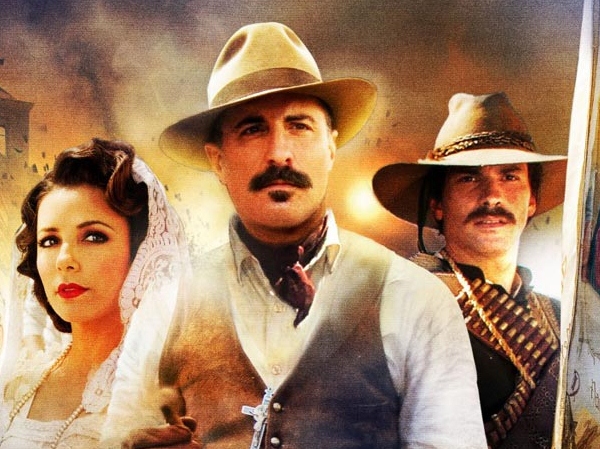
Andy Garcia and Oscar Isaac bring some depth and dignity to a script that is sincere but clunky.  Garcia plays Enrique Gorostieta Velarde, a non-believer married to a devout woman (Eva Longoria) and a former general now painfully under-employed as a manager at a soap factory.  When the Cristeros offer him the job of commanding their troops, he accepts because he wants to do the work he was born for, because it will please his wife, and because, he discovers, he would like to believe in something.  One of his biggest challenges is winning the respect of the Cristero’s legendary fighter, Victoriano Ramirez (Isaac), known as “El Catorce” because he defeated fourteen of the President’s army by himself.  Rodriguez plays one of the women who played key roles in transporting guns and ammunition.

The battle scenes are impressively staged and there are some affecting moments, but it assumes a level of belief and commitment on the part of its audience that may not apply to those who are not familiar with Catholic teachings.  Ultimately, it is closer to worship than story-telling, more likely to validate believers than to engage new hearts.

Parents should know that this film has extended battle violence with many characters and animals injured and killed, graphic and disturbing images, and a harrowing scene of a child who is tortured and killed.

Family discussion: How does the quote at the beginning of the movie relate to the story? How did participating in the fight change the general’s mind about God?

If you like this, try: “The Mission” and “Braveheart”

Related Tags:


Action/Adventure Based on a true story Epic/Historical Movies -- format War

Interview: Writer/Director Richard Linklater of “Bernie”

Posted on April 27, 2012 at 8:00 am

Richard Linklater has directed some of my favorite movies like “Waking Life,” “Before Sunset,” “School of Rock,” and “Dazed and Confused.”  He talked to me about his new film, “Bernie,” starring Jack Black as the real-life Bernie Tiede, the most popular man in the small Eastern Texas town of Carthage even after he confessed to killing a wealthy widow and stuffing her in a freezer for nine months.  Tiede, now in prison for the murder, was a funeral director who became friendly with octogenarian Marjorie Nugent, known as “the meanest woman in east Texas.”  She lavished him with gifts and trips and made him her heir, but then became possessive and demanding and abusive.  He shot her, hid the body in her freezer, told everyone she was in assisted living, and spent a lot of her money helping people in the community.  Shirley Maclaine plays the widow and the prosecutor is played by Matthew McConaughey.  As Ms. Nugent’s nephew wrote in the New York Times:

There are little things in “Bernie” that aren’t exactly true, bits of dialogue, a changed name here and there. But the big things, the weirdest things, the things you’d assume would have to be made up, happened exactly as the movie says they did. The trial lawyers really did wear Stetsons and cowboy boots and really were named Danny Buck Davidson and Scrappy Holmes. Daddy Sam’s barbecue and bail bonds, just a few blocks from the courthouse in Carthage (population: 6,700), really does have a sign that says, “You Kill It, I’ll Cook It!” And they really did find my Aunt Marge on top of the flounder and under the Marie Callender’s chicken potpies, wrapped in a Lands’ End sheet. They had to wait two days to do the autopsy. It took her that long to thaw.

One of the highlights of this film is the commentary from the people in Carthage.  Are those real townspeople really talking about their own experiences?

Oh, they’re definitely, mostly real people, I mean, “non-actors,” but some are actors. Most are people from the area of the state near Carthage and surrounding towns. Some of them were actually intimate with Bernie and Mrs. Nugent, so it’s kind of a mix.

It feels so natural.  Was it unscripted?

No, it’s scripted, but they kind of put it in their own words, quite often. I looked at a lot of people and found people that could be themselves, doing material and throwing in. You know, some of my favorite ones were things that people just threw in there.  When Sonny Carl Davis, who’s an actor, goes off on the town, “He’s my daddy, he’s my cousin,” you know, he’s got a way with words.  And Juli Erickson saying, “Honey, there are people in this town who woulda shot her for five dollars,’ stuff like that.

What made you decide on this quasi-documentary format?

I really never thought of it much as documentary, because the stories were dramatic.  I saw a story told from town gossips—and Southern gossip is such a huge thing.   I attended the trial, and read and got my hands on everything. I was going through Skip Hollandsworth’s journalistic notes where he had interviewed everybody, and what they were saying was really kind of funny, I felt, and very telling of the town and of the situation.  If you think about it, Bernie was in jail, Ms. Nugent was gone, and they’re not there to speak for themselves. As in small towns, with any event like this, all that’s left is the community itself reverberating around with opinions. If you were to go to Carthage, anybody over a certain age would be able to tell you what happened; how they knew Bernie, about the nine months she was in the freezer, how he preached at church, “we hung out, went to a party at his house,” maybe how he should’ve killed her to get away with it—everyone has their own idea, how they would’ve done it? You know, it’s just one of those crazy things. It’s a very rare event, such a notorious crime in that area.  The guy says on closing credits, “we don’t have stranger killings, usually it’s family.”

You certainly deglamorized Matthew McConaughey.  I love the choice of the glasses, they were wonderful.

Oh, you liked those? Let me think about it, he also had little plumpers in his mouth, and a little gut, an extra 25 pounds.  He still had a ways to go to get to the real Danny, but he tried.

And you were at the trial?  I never heard of a change of venue to a different city because the defendant was too popular!

Yeah, no one’s ever heard of that. I’ve talked to every judge, DA, defense attorney, since this trial.  “Have you ever heard of a trial being moved because it was too because he was too well liked and they didn’t think they could get a conviction, so they had to move to get a jury of his peers?”  People just kind of go, “No, I’ve never heard of that.”  Skip’s article probably didn’t help Bernie—it just was not on terms that were any good. I think Danny Buck started feeling pretty confident at some point and there wasn’t a plea bargain, or it didn’t work out or something.  At the end of the day he definitely got a really hard sentence. Well, the deck was stacked against him. First off, the change of venue, and then the judge disallowed the psychiatrist to examine him, who was going to speak on behalf of his disassociated moment, temporary insanity, and that got disallowed. That was his only hope. As Scrappy tells it, I had a guy who had confessed and told em’ everything and he didn’t have a lot to work with by the time he was with Bernie and yet he was really going for this thing…. The evidence that Danny was allowed to show him at trial, pulling Ms. Nugent out of the freezer, with some really horrific images and out of context. And he successfully prosecutes him as the other— not like us— flying first class, going to the opera.

Tell me about working with Oscar winner and old-style Hollywood movie star Shirley MacLaine.

There’s no one like her. I had always had her in mind for this part, I guess because she had played a Texas grand dame a couple times already, as Aurora in “Terms of Endearment” and the sequel, and I was just lucky she did it.  I think she wanted to work with Jack. It’s not a huge part for her, but I think she had fun. It kept her laughing, but she was sort of perfect. What was funny, I think, Shirley liked Ms. Nugent. The first thing she told me was, “even after she’s dead, she’s still around. That’s how I’m going to be! That’s how I’m going to be, you can tell me, that’ll be me.” I think she’s right!   There was so much historical record, there was so much testimony. It is a little bit of a dance of how much of a bitch, to what level the bitchiness should reach, but at the end of the day, Ms. Nugent was actually a lot worse than Shirley was in the movie, according to all accounts.  Shirley kind of humanized her, but that was my goal. I think the fun part—and this is why I love Shirley for the part—is that she still has that little girl infatuation, she’s still very sensual.  When they were first together we called it the honeymoon, the time where she was happy, when out of the blue this terminally miserable lady who could never be happy with anyone or anything, had some fun, a guy paid some attention to her, before she had to possess him and ruin it. There were some happy times there.

I know you’ve worked with him before, but Jack Black would not have been the first person to come to my mind for this part, because Bernie’s a very restrained character, a kind of repressed character—and I think of Jack Black as irrepressible.

Well, that’s what you know from parts you’ve seen him in—but I know him, and having worked with him before, I knew he could do it. I was just lucky he wanted to do the part and found it interesting. And you know, a good actor like Jack, you find there’s a part of Jack that could relate.  Bernie is a guy who’s non-confrontational and Jack really is the sweetest guy in the world, a total nice guy.  He saw Bernie very clearly, and could in some ways relate to him.  And who else could sing like that? There’s really no one else at the end of the day who could play this part, who could sing to Bernie’s actual level.

I love the parts when he sang, when he steps in at that funeral and sings “Amazing Grace,” it was fantastic.  What was it like to stage a big musical number from “The Music Man?”

Fun! A dream come true!  Anytime, you’re making a musical, it’s just fantastic. I felt like, “I’m Vincente Minnelli, and it’s the fifties and I’m making a musical!”

Related Tags:


Based on a true story Directors Interview

Blue Like Jazz

Posted on April 19, 2012 at 6:05 pm

B+
Lowest Recommended Age: Mature High Schooler
MPAA Rating: Rated PG-13 for mature thematic material, sexuality, drug and alcohol content, and some language
Profanity: Some strong language
Alcohol/ Drugs: Drinking and drugs
Violence/ Scariness: References to tragic world situations, family stress
Diversity Issues: A theme of the movie
Date Released to Theaters: April 20, 2012
Date Released to DVD: August 6, 2012
Amazon.com ASIN: 0785263705

Donald Miller’s best-selling collection of essays, Blue Like Jazz: Nonreligious Thoughts on Christian Spirituality has become a crowd-financed and lightly fictionalized film about a Texas teenager from a sheltered Baptist community who goes to the famously free-thinking Reed College in Portland, Oregon.

Marshall Allman of “True Blood” plays Miller, whose Alice in Wonderland-style immersion in a world where everything is questioned and debated is disturbing the way jazz music is disturbing — it never resolves.  In Texas, the answers were always laid out in nice straight lines.  Everything resolves.  Miller’s estranged father, an intellectual who listens to jazz and lives in a trailer, tells him it is time to improvise, to challenge his ideas.  His father has arranged for him to be admitted to Reed.  When Miller begins to suspect for the first time that not everyone practices what they preach, even at church, he decides to give it a try.

“Forget everything you think you know,” he is told when he arrives.  “Sexual identity is  social construct,” explains a girl who is using the urinal next to him in the men’s room.  One student is handing out free bottles of water and another is handing out literature explaining why bottled water is a scourge and a fraud.  Students get credit for civil disobedience.  Even his most mundane beliefs are challenged: no one in Oregon carries an umbrella when it rains.  Why separate yourself from the elements?

The script by Miller, director Steve Taylor, and co-producer Ben Pearson, smooths out the story (the real Miller did not arrive at Reed until he was 30 and he audited some classes but did not enroll).  They wisely avoid the easy and obvious “fish out of water” confrontations.  Refreshingly, Miller and his classmate heretics are from the beginning almost always very tolerant of each other’s ways of approaching the world.  Indeed, while Miller is warned that the other students may not accept his faith, the most intolerant behavior comes from Miller when he feels betrayed in a very personal way by his church (the film’s only disappointing departure from the real story for the sake of narrative tidiness).

This is a very strong movie in its own terms, a thoughtful, smart, sensitive coming-of-age story.  Reedies will enjoy familiar sights from Powell’s bookstore (the site of a debate about the existence of God) to the scroungers’ table in the cafeteria.  Most important is that just as Miller’s book explores an expansive, golden-rule-based version of Christianity, the film itself takes sincere, faith-based story-telling out of the narrow confines of what is currently classified as “Christian entertainment.”  The real divide is not between believers and non-believers but between those who believe that questioning and tolerance bring them closer to God and those who prefer constant reinforcement of what they think they already know.  The vocabulary of faith should not be the exclusive property of one small subset of believers, and it is heartening to watch a movie that makes that point with such grace.

(more…)

Related Tags:


Based on a book Based on a true story Drama DVD/Blu-Ray Pick of the Week Romance Spiritual films
THE MOVIE MOM® is a registered trademark of Nell Minow. Use of the mark without express consent from Nell Minow constitutes trademark infringement and unfair competition in violation of federal and state laws. All material © Nell Minow 1995-2026, all rights reserved, and no use or republication is permitted without explicit permission. This site hosts Nell Minow’s Movie Mom® archive, with material that originally appeared on Yahoo! Movies, Beliefnet, and other sources. Much of her new material can be found at Rogerebert.com, Huffington Post, and WheretoWatch. Her books include The Movie Mom’s Guide to Family Movies and 101 Must-See Movie Moments, and she can be heard each week on radio stations across the country.

Website Designed by Max LaZebnik