
One Day

One Day

Posted on August 18, 2011 at 6:32 pm

A gimmick that sort of worked in a novel becomes an obstacle that trips up this love story based on best-seller by David Nicholls.  It is better at telling us to care about the two characters than it is at making us feel anything for the couple who stumble their way toward each other for almost 20 years.

The gimmick is that we check in on Emma (Anne Hathaway) and Dex (Jim Sturgess) every year on the same day, July 15, known in England as St. Swithin’s Day, less a holiday than a Groundhog Day-style harbinger of the weather.  So instead of following them on days when especially significant or illuminating events happen, we see whatever happens to be going on each July 15.   Sometimes it is an important moment but most often it is more indicative than revealing.  In the book we had their internal perspective on what was going on.  Dex’s dead-on assessment of Emma’s room in the first chapter was as revealing about himself  as it was about her.  It was so astute that it made up for his cluelessness about himself and frequent boorishness for many years to come.   On screen, even Hathaway’s radiance and Sturgess’ charm cannot persuade us that these two people would have stayed in touch, much less been dear friends, over decades.

The gifted director Lone Sherfig (“An Education“) resists the temptation to throw in a lot of signifiers of time passing, but inevitably we get distracted by the shifting hairstyles and conversion from typewriters to laptops and phone booths to cell phones.  Covering 20 days over two decades means that there is very little time for each update, and without the interior monologues that gave the novel’s characters more substance, it feels more like a perfume commercial than a story.  There is more wit in the interplay of the digits of the passing years with the action of the scene than in most of the interactions between Emma and Dex.  Nicholls, who adapted his book for the screen, is too attached to details that do not work in a movie.  It would have been much better to jettison as many as half of the days to give us a chance to catch our breath and see how the friendship actually works.  There is too much of Dex’s “VH1 Behind the Music”-style descent into alcohol, drugs, and one-night stands (even in the book, he seemed hardly worthy of the loyal and principled Emma) and too little of the characters around them who are supposed to have been an influence.  And there is much too little of actual events.  It is Emma’s experiences as a teacher that lead her to find her voice as a writer.  How do I know that?  From reading the book.  It all feels rushed and abrupt and unsupported, and the ending feels like a maudlin cheat.


(more…)

Related Tags:


Based on a book Date movie Drama Romance
The Help

The Help

Posted on August 9, 2011 at 6:00 pm

B+
Lowest Recommended Age: Middle School
MPAA Rating: Rated PG-13 for thematic material
Profanity: Some strong language, racist terms of the era
Alcohol/ Drugs: Drinking, smoking
Violence/ Scariness: Some graphic scenes of a miscarriage, disturbing material about pre Civil Rights-era racial discrimination, references to murder of Medgar Evers
Diversity Issues: A theme of the movie
Date Released to Theaters: August 10, 2011
Date Released to DVD: December 5, 2011
Amazon.com ASIN: B005J6LKVI

The book-club favorite about African-American women working as domestics in the early Civil Rights era South has been lovingly turned into a film that like its source material engages with its sensitive subject matter humbly and sincerely.
Kathryn Stockett grew up in Jackson, Mississippi and was devoted to her family’s “help,” which inspired her first novel, the story of Skeeter, an awkward girl just out of college (Emma Stone) who persuades the women who work as domestics to tell her their stories for a book.  This is a minefield of an idea, which may be one reason the book was rejected 60 times.  We are rightly sensitive about the presumption of a white woman acting as interpreter or, even worse, as liberator.  And Stockett had her African-American characters speaking in dialect.  There can be no better proof that we have still not figured out how to handle these issues than this summer’s cover of Vanity Fair with a bikini-clad photo of Stone, describing her on the inside of the magazine as the “star” of “The Help.”  She is not the star, just as her character is not the author of the book she produces.  She is the ingenue.  The stars of the story are the maids played by Viola Davis (Aibileen Clark) and Octavia Spencer (Minny Jackson).  Entertainment Weekly did a much better job.  All three actresses appear on the cover, with a headline: “How do you turn a beloved, racially charged book into a moving, funny film?  Very carefully.”

That is thanks to Stockett’s closest childhood friend, Tate Taylor, who grew up with her in Jackson, who optioned the book before it was published, and who wrote and directed the film, and who insisted it be shot in Mississippi and that it reflect the South he knew.

Skeeter is accepted by the ladies who run things in Jackson, but she does not fit in.  She is not married and hopes for something beyond bridge club luncheons and dinner-dances.  She applies for a job at the local newspaper and is hired to do the household hints column.  Since she knows nothing about cooking, cleaning, or laundry, she asks her friend’s maid, Aibeleen, for help.  As they talk, she becomes more aware of the bigotry around her and of her own failure to oppose it.  She begins to wonder about the lives of the women who raise the children and feed the families in her community but are not permitted to use the bathrooms that they scrub.  A New York publisher (Mary Steenburgen) encourages her to collect their stories for a ground-breaking book.  Skeeter asks Aibeleen and Minny to help her, knowing that she may be putting them at risk of losing their jobs, or worse.  Privately, Skeeter works on the book.  Quietly, and then less quietly, she works to oppose a local initiative to require all homes to build separate “colored” bathrooms.

The woman behind the initiative is Hilly Holbrook (Bryce Dallas Howard), ostensibly Skeeter’s best friend and the alpha girl in their community.  It is less a matter of prejudice than a struggle for power, but that just makes Skeeter’s refusal to go along more inflammatory.  Meanwhile, Hilly has fired Minny, who goes to work for Celia (Jessica Chastain), a pretty blonde from the lower class who does not realize that she is being frozen out by the society ladies of the town.  And the more Hilly feels threatened, the more the pushes for her “sanitation” initiative.

Taylor said that Greenwood, Mississippi is closer to what Jackson looked like in the 60’s than Jackson is now and the period detail pulls us into the story.  Octavia Spencer, playing a part she helped to inspire, does not let Minny become a caricature and Viola Davis gives another richly layered performance as the quieter Aibeleen.  If Howard makes Hilly a little too shrill (and the ending more upbeat than would have been possible in that era) it is understandable given the changing times.  No one would believe today that such a short time ago, blatant virulence could be so casual, which is why the conversations this movie will prompt are so important.  And Stockett deserves credit for her care in acknowledging moments of generosity and affection on all sides in spite of the restrictions of the era.

This is an involving drama with respect for its characters that has some important points to make about race and gender, about the past that still haunts us, about friendship and passion, and most of all about the transformative power of stories, the ones we tell and the ones we listen to.  As Douglas Adams wrote:

It is difficult to be sat on all day, every day, by some other creature, without forming an opinion about them.   On the other hand, it is perfectly possible to sit all day, every day, on top of another creature and not have the slightest thought about them whatsoever.

“The Help” does not pretend to be perfect, but it is an honorable step forward and one of the most heartwarming dramas of the year.

(more…)

Related Tags:


Based on a book Drama DVD/Blu-Ray Pick of the Week
The 5th of July

The 5th of July

Posted on July 5, 2011 at 9:06 am

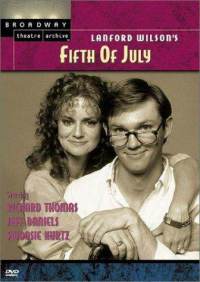
This filmed version of Lanford Wilson’s Fifth of July is a brilliantly acted story of the complicated relationships of a group of friends and relatives who get together over the 4th of July holiday.  It centers around the relationship of Kenneth Talley, Jr. (Richard Thomas), a disabled Vietnam vet in a wheelchair and his partner Jed (Jeff Daniels), his sister June (Joyce Reehling) and recently widowed aunt Sally (Helen Stenborg), and his old friends, a  wealthy couple named John and Gwen (Swoosie Kurtz in her Tony award-winning role).  It is a searing but ultimately hopeful and healing story of very real characters and also a thoughtful commentary on the Vietnam era.  This is one of three plays the gifted Wilson wrote about the Talley family, and it is a part of the superb series of Broadway Theater Archive productions that brought the best of live theater to Showtime audiences in the early 80’s.

Related Tags:


After the kids go to bed Based on a play Drama Family Issues Neglected gem

Larry Crowne

Posted on June 30, 2011 at 6:00 pm

“Larry Crowne” is such a perfectly pleasant movie that it may not be until you walk toward the exit that you realize that something is missing. Until then, the good spirits of stars Tom Hanks and Julia Roberts, clearly enjoying themselves and each other as they beam their considerable star power our way keep us feeling if not entertained at least appreciated. Hanks, directing for the first time since his debut with the terrific “That Thing You Do” is immensely hospitable. He all but hands out milk and cookies to make the audience feel welcome, with a series of recession-era but sweetly comic scenes and quirky but endearing characters and a can’t miss theme of a man literally and metaphorically casting off the elements of his past that are holding him back and discovering that he is capable of taking on new challenges and new relationships.

But Hanks the star and director has a problem with Hanks the co-screenwriter (along with “My Big Fat Greek Wedding’s” Nia Vardelos). Something is missing from the story.

Of course we fall in love with Larry Crowne (Hanks) right from the opening credits. The very first thing we see him do is pick up trash in the parking lot on the way to his job at a big, WalMart-style store. Then in a quick montage we see that he always does more than expected and genuinely enjoys his job. He is ever-cheerful with colleagues and helpful with customers, and an eight-time winner of the “Employee of the Month” award. And then he gets fired. Our first clue that something is not right with the story is the over-the-top awfulness of the termination, but we let that pass because we want to see what he will do.

Larry is downsized because he does not have a college degree. He joined the Navy after high school, got out after 20 years as a culinary specialist (cook), and has been working at the store ever since. He is in a financial pinch because he bought out his ex-wife’s share of their home, which is now worth much less than its mortgage. A perky blonde bank representative (Hanks’ real-life wife, Rita Wilson) keeps offering him complimentary coffee as she gives him the bad news. Larry can’t find a new job and realizes he needs to go to college. He sells his gas guzzler and trades his flat-screen TV for a scooter.

Mercedes (Julia Roberts) is a teacher at the community college whose greatest hope is that fewer than 10 students will register for her classes so she can cancel. She feels very far from what she once aspired to, supporting a husband (“Breaking Bad’s” Bryan Cranston) whose own aspirations have shrunk from novelist to comment on a blog. She once hoped to teach Shakespeare and Shaw. Now she teaches students who cannot even remember how to pronounce her name how to get up in front of the class and say something.

So we know where this is going, and we want it to go there, and the ingredients are all assembled. The situation is timely and engaging. The cast is exceptional. Larry has adorable neighbors (Cedric the Entertainer and Taraji P. Henson), and adorable classmates: the ravishingly lovely Gugu Mbatha-Raw as the girl who gives Crowne a literally top-to-bottom makeover and introduces him to her scooter-riding gang, Grace Gummer (Meryl Streep’s daughter) as a lacrosse-player more comfortable on the field than in the classroom, “Night at the Museum’s” Rami Malek, sweet but a little dim. George Takei is marvelous as a professor of economics. Mercedes has a sympathetic colleague (the always-welcome Pam Grier).

But something is missing. All of Roberts’ movie star magic can’t make the character of Mercedes as appealing as she needs to be. We never get a sense of how she got to the slough of despond she is in and the character is so inconsistent she seems blurry. All of Roberts’ usual tricks, the dazzling smile, the laugh, the walk, can’t disguise the fact that while she tells her students what she is teaching them is to care, it is not clear to her or to them or to us that she has learned that lesson herself. There is no moment of change or connection or even notice to make us feel that there is a genuine basis for a relationship, and the ending is hurried and superficial. There is build-up without pay-off. I enjoyed spending time with these characters. I wish they were in a better movie.

(more…)

Related Tags:


Comedy Date movie Drama Romance
1776

1776

Posted on June 27, 2011 at 3:56 pm

A
Lowest Recommended Age: 4th - 6th Grades
MPAA Rating: Rated PG for language
Profanity: Some mild language
Alcohol/ Drugs: Drinking, smoking
Violence/ Scariness: References to war
Diversity Issues: A theme of the film, decisions to maintain slavery and lack of rights for women
Date Released to Theaters: 1972
Date Released to DVD: July 2, 2012
Amazon.com ASIN: B000067D1R

Happy Independence Day!  There’s only one possible pick of the week for the 4th of July.

1776.jpg

This rousing musical about the Declaration of Independence makes the Founding Fathers vivid, human, and interesting characters, and is so involving that you almost forget that you already know how it all turned out. William Daniels is the “obnoxious and disliked” John Adams, Ken Howard is Thomas Jefferson, who would rather be with his wife than work on the Declaration, and Howard da Silva is a wry and witty Benjamin Franklin. As they debate independence, we see the courage that went into the birth of the United States, and as they compromise with the South to permit slavery in the brand-new country we see the tragedy.  It is outstanding family entertainment.

http://www.youtube.com/watch?v=7Iiiy8GnBNI
Related Tags:


Based on a play Based on a true story Classic Drama DVD/Blu-Ray Pick of the Week Epic/Historical For the Whole Family For Your Netflix Queue Holidays Movie Mom’s Top Picks for Families Musical
THE MOVIE MOM® is a registered trademark of Nell Minow. Use of the mark without express consent from Nell Minow constitutes trademark infringement and unfair competition in violation of federal and state laws. All material © Nell Minow 1995-2026, all rights reserved, and no use or republication is permitted without explicit permission. This site hosts Nell Minow’s Movie Mom® archive, with material that originally appeared on Yahoo! Movies, Beliefnet, and other sources. Much of her new material can be found at Rogerebert.com, Huffington Post, and WheretoWatch. Her books include The Movie Mom’s Guide to Family Movies and 101 Must-See Movie Moments, and she can be heard each week on radio stations across the country.

Website Designed by Max LaZebnik