Coming Soon from Ryan Murphy “Prom” — With a Dream Cast Including Streep, Rannells, Key, Awkwafina
Posted on June 27, 2019 at 8:00 am
I am so excited about this! Ryan Murphy (“Glee,” “Versace,” “Nip/Tuck”) is bringing the Tony-nominated musical “Prom” to television with an all-star cast including Oscar-winner Meryl Streep, Tony-winner Andrew Rannells (“Girls,” “Book of Mormom”), “Key and Peele” star Keegan-Michael Key, “Oceans 8” and “Crazy Rich Asians” star Awkwafina, and pop princess Ariana Grande.
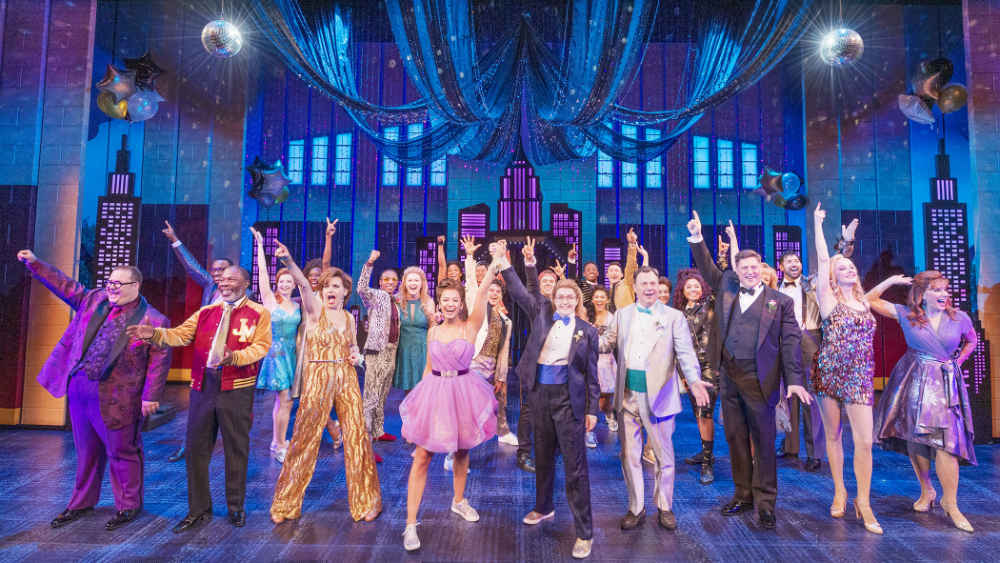
The story is about Broadway stars running away from terrible reviews of their new show who decide to get some good publicity by providing support to a girl who has been forbidden to bring another girl as her date to the school prom. Here’s a look at the show on Broadway.
Streep will play Dee Dee Allen, a two-time Tony winner who teams with Corden’s Barry Glickman in a flop musical about Eleanor Roosevelt. After career-ending reviews, they decide — along with Broadway babies Kidman as Angie Dickinson and Rannells (Book of Mormon) as Trent Oliver — to champion a cause to rehabilitate their careers. They find one in Emma, a high school senior in Indiana who isn’t allowed to go to her prom because she’s gay. A nationwide search led by casting director Alexa Fogel is on to fill the role of Emma.
Grande will star as Alyssa, a popular daughter of the head of the PTA. Awkwafina will play the group’s publicist Ms. Sheldon, and Key will play Streep’s love interest and Emma’s ally, Principal Hawkins.
Rated R for language throughout, some drug use and sexual content
Profanity:
Very strong language
Alcohol/ Drugs:
Extended substance abuse including drugs and alcohol
Violence/ Scariness:
Suicide attempt, family issues
Diversity Issues:
A theme of the movie
Date Released to Theaters:
May 31, 2019
Date Released to DVD:
August 26, 2019
Copyright 2019 Paramount
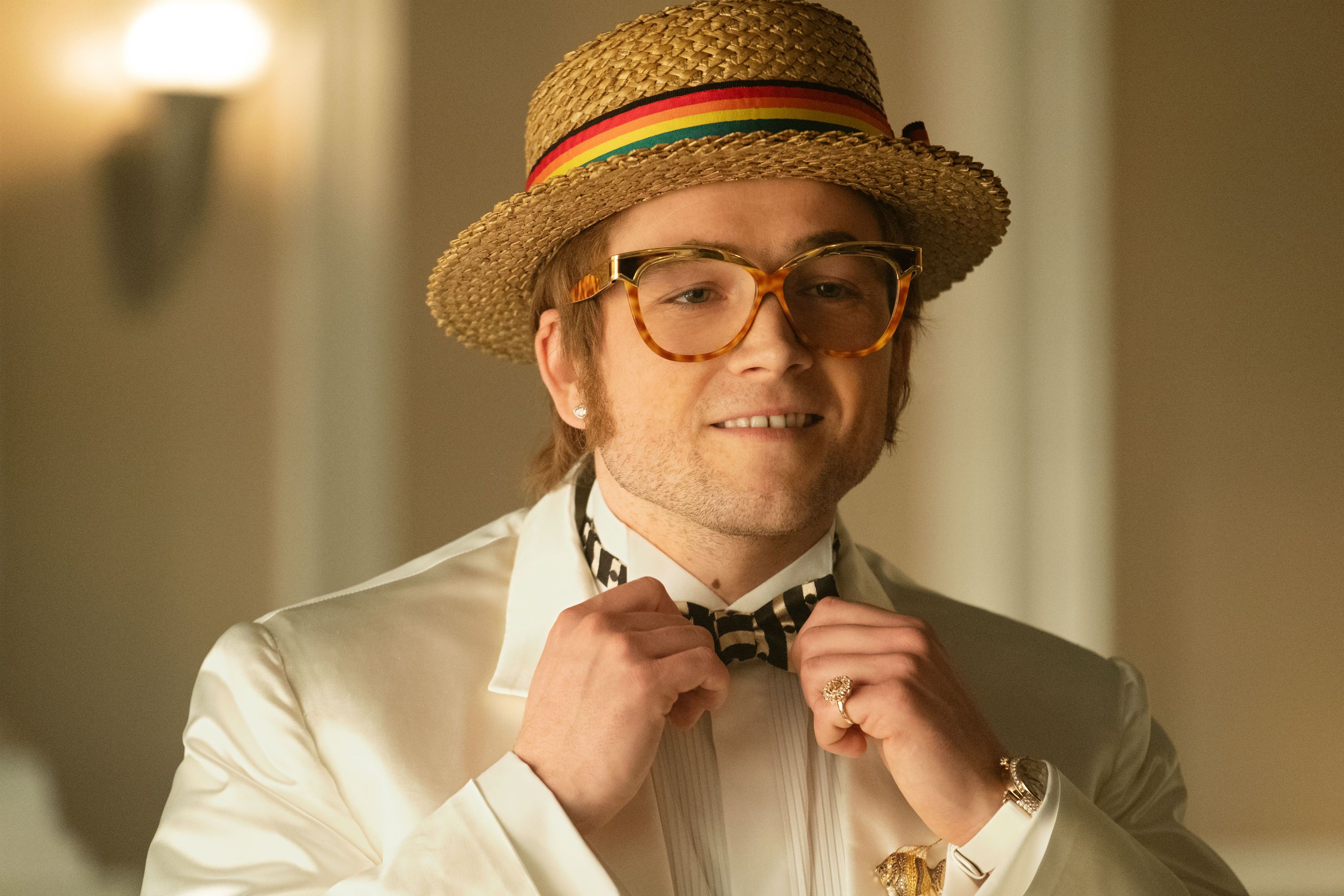
Elton John strides purposively down a corridor dressed in what looks like devil costume for Liberace’s Halloween party. But he is not moving toward a stage or recording studio. He is not going to sing or compose. He is going to tell his story to a different kind of audience, a support group in a drug rehab facility. And to us.
“Rocketman,” produced by Sir Elton himself, is a sometimes-impressionistic retelling of the classic VH1 “Behind the Music” story of sex, drugs, and rock and roll. Instead of “and then I wrote” with a chronological rehash of hits, celebrity encounters, romantic ups and downs, and AA-style amends, it is a dramatic version of a jukebox musical, with full-on dance numbers and songs that match the mood of the moment. Director Dexter Fletcher, who also finished up “Bohemian Rhapsody” after the original director was fired, wisely uses the more flamboyant elements of the story as a backdrop and keeps the camera focus on Taron Egerton (the “Kingsman” movies and “Eddie the Eagle,” also directed by Fletcher). He makes us see the energy and magnetism of Sir Elton as a performer, but it is in the most intimate close-ups that we see Sir Elton the person, vulnerable, scared, and longing to be truly accepted.
As Sir Elton tells his story to the support group, he removes the costume, a piece at a time (the horns come off first), and he reveals his own layers as well, starting with the child then known as Reg Dwight (an impressive Matthew Illesley), who lives with his distant father (when Reg asks for a hug, his father says, “Don’t be soft.”) and his self-involved mother (Bryce Dallas Howard), and his kind-hearted grandmother (Gemma Jones). Reg’s musical gifts are evident immediately; he can play anything he hears. He gets a scholarship to the Royal Academy of Music (his grandmother takes him there when his mother can’t be bothered).
And then he hears Elvis, and it’s all about rock and roll. His band plays back-up for touring American acts, and he changes his name (“Elton” was nicked from a bandmate; in the movie John comes from John Lennon but in real life it was from his mentor, “Long John” Baldry). And then he answers an ad for singers and songwriters and, when he says he composes and does not write lyrics, an unopened envelope is handed to him and it turns out to be from Bernie Taupin (Jamie Bell of Billy Elliot and Film Stars Don’t Die In Liverpool). They form a close working and personal relationship.
And then there is the breakthrough performance at LA’s legendary Troubadour club. The future Sir Elton at first refuses to leave the bathroom when he hears that musical legends are in the audience: some of the Beach Boys, Leon Russell, Neil Young. But then he comes on stage and it is magical. We see him, and then the audience literally float up into the air, an exquisitely lovely moment that perfectly translates the euphoria of the performance.
Then there is a troubled romantic and professional relationship with a new manager (smoldering Richard Madden as John Reid) and unimaginable excess as he still struggles for acceptance from his parents. In a particularly wrenching scene Sir Elton sees his father, who will not see him perform, warmly affectionate with the children of his second wife. As we return to the scene at rehab, we see him finally able to accept the love he so desperately wants.
Egerton showed us in the “Kingsman” movies that he has what it takes for the performative side of this story, but this is the first time we have had a chance to see just how sensitive and subtle an actor he is. There are moments when we can see three or four different emotions on his face at once, as in his phone call to his mother to tell her he is gay or when he is mesmerized, terrified, and flickering back and forth between being open and hiding his feelings with Reid. In one split second he goes from drugged-out, depressed, and anxious back stage to full-on rock star as he walks out toward the audience. It is hard to imagine there will be a better performance on screen this year.
Sir Elton wanted the focus of this story to be on his personal life and his feelings, interpreted by the music, rather than his story as a composer and performing artist. For that, of course, we have Sir Elton himself, his music videos and recordings of his live performances, and the songs which over decades have said so much.
Parents should know that this movie includes extensive substance abuse, a suicide attempt, family dysfunction, addiction issues, sexual references and situation, and very strong language.
Family discussion: What person did he want to be? Which is your favorite Elton John song? How do you like this more subjective form of storytelling?
If you like this, try: the music of Elton John and other real-life stories of musicians including “Bohemian Rhapsody,” “Coal Miner’s Daughter,” and “Walk the Line”
Extended fantasy/action peril and violence, attempted murder, near-drowning, discussion of sad deaths of parents
Diversity Issues:
Issue of female autonomy and power
Date Released to Theaters:
May 24, 2019
Date Released to DVD:
September 16, 2019
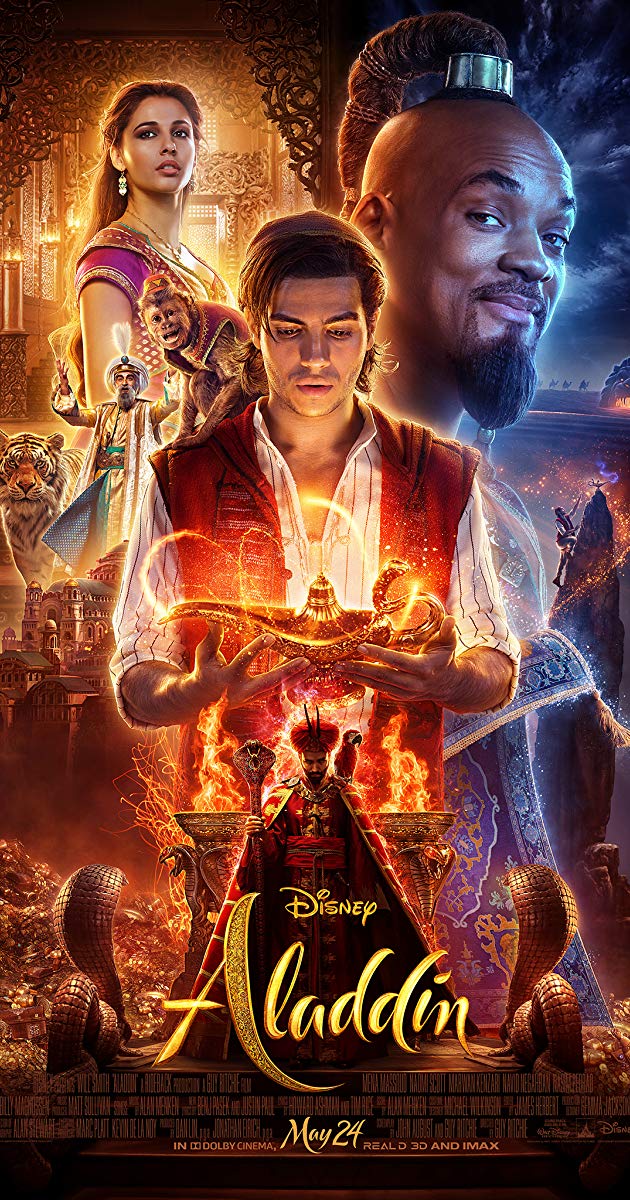
Copyright Disney 2019It is a bit of a puzzle that a director known for dynamic action doing a live action remake of a musical animated film that was exceptionally lively has somehow produced a movie that seems bogged down, even static. The new “Aladdin” from co-writer/director Guy Ritchie (“Lock, Stock, and Two Smoking Barrels,” “Sherlock Holmes”) is colorful and tuneful, but for much of its just over two hours running time it lumbers along, despite its best efforts to entertain.
The original Disney animated version of “Aladdin” is one of the studio’s all-time best thanks to a wonderfully melodic score, with songs by Alan Mencken and Howard Ashman and possibly the all-time greatest animated movie voice performance in history, Robin Williams as the Genie. The mercurial Williams found his ultimate mode of presentation with the help of Disney’s top animators as the magical, infinitely malleable, cartoon character, instantly creating characters ranging from Ed Sullivan, William F. Buckley, and Jack Nicholson to Peter Lorre and a bunch of zombies, always retaining the essential heart and humor that made a fantasy come alive. (The closest Williams ever came to replicating avalanche of portrayals might be his innumerable improvisations with a shawl on “Inside the Actor’s Studio.”) No live action version, even with the help of the latest CGI technology and the powerhouse charisma of Will Smith, can match the kaleidoscopic imagination of the 1992 Genie.
This version does make some substantial improvements in the story of the “street rat” who loves a princess and then, with the help of the genie in a magical lamp, pretends to be a prince so he can court her. Disney says it has the most diverse cast in the studio’s history, and it is great to see all of the lead roles performed by people whose ethnicity matches their characters, with Egyptian-born Mena Massoud as Aladdin and Naomi Scott, of British and Indian heritage, as Jasmine. The locations are authentic as well. Filmed in Jordan, and with the always-outstanding work of the Disney production designers, the settings are splendid, and the classic songs still sound fresh and hummable, especially “Prince Ali” and “A Whole New World.” The film should really be called “Aladdin and Jasmine” because it gives the princess a full, meaningful role in the story, respecting her agency, ability, and dedication to her people. It gives her father, the Sultan (Navid Negahban) more agency, as well, unlike the animated character, who spends much of the story in an enchanted fog. And it’s nice to see Genie get a bit more of a story, too, thanks to the handmaiden to the princess, played by “SNL’s” Nasim Pedrad.
But the story-telling itself is foggy in this version. Jafar (Marwan Kenzari), the story’s villain, does not have the menace of the original. He seems young and angry, more petulant than ominous. There is a hint of an intriguing backstory for him that gets lost in the busy, “look at me”-ness of the film. A storyline about whether the Sultan should approve invasion of another country does not work well and a dance number with the Genie controlling Aladdin has too many cuts to deliver on the humor of the situation. The “Step Up” movies do these moments much better, and Jasmine’s new song from “La La Land’s” Benj Pasek and Justin Paul is outshone by the originals. A wink at the map of Disneyland as Jasmine does the ancient equivalent of Googling “Prince Ali” is out of place.
If there had been no animated version, this one would have served as an entertaining family movie. But as has happened too often with Disney’s live action remakes of its best animated films, it is just an unnecessary reminder of how much we loved the original.
Parents should know that this film includes fantasy peril and violence including near-drowning, attempted murder and references to killing and to sad death of parents, action, brief alcohol, and a kiss.
Family discussion: What would your three wishes be? Remember to be careful with your words! Why was Aladdin so awkward when he becomes Ali? Why was Jafar so angry? What does it mean to be a diamond in the rough, and what made Aladdin one?
If you like this, try: the original Disney animated version and the stories of the 1001 Nights
Rated PG for some mild thematic elements and brief action
Profanity:
Mild language in a song
Alcohol/ Drugs:
None
Violence/ Scariness:
Some peril, references to sad death of parent
Diversity Issues:
None
Date Released to Theaters:
December 19, 2018
Date Released to DVD:
March 18, 2019
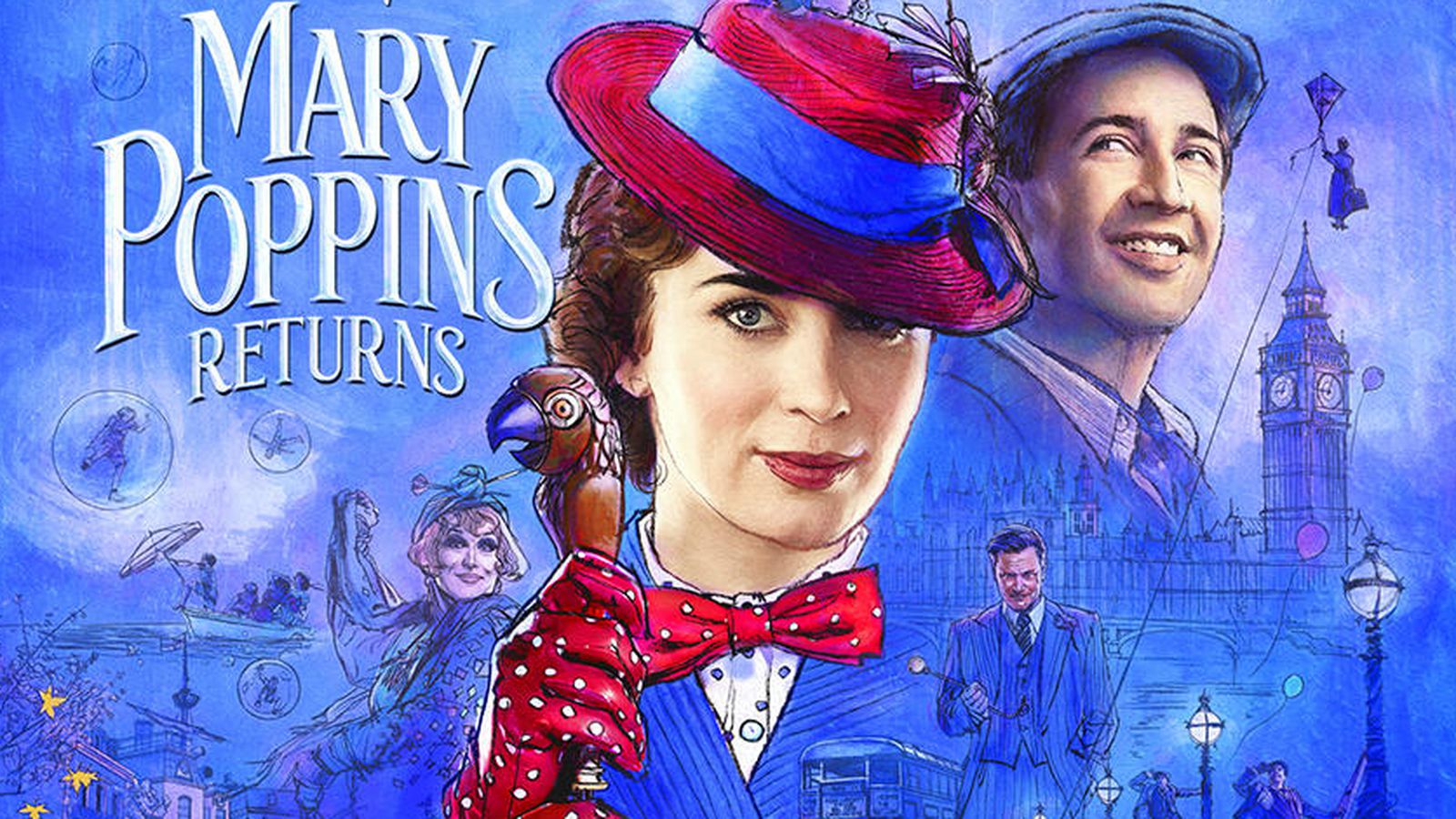
Copyright 2018 Walt DisneyIf I may borrow from the original “Mary Poppins movie” for a moment, the new sequel, “Mary Poppins Returns” is a very jolly holiday with Mary indeed. Inspired, like the first, by the book series by P.L. Travers, this movie has Emily Blunt taking over from Oscar-winner Julie Andrews as the magical nanny who arrives once again just as the Banks family needs her most.
In the first film, she was nanny to Jane and Michael Banks. She took them on magical adventures that included a tea party on the ceiling and diving into a chalk picture for an animated musical number with dancing penguins. But the real magic she brought to the Banks family was a reminder of what was important. The fond but distracted parents learned that it was more important to fly a kite with the family than to keep the job that supports the family and its domestic employees or fight for the rights of women. (Well, the 60’s was a complicated time. But the message of family connections is still valid.)
This sequel very sweetly brings Mary Poppins back, once again arriving from the sky via a parrot-head handled umbrella, again to care for the Banks children, meaning the now-grown Jane and Michael Banks (Emily Mortimer and voice of Paddington Ben Wishaw). Oh, and Michael’s three children, too, who have taken on too many adult responsibilities as the family still mourns the loss of their mother. Jane works for the rights of workers and does her best to help her brother and his children, who still live in the old house on Cherry Tree Lane.
They may lose the house, though, as Michael cannot pay the bank, yes, the same one his father worked at, what he owes. It’s now run by Mr. Wilkins (Colin Firth), who promises he will do everything he can to help Michael, but who shows up as a wolf in an animated adventure when Mary Poppins takes the children into the design on their late mother’s porcelain bowl, so perhaps he should not be trusted.
Jane and Michael remember Mary Poppins, but now believe that they only imagined the magical adventures. They have lost their ability to see magic in the world. Mary Poppins, with her brisk, no-explanations manner, has come back to show them how to find it. And that means a visit to another of her eccentric relatives (Meryl Streep, enjoying herself enormously), and journeys undersea via the bathtub and into the sky with balloons. And it means singing and dancing, too, with a wild music-hall-style number in an animated theater and a tender ballad about The Place Where Lost Things Go. Plus, Dick van Dyke is back. And he dances.
We take it for granted that this movie would have visual Disney magic. No one assembles a more gifted collection of production designers, costume designers, and visual effects designers than Disney, and no studio has a better, more organic sense of its own history and culture. So when Disney decided to revisit the 54-year-old classic based on P.L. Travers’s novels, after having already mined its own history with a movie about the making of that movie, it was fair to expect that it would look and feel as though we had never left. The magic touch is there, with gentle references to the earlier film, including the animated adventure with a retro, hand-drawn, cel-based look along the lines of Disney’s specialty, and an enchanting appearance from Dick Van Dyke, who played two characters in the original. Emily Blunt as Mary Poppins and “Hamilton’s’ Lin-Manuel Miranda as her lamp-lighting friend are practically perfect in every way. And, as “Saving Mr. Banks” reminded us, the real magic, is that at its heart it is not just about fantasy adventures but about healing the family. The songs, the special effects, the imagination are a lot of fun but what makes this movie top ten-worthy is the heart.
Parents should know that there are references to a sad death of a parent, worries about money, and some situations with mild peril. A song has some mildly spicy lyrics with references to nudity.
Family discussion: Which was your favorite adventure? Why didn’t Mary Poppins stay?
If you like this, try: the books by P.L. Travers and the classic original film
Rated PG-13 for thematic elements, suggestive material, drug content and language
Profanity:
Some strong language
Alcohol/ Drugs:
Alcohol and drugs
Violence/ Scariness:
Medical issues, sad death
Diversity Issues:
A theme of the movie
Date Released to Theaters:
November 1, 2018
Date Released to DVD:
February 11, 2019
Copyright 20th Century Fox 2018
“Bohemian Rhapsody” is a just-good movie with a great performance based on the life of a once-to-a-planet musician of endless talent and magnetism and a four-octave range of unmatched clarity and suppleness. In other words, it is entertaining, if not illuminating. Indeed, it is strange that a movie about fictional rock and pop stars, the 2018 version of “A Star is Born” is more insightful about what it is like to perform at that level than this movie based on the life of Freddie Mercury, the brilliantly genre-bending front man of power rock band Queen.
Musician biopics have a huge advantage over movies telling the life stories of writers, visual artists, and other public figures. It is, of course, the music. Whether the movie is highly fictionalized with Cary Grant as Cole Porter or Mickey Rooney as Lorenz Hart, in films that pretended they were not gay, or more honest, like Oscar winners Sissy Spacek as Loretta Lynn and Jamie Foxx as Ray Charles, the highlight of the films will always be the music that made the real-life characters stars. “Bohemian Rhapsody” has Queen’s rousing masterpieces and Rami Malek channels Mercury superbly, especially in those performance scenes, with a breathtaking re-creation of Queen’s legendary Live Aid performance in the film’s climactic scene.
The biggest risk in a biographical movie about a musician, though, is avoiding “VH1 Behind the Music”-itis. Unfortunately, real life for future Rock and Roll Hall of Famers does tend to follow the same pattern, and that is why we see the same scenes over and over. The family wants them to get a respectable job and not waste time on music. The early struggles. The recording session where someone in the control room says, “Wait a second, these guys have something special! Let me call my friend in the music business to sign them up.” The Vorkapich montage of tour dates to increasingly enthusiastic crowds. Yay, success! Yay, EXCESS! The squabbles. The industry executive who does not want them to be innovative (in this case, a sly meta-joke as he is portrayed by an unrecognizable Mike Meyers, whose iconic head-banging to the film’s title song in “Wayne’s World” created another generation of fans). The breakups. The reconciliation. It’s very hard to tell that story again and make it specific enough to stand out.
And then there is the other risk. Either the surviving members of the band are not involved, so you risk authenticity, or they do participate, as Brian May and Roger Taylor did here, so we see their version, which may be spun, even sanitized.
Freddie Mercury was born Farrokh Bulsara, to a Parsi family from the Zoroastrian community of the Indian subcontinent. We first see him in the film working as an airport baggage handler, being called by the (inaccurate) racist epithet “Paki.” Farroukh, already calling himself Freddie, is a fan of a popular local rock group called Smile. When their lead singer quits, he does an impromptu demonstration of his stunningly melodic voice, explaining that his overbite is caused by an extra set of incisors, which he credits for his range. The film then trudges through the steps outlined above.
The dramatic scenes are soapy and predictable — betrayed by a manager, estrangement from the band, too many cats, too many parties, learning that you can’t escape yourself, some reconciliation. Lucy Boynton (continuing her connection to 80’s music from “Sing Street”) is lovely as the ever-loyal Mary, who was Freddie’s closest friend, even after their romantic relationship ended because he was gay. The other band members barely register as individuals; more time is given to Myers’ stunt casting as the record industry guy who tells them that the six-minute “Bohemian Rhapsody” will never be played by teenagers in a car (get it? that’s what happens in “Wayne’s World!”). The “this is how we wrote that song” sections are especially weak. The songs themselves, though, are as captivating as ever and Malek, who struggles a bit with the overbite prosthetic, recreates them with all they buoyancy and flamboyance Freddie would want.
Parents should know that this film has the expected sex, drugs, and rock and roll in a story of a real-life rock star, with strong language, sexual references and non-explicit situations, and wild partying, along with medical issues and a sad death.
Family discussion: Who understood Freddie best? Why was Live Aid so important to him?
If you like this, try: the documentary “The Story of Queen: Mercury Rising” and YouTube clips of the Live Aid performance