
Singin’ in the Rain

Posted on December 13, 2002 at 5:17 am

A+
Lowest Recommended Age: Kindergarten - 3rd Grade
MPAA Rating: G
Profanity: None
Alcohol/ Drugs: None
Violence/ Scariness: None
Diversity Issues: None
Date Released to Theaters: 1952
Date Released to DVD: July 16, 2012
Amazon.com ASIN: B0087YYHZU

The 60th anniversary of one of the best-loved movies of all time is being celebrated with gorgeous new DVD and Blu-Ray releases.

Silent movie star Don Lockwood (Gene Kelly) is paired on screen with Lina Lamont (Jean Hagan), who would like to be paired with him offscreen as well. But Lina’s personality is as grating as her squeaky, nasal voice. She is mean, selfish, arrogant, and stupid. Chased by fans following the opening of their latest movie, Don jumps into the car of Kathy Seldon (Debbie Reynolds), who tells him she is a serious actress, and not at all interested in the movies. But later, at a party celebrating the new movie, Kathy appears again, jumping out of a cake. Don teases her about her “art” and she throws a pie at him, getting Lina right in the face by mistake. Lina, furious, has Kathy fired.

At the party, the guests are treated to an exhibition of the latest technology, “talking pictures.” Everyone present dismisses it as a novelty. But when “The Jazz Singer” becomes a hit, everyone in Hollywood begins to make talkies. Production is halted on the latest Lockwood/Lamont movie, “The Dueling Cavalier,” while the stars are coached in vocal technique (with a delightful song mocking the exercises, “Moses Supposes”). But the movie is a disaster. Test audiences jeer and laugh.

Meanwhile, Don and Kathy have fallen in love. After an all-night session, Don, Kathy, and Don’s best friend, Cosmo (Donald O’Connor), come up with an idea. They can make it into a musical, “The Dancing Cavalier,” dubbing Kathy’s voice for Lina’s. Don resists at first, because it is unfair to Kathy. But they persuade him that it will just be this one time, and he goes along.

With Kathy’s voice and some musical numbers, the movie is a success. Lina insists that Kathy continue to dub all her movies, and, when the audience insists on hearing her sing, Lina forces Kathy to stand back stage so she can perform. But Don, Cosmo, and the beleagered studio head reveal the secret, and Don introduces Kathy to the audience as the real star of the movie.

Discussion: This is often considered the finest musical of all time. Certainly it has it all, classic musical numbers and a witty script, unusually sharp and satiric for a musical comedy, especially one making fun of the industry that produced it. Asked to name the top ten moments in the history of movies, most people would include the title number from this movie, in which Gene Kelly splashes and sings the rain with what Roger Ebert called “saturated ecstasy.” When he swings the umbrella around and around and dances on and off the curb, his “glorious feeling” is contagious. Only in a movie containing that sequence would Donald O’Connor’s sensational “Make ‘Em Laugh” number be mentioned second. It is a wildly funny pastiche of every possible slapstick gag, done with energy and skill so meticulous that it appears it is entirely spontaneous.

Screenwriters Betty Comden and Adoph Green, asked to use some of the classic songs by Arthur Freed (later producer of most of the great MGM musicals) and Nacio Herb Brown, decided to set the movie in the era in which they first appeared, the early talkies. This gave them a chance to use some of the Hollywood folklore of that era, when careers like John Gilbert’s were destroyed overnight, as audiences found out that their voices didn’t match their faces. One especially funny scene has the technicians trying to find a way to record Lina’s dialogue. When they put the microphone on her dress, all you hear is the sound of her pearls as she rubs them. When they put it lower down, you hear her heartbeat. When they put it near her, her voice fades in and out as she tosses her head. Note that the cameras are put inside huge boxes — that is authentic, as the cameras of that era were so loud that they had to be encased to prevent their own whirring from being recorded.

Don and Cosmo are consummate adaptors. As we see in flashback, they have already switched from vaudeville to movies, and then Cosmo from performer to accompanist (to musical director) and Don from stunt man to leading man. Lina resists change and tries to bully her way out of it, but Don, Cosmo, and Kathy all demonstrate resilience and openness to new ideas, and a willingness to be creative in solving problems.

Questions for Kids:

· Why does Kathy at first lie about liking the movies?

· Why does Don lie about his background? How is that different from the way that Lina behaves?

· Have there been any new inventions that you have seen that have changed people’s jobs a lot?

· What inventions do you use that your parents didn’t have when they were children? Your grandparents?

Connections: The transition from silent movies to talkies was also lampooned in the first play by George S. Kaufman and Moss Hart, “Once in a Lifetime.” A silent star who has become deranged is the centerpiece of “Sunset Boulevard.” When told “You used to be big in pictures,” she says, “I’m still big — it’s the pictures that got small.” She also says, memorably, that in her day stars didn’t need to talk: “We had faces then!”

Activities: Children might like to see some of the early silent movies to get an idea of what Hollywood was like in the days depicted in this movie. The films of Charlie Chaplin, Laurel and Hardy, Buster Keaton and Harold Lloyd are still wonderful, and kids will enjoy learning that a story can be told without words.

Related Tags:


Classic Comedy Date movie DVD/Blu-Ray Pick of the Week For the Whole Family For Your Netflix Queue Movie Mom’s Top Picks for Families Musical Romance

The Court Jester

Posted on December 13, 2002 at 5:17 am

“Life could not better be” than the pure cinematic joy of this movie from the first frame to the last.  Danny Kaye has his best role as Hawkins, a follower of the Black Fox, a Robin Hood- style rebel who hopes to put the infant royal heir on the throne in place of the usurper.

Hawkins is assigned to entertain the troops and watch over the baby, who has the royal birthmark on his rear.  He wishes for more exciting assignments like those given to Jean (Glynis Johns), a smart, courageous, and tough Captain of the rebel forces.  Hawkins loves her but has not been able to tell her.

Hawkins finally gets his chance for a more active role when he gets to disguise himself as Giacomo, the King’s new jester, to get access to the palace. He does not know that the real Giacomo is also undercover – in reality, he is an assassin brought in to murder the usurper in favor of another usurper, Sir Ravenhurst (go-to bad guy who is good with a sword Basil Rathbone).  Hawkins finds himself in the midst of intrigue, hypnotized into wooing the Princess (Angela Lansbury) by her lady in waiting (Mildred Natwick), and ordered by Sir Ravenhurst to kill those who stand between him and the throne.

Hawkins disguises himself as Giacomo, the King’s new jester, to get access to the palace. He finds himself in the midst of intrigue, hypnotized into wooing the Princess (Angela Lansbury) by her lady in waiting (Mildred Natwick), and hired by Sir Ravenhurst (Basil Rathbone) to kill those who stand between him and the throne. Jean is captured by the King’s soldiers, who have been told to round up the prettiest “wenches” in the kingdom. And Hawkins has to do battle with a huge knight named Sir Griswold. Although he has trouble remembering that the pellet with the poison is in the pestle with the vessel, the good guys triumph and the baby with the birthmark is returned to the throne.

Every scene in this film is a gem.  Perhaps the best-remembered is the hilarious exchange about the pellet with the poison and the vessel with the pestle.  Just as good is the battle with a huge knight named Sir Griswold, where Hawkins’ armor is magnetized by lightning. And it is worth pointing out the scene in which Jean and Hawkins confess their love for one another. He asks shyly if she could love a man who was not a fighter, and she explains that tenderness and kindness are important to her. They are each proud of the other the way they are, almost revolutionary for a movie of that era.

This is Danny Kaye’s best movie, and one of the funniest comedies ever, with a plot that is both exciting and hilarious.  Terrific family fun.

Questions for Kids:

· How is this movie like “The Adventures of Robin Hood” and “Ivanhoe”? How is it different?

· Why did the soldiers cheat on Hawkins’ tests for becoming a knight?

· Why did courts have jesters? Whose job is most like that today?

Connections: Kids who enjoy this movie will also enjoy some of Danny Kaye’s other comedies, especially “The Inspector General” and “Knock on Wood.” Kaye also played the title role in “Hans Christian Andersen.” They might also enjoy seeing him perform with Bing Crosby in “White Christmas” and play the more dramatic role of coronet-player Red Nichols in “The Five Pennies.”

Basil Rathbone’s performance here, especially in the sword fight, is reminiscent of his appearances in “The Adventures of Robin Hood” and “The Mark of Zorro.” Glynis Johns played Mrs. Banks, the mother, in “Mary Poppins.” Angela Lansbury played Velvet’s older sister in “National Velvet” and Mrs. Price in “Bedknobs and Broomsticks,” as well as Jessica Fletcher in television’s “Murder, She Wrote.”

Related Tags:


Action/Adventure Classic Comedy For the Whole Family For Your Netflix Queue Movie Mom’s Top Picks for Families Musical Romance

The Little Mermaid

Posted on December 13, 2002 at 5:17 am

A+
Lowest Recommended Age: Kindergarten - 3rd Grade
Profanity: None
Alcohol/ Drugs: None
Violence/ Scariness: Some scary scenes, characters in peril
Diversity Issues: None
Date Released to Theaters: 1989
Date Released to DVD: September 30, 2013
Amazon.com ASIN: B0036TGT2A

little mermaid diamondAfter some lackluster years, Disney came back into the top rank of animated features with this superbly entertaining musical, based loosely on the fairy tale by Hans Christian Andersen (but with a happier ending).

Ariel was the first in a series of refreshingly plucky Disney heroines. Instead of dreaming about the day her prince will come, or waiting for a fairy godmother or a Prince’s kiss, Ariel is a spirited and curious mermaid who is willing to take action in order to meet Prince Eric, the man of her dreams, though she is gullible and impetuous in agreeing to the terms demanded by the seawitch in exchange for making it possible for her to go on land.

She goes to the seawitch (Pat Carroll, first rate as Ursula the octopus) to ask her to turn her tail into legs. But Ursula has two conditions. Ariel has to give up her voice. And if Eric does not kiss her within three days, Ariel will become Ursula’s slave forever. She agrees, and has to find a way to persuade Eric to fall in love with her without using her voice, despite Ursula’s crafty plans to prevent it.

NOTE: In addition to the “normal” scariness of the sea witch, some children may find the casual bloodthirstiness of the French chef upsetting, especially in the musical number in which he tries to turn Sebastian into crabmeat.

The wonderful voice characterizations in this film include Buddy Hackett (“The Music Man”) as Scuttle the scavanging seagull and Samuel E. Wright as Sebastian, the calypso-singing crab. The first-class musical score by Alan Menken and Howard Ashman (who worked together on the off-Broadway hit, “Little Shop of Horrors”) ranks with the best of Broadway and won Oscars for Best Score and Best Song (“Under the Sea”). Some viewers criticize the movie for providing yet another wasp-waisted Disney heroine whose whole world revolves around a man. But Ariel is adventuresome, rebellious, and brave. It is true that she makes the mistake of giving up her voice to the sea witch (a very strong female character, to say the least), which provides a good opportunity for family discussion.

A straight to video sequel about Ariel’s daughter called The Little Mermaid II: Return to the Sea is exceptionally good, with first-class animation and a lot of heart and humor.
Related Tags:


Animation Based on a book Classic DVD/Blu-Ray Pick of the Week Fantasy For the Whole Family Musical Romance Talking animals

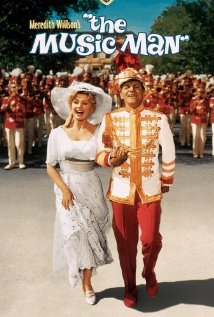
The Music Man

Posted on December 13, 2002 at 5:17 am

“Professor” Harold Hill (Robert Preston) is a con man posing as a salesman of band instruments and uniforms. He happens upon River City, a small town in Iowa. As the citizens explain in song, Iowa is a place of stubborn people who keep to themselves unless someone needs help. But Hill happens upon an old friend, Marcellus Washburn (Buddy Hackett), and is ready to run his favorite scam. He plans to sell the town on the idea of a boys band, with himself as leader, get them to order instruments and uniforms, and skip town with the money. Marcellus tells him a bit about the town and its people, and especially about the town librarian and music teacher, Marian Paroo (Shirley Jones).

Copyright Warner Brothers 1962

Marian lives with her mother (Pert Kelton) and her little brother Winthrop (Ronny Howard), a shy boy with a lisp, who deeply mourns his late father. In her own way, Marian, like Winthrop, is still grieving, and finds it hard to allow herself to become close to anyone. This is especially difficult because she is the subject of some gossip in the town. She has the job as librarian because an elderly man, a friend of her fathers, bequeathed the library building to the town, but left the books to her, to ensure that she would have permanent employment. This has caused some speculation about their relationship. And the ladies in the town also think the books she recommends (including the Rubiyat and Balzac) are improper. Despite her mother’s attempts to encourage her to be friendlier, Marian is very skeptical about Harold’s motives and his credentials. He is able to dazzle the town (with the famous patter song “Trouble,” offering the band as an alternative to the decadence of the town’s new pool parlor), but she vows to check his credentials.

The town gets caught up in the notion of the band. Harold’s charm and smooth promises enrapture everyone from the town council (he transforms them from four squabbling politicians into a harmonizing barbershop quartet) to the teen-age boy all the others look up to (Harold challenges him to invent an apparatus for holding the music so that the piccolo player can read it and encourages his romance with the mayor’s daughter). Harold even charms Winthrop, who is at last excited and happy about something. Harold tells all the parents that their children are wonderfully gifted and that the band will make them stars. Meanwhile, Harold’s attention to Marian is becoming more than just a way to help him get the money. And, despite evidence that he does not have the credentials he claims, and her certainty that he is not what he pretends to be, she finds herself softening toward him and protecting him.

Because of her, he stays too long, and he is arrested. As he says, “For the first time, I got my foot caught in the door.” But somehow, the boys force a few sounds out of the instruments, enough for their proud parents. And Harold stays on — it turns out that all along, deep inside, what he really wanted was to lead a band.

Discussion: Robert Preston brought his award-winning performance as Harold Hill on Broadway to the screen in this impeccable production, perfect in every detail. In addition to the glorious production, with some of the most gorgeous music and dancing ever filmed, there is a fine story with appealing characters. Marian learns about the importance of dreams from Harold, and he learns about the importance of responsibility from her.

Harold has made a life out of other people’s dreams, creating them and then spoiling them. He gives people an image of themselves as important and creative, and it is clear that this is what he loves about what he does, not stealing the money from them. Marian has faith in Harold. It is not the blind faith of the rest of the town, the people who see the seventy-six trombones he sings about. She sees what is good inside him, the real way that he affects people like Winthrop, the way he affects her. As she sings, “There were bells on the hills, but I never heard them ringing, oh, I never heard them at all, ’til there was you.” When Marian sees Harold and is willing to love him in spite of his past, he is for the first time able to move on from the notion of himself as a thief and a liar. Each finds the core of the other, allowing both of them to heal and take the risk necessary to make their dreams come true. For him, the risk is prison and disgrace. For her, the risk is the kind of hurt she felt when her father died, the risk we all take in loving someone. And because this is a musical, they live happily ever after.

Questions for Kids:

· Why is Winthrop so shy? What makes him change?

· How does Harold change people’s minds? Is that good or bad?

· How does the music help to tell the story? Listen to the songs “76 Trombones” and “Goodnight My Someone” again. They are very much alike, as you can tell when they are sung together. What did the composer want that to tell you about the people who sing them?

· Why were the parents worried about their children playing pool? What do parents worry about today?

· How is Marian’s library like yours? Do you know your librarian? Do people in your town ever argue about what books should be in the library?

Connections: This movie shows some of the most talented people of their time at the top of their form. Shirley Jones appeared in many musicals, including “Oklahoma” and “Carousel,” always exquisitely lovely in voice and appearance. She also won an Oscar for her dramatic role as a prostitute in “Elmer Gantry.” And of course she was the mother in television’s musical comedy series, “The Partridge Family.”

Robert Preston had more luck in theater than in movies finding roles that gave him a chance to show all he could do. But every one of his film appearances is worth watching, including “The Last Starfighter” and “All the Way Home.” Choreographer Oona White also did the sensational dance numbers in “Bye Bye Birdie.” Composer Meredith Willson never came close to the glorious score for “The Music Man,” but he produced some nice songs for “The Unsinkable Molly Brown.”


Related Tags:


Classic Crime For the Whole Family Musical Romance

Quest For Camelot

Posted on December 13, 2002 at 5:16 am

A young girl named Kayley dreams of being a knight like her father, who was killed defending King Arthur from the brutal Ruber. When Ruber steals Excalibur from Camelot, Kayley goes into the forbidden forest to find it. There she meets Garrett, a squire befriended by her late father, who left Camelot after he became blind. Joined by a two-headed dragon, they find the sword and fight Ruber to return Excalibur to Arthur.

This is the first attempt by Warner Brothers, home of Bugs Bunny and Donald Duck, to get into Disney territory with a full-length animated musical drama, and it is a step in the right direction, even if it does not match Disney or even non-Disney features like “Anastasia.” questforcamelot.jpg
The movie’s greatest strength is the first-class talent providing the voices: Cary Elwes as Garrett, Jane Seymour and Gabriel Byrne as Kayley’s parents, Don Rickles and Monty Python’s Eric Idle as the dragon, and (all too briefly) Sir John Gielgud as Merlin. The animation has some good moments, especially a sleepy ogre. The heroine and hero are spirited if a bit too generic. But with the exception of the dragon’s cute duet, the songs add little and slow down the story. Themes worth discussing include the importance of cooperation, loyalty, and the strengths of those considered disabled.

Related Tags:


Action/Adventure Animation Fantasy For the Whole Family Musical Talking animals
THE MOVIE MOM® is a registered trademark of Nell Minow. Use of the mark without express consent from Nell Minow constitutes trademark infringement and unfair competition in violation of federal and state laws. All material © Nell Minow 1995-2025, all rights reserved, and no use or republication is permitted without explicit permission. This site hosts Nell Minow’s Movie Mom® archive, with material that originally appeared on Yahoo! Movies, Beliefnet, and other sources. Much of her new material can be found at Rogerebert.com, Huffington Post, and WheretoWatch. Her books include The Movie Mom’s Guide to Family Movies and 101 Must-See Movie Moments, and she can be heard each week on radio stations across the country.

Website Designed by Max LaZebnik