The Russo Brothers Talk: Thanos, Infinity Powers, and Their Favorite Special Effect in “Avengers: Infinity War”

Posted on May 12, 2018 at 8:03 am

Everyone knew that “Avengers: Infinity War” was going to be big. But were our expectations impossibly high? Even the extraordinarily talented brothers and co-directors Anthony and Joseph Russo, who made two of the most critically acclaimed of the 18 Marvel superheroes in the past decade, had to feel daunted by the challenge of taking on so many characters and such a complicated story. In an interview, they talked about choosing which characters would be most interesting together, who the supervillain Thanos is, which special effect they particularly enjoyed, and which superpowers they most wish they had.

People love the movie but are very shook up by some of the developments. Do you feel like the two most hated people in the whole world right now?

JR: It’s interesting that people are having this kind of emotional response. But this is a really unique experiment in filmmaking in the Marvel Universe. Ten years of storytelling spread out over very diverse franchises, diverse tonally, diverse from a story standpoint, with unique and different characters. This film represents the ending of that story and “Avengers 4” as well. So the audience is invested in the incredible amount of emotion and time and energy and passion in these characters. And the response we’re seeing to the movie is that it’s a representation of that emotion and passion that they feel for this unique experiment in cinema.

As I have told you before, I am a huge fan especially of your work on “Captain America: Winter Soldier” and “Civil War,” which integrated with the rest of the MCU but had a very distinctive tone inspired in part by the 1970’s cinema of paranoia films. The two most recent Marvel superhero movies were also great, “Black Panther” and “Thor: Ragnarok,” but they had very different tones from very different directors. How do you take those characters and more and make them seem as though they’re in the same movie while maintaining their distinctive personas, worlds, and storylines?

JR: We look at that as one of the great creative upsides of trying something like this. We’ve always thought of ourselves, specifically our creative processes, as sort of akin to being mad scientists. We like to take disparate elements and smash them together and see what that gives us on a tonal level. We’ve done that in a lot of our work, and this movie is the perfect setup for that process.

Like you said, we have all these different tones and styles to draw on. But primarily we look at it as our responsibility to give people our version of these characters. That’s what we love about these characters — they can morph from movie to movie. Our version of Captain America was very different than Joss Whedon’s version. Taika Waititi’s version of Thor has been very different than the previous versions.
I think audiences like that. They like the fact that each individual movie is a conceptual and tonal and narrative presentation that while it is tethered on a story level to what’s come before; its own expression on a tonal level and a style level is unique. And so we try to be very specific to what the needs of our story were in this movie and how we want it balanced, because we’re big fans of balanced storytelling. We like movies that make you laugh, make you cry, make you think, etc.

This movie was challenging to balance because it is so dark in many respects, and intense. So we use that variety of tones that all these characters bring us to give what we think is like a very complete fulfilling cinema experience, the kind of experience that we aspire to see.
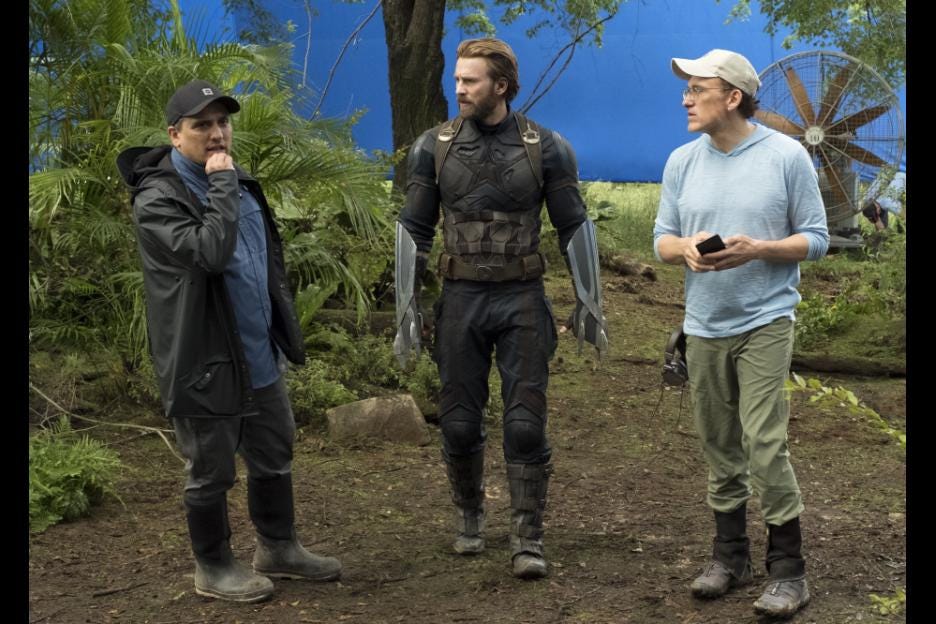
In the past, the series has addressed some classic fanboy questions about power like whether Thor’s hammer is stronger than Captain America’s shield. I thought it was interesting that in this film it was more about the way the personalities work together. And it was particularly choice to put the two strongest egos up against each other, Doctor Strange and Tony Stark. So tell me how you looked at all the characters lined in front of you and thought about who would set off the most sparks against who?

AR: Tony Stark and Stephen Strange — one thing that drew us to it is exactly what you’re saying, their egos, and their narcissism. We knew that it would be hard for those two characters to exist within the same space. But I think also what we loved about that was the contrast between the two with Tony being such a man of science and Strange being a man of magic and the incongruity of those two things, their approaches and their respective powers. So that was particularly fun for us.

We spent a long time with the writers, Christopher Markus and Stephen McFeely exploring every possible combination before we started to lock into a story. But that was so elemental in terms of what the fun and thrill and creative upside of this film would be for us. So the Star Lord/Thor combination with the Guardians was certainly one of our most exciting ones. I have to say the Gamora/Thanos combination was one thing that we were particularly interested in. We always love it when there’s a relationship between a villain and a hero that has a personal dimension to it. That was really what excited us most about “Winter Soldier” right from when we started with Marvel. And so to be able to play with that father/daughter relationship and that villain/hero relationship in a way that had so many personal layers and so much personal complexity to it; that’s something for us as storytellers that’s very exciting creatively.

I loved the interplay between Thor, Groot, and Rocket.

JR: Thor is in a very vulnerable and emotional place of himself. He’s hiding it under a veneer disconcern. He’s trying to act like you know the his mission is to to stop Thanos, which it is, but he’s devastated with all the loss that he suffered in this film and in Ragnarok. Rocket is the most caustic and seemingly unemotional character and Groot, too, is in a very caustic and emotional phase as a teenager. Putting them together, was interesting and it is the most emotional that we have seen Rocket, the most sensitive that you’ve ever seen Rocket portrayed in that scene on the pod. That is because it’s hard not to empathize with Thor because of the level of loss that he has endured. It’s played for somewhat absurdist humor at first. But then slowly it seeps into Rocket’s heart and he makes a gesture by handing Thor that eye.

But we also do get a lot of humor out of that crew.

AR: I think that that grouping is interesting in that you know if you go back to our very early work with like “Welcome to Collinwood” or “Arrested Development,” Joe and I have a strong penchant for for absurdity and absurdist comedy. There’s a strong spirit of absurdism moving through that story line.

Well tell me a little bit about the monumental challenge of keeping so many different not just characters but different locations going at the same time? How do you even begin to remind everybody who is where and what is happening?

JR: Great question. It takes a lot of work and a lot of story discipline. We spent a long time in the writers room with Markus and McFeely going through various iterations of the structure of the script to try and unlock one that tracks the best. Once we committed to the script we then in editorial did the same thing over again. Because rarely does the script offer the same sort of information that a cut film will. Once you cut the film together you can sit there and assess transitions and assess which characters have been missing for too long. And so we really played with that for about five or six months with different iterations of structure until I think we lighted the one that we felt tracked the cleanest and the best. So it really just requires an intensive amount of work.

We’ve been building up to the confrontation with Thanos for a very long time. What makes him the villain you wanted to have as the ultimate threat?

AR: Right from the very beginning Thanos started to loom large in our mind because we knew the goal for this film and the following Avengers film was to provide a climax and a culmination for the entire road that we’ve been travelling for ten years. And a narrative that would somehow inolve the MCU at least to some degree in its entirety. Thanos was in a very unique position for us to find a central figure that could actually bring every corner of the MCU together in a single narrative in his quest for the stones and the fact that the stones have been so well placed throughout the various films. All of a sudden he just started to become this sort of sense central concept here.

And the other thing in thinking about Thanos was that like he had been so lightly teased up to this point in the MCU; we knew very little about him on-screen. We understood that very little about him. So for us and for Markus and McFeely, it was an opportunity to go into a very deep dive into the question of who was this guy and how is he going to end up crashing into these other characters and ideas that we’ve been playing with in this world. And as we started to sink deeper into that and realize that he was sort of like the central figure in a way, we began to fill him out as if he was a lead character and build a narrative around him in a way that you typically build a narrative around a lead character.

That was one of the most exciting parts of the creative process for us, the fact that we got to think about a villain in those terms, to put a villain in that position in the narrative. And I think ultimately that’s really what a lot of people are responding to in this film. It is a very fresh perspective to approach a movie like this from. A lot of the surprises and a lot of the shock of the experience comes from the fact that the movie was designed that way.

We couldn’t have asked for a better actor of course than Josh Brolin to play that role. I can’t think of any other actor that can embody the physical presence that that character has or the level of violence that character has within him, at the same time giving him a soul and a depth and a complexity, and an emotional landscape that you can actually read and relate to on screen. It was quite remarkable and we have to give a big thanks to our visual effects team for being able to innovate and use new technologies to translate Brolin’s performance onto a CG character in a way that I don’t think anyone’s ever seen before on screen.

I won’t ask who your favorite Avenger is, but can you tell me which of the Avenger powers you would most like to have?

JR: I always say and it’s easy because it was my favorite character growing up and I collected most of his books was Spiderman. So I think it was because I always secretly desired to go in to climb walls and swing on webs.

The special effect in the scene with the hair on his arms was absolutely fantastic.

JR: Yeah, it’s a favorite of ours, just the opportunity to physically represent the Spidey sense.

AR: It’s pretty much informed by our experience and having to make two of the largest movies ever made back-to-back; I would love to have the Time infinity stone. We could use that.

Related Tags:


Behind the Scenes Comic book/Comic Strip/Graphic Novel Directors Interview
Life of the Party

Life of the Party

Posted on May 10, 2018 at 5:53 pm

B +
Lowest Recommended Age: High School
MPAA Rating: Rated PG-13 for sexual material, drug content and partying
Profanity: Some strong language
Alcohol/ Drugs: Drinking and drugs
Violence/ Scariness: Comic peril and violence, gun, no one hurt
Diversity Issues: None
Date Released to Theaters: May 11, 2018
Date Released to DVD: August 7, 2018
Copyright 2018 Warner Brothers

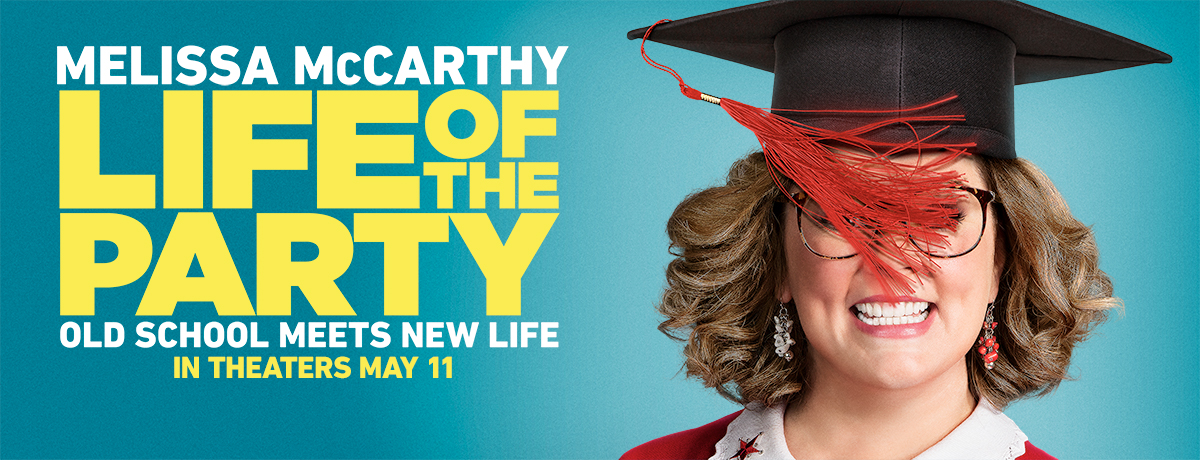
Thank you, Melissa McCarthy and Ben Falcone, for figuring out that what we want to see is Melissa McCarthy as America’s sweetheart, not a deranged sociopath. In their previous films, “Tammy” and “The Boss” and in McCarthy’s “Identity Thief” the brilliant comic actress with the adorable dimples was cast as weird, heartless, damaged and damaging characters. It takes nothing away from McCarthy’s considerable dramatic talent (she was outstanding in “St. Vincent” and we are very much looking forward to her performance later this year in the fact-based story of a literary fraud and forger, “Can You Ever Forgive Me?”) to say that she is at her very best and funniest when she is irrepressibly sunny.

And so Falcone and McCarthy have created just that in Life of the Party, where she plays Deanna, a loving mother and housewife who learns, as she and her husband (Matt Walsh of “Veep”) drop their daughter off at college for her senior year, that her husband is leaving her because he has fallen in love with another woman (“Modern Family’s” Julie Bowen).

Deanna, who wears a “Proud Mom” sweatshirt and has devoted her whole life to her family, is angry and disappointed. She decides that her biggest regret was dropping out of school when she became pregnant with Maddie (Molly Gordon), so what she wants to do is go back and get her degree. This has the additional benefit of being on campus with Maddie who is predictably a bit nonplussed, but supportive. And Maddie’s sorority sisters love Deanna’s enthusiasm and kindness. Yes there’s a mean girl (and an 80’s party dance-off! Yay!), but we don’t have to slog through the expected scenes of students underestimating Deanna just so she can show them how wrong they were.

As in McCarthy’s other best comic roles, in “Bridesmaids,” “Spy,” “Ghostbusters,” and “The Heat,” Deanna may be awkward and overly effusive, but she is also supremely capable and in most situations, confident as well. It’s easy to get a cheap laugh from incompetence and failure, and there are a few of those here, primarily from the underused Gillian Jacobs, playing an undergraduate who was in a coma for eight years and has some catching up to do. Deanna may have a problem with oversharing, she does not always make good choices, and for some reason public speaking puts her into a panic, but she is both smart and wise. She has a sustaining friendship (the invaluable Maya Rudolph) and a perpetual sunniness that everyone around her finds endearing. Her soon-to-be-ex with a skinny blonde girlfriend and a new earring tells her he needs an “upgrade.” But it is Deanna who finds herself upgrading in every category, including a handsome and devoted young beau, played by the very appealing Luke Benward. That is a satisfying starting point for some mostly-adorable silliness and a lot of heart. Deanna repeatedly says she is “down to clown,” which is supposed to be an eye-rolling mom-ism. But it is McCarthy who is truly down to clown and we are all the better for it.

Parents should know that this movie includes sexual references and situations, potty humor and crude jokes, drinking and drugs, comic mayhem, peril and violence, a gunshot, and some mild language.

Family discussion: What did the girls like about Deanna? What was the biggest change she made?

If you like this, try: More college comedies, including “Back to School,” “Sydney White,” “High Time,” and “The House Bunny”

Related Tags:


Comedy DVD/Blu-Ray Features & Top 10s movie review Movies -- format
Celebrate Mother’s Day with a Mamma Mia Sing-Along!!

Celebrate Mother’s Day with a Mamma Mia Sing-Along!!

Posted on May 9, 2018 at 3:10 pm

You know what moms love?  Well, breakfast in bed, of course, and hand-made cards and poems, but after that, they love “Mamma Mia!”  And there are free screenings all across the country this Sunday for Mother’s Day!

Copyright Universal 2018

In anticipation of its upcoming Mamma Mia! Here We Go Again, Universal Pictures today announced that free sing-along screenings of the blockbuster musical comedy Mamma Mia! will be available on Mother’s Day, Sunday, May 13, at 25 theater locations across the U.S. and Canada. Each guest who requests a ticket the day of the screening—at a participating location—will be given one free admission to the 10:00 a.m. showing, up to theater capacity.

Free tickets will be available on a first-come, first-served basis and may only be picked up at the theater box office starting at 9:00 a.m. on Sunday, May 13. This offer is valid for the 10:00 a.m. showing of Mamma Mia! The Movie on May 13, at participating locations only.

For more information and a list of theaters offering the special screenings, please visit www.MammasDaySingAlong.com

And get ready for a prequel/sequel, coming July 20, 2018!

Related Tags:


Based on a play Musical
Tully

Tully

Posted on May 3, 2018 at 2:27 pm

B +
Lowest Recommended Age: Mature High Schooler
MPAA Rating: Rated R for language and some sexuality/nudity
Profanity: Strong language
Alcohol/ Drugs: Drinking and drunkenness, drunk driving
Violence/ Scariness: Auto accident with injuries
Diversity Issues: None
Date Released to Theaters: May 4, 2018
Date Released to DVD: July 30, 2018
Copyright 2018 Focus Features

With “Tully,” their third collaboration, director Jason Reitman and screenwriter Diablo Cody are approaching a “Before Sunrise/Sunset/Midnight”-style series about the challenges of growing up and getting older.

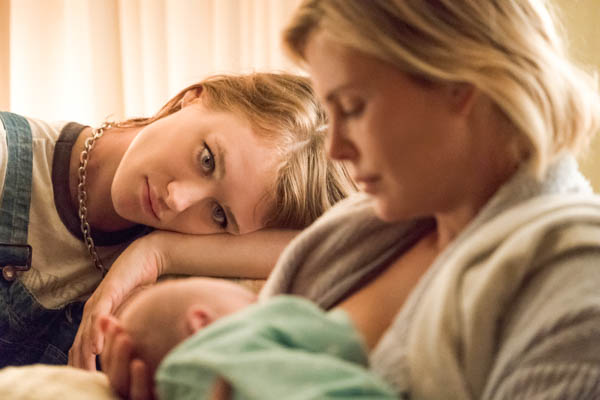
It may not be the same set of characters, but “Juno,” “Young Adult,” and now “Tully” can be seen as a continuing story with smart, flawed female protagonists. The first was a pregnant teenager, then a floundering author trying to reclaim the life she thought she was going to have when she was in high school, and now a married mother of two, pregnant with a third, trying to connect with the person she once was when all of her time and attention was not taken up with obligations to others. Charlize Theron plays Marlo, the exhausted mother, and Mackenzie Davis plays the title character, a night nanny who turns out to be just what Marlo needs in ways that surprise her and us.

Marlo is exhausted and overwhelmed. Her second child is a son who is described by the school principal in the words that strike terror and a fierce defensiveness in the heart of a parent: “quirky” and “out of the box” — and then, finally, “not a good fit.” Every morning, with infinite patience and tenderness, Marlo gently brushes his whole body because she saw online that it might help him with sensory integration. When he has a meltdown because she isn’t parking in the usual spot, she is compassionate. But it is clear that she is giving so much to her family that she has lost some sense of herself and her own needs.

Marlo has a brother (Mark Duplass) who offers her a baby gift — the services of a night nanny, someone who comes at night to help new parents get some rest. Marlo and her husband (Ron Livingston) enjoy mocking her brother and his wife for being materialistic and bourgeois. It also makes them feel a bit superior and helps them ignore their envy at his financial stability. The idea of a “night nanny,” even paid for by someone else seems like just another mockable bougie pretension. But then Marlo has the baby as her husband’s job keeps him away from home and, even more exhausted and overwhelmed, she calls the number her brother gave her, and Tully (Mackenzie Davis) shows up like a hipster Mary Poppins.

She’s not just a baby whisperer; she’s a Marlo whisperer, too.  With patience and kindness, she listens attentively, and she very gently and supportively guides Marlo, to feel peaceful and cared for.  “Kiss the baby,” she says, as Marlo begins to trudge upstairs to bed. “She’ll be different in the morning.  We all will.”  Marlo comes down the next morning and the house is neat.  Tully even makes cupcakes.  She even presses Marlo about reconnecting to her husband.

Theron’s performance here is superb.  “Brave” when referring to an actress, usually means that she doesn’t look like a size zero teenager.  And Theron went for it here, gaining 50 pounds from her “Atomic Blonde” action star look, and she does indeed appear like a very pretty woman who has had three children.  But what is brave here is her extraordinary emotional authenticity, her vulnerability, and her wry humor.  When she tells the officious, though superficially kind school principal that the baby is a blessing, we can see three levels to that word.  Marlo is saying the word she thinks will ingratiate her with the principal who is trying to politely extricate her son from the school (those deadly words, “not a good fit”).  She is sarcastic (Cody loves sarcasm).  But, you know what? She really believes it, too.  Tully’s greatest contribution is reminding Marlo that all that is overwhelming her is what she once wished for.  This is her happy ever after ending and even if it’s going to be messy, there has to be a way to hold on to that before she ends up missing it.

Sharply but lovingly observed, clearly based on deeply lived experience, with lots of Cody’s shrewd wit and enormous compassion for its characters, “Tully” is as welcome in theaters as its title character is at Marlo’s door.

Parents should know that this film includes glimpses of pornography, explicit sexual references and nudity, very strong language, childbirth scene, drinking and drunkenness, and an auto accident with injuries.

Family discussion: Who is Tully? Why did she visit Marlo? Why are Marlo and her brother so different? What does “quirky” mean?

If you like this, try: “Juno,” by the same director and writer

Related Tags:


Drama DVD/Blu-Ray Family Issues movie review
Avengers: Infinity War

Avengers: Infinity War

Posted on April 25, 2018 at 1:10 pm

B +
Lowest Recommended Age: Middle School
MPAA Rating: Rated PG-13 for intense sequences of sci-fi violence and action throughout, language and some crude references
Profanity: About a dozen bad words
Alcohol/ Drugs: None
Violence/ Scariness: Extended and intense action-style peril and violence, chases, explosions, supervillains, characters injured and killed
Diversity Issues: None
Date Released to Theaters: April 27, 2018
Date Released to DVD: August 13, 2018
Copyright Marvel 2018

A two hour and forty minute movie can still feel too short when there are so many of our favorite characters, and that is the good news and the bad news about the much-anticipated “Avengers: Infinity War.”

The good news is that we get the ultimate mash-up of the Avengers and the Guardians of the Galaxy. That means a whole lot of quippy action scenes. My greatest fear was that with so many characters most of them would not have enough time to do much on screen either by way of action or by way of drama, and the pretty good news is that screenwriters Christopher Markus and Stephen McFeely and directors Joe and Anthony Russo do a good job of giving everyone his or her own space — literally, by sending them off in different directions to keep the interactions manageable, and figuratively, by giving most of them individual character arcs, or, perhaps we should say arc-lettes as they are sketched in just enough to add a little substance sauce to the main course of the action.

The less great news is that the storyline is something of a let-down following the exceptional depth and complexity of “The Black Panther.” As I have said many, many times before, superhero movies depend entirely on the quality of the supervillain, and Erik Killmonger was the top of the line as bad guys go, nuanced, sympathetic, human, and utterly magnetic. Any movie, but especially a fantasy movie, has to be completely clear about the stakes, meaning that in a superhero movie we have to know exactly what the relative strengths and weaknesses of the opposing forces are and what they are fighting over. We don’t need a lot of detail; there’s a reason Alfred Hitchcock used to speak so dismissively about the “McGuffin,” whatever it was everyone in the story wants so badly. All we need to know is why it matters, how to get it, and how keep it from the wrong person.

The bad guy here is Thanos (Josh Brolin) a CGI-d Titan of enormous power who is seeing the ultimate power, which he can achieve via the six Infinity Stones. He has a handy glove with spaces for each stone, and once he has them all he can achieve his goal of wiping out half of the life forms in the universe with the snap of his gigantic fingers. Much of the movie consists of him beating up all of the superheroes, a couple of whom are quickly dispatched in the first scene. We hear a lot about how important it is that he be stopped but we do not get many specifics about how his powers work or what, if any, vulnerabilities can be used against him. And that makes the battles more set-pieces, exceptionally well-staged set-pieces than drama. And then, in the middle, almost quiet next to the supernova intensity of the star power, the dazzle to the saturation point of the action scenes, and the Hulk-level heavy lifting of the realignment of the movie MCU to accommodate some thoughtful and even subtle variations on whether it is right to sacrifice one life to save many others.

But mostly, there’s a lot of action. Remember that refugee spaceship at the end of “Thor: Ragnarok?” And the feud between Iron Man/Tony Stark (Robert Downey, Jr.) and Captain America/Steve Rogers (Chris Evans, no longer the clean-cut WWII poster boy)? We pick up both as Thanos, the most powerful creature on the planet and the adoptive father of Gamora (Zoe Saldana) and Nebula (Karen Gillan) arrives in search of the five remaining Infinity Stones he needs to complete the set and wipe out half the universe. It’s time to get the band back together, with some of the team who have been missing in action, like Thor (Chris Hemsworth) and Bruce Banner (Mark Ruffalo), having a bit of trouble getting his Hulk on. And the team now includes a high school intern, Peter Parker/Spider-Man (Tom Holland), who is so new and so in awe that he still calls Iron Man “Mr. Stark.”

Thanos has some nasty henchmen and henchwomen and hench-creatures who show up to help him find the stones. And the Guardians of the Galaxy, including Gamora, join on, with a sulky, now-adolescent Groot who can’t be pried away from his hand-held game device.

There are some very funny moments as the group gets to know each other, a few cheeky pop culture references, and an extended section in Wakanda gives us a chance to spend some more time with some characters who are already fan favorites (How about giving Shuri her own movie, Kevin Feige? And the Dora Milaje?) A few non-Avengers make a strong impression in their brief screen time, especially Peter Dinklage as a giant weapons-maker. But after nearly three hours (and only one after-credits scene?), with some savagely painful losses, it is unsatisfying to leave on the biggest cliffhanger since they freeze-dried Han Solo. There’s a point past which you stop topping yourself and just run out of breath — and that point is when you inform us several times that Thanos has ultimate power and then take us to a planet where there is a weapon that can stop him. There’s an infinite regression/irresistible force-immovable object paradox issue.

This movie is so big it has three superheroes played by superstars named Chris, and I haven’t even gotten to Benedict Cumberbatch as Dr. Strange, Winston Duke as M’Baku, Paul Bettany as Vision, Don Cheadle as War Machine, Sebastian Stan as Bucky, and Anthony Mackie as Falcon, all of whom get a chance to make an impression that leaves us wanting more. At times it feels like the Fellowship of the Infinity Stones, even approaching the grandeur of the Tolkien trilogy in its scope and the depth of its world-building. Or, I should say, worlds-building. There’s even time for some very sweet romance, and we see how those romantic complications present complicated challenges in the midst of battle. Also, dog monsters.

I trust the Russos to bring it all together with the next chapter. I hope it’s soon.

Parents should know that this film features extended comic-book action-style violence with many characters injured and killed, brief crude humor, and about a dozen strong words.

Family discussion: How many times did someone in the film have to decide whether it was worth sacrificing one life to save many others? Which superheroes were better at cooperating and why? Why does Thanos think he is right?

If you like this, try: the other Marvel movies, especially “Iron Man,” “The Avengers,” “Thor: Ragnarok,” and “The Black Panther”

Related Tags:


3D Action/Adventure Comic book/Comic Strip/Graphic Novel DVD/Blu-Ray movie review Movies -- format Movies -- Reviews Scene After the Credits Series/Sequel Superhero
THE MOVIE MOM® is a registered trademark of Nell Minow. Use of the mark without express consent from Nell Minow constitutes trademark infringement and unfair competition in violation of federal and state laws. All material © Nell Minow 1995-2026, all rights reserved, and no use or republication is permitted without explicit permission. This site hosts Nell Minow’s Movie Mom® archive, with material that originally appeared on Yahoo! Movies, Beliefnet, and other sources. Much of her new material can be found at Rogerebert.com, Huffington Post, and WheretoWatch. Her books include The Movie Mom’s Guide to Family Movies and 101 Must-See Movie Moments, and she can be heard each week on radio stations across the country.

Website Designed by Max LaZebnik