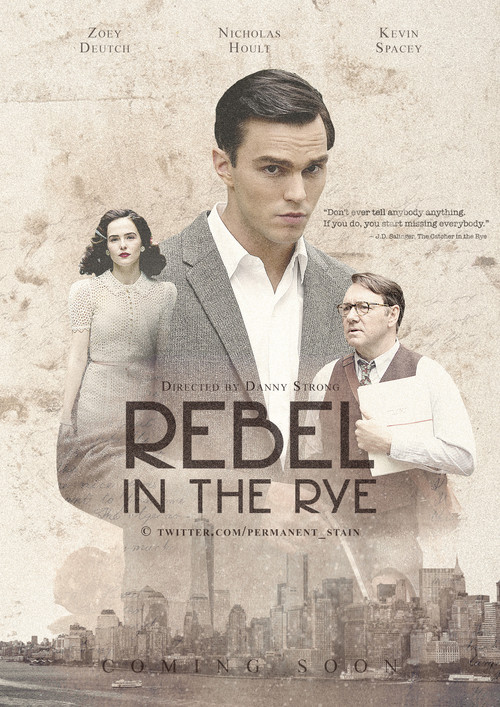
Rebel in the Rye

Rebel in the Rye

Posted on September 14, 2017 at 5:50 pm

B +
Lowest Recommended Age: High School
MPAA Rating: Rated PG-13 for some language including sexual references, brief violence, and smoking
Profanity: A few strong and crude words
Alcohol/ Drugs: Drinking, smoking
Violence/ Scariness: Wartime violence with disturbing images including holocaust images
Diversity Issues: None
Date Released to Theaters: September 15, 2017
Copyright 2017 IFC

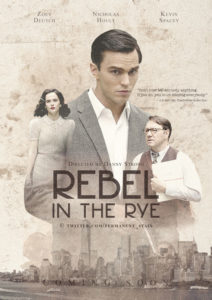
J.D. Salinger had three great losses and three great teachers, and “Rebel in the Rye” is the story of how those all came together to influence the author of one of the most popular and influential novels of the 20th century, The Catcher in the Rye, along with his shorter pieces, a few novellas and stories. Salinger is almost as well known for his decades of seclusion in New Hampshire as he is for his work. Reportedly, after publishing his last story in 1965, he continued to write full-time, but never showed it to anyone or allowed it to be published. It may be that the mystery is a better story than the writing.

Writer/director Danny Strong (co-creator of “Empire,” screenwriter of the “Mockingjay” films and actor in “Gilmore Girls” and “Buffy”) introduces us to Salinger before all of that happened, young, ambitious, and like Catcher in the Rye‘s Holden Caulfield, a smart aleck who has left or been asked to leave a number of top schools. Nicholas Hoult (“About a Boy,” “Mad Max: Fury Road”) shows us the teenage Salinger, arrogant but insecure, especially arrogant when it came to writing and especially insecure when it came to girls. He meets Oona O’Neill (Zoey Deutch), the daughter of playwright Eugene O’Neill, and they begin to date, though what makes her most attractive to him is her lineage and her admiration for his writing. And, after leaving NYU, he enrolls in Columbia, where he takes a class from the editor of Story Magazine, Whit Burnett (Kevin Spacey). “There is nothing more sacred than stories,” Burnett tells the class. And he advises Salinger not to let his voice overwhelm the story, not to let his ego obstruct the emotional experience of the reader.

Burnett will be Salinger’s most important influence on the content of his stories, suggesting that Holden Caulfield deserves a novel. And O’Neill will be an influence, too, the first of the three great losses, when she leaves him to marry Charlie Chaplin.  Just as he is beginning to make progress as a writer, with his first published work in Burnett’s literary journal, Salinger joins the military in WWII, where he endures great peril and hardship and witnesses some of the worst events in world history, including the landing on Normandy beach and the liberation of a concentration camp.  These traumatic experiences caused great distress for Salinger, what would today be called PTSD (as Salinger movingly described in my favorite of his stories, “For Esme, with Love and Squalor.”  But it was these experiences that gave him the depth and scope to write his sole novel.

Burnett teaches Salinger that publication is incidental; what matters is doing the work of writing.  Salinger’s agent (Sarah Paulson, wry but sympathetic) tells him that “publication is everything” and urges him to “soften” his stories according to the “notes (comments) she gets back from editors.  Salinger, initially refusing to make any changes, finally does and even admits that they made the story better.

But the stress of success becomes too much for him.  “I’m shackled by my own creation,” he says as Catcher is seen as an invitation for readers to come see him.  The last loss and the last teacher are combined in a zen master who advises him to let go of his need for approval.  He moves to New Hampshire and never has anything to do with the literary world again. “If I can dedicate my life to writing and get nothing in return,” he says, “I think I might find happiness.”

Hoult is fine in showing us how Salinger changes, especially the effect of the war.  His scenes with his parents (Hope Davis and Victor Garber) and with the women he is trying to impress are especially effective.  Strong, as a writer himself, well understands the struggle to understand which voices to listen to, whether internal or external, in evaluating the work, and the complexity of needing approval even as we try to transcend that need.  The film evokes the mid-century era without being showy or distracting, and, an even more difficult challenge, explores the life of someone who wanted to be left alone without being exploitive.  Salinger insisted that there will never be a film about Holden Caulfield, and he was right as the value of that book is in the voice of its narrator more than in the incidents it portrays.  This is a better version of a story about someone who wants to catch children to keep them safe, at least in his own mind, or in the stories he will never show.

Parents should know that this film includes wartime violence with disturbing images including holocaust footage, drinking and drunkenness, constant smoking, and sexual references.

Family discussion:  Who was right about writing vs. publishing?  What makes Catcher in the Rye so compelling?  How was Salinger’s wartime experience reflected in his writing?

If you like this, try: the books of JD Salinger

 

Related Tags:


Based on a true story Biography Drama DVD/Blu-Ray movie review Movies -- format Movies -- Reviews
Dolores Huerta and Peter Bratt on the New Documentary “Dolores”

Dolores Huerta and Peter Bratt on the New Documentary “Dolores”

Posted on September 12, 2017 at 8:00 am

Dolores” is a new documentary that tells the story of activist icon Dolores C. Huerta, president and founder of the Dolores Huerta Foundation, co-founder of the United Farm Workers of America. If Ginger Rogers is known for matching Fred Astaire’s steps backwards and in high heels, Huerta was as responsible as the better-recognized Cesar Chavez for bringing the attention of the world to the rights of immigrants, women, and farm workers while raising eleven children as a single mother and constantly being marginalized and underrated because of her race and gender. I spoke to Huerta, who was awarded the nation’s highest civilian honor by President Barack Obama, along with the director of the documentary, Peter Bratt.

In the film, we see you begin by sitting down in living rooms or talking to farm workers in the fields to encourage them to insist on fair treatment. What did you say to them?

Dolores Huerta: When you are organizing a group of people, the first thing that we do is we talk about the history of what other people have been able to accomplish; people that look like them, workers like them, ordinary people, working people, and we give them the list. These are people like yourself, this is what they were able to do in their community. And then we talked about the issues that they’re facing in their own community and then we would say to them, “Well, just like these other people did, they were able to accomplish all these great things. You can do the same thing. But the thing is that you got to do it because if you don’t nobody else is going to do it for you; nobody else is going to come into your community and solve your problems. So you have to take on the issues yourself. You’re the ones who have to volunteer to make the work happen.”

So we do a whole series of these little house meetings and you probably get a hundred and fifty people together and out of that group then you have a cadre of them that will come up and they’ll volunteer to do the work that needs to be done and that’s how the leaders are developed. When you go into a community you’ll never know ahead of time who the leaders are going to be. The leaders come up from the volunteers that do the work and it’s amazing because then they do these incredible things in their community that they never thought they had the power to make that happen. Basically, the message is: you have power, the power is in your person and you can make this happen but you can’t do it alone; you’ve got to work with other people to make it happen, you have to make a plan and you have to volunteer. And it works; it’s like magic.

You go out there and you find those people that have this burning passion that they want to change things and you basically are just giving them the tools. This is the way that you do it: you come together with a group of people, you pass petitions, you go to the city council, you go to the board of supervisors and you can make it happen.

Peter Bratt: She actually was telling me a story that she hopped on a Greyhound to northern central California, throughout the bus ride was expecting sixty to seventy people at a house meeting which had only one person, and she said she gave it her all because one person can be the most incredible leader that can change thousands of lives. That was a great lesson.

Why was it important to you to tell this story?

Peter Bratt: Dolores in my view challenges the three pillars of society. She’s challenging patriarchy and yes, that’s part of gender discrimination but it’s also racial. She’s also a Chicana; she’s a woman of color. The third one is as a labor activist she’s challenging the institution of capitalism, and I think those are the three great threats and that made her dangerous. I think those complexities combined to keep her in the margins.

The people who appear in the film are very candid and sometimes very emotional. How do you as a filmmaker develop a sense of trust so that they will share those memories and feelings?

Peter Bratt: I have some history with Dolores. I’ve known her for a little while and I think there was initially a great amount of trust between her and myself and Carlos Santana whose idea this was, and I also knew a few of her daughters from years back. So I think initially there was trust but you still have to prove yourself and earn even more trust. The most important thing as a director is you have to create a safe environment where you make the person feel safe enough to open their heart and reveal the soul; that’s ultimately where you’re trying to get. We interviewed probably about fifty people and the ones that we selected for the film were the ones who we felt truly opened their hearts and spoke their truth.

What has surprised you in terms of how far we’ve come and what has been the most persistently frustrating?

Dolores Huerta: Women are now 50 percent of the law schools and medical schools, so we can look at all the progress that we’ve made, but we can see all the progress that we still need to make and now with the voter suppression going on and with the racism rearing its ugly head we know that we’ve got to really step up our game on the progressive side and get people to vote because a lot of people aren’t voting. They’ve taken civics out of our high schools. People were asleep but I think they’re waking up now. Trump has given everybody a good kick and people are waking up and realizing they’ve got to get involved. That’s the message that we want to send with the film; for people to get involved at the local level, at the community level, at the state level and international level because we can’t afford to let the right wing take over our country. My son Emilio is running for Congress to continue the fight for social justice.

Peter Bratt: Sometimes I just want to put the covers over my head and stay in bed and I feel like no matter what I do it’s ineffectual and I get depressed. So for me having spent these last few years with Dolores, to see her not just doing the work but impassioned about doing the work and getting out there at the grassroots level and she still goes out into the fields in 100 degrees to organize this farm operation, she’s still doing it in the school boards, on water boards, she’s been getting people involved and to see her so engaged and relentless. The fortitude is awe inspiring and yet there is this joy and this passion while continuing to do the work, It encourages me to like quit feeling sorry for myself and get back out there. To me as a filmmaker that’s the biggest reward, to see people lift themselves up and recommit themselves.

A briefer version of this interview originally appeared on the Huffington Post.

Related Tags:


Biography Directors Directors Documentary Gender and Diversity Race and Diversity
Home Again

Home Again

Posted on September 7, 2017 at 5:17 pm

B +
Lowest Recommended Age: High School
MPAA Rating: Rated PG-13 for some thematic and sexual material
Profanity: Some mild language
Alcohol/ Drugs: Drinking and drunkenness, marijuana, discussion of antidepressant medication
Violence/ Scariness: Tense family confrontations, scuffle
Diversity Issues: None
Date Released to Theaters: September 9, 2017
Date Released to DVD: December 11, 2017
Copyright 2017 Open Road

Producer/director/writer Nancy Meyers has the formula on lockdown: Take one Oscar-winning performer, preferably of a certain age (Diane Keaton, Anne Hathaway, Robert de Niro, Meryl Streep, Kate Winslet). Create a setting of lush, heavenly comfort with soft pillows, gleaming surfaces, white wine, and luscious food. Add a generic title (“The Intern,” “The Holiday”). Put some overly familiar pop songs on the soundtrack and use them to hide the lack of dialogue in scenes when we should be allowed to hear what the characters are saying that is making them think differently about each other. Settle back for a story where the female character is ADORED by everyone and also very capable and pretty much right about everything.

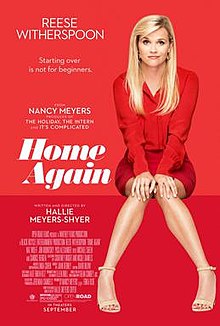
Whether her daughter absorbed all of this by osmosis or is merely a fully-owned subsidiary of the Meyers operation, we may never know. But “Home Again,” the first film from writer/director Hallie Meyers-Shyer is produced by her mother and follows exactly the same formula. It is, to say the least, highly unusual for a first-time writer/director to helm such a high budget, high-profile project, starring, yes, an Oscar-winner, Reese Witherspoon, as yes, a women of a certain age who lives in a spectacularly gorgeous home (Fountain in front! Guest house in back!). But Meyers is a reliable commodity, and as generous with her daughter as her ever-beneficent heroines are in the films. Remember Streep bringing out all those pies for her friends?

If there are no surprises here, one of the non-surprises is that the movie is an easy watch, combining, as Meyers films do, pleasant fantasy with aspirational settings. I know I’ll watch it again when it comes on cable, or if I have the flu or need to fold laundry.

Witherspoon is Alice, as in Wonderland, a mother of two who has moved into her late father’s house in Los Angeles because she and her music industry producer who wears leather bracelets husband Austen (Michael Sheen) have separated. Her father was a much-married, Oscar-winning screenwriter and director because apparently that is pretty much the only world she knows or the only one we can dream of.

Alice goes out with friends on her birthday and gets tipsy with three young men who have just arrived in Los Angeles after success with a short, black and white film they are hoping to turn into a feature. She and Harry (Pico Alexander) end up in bed together, though too drunk to do anything. The next morning, Alice’s mother (Candace Bergen) arrives, befriends the three young men, and invites them to stay in Alice’s guest house.

Alice is against this at first, but comes to enjoy it, as the guys help her with the house and her girls and she and Harry end up doing what they were unable to do that first night. The ultimate seduction move is, of course, fixing the hinge on her cabinet, and I don’t say that metaphorically. They all of course ADORE her and are themselves adorable. Enter Austen, wanting to assert his alpha male status and win back Alice because of course he ADORES her, too.

So, basically a high-end Hallmark movie, not that there’s anything wrong with that.

NOTE: This is the second movie in a row for Meyers with an inappropriate and borderline offensive “joke” about children who take antidepressants. What’s up with that?

Parents should know that this movie includes sexual references and situations, drinking and drunkenness, as well as family conflicts and divorce, a child dealing with stress, and a scuffle.

Family discussion: Were you surprised by Alice’s decision? How did Harry help her understand what she needed?

If you like this, try: “The Holiday” and “It’s Complicated” — and you can glimpse writer/director Hallie Meyers-Shyer in her parents remake of “The Parent Trap”

Related Tags:


Comedy DVD/Blu-Ray Family Issues Romance

BBC’s Top 25 Funniest Movies

Posted on September 2, 2017 at 8:00 am

The BBC surveyed critics to come up with the top 25 funniest movies of all time. Of course there’s a lot of overlap with the AFI list. And some of the movies are just what you might guess: “Some Like it Hot,” “Airplane,” “Blazing Saddles.” If by any chance you’ve overlooked any of these, please try to find them. If you’ve seen them, watch them again!

Related Tags:


Comedy Film History For Your Netflix Queue Lists Movies for Grown-Ups Neglected gem
Crown Heights

Crown Heights

Posted on August 31, 2017 at 5:54 pm

B +
Lowest Recommended Age: High School
MPAA Rating: Rated R for language, some sexuality/nudity and violence
Profanity: Strong language
Alcohol/ Drugs: Some alcohol, drug references
Violence/ Scariness: Peril and violence, murder
Date Released to Theaters: September 1, 2017

Copyright Amazon 2017
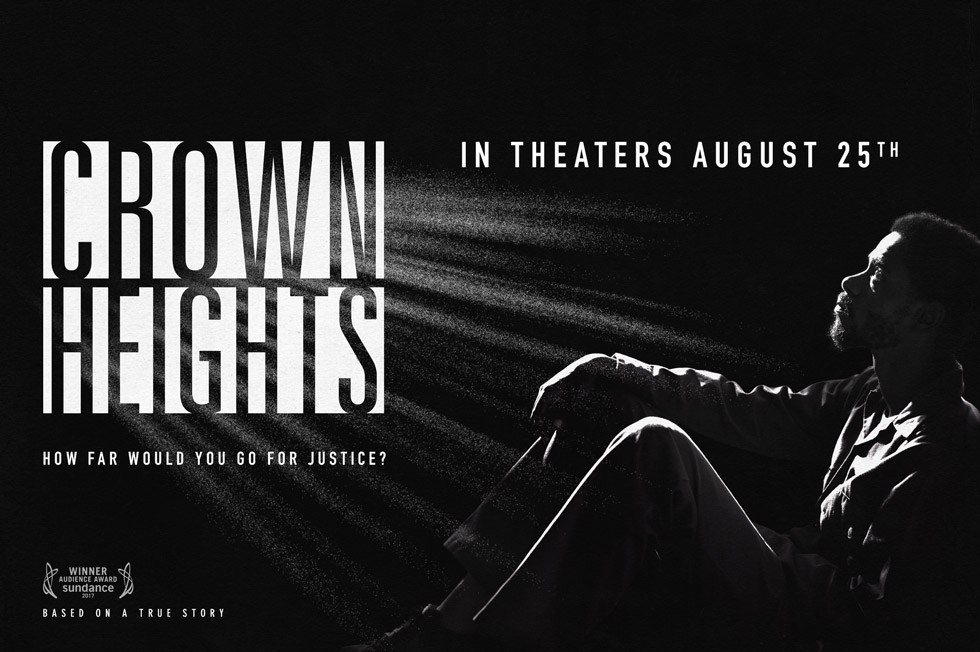
The story of Damon and Pythias has exemplified friendship and loyalty since the time of the ancient Greeks. The story of Colin Warner and Carl King should stand beside it. King spent 21 years working to get Warner released from prison after he was unjustly sentenced for murder. A reporter for “This American Life” told their story, and now it has been adapted for the screen by former NFL player Nnamdi Asomugha, who plays King opposite the extraordinarily gifted LaKeith Stanfield (“Get Out,” “Short Term 12″) as Warner.

The friends met growing up in Trinidad and then reconnected when both emigrated to the Crown Heights neighborhood of Brooklyn. Writer/director Matt Ruskin and Director of Photography Ben Kutchins evoke the lively but volatile and gritty atmosphere of 1980 Brooklyn. Warner is not even in the wrong place at the wrong time. He is nowhere near the spot where an apparent revenge execution-style murder is committed. But the cops are overwhelmed and under a lot of pressure to produce arrests and close cases. Archival footage of Presidents Reagan, Clinton, and George W. Bush promising crackdowns on crime provide context.

It is possible that determination to be fair to as many people as possible costs the film some dramatic momentum, especially as it stretches over decades, with setback after setback and complication after complication, plus the various family stresses, particularly with King as his wife understandably gets frustrated with the time and money he is devoting to Warner instead of their children. But the dignity and sensitivity of the performances by Stanfield and Asomugha hold the story together. But the time King takes a job as a process server in order to better understand what kind of legal help they need, things begin to pick up. A tender romance and a touching expression of forgiveness give the film a quiet power that I hope will not always feel as timely as it does right now.

Parents should knot that this story concerns a wrongful murder conviction and includes peril, violence, abuse, strong language, some sexual references and situations, and some nudity.

Family discussion: Why does this film title refer to the neighborhood, not the people involved? Why didn’t Carl give up? Listen to the story that inspired this film on “This American Life.”

If you like this, try: “Conviction” and “Hurricane”

Related Tags:


Based on a true story Courtroom Crime Drama movie review Movies -- format Movies -- Reviews
THE MOVIE MOM® is a registered trademark of Nell Minow. Use of the mark without express consent from Nell Minow constitutes trademark infringement and unfair competition in violation of federal and state laws. All material © Nell Minow 1995-2026, all rights reserved, and no use or republication is permitted without explicit permission. This site hosts Nell Minow’s Movie Mom® archive, with material that originally appeared on Yahoo! Movies, Beliefnet, and other sources. Much of her new material can be found at Rogerebert.com, Huffington Post, and WheretoWatch. Her books include The Movie Mom’s Guide to Family Movies and 101 Must-See Movie Moments, and she can be heard each week on radio stations across the country.

Website Designed by Max LaZebnik