Wicked Part 1

Wicked Part 1

Posted on November 21, 2024 at 12:35 pm

B +
Lowest Recommended Age: Middle School
MPAA Rating: Rated PG for some scary action, brief suggestive material, and thematic material
Profanity: None
Alcohol/ Drugs: None
Violence/ Scariness: Fantasy peril and violence
Diversity Issues: A theme of the movie
Date Released to Theaters: November 22, 2024

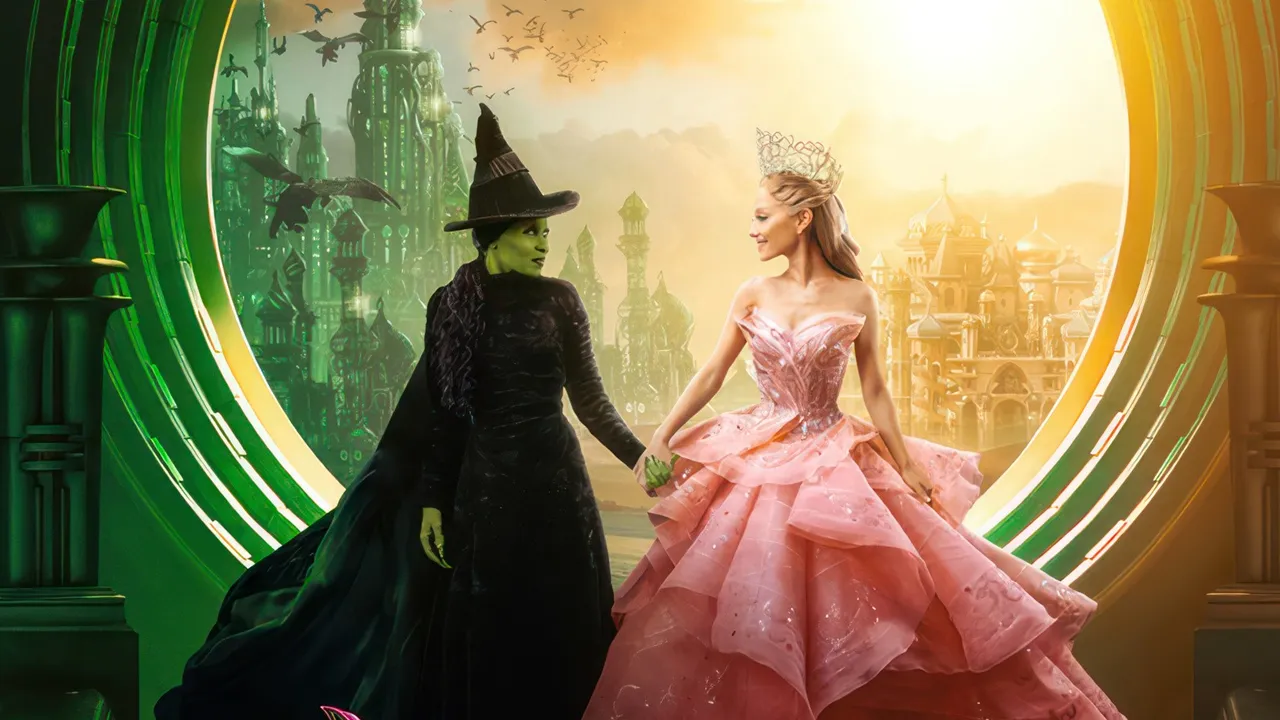
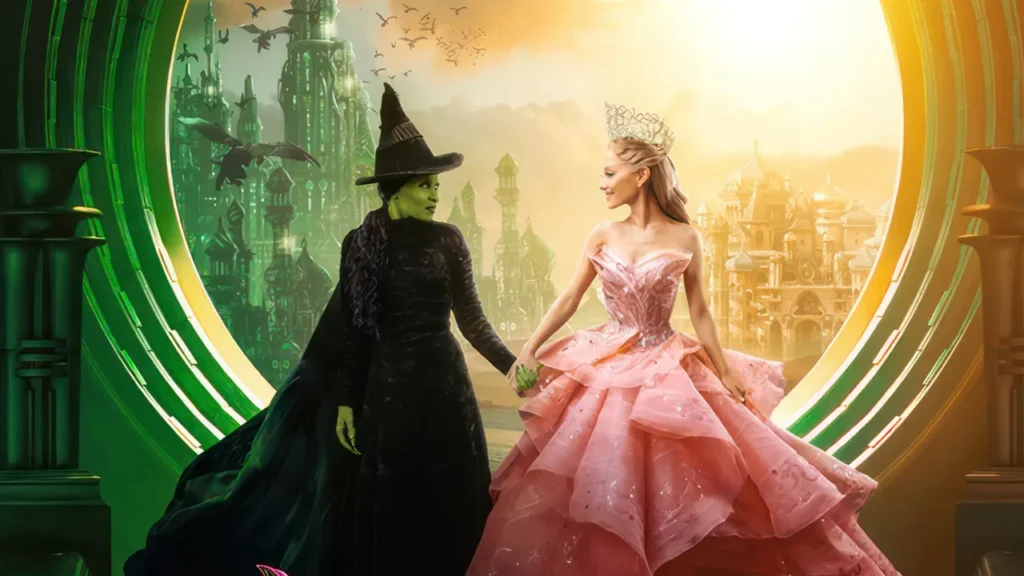
I feel confident that “Wicked,” this movie musical set in Oz is going to be POP-ular. It is, of course, adapted from the long-running, award-winning Broadway play, which was adapted from the book by Gregory Maguire, which was itself inspired by The Wizard of Oz by L. Frank Baum and the family classic MGM movie it inspired, starring Judy Garland, plus the funkified The Wiz, another musical play and movie. But this is not just some IP brand extension; it is as much an exploration of the nature of good and evil as it is a backstory about some of the world’s most iconic characters. It is also a lot–part one is nearly three hours long, with every minute a cornucopia of visuals, music, dancing, and ideas. Some will be overwhelmed, but many will find it dazzling and worth many repeat viewings.
Wicked Part 1
Copyright 2024 Universal

The movie begins with the report that the Wicked Witch of the West has melted due to “a bucket of water thrown by a child.” Glinda the Good Witch arrives via bubble in Munchkin Country to confirm the news. This parallels Judy Garland’s arrival in the MGM film, her tornado-tossed house landing on the Wicked Witch of the East, and then Glinda arrives by bubble to ask Dorothy if she is a good witch or a bad witch. We will glimpse a few other references to the classic film, including a cute animal peeking out of a basket on the back of a bicycle, a shot of the four classic characters, plus Toto, walking through the poppy fields, and the first stop in the Emerald City a makeover musical number in a fantasy beauty salon. We also see the origins of some familiar elements, including the witch’s broom and Glinda’s name. As in the Baum book, the magical slippers are silver, not ruby.

One of the Munchkins asks a questions humans have been pondering since pondering began: Are people born wicked or do they become wicked, and if so, why? That is the theme of this version of the story.

Ariana Grande, appearing under the name on her birth certificate, Ariana Grande-Butera, plays Galinda (yes, that’s her name), a pampered princess who arrives at Oz’s most prestigious institute of higher learning, Shiz University. Think Hogwarts, because though the students are adults, it feels more like a boarding school. It is set in a fabulous compound that feels like a dream project (in both senses of the word) for brilliant production designer Nathan Crowley that is part Victorian, part Edmund Dulac fairy tale, with curves and curlicues everywhere inspired by Art Nouveau, and a sprinkle here and there of steampunk.

Also arriving are two sisters, Elphaba (Cynthia Erivo), with bright green skin, and her sister, Nessarose (played by Marissa Bode, who, like her character, does not have green skin and uses a wheelchair. Galinda is so confident she expects everyone to adore her and is so careless about mistakes that she often uses malapropisms that sort of sound like real words but are not. Elphaba is tentative and shy, but has internal strength of character and a sense of responsibility. She was the result of her late mother’s affair. The only father she has ever known, her mother’s husband, barely acknowledges her, except to order her to take care of Nessarose.

Madame Morrible (Michelle Yeoh) immediately recognizes that Elphaba is gifted with extraordinary magical powers and takes her on for special tutoring. She also decides that the two young women should share a room. At first they dislike and mostly ignore one another, and Galinda pranks Elphaba by giving her an ugly hat to wear to a party. But when the other students laugh at Elphaba, who responds defiantly by dancing by herself, Galinda experiences her first spark of genuine empathy. Instead of claiming to be kind, she shows real kindness by joining Elphaba on the dance floor, and her unquestioned role as the arbiter of status soon has the rest of the crowd joining them in the dance.

Also at the party are Nessarose with Boq (Ethan Slater), who has a crush on Galinda but invited Nessarose because Galinda told him to, and the extremely handsome and charming Prince Fiyero (“Bridgerton’s” Jonathan Bailey). He was a late arrival at Shiz, after being kick out of other schools. At first he seems to be a perfect match for Galinda (she certainly thinks so). They are both gorgeous but superficial and incurious. Then, in the movie’s most significant scene, Fiyero is the only one who helps Elphaba rescue a caged lion cub, and she is the only one who realizes that his constant pursuit of pleasure is not making him happy.
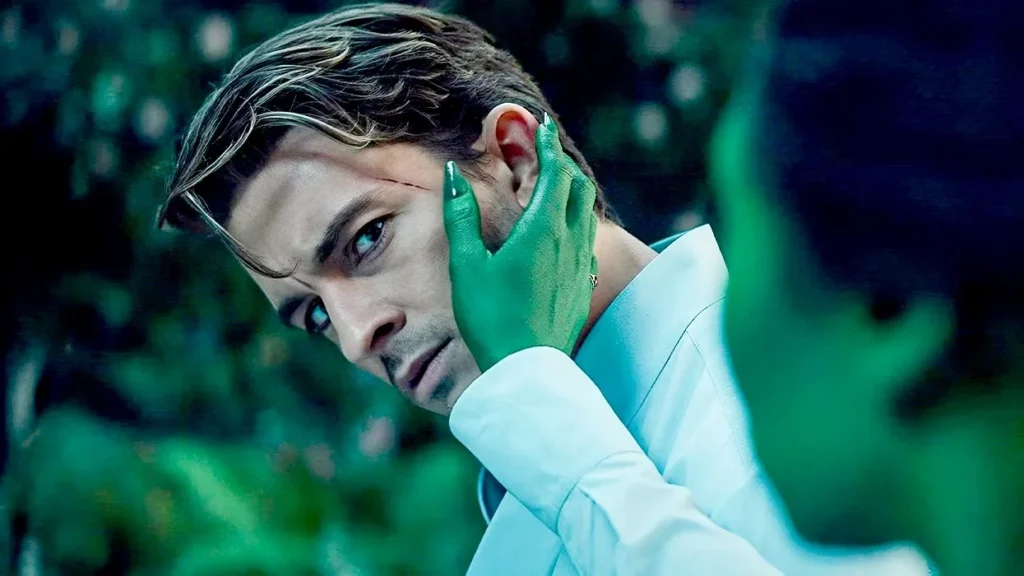
Jonathan Bailey as Flyero Copyright 2024 Universal

Director Jon M. Chu (“Crazy Rich Asians,”) brings a lot of energy to the movie. Though he does not have the luxury of his “Step Up” and “In the Heights” acting leads’ extensive dance training and skill, the musical numbers, especially the big dance numbers, are creatively and dynamically staged. I especially liked “One Short Day,” as Glinda (she’s changed her name by then) and Elphaba first arrive in the Emerald City. Keep an eye out for the original Broadway Glinda and Elphaba, Kristen Chenoweth and Idina Menzel, in a stage show about Oz history, or rather the Wizard’s preferred version of it.

Bailey has a sinuous charm that conveys Fiyero’s charisma but hints at his feeling lost and struggling with aimlessness beneath the surface. Goldblum’s quirky energy is just right as the Wizard who began as a carny from the midwest. Erivo is the heart of the film, always magnetic and compelling as Elphaba. The bright green makeup does not mask the extraordinary expressiveness of her face, always thoughtful, present, authentic, and grounded, despite the distracting details of the ultra-fantasy world around her. And like Grande, she has a once-to-a generation voice.

The splendor and imagination of the setting and costumes and even the huge musical numbers surround and mostly support real and meaningful questions about bad people doing good things, good people doing bad things, and everyone struggling to find a place somewhere on the continuum between being good and being wicked. Galinda (we learn how she became Glinda) is considered good because she is pretty and smiles a lot. But she is arrogant and selfish. Elphaba is considered if not bad at least weird because she does not smile or conform (note that neither wears the school uniform) but she is devoted to her sister. She is looking for the love she has never received but has no interest in changing anything about herself to try to get it. She knows that would not be real. Other characters surprise us by not being what we expect on the good/wicked scale.

This is a sumptuous and unsubtle treat grounded in Erivo’s graceful and subtle performance. When she defies gravity, she lifts us with her, and we lean forward to the next chapter.

Parents should know that like the MGM movie version, this story features fantasy action and peril with some scary and disturbing images, along with issues of bigotry and cruel treatment. A child is the result of an affair, causing grief and shame.

Family discussion: Why did Elphaba tell Flyero he was not happy? Why did the Wizard want to cage the animals? Are these characters good or wicked or both: Elphaba, Galinda, Madame Morrible? Are any of the characters like someone you know?

If you like this, try: the original Wizard of Oz book and its sequels (great for reading aloud) and the many other versions of the story
Related Tags:


Based on a book Based on a play Critics Choice Seal of Distinction DVD/Blu-Ray Pick of the Week Fantasy Movies -- format Movies -- Reviews Musical Talking animals
The Wild Robot

The Wild Robot

Posted on September 25, 2024 at 5:31 pm

B +
Lowest Recommended Age: Kindergarten - 3rd Grade
MPAA Rating: Rated PG for thematic elements, action, and peril
Profanity: Some schoolyard language
Alcohol/ Drugs: None
Violence/ Scariness: Sci-ff/cartoon style violence, shooting, off-screen deaths including death of a parent and a mentor
Diversity Issues: A theme of the movie
Date Released to Theaters: September 26, 2024
The Wild Robot
Copyright 2024 Dreamworks

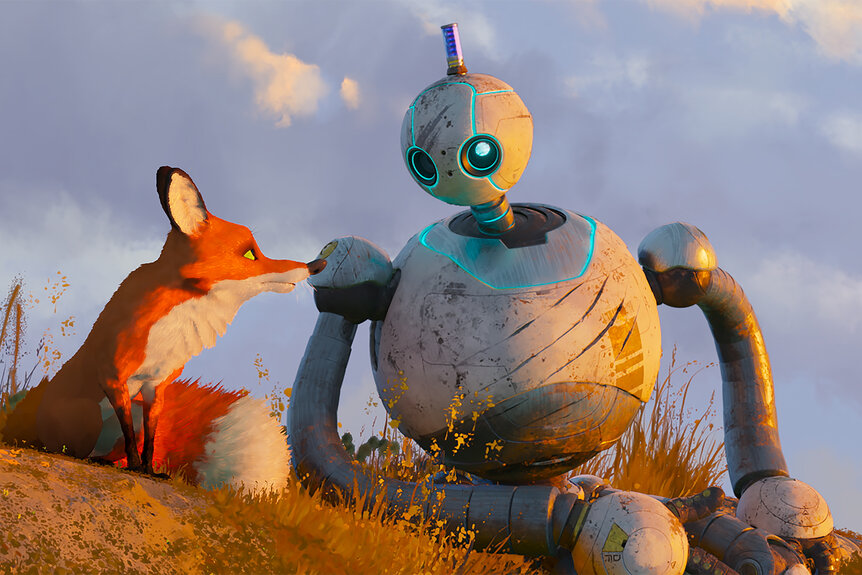
A plane delivering high-tech equipment flies into a storm and a crate falls out, landing on an island inhabited only by animals. Inside the crate is a super-intelligent, ultra-capable robot programmed to complete any task a human might require. The contrast between the natural world of the plants and animals and the metal and programming of the robot is the premise for this story, based on the book series by Peter Brown, told with humor and heart by specialist in “opposites attract” stories director Chris Sanders (“How to Train Your Dragon,” “Lilo & Stitch.”

On one side, fur, feathers, and scales. On the other side, metal and code. The robot, identified by the corporation that created it, is called ROZZUM unit 7134, is a kind of souped-up Swiss Army knife. One of the movie’s greatest pleasures is the way its infinitely adaptable parts and appendages are deployed. Nothing in the robot’s programming has prepared it for the island. But it is capable of learning and adjusting to its environment, so after failure to get a satisfying answer to questions like, “Are you my client?” and “Do you need assistance?” she (we will use that pronoun because the robot has the sweet voice of Oscar-winner Lupita Nyong’o, takes the local next step. She sits down and observes her new environment to learn how to communicate with her fellow inhabitants, which enables us to hear what they have to say, thanks to the brilliant voice work of Pedro Pascal as a fox named Fink, Bill Nighy as a goose named Longneck, Ving Rhames as a falcon named Thunderbolt, Mark Hamill as a bear named Thorn, and Catherine O’Hara, hilarious as always, as Pinktail, a mother opossum covered with her babies.

Roz (as she will ultimately be called) could hardly be more poorly fashioned for this environment. It is funny to see her expect the animals to feel rewarded when she follows her programing by giving them stickers, promotional material for the company that made her, followed by a burst of confetti, even more out of place in the lush natural world than she does. The animals at first consider her a monster.

The early scenes about their unfitness for each other leads organically to interest, understanding, respect, and ultimately a very heartwarming sense of family. A turning point is Roz’s rescue of an orphaned goose egg, left alone after an accident and stolen by Fink for a meal. Roz does not understand what it means to care for the egg, and then, when it hatches and the little gosling imprints on Roz as its mother, she has a task at last: to teach the bird to eat, swim, and fly, so that it can be ready to migrate before it gets too cold. “I do not have the programming to be a mother,” Roz says. “No one does,” Pinktail correctly observes.

Roz develops what can only be described as feelings for the little goose, named Brightbill (Kit Connor). She loses some components and breaks down a bit, from pristine and shiny to scuffed and mossy, with a prosthetic calf made from a log.Is she mirroring what she sees around her? Is she creating the programming necessary to give a child a sense of security and the knowledge he is special to someone? Or is there some way for a machine to develop a soul? Or is it just a reflection of all of the damage to her mechanics? Possibly all of the above. But it is a smaller reach than one might think from being programmed to be of service to placing meaning and purpose on that imperative.

A lot more happens, including some parent-child estrangement (adolescents!) and a lot for Brightbill to learn from his fellow geese, as well as Fink becoming less “fox-y” and all of the animals learning to help each other. The action scenes are dynamic and involving but it is the gentleness of the lessons the characters learn about kindness that will make this film an endearing family favorite.

Parents should know that there is some sci-fi-style shooting. A character is killed off-screen sacrificing himself to save others and a character’s family is discreetly killed in an accident. Another character appears to have been eaten but is not. Characters use some schoolyard language.

Family discussion: What was the most important thing Roz learned and how did she learn it? If you had a Roz, what would you ask her to do? Do you think we will have machines like that?

If you like this, try: the books, and “The Iron Giant” and “Wall-E

Related Tags:


Action/Adventure Animation Based on a book Fantasy movie review Movies -- format Movies -- Reviews Scene After the Credits Science-Fiction Talking animals
Kingdom of the Planet of the Apes

Kingdom of the Planet of the Apes

Posted on May 9, 2024 at 11:37 am

B-
Lowest Recommended Age: Middle School
MPAA Rating: Rated PG-13 for intense sequences of sci-fi violence/action
Profanity: Brief strong language
Alcohol/ Drugs: None
Violence/ Scariness: Extended and intense peril and violence, beating, sling-shots, taser-like spears, explosion, flood, marauders, characters injured and killed
Diversity Issues: A metaphorical theme of the movie
Date Released to Theaters: May 10, 2024
Copyright 20th Century 2024K

Know going in that this is the kind of movie where the humans are mute, cognitively impaired, and yet the main human character wears tailored pants and a woven shirt that look like they came from the mall. This should not be a surprise as it is also the kind of movie there the title is, at best, paradoxical, as a planet is bigger than a kingdom and in any even the kingdom in this story is only a small part of the planet. So shouldn’t it be “Kingdom ON the Planet of the Apes?” Of all the suspension of disbelief required for the film, the idea that complex machinery would operate as intended after hundreds of years — well, that idea procured intended laughs in Woody Allen’s “Sleeper” and unintended laughs in “Battlefield Earth.”

Know, too, that, for anyone who is trying to keep track of the “how does ‘Tokyo Drift’ fit into the chronology”-type questions about the original series of films, the television show, and the Tim Burton-and-after movies, this one takes place a long time after the death of legendary character Cesar, who sacrificed himself, and, possibly, before the Charlton Heston original. Maybe.

Noa (Owen Teague) is a young, male ape who lives in a gentle clan with his parents and two best friends. We first see them preparing for a coming-of-age ritual. Each of them must find an eagle’s egg (but always leaving one in the nest), and bring it back safely. The clan is centered around their trained eagles, and Noa’s stern father is their leader. Noa struggles to get his father’s approval. We see that they have some signs of what we think of as human civilization, in addition to the rituals. They have built some simple structures as homes, they ride horses, they obey the rules of the clan, and they have adornments and some tools and simple weapons, like slingshots. Also, as mentioned above, that most human of attributes, daddy issues.

A marauding group of apes arrive, with more powerful weapons, including spears with taser-like points. They destroy the compound, kill Noa’s father, and capture everyone else, except for Noa, who manages to escape, vowing to find his clan and get revenge. He meets up with Raca (the deep, kind voice of Peter Macon), a follower of the lessons of Cesar. And they meet up with a human woman they call Nova (Freya Allan) — cue the jokes about how humans are slow-witted and smell bad.

They try to drop Nova off with a group of humans (note: none wearing pants and a shirt), but the same marauding apes arrive to capture the humans like cowboys capture mustangs or, in “The Time Machine,” the Morlocks capture the Eloi. It turns out Nova has some secrets.

She and Noa are themselves captured by the apes, they find themselves in the kingdom of Proximus (Kevin Durand), a tyrant who, like the male humans of our time, is obsessed with Ancient Rome. They live on what was once a human stronghold, and Proximus is determined to break into the vault, to get access to whatever it was the humans were so intent on protecting.

I suspect we may hear some people claim that this film is intended as a metaphor to illuminate some of the most divisive topics of our era — colonialism, immigration, xenophobia, the way we tell our history. That gives this film too much credit, but the way both Raca and Proximus claim to be the true heirs of Cesar’s authority, with very different interpretations of his message, should resonate with viewers.

We are mostly there for the special effects and action scenes, though, and those are vivid and effective. The settings are stunning and the motion capture and CGI are next-level, giving the ape characters real weight and their expressions, well, expressive. As one of the most enduring series in history moves, potentially, toward the time of the very first film, the questions remain: whether humans and apes can find a way to co-exist, whether technology can advance without causing great harm and existential threats, and whether humans or apes can ever find a way to overcome fear and greed to work together for the common good.

Parents should know that this movie includes extended peril and violence. Characters are injured and killed and there are some graphic and disturbing images. Characters use brief strong language (a human teaches it to the apes, of course).

Family discussion: Why did the clans have such different cultures?

If you like this, try: the other movies in the series and the original films with Roddy McDowell, Kim Hunter, and Charlton Heston

Related Tags:


Action/Adventure IMAX movie review Movies -- format Movies -- Reviews Science-Fiction Series/Sequel Talking animals Thriller
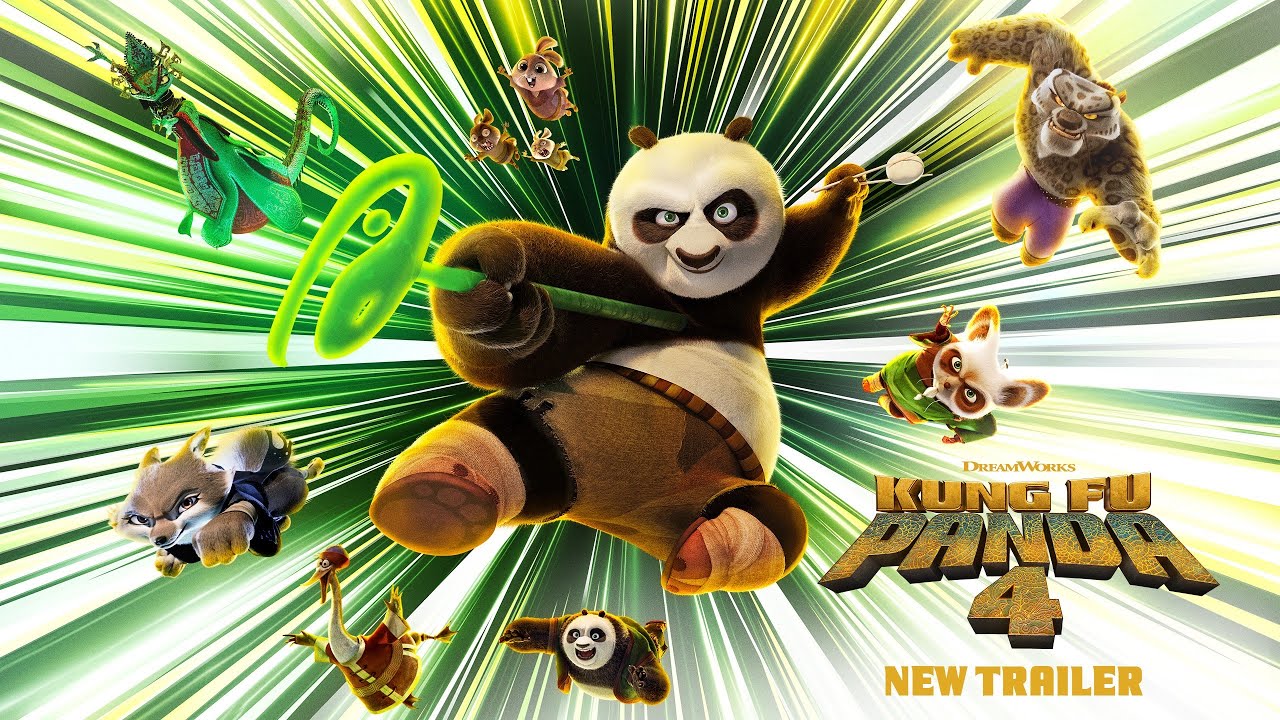
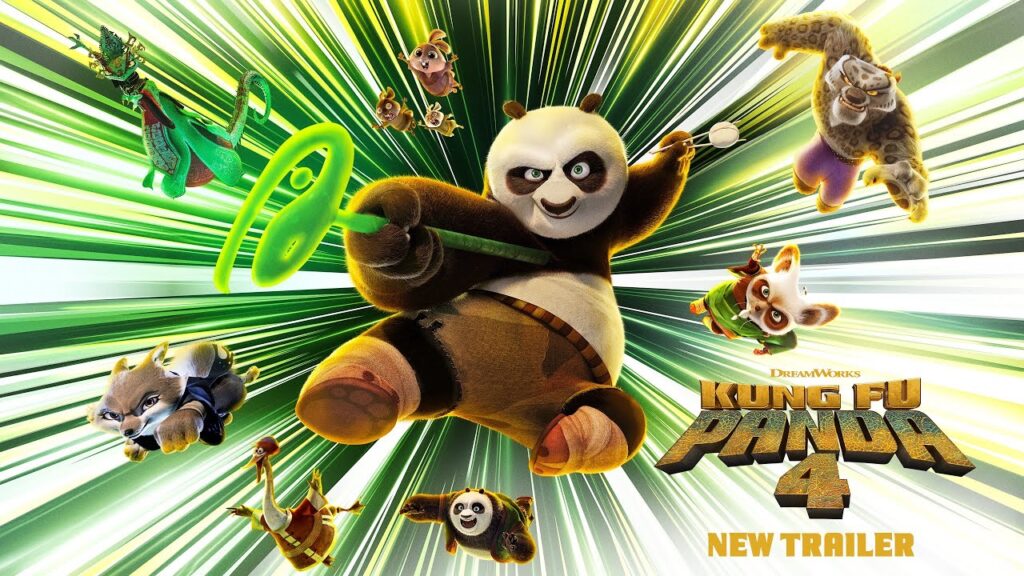
Kung Fu Panda 4

Kung Fu Panda 4

Posted on March 7, 2024 at 6:33 am

B +
Lowest Recommended Age: Kindergarten - 3rd Grade
MPAA Rating: Rated PG for martial arts action/mild violence, scary images and some mild rude humor
Profanity: Some schoolyard language
Alcohol/ Drugs: None
Violence/ Scariness: Extended action-style peril and martial arts fight scenes
Diversity Issues: None
Date Released to Theaters: March 8, 2024
Date Released to DVD: April 25, 2024

Skidoosh! Jack Black returns as Po in the fourth chapter of the saga about the big-hearted panda who has become a kung fu master with the title of Dragon Warrior, and earned the gratitude of his community and the respect of his colleagues, the Furious Five. If you don’t know who they are, don’t worry; they are briefly seen and not heard (very expensive voice talent) in this film.

Kung Fu Panda 4

But there’s plenty of top-level voice talent anyway, with Dustin Hoffman returning as the red panda Master Shifu, Viola Davis as The Chameleon, Black’s “Jumanji: Welcome to the Jungle” co-star Awkwafina as a fox named Zhen. Also returning are Po’s two dads, his adoptive father, the excitable Mr. Ping (James Hong) and the cuddly and fearful Li (Bryan Cranston), now close friends.

A brief prologue shows the return of the first villain Po defeated, Tai Lung (Ian McShane), apparently escaped from the spirit world determined “to take what is mine, which is everything that is yours.”

Po is happy as the movie begins. He is respected and beloved in his community and welcomes customers to Mr. Ping’s expanded restaurant. He signs autographs and poses for pictures (created with a paintbrush). He has accepted the staff of wisdom from Master Shifu without really thinking about what it means — that it is time for him to ascend to the next level, “passing on wisdom and inspiring hope,” and select a successor Dragon Warrior. Po is proud of achieving that title and reluctant to let it go. When he meditates on a new Dragon Warrior, his mind quickly moves from “inner peace” to “dinner, please.”

Tai Lung has not returned. That was an even more dangerous villain, The Chameleon, a shapeshifter with powerful magic. Po meets Zhen, a thief and a liar who grew up on the streets of Juniper City. She promises to bring him to The Chameleon. But can she be trusted?

This fourth chapter meets or exceeds the vibrance and heart of the first three films. The animation is superb, with outstandingly imagined settings, camera angles, styles, and action scenes. The gentle exploration of the conflicting feelings about growing up is sensitive and insightful. Awkwafina is, as always, funny and endearing in her portrayal of a character who is seeing what it means to be trustworthy and kind for the first time. The Chameleon, marvelously designed, with voice by Davis, is an excellent villain, imperious, steely, and ruthless. And there are a number of funny supporting characters, including Oscar winner Ke Huy Quan as the leader of the underground lair of thieves, and a trio of deceptively cute but secretly bloodthirsty little creatures. The balance between action and humor is just right, with a very funny bulls in a china shop moment and a precariously balanced tavern. And Po is, as always, an appealing hero, always on the side of helping others but still with more to learn.

Parents should know that this film includes extended action- and cartoon-style scenes of martial arts peril and violence, some schoolyard language (“screwed up,” etc.), and references to orphanhood and neglect. Some families may be sensitive to the portrayal of an adopted character who is equally devoted to his biological and adoptive father.

Family discussion:

If you like this, try: the other “Kung Fu Panda” movies and “Jumanji: Welcome to the Jungle” with Black and Awkwafina

Related Tags:


Action/Adventure Animation DVD/Blu-Ray Pick of the Week Fantasy movie review Movies -- format Series/Sequel Talking animals
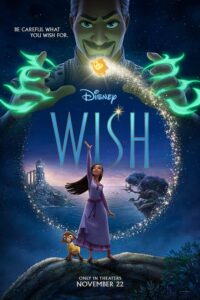
Wish

Wish

Posted on November 21, 2023 at 5:40 pm

A-
Lowest Recommended Age: Kindergarten - 3rd Grade
MPAA Rating: Rated PG for thematic elements and mild action
Profanity: NOne
Alcohol/ Drugs: None
Violence/ Scariness: Fantasy-style peril and some violence
Diversity Issues: Diverse characters
Date Released to Theaters: November 22, 2023

Copyright Disney 2023
The animators at Disney, now celebrating their 100th anniversary, have had a lot of time to think about wishing. From Disney’s first feature film, “Snow White,” which had a heroine warbling about the day her prince would come to their second feature film, with the greatest wishing song of all time, the one we still hear every time a Disney movie begins with a view of Cinderella’s castle and “When You Wish Upon a Star,” to all of the princesses singing their wishes — “A Dream is a Wish Your Heart Makes,” “A Part of His World,” “Once Upon a Dream,” Belle singing she wants more than “this provincial life,” Moana singing about “How Far I’ll Go,” no one’s movies do better at giving us characters with wishes we want to see come true. So there’s no better way to pay tribute to Disney history than “Wish,” a movie about wishes, with loving references to many of their most beloved classics.

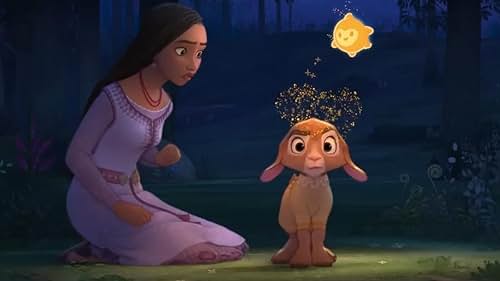
Oscar-winner Ariana Dubose provides the voice of Asha, a 17-year-old girl who lives on an island in the Mediterranean Sea with her mother, Sakina (Natasha Rothwell), and grandfather, Sabino (Victor Garber). Like Disney animation, Sabino is reaching his centenary. Like most Disney heroines, she has cute sidekick, a goat named Valentino (Alan Tudyk).

Their island is governed by King Magnifico (Chris Pine). The people of the kingdom believe that he will grant the wishes they share with him when they turn 18. But as Asha finds when she becomes his assistant, he hoards the wishes, which appear in floating translucent spheres. When people turn their wishes over to him, they lose their memory of what it was they aspired to, and they become docile and easily governed.

Asha makes her own wish the old-fashioned way, on a star, just like Geppetto in “Pinocchio.” To her surprise, the star responds by flying down from the sky to help her out, starting with giving Valentino the ability to speak. Asha originally only wanted to make the wishes of her mother and grandfather come true. But she realizes that she has to give all of the wishes back to the people who wished them. In addition to the star and the goat, she gets some help from her seven friends, who adorably match up with the seven dwarfs from Disney’s first feature. One Is sleepy, one is grumpy, one is bashful…you get the rest. The “Doc” character is Asha’s best friend Dahlia, the King’s chef, voiced by Jennifer Kumiyama. To honor the actress, who uses a wheelchair, Dahlia uses a cane, welcome representation for audience members who use adaptive equipment and their families, and welcome normalization for those who may not yet have those people in their lives.

The character design here is understated by contemporary animation standards, perhaps another nod to the classical era. The backgrounds and settings are pure Disney magic, though, delicately colored, stunningly beautiful, and bursting with imagination. Asha’s home and Magnifico’s castle are fairy tale delights. The musical numbers are lovely and the one with dancing chickens is a highlight.

And the story is well designed, exciting and heartwarming. It has a gentle but skillful exploration of the meaning of wishes, how they help us imagine what is most significant to us and think about how to get there, and about the importance of finding our own way to make our dreams come true and support the dreams of those around us. Asha is an endearing heroine, unsure about herself but always sure about what is right. When key characters switch loyalties at meaningful moments, as the king becomes more ruthless, it underscores the importance of values as well as aspirations — just as we would hope as Disney starts on its next century as the gold standard in family movies.

NOTE: Stay ALL the way to the end of the credits for a sweet extra snippet.

Parents should know that this film has a mean, selfish villain who attacks people with sometimes-scary green lightning. There is a reference, as in most Disney films, to a parent who died.

Family discussion: What is your wish? What did the king mean by “safe” and was he right? How many references to other Disney movies did you catch?

If you like this, try: the other animated Disney classics like “Snow White,” “Pinocchio,” “The Little Mermaid,” “Beauty and the Beast,” “Frozen,” “Mulan,” and “Encanto” and the live-action fairy tale, “Stardust”

Related Tags:


Fantasy movie review Movies -- format Movies -- Reviews Musical Talking animals
THE MOVIE MOM® is a registered trademark of Nell Minow. Use of the mark without express consent from Nell Minow constitutes trademark infringement and unfair competition in violation of federal and state laws. All material © Nell Minow 1995-2026, all rights reserved, and no use or republication is permitted without explicit permission. This site hosts Nell Minow’s Movie Mom® archive, with material that originally appeared on Yahoo! Movies, Beliefnet, and other sources. Much of her new material can be found at Rogerebert.com, Huffington Post, and WheretoWatch. Her books include The Movie Mom’s Guide to Family Movies and 101 Must-See Movie Moments, and she can be heard each week on radio stations across the country.

Website Designed by Max LaZebnik