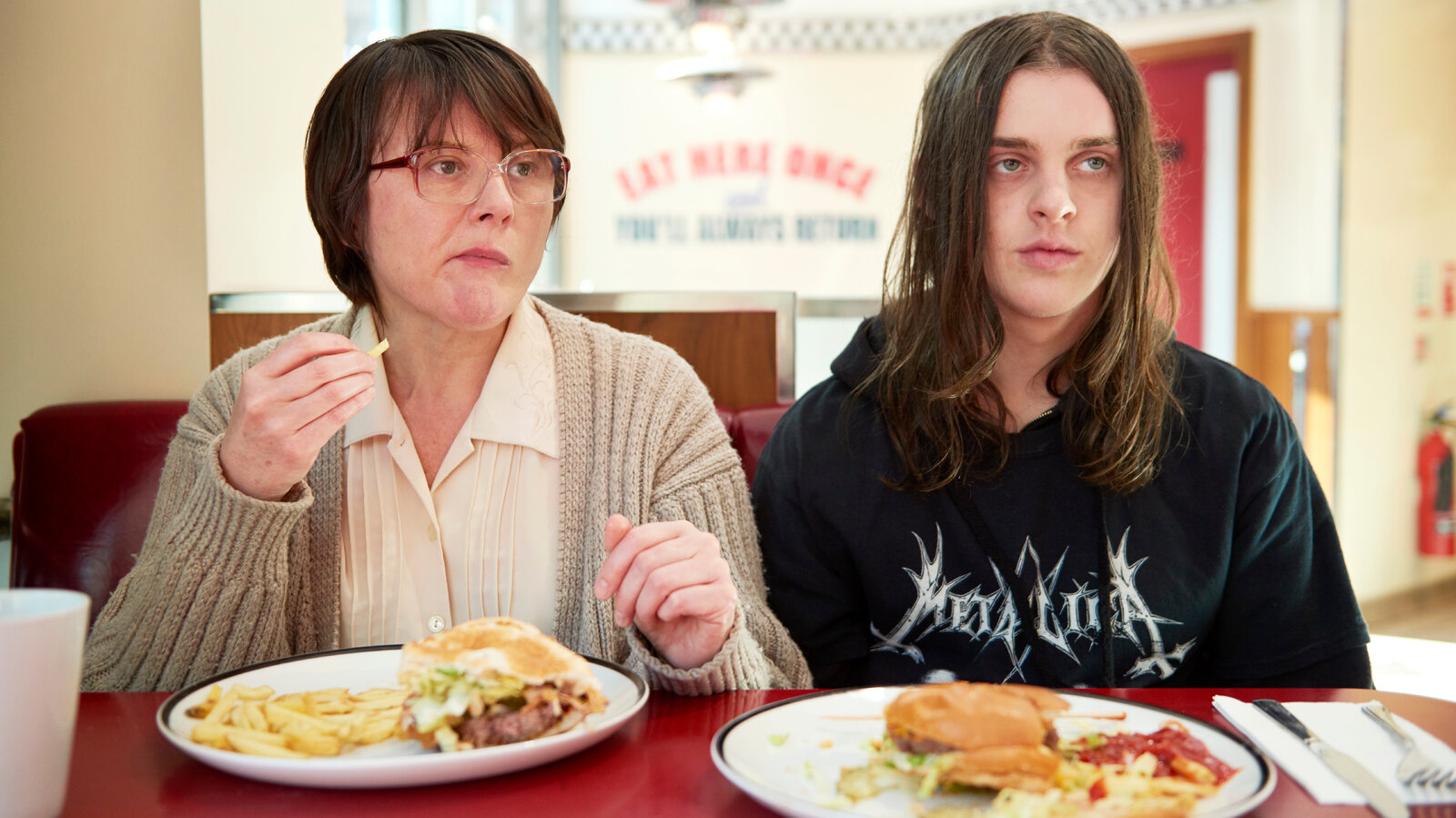
Our Friend

Our Friend

Posted on January 21, 2021 at 5:35 pm

B +
Lowest Recommended Age: High School
MPAA Rating: Rated R for language
Profanity: Very strong language
Alcohol/ Drugs: Social drinking, medication
Violence/ Scariness: Illness and very sad death
Diversity Issues: None
Date Released to Theaters: January 22, 2021
Date Released to DVD: March 29, 2021

Copyright 2021 Roadside Attractions
“Friend” is a category that is near-endless in scope. We use it to describe a work colleague we have lunch with sometimes, someone we’ve seen at parties whose middle name we don’t know, someone we met playing tennis who never heard the story of how our two-year-old locked herself in the bathroom with the cat. We use that word for the people we deliver casseroles to when things get tough, and those who deliver them to us, never crossing the doorway into the house. And yet we use the same word to encompass a person who gave up his job, his home, and his relationship to help people he cares about through as excruciatingly painful and physically, mentally, and emotionally exhausting experience as there is, the terminal illness of a young mother. That is the real-life story of Our Friend.

Dakota Johnson plays Nicole Teague, wife of journalist Matthew Teague (Casey Affleck), devoted and endlessly patient mother to Molly and Evangeline, and best friend of Dane (Jason Segel), a shy and sometimes awkward guy who has struggled with depression and with direction. But when Nicole’s diagnosis is dire, he leaves New Orleans to move in with the family, saying simply, “I just feel like I’m supposed to be here right now.”

He tells his girlfriend it will probably be just for a few weeks. But he stays as his vacation days get used up and he loses his job and as her patience gets used up and he loses her. He just stays, never asking how he can help, just quietly providing a sense of stability in the home.

“Our Friend” is based on Matthew Teague’s award-winning story in Esquire. In an interview, I asked Teague about Dane, who, as characters in the movie point out, is not successful in conventional terms but whose quiet and extraordinarily sensitive support defines the term “no greater love.” He said simply, “He is my hero. And it’s pretty great to have a best friend who is also your hero.”

Teague also spoke candidly about the two kinds of health care professionals families encounter in critical illness. The first are only about doing anything medically possible to prolong life. The second come in for hospice care, and will do anything they can to keep the patient comfortable and support the family.

We see both in this film, the second portrayed by the great Cherry Jones as the well-named Faith. Pointedly, as really happened, Dane arrives just as both Nicole and the family dog are diagnosed with cancer, and it is Dane who has to take the dog to the vet and be there for what we euphemistically call being put to sleep. Matthew exhaustedly says he wants to make sure the girls do not associate the two cancers.

We see the impact of the illness on Nicole. As the doctor warns at the beginning, the family will see her unlike anything in their past understanding of who she is. There will be confusion, anger, lashing out, and not just from Nicole. But the focus of the film, as the title indicates, is on the friend, who just shows up and says, “Would it help if I stayed with you for a while?”

The script by Brad Ingelsby (“The Way Back,” “Run All Night”) jumps back and forth in time, as though it is all from Matthew’s memory as he writes the story. It opens with Dane sitting on the porch with the girls as Matthew and Nicole rehearse what they will say to let their daughters know that their mother is dying. Though typed titles tell us where we are in time vis a vis the diagnosis, it is sometimes distracting. But director Gabriela Cowperthwaite, who showed great compassion for damaged characters in “Meagan Leavy,” imbues the film with enormous compassion for its characters and the lead actors, especially Segel, bring endless warmth and humanity to their roles, which always feel fully inhabited. We feel their loss. And we feel the sustaining connections that help them through.

Parents should know that this movie is the story of the illness and death of a young mother, and it is very sad. Characters use strong language and there are references to adultery.

Family discussion: What made Dane different from the other friends? Who has been a Dane in your life? Who would you be a Dane for?

If you like this, try: “50/50,” with Seth Rogen playing a character based on himself in the true story of a someone who helps a young friend with cancer, and “My Life” with Michael Keaton and Nicole Kidman

Related Tags:


Based on a true story Drama DVD/Blu-Ray Illness, Medicine, and Health Care movie review Movies -- format
The Marksman

The Marksman

Posted on January 13, 2021 at 8:00 am

B-
Lowest Recommended Age: High School
MPAA Rating: Rated PG-13 for brief strong language, violence, and some bloody images
Profanity: Some strong language
Alcohol/ Drugs: Alcohol, scene in bar
Violence/ Scariness: Extensive peril and violence, brutal murders, disturbing images
Diversity Issues: A theme of the movie
Date Released to Theaters: January 15, 2021
Date Released to DVD: May 17, 2021
Copyright 2021 Voltage Pictures

I can’t help saying that “The Marksman,” the 2021 entry in the annual Liam Neeson action film we usually get to start the year, is no bullseye. Neeson is always watchable and the Mark Patten cinematography makes the most of the southwestern landscape. The shoot-outs are well-staged. But the screenplay by
Chris Charles, Danny Kravitz, and director Robert Lorenz is underwritten and predictable.

This is less the “Taken” or “Cold Pursuit”-style action thriller where we get to enjoy Neeson showing off his special skills than it is a Clint Eastwood-style cranky old guy movie, perhaps because Lorenz is Eastwood’s longtime producer. There’s even a pause where the two main characters watch “Hang ’em High,” a 1968 Eastwood film that was the first from Eastwood’s own production company. In “The Marksman,” Neeson plays an Eastwood-like character who rails against his fate: “I’m trying to understand how you can work your whole life, serve your country, pay your taxes” and end up with nothing.”

Neeson plays Jim a Marine vet turned rancher on the Arizona border. He sometimes finds Mexicans who have been injured illegally crossed the border, and he always calls the immigration authorities, where his stepdaughter Sarah (Katheryn Winnick) is an official.

Wiped out by medical expenses, he is notified by a banker that his ranch is about to be auctioned in 90 days, but can be sold sooner if they get a good offer. The loan officer Jim knew — and who knew Jim — is no longer  at the bank. The fact that Jim’s late wife’s ashes are spread on the hill and that he is “no deadbeat,” does not mean he gets extra time. “You have yourself a good evening,” the banker says as he gets into his car.

Jim finds a Mexican mother and son who have sneaked through a hole in the border fence. He calls the authorities, but then cartel thugs led by Mauricio (Juan Pablo Raba) come after them and start shooting. Jim shoots back. “Sorry, Pancho, these illegals are mine.”

The boy’s uncle stole some money from the cartel. They killed him and now they want to send a message by killing his family. The boy’s mother is shot. As she is dying, she gives the boy a rosary and hands Jim a blood-soaked scrap of paper with an address in Chicago, where the boy’s relatives are. She asks Jim to promise to bring her son to them.

And so, Jim and Miguel (Jacob Perez) get on the road. Jim does not have a phone or GPS, so he needs a paper map, which an amused sales clerk lets him have at no charge. But the very high tech cartel thugs are able to trace him through his credit card. And so it is a cat-and-mouse road trip with the interactions, escapes, and confrontations you would expect. Which is the problem. This movie is so bereft of ideas that it telegraphs everything that is coming (I mean, the title makes sure we know what Neeson’s special skills are this time) and repeating too much of it.

I respect Neeson’s special skills. I just hope next time they include picking a better script.

Parents should know that this film is about a former Marine who tries to protect a young boy after his mother and uncle are murdered by members of a Mexican drug cartel. The film includes shoot-outs and fighting, with many injuries and deaths, including a parent and a dog, all witnessed by the boy. There is also some strong language and some drinking.

Family discussion: Why does Jim help Miguel? Why does he change his mind about helping Miguel? Why does he end things with Mauricio the way he does? Do you agree?

If you like this, try: “Let Him Go” with Kevin Costner and Diane Lane and “Taken” with Neeson

Related Tags:


Action/Adventure DVD/Blu-Ray movie review Movies -- format
Herself

Herself

Posted on January 7, 2021 at 5:33 pm

B +
Lowest Recommended Age: High School
Profanity: Some strong and crude language
Alcohol/ Drugs: Alcohol
Violence/ Scariness: Brutal domestic abuse, illness, adult and child injured
Diversity Issues: Diverse characters
Date Released to Theaters: January 8, 2021
Copyright Amazon 2020

Reflexive pronouns are used differently in the UK. In the US, we mostly use “himself” and “herself” to emphasize achievement: “He learned to ride his bicycle himself!” But in the UK those words are colloquially used as subjects, to refer to individuals. So, in “Herself,” a film co-written by and starring Irish actress Clare Dunne, a man who is helping her character with a big project hands her a tool to take the first step, saying, “We’ll let herself do the honors.” The title refers to both uses of the word, indicating agency and independence.

Dunne plays Sandra, who tells her daughters in the opening scene that the birthmark under her eye was God’s way of making sure he can always find her, because “there are a lot of Sandras in Dublin.” We can see immediately what a patient, loving mother she is, and then again as she dances with her daughters to Sia in their kitchen. But when her husband Gary (Ian Lloyd Anderson) comes home, the mood shifts subtly but unmistakably. In what is obviously a pattern, he sends the girls outside and begins to beat Sandra brutally. But this time is different. She has made a plan and whispered the code word to her older daughter. Soon they are in shelter space in a hotel.

Sandra sees a video of a man explaining how anyone can build a tiny house. Without any help from the social service agencies, she decides to do it — by herself.

But what that means is getting the help of other people, including a local builder named Aido (Conleth Hill), neighbors, and the disabled doctor she works for as a cleaning lady (the always-marvelous Harriet Walter, mistress of the dry delivery). Like all abusers, Gary had cut her off from other people. But learning to trust and to reach out is as healing as the house itself.

Little details add a lot of richness to the story, showing us instead of telling us. Sandra meets Aido when he rebukes a sales clerk for being rude to her. And we see Aido change his mind about saying no to her when his son Francis (Daniel Ryan), who has Down syndrome, quietly hands Sandra his old work boots to help her get started. Gary’s mother has a poignant confession. A sympathetic social worker (Cathy Belton) helps Sandra when Gary sues her for custody. And the scenes with the neighbors, many of them immigrants, who help build the house are charming and engaging. Dunne’s performance is deeply moving and the story is genuinely heartwarming.

Parents should know that this film includes domestic abuse. Adults and children are injured. There is some strong and crude language.

Family discussion: Why did Sandra tell the judge she was asking the wrong questions? What can we do to provide better support for people like Sandra?

If you like this, try: “Still Mine” and “Places in the Heart”

Related Tags:


Drama Family Issues movie review Movies -- format Movies -- Reviews
If Not Now, When?

If Not Now, When?

Posted on January 7, 2021 at 3:18 pm

B-
Lowest Recommended Age: High School
Profanity: Some strong language
Alcohol/ Drugs: Addiction
Violence/ Scariness: Fight scene, angry confrontations
Diversity Issues: None
Date Released to Theaters: January 8, 2021

Copyright 2020 Vertical Entertainment
Meagan Good and Tamara Bass co-produced, co-directed, and star in “If Not Now, When?” with a screenplay by Bass. It is the story of four friends who come together as one of them is facing a crisis, and then support each other as each of them faces difficult decisions about life, work, parenting, and romance. Sound soapy? It is, but not because those issues should be dismissed as, in the words of Stephen H. Scheuer’s 1958-1993 guide to movies, “for the ladies.” Plenty of films make clear that those are foundational life questions that everyone struggles with. But the script is the weak point in this film, with exposition-heavy dialogue that too often tells instead of shows.

As we might expect, the strong point of the movie is the performances. Bass and Good understand actors, starting with the casting, and they give them the space to bring more life and emotion to the script than it merits.

In a brief prologue, we see the four friends in high school, working up an elaborate dance routine for a promposal — which is quickly declined. But they’re not bothered. It is clear that they are just as happy going with each other. Tyra (played as a teenager by Li Eubanks), asks them to wait while she goes to the bathroom. It turns out she is in labor. She has not told anyone she is pregnant, not even her friends. They stay with her and promise their support.

Fifteen years later, Tyra (Good) is being discharged from a hospital following an accidental drug overdose. Her friends and her husband, Max (Kyle Schmid) stage an intervention, telling her she needs to go to rehab because she is dependent on opioids. She refuses until she sees her 14-year-old daughter Jillian (Lexi Underwood), who found her unconscious and had to call 911. She reluctantly agrees to go, though at first insists that she does not have a problem.

While she is in rehab, we spend time with the three friends. Suzanne (Mekia Cox) is married to a bitter, unfaithful, alcoholic former football player. She loves another man but won’t leave her husband because she is pregnant, and, more important, because she wants everyone to think her life is perfect. Patrice (Bass), a nurse, is drawn to a doctor at her hospital, but is afraid he will reject her when he learns more about her. Jillian thinks of Patrice as a second mother, and is living with her while Tyra is away.

And Diedre (Meagan Holder), a gifted dancer, is weighing two offers, a dream job choreographing a pop star’s tour and a chance to reconcile with her ex (McKinley Freeman as Jackson), the father of her son. Other than the football player, the men are all gorgeous and pretty much fully devoted to supporting the ladies they adore. With over four different stories and ten characters, including children, there is not enough time to give enough depth to most of them to make us invest in their stories. Much of the film has no score other than some on-the-nose needle drops. Oddly, the lyrics of one say “you are what you choose to be” but another says, “I’ll be different for you, baby.”

Trya’s story gets the most attention, and the most interesting relationship in the film is between Tyra and her counselor at rehab, an exquisite performance by Valarie Pettiford. But the movie really comes to life only when the women are talking to each other, renewing their connections and providing the support that only those ride-or-die friends for decades can give. Good and Bass clearly share that connection, but it is only intermittently that it comes across in the film.

Parents should know that this film includes drug addiction and alcoholism, infidelity, some violence, sexual references and situations, and some strong language.

Family discussion: Why was it so difficult for these women to admit their problems? What made Tyra change her mind about cooperating with treatment?

If you like this, try: “Waiting to Exhale” and “Now and Then”

Related Tags:


Drama movie review Movies -- format Movies -- Reviews Romance
Soul

Soul

Posted on December 22, 2020 at 4:18 pm

A-
Lowest Recommended Age: 4th - 6th Grade
MPAA Rating: Rated PG for some language and thematic elements
Profanity: Mild language
Alcohol/ Drugs: None
Violence/ Scariness: Issues of life and death
Diversity Issues: Diverse characters
Date Released to Theaters: December 25, 2020

Copyright Pixar 2020
Pixar likes to take big swings, not just artistically but thematically. In “Soul,” Pixar has its first adult male (human) and its first Black lead character in Joe Gardner, voiced by Jamie Foxx. It has a less stylized look, set in a sepia-toned New York City. And it is about the most fundamental existential questions of all: Why am I me? What makes life meaningful?

We are human because we ask those questions. And the answer to that second one is: In part to make movies like this one, to explore what makes life worthwhile.

Joe is a jazz musician. At least, that’s what he is in his heart, what he wants to be, what he thinks he was born to be. But what he is at the moment is a high school music teacher trying to make teenagers’ instruments sound less screechy and more on key. And then (this is still in the first minutes of the movie) he gets the chance of his dreams. A former student named Curly (Questlove) invites Joe to to audition for saxophonist Dorothea Williams (Angela Bassett). Joe takes a risk by adding his own ideas to Dorthea’s music, and she agrees to let him join her on stage that night. It’s everything he ever hoped for.

That’s why he is not paying careful attention as he walks home, and so he falls into a sewer and dies. We’re still in the first minutes of the film.

Instead of The Great Beyond, Joe ends up in The Great Before, where young souls prepare to be born. Joe thinks this could be his opportunity to return to earth and become the musician he knows was his reason for being alive. The counselors who guide the little souls think he is a mentor, and assign him to their hardest case, known as 22 (Tina Fey). Mentors like Lincoln, Mother Teresa, and Gandhi have all failed to persuade her. So we have one character who will do anything to get back to life on earth and one who refuses to go because she doesn’t see the point.

Copyright 2020 Pixar

The counselors look like Calder wire sculptures. They are all named Jerry. And they have a diverse range of voices, including Wes Studi, Fortune Feimster, and Richard Ayoade. Why do they look and sound like that? Because they are too complex for humans to comprehend, they have created these simple, accessible forms.

That’s what all story-tellers try to do, what stories are for, and what Pixar has done here: they take very complicated characters and themes and make them accessible to us. When they do it right, we cry. And then we continue to think about what they illuminate for us. If they do it right, we are enlarged by it, as the characters are. This is Pixar, so it will make you laugh, think, and cry, and then think some more. And because it is Pixar the art, from the character design to the real and imagined settings are believable and enthralling. The sublime jazz music is from Jon Batiste and the score is from top team Trent Reznor and Atticus Ross (also heard this year in “Mank” and “Watchmen”).

Co-writer/co-director Kemp Powers (screenwriter of one of December’s other best films, “One Night in Miami”) was one of many Black voices brought in to make sure the film is authentic to the lived experience of Black people for two reasons. First, they wanted Black audience members to recognize the characters and the experiences. Powers encouraged the addition of one of my favorite scenes in the film, the barbershop owned by Joe’s friend Dez (Donnell Rawlings). Co-writer/co-director Pete Docter is exploring what happens to us after we survive growing up, as in his now-classic “Inside Out.”

We learn from Joe’s interactions with Dez and Curly that he is so caught up in music and his fear of not realizing his dream of playing “Black improvisational music” that he does not really listen to others. (An encounter later on with another student helps him begin to realize that even people who are not a part of his “real” life have something to tell him.) And we learn before Joe does that just because we have a dream does not mean it is the only dream or the best dream.

There are so many ideas and insights and so much music in “Soul” that it rewards several viewings. In The Great Before, each soul waiting to be born visits the Hall of You, to pick up individual personal qualities, like being excitable or aloof. They can give the soul the what and the who, but the why is something they have to discover for themselves. There is a sort of no-man’s-land for people who operate outside the rules of The Great Before, including a pirate shipped manned (so to speak) by people like Moonwind (talk show host Graham Norton) who is still alive on earth but through meditation communes with the universe. There are many lovely touches in the details, like the pre-credits “When You Wish Upon a Star” played by Joe’s students.

Joe and 22 end up back on earth, chased by a celestial accountant named Terry (Rachel House) trying to bring them back to The Great Before. Can Joe get to the performance after all? Can 22 find some reason to live as a human? (You don’t have to be an existential philosopher to agree with her that pizza is pretty great.)

We’ve all seen a lot of movies with heroes who seek and find their one true purpose. Many are based on real life, about people who became successful and famous ins spite of doubters. There are always those who nag them to do something else and we are supposed to see them as short-sighted and selfish. “Soul” wants us to see more than that, and it shows us how to begin.

Parents should know that this movie concerns life and death and a character is killed in an accident early in the film and then goes to The Great Before. There is some mild language and some cartoon-style peril.

Family discussion: What would you see in the Hall of You? What would you tell 22? How has this year made you think about what is important?

If you like this, try: “Inside Out” and “Everybody Rides the Carousel”

Related Tags:


Animation Fantasy movie review Movies -- format Movies -- Reviews Spiritual films
THE MOVIE MOM® is a registered trademark of Nell Minow. Use of the mark without express consent from Nell Minow constitutes trademark infringement and unfair competition in violation of federal and state laws. All material © Nell Minow 1995-2026, all rights reserved, and no use or republication is permitted without explicit permission. This site hosts Nell Minow’s Movie Mom® archive, with material that originally appeared on Yahoo! Movies, Beliefnet, and other sources. Much of her new material can be found at Rogerebert.com, Huffington Post, and WheretoWatch. Her books include The Movie Mom’s Guide to Family Movies and 101 Must-See Movie Moments, and she can be heard each week on radio stations across the country.

Website Designed by Max LaZebnik