Black Beauty

Black Beauty

Posted on November 25, 2020 at 12:01 pm

B
Lowest Recommended Age: Middle School
MPAA Rating: NR
Profanity: None
Alcohol/ Drugs: None
Violence/ Scariness: Animal abuse, sad deaths of humans and animals, fire
Diversity Issues: Class issues
Date Released to Theaters: November 27, 2020

Copyright 2020 Disney
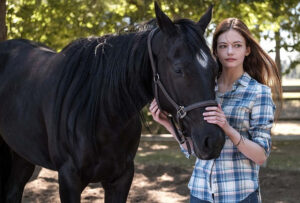
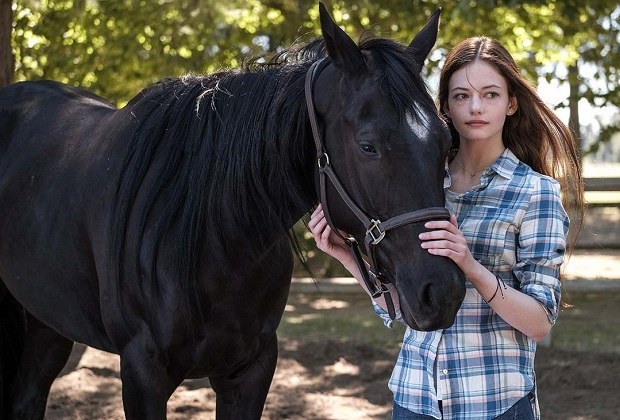
The latest “Black Beauty” is the sixth film adaptation of the classic Victorian novel by Anna Sewell, told by a horse who goes from owner to owner, some kind, some cruel. This latest version, streaming on Disney+, updates and relocates the story, set in contemporary United States (but filmed in South Africa). And this time, the two main characters are female.

Kate Winslet provides the narration, and we first meet the black horse with a white star on her forehead living wild in “an endless golden meadow,” taught by her mother that “a mustang’s spirit can never be broken.” She promises to tell us the secret to this inner strength by the end of the story. It will be tested, though, as she is caught by cowboys, who sell the horses they capture to riders if they can be tamed and to be killed if they cannot. The black horse is about to be relegated to that second category as untamable. But a kind-hearted trainer says that she is just frightened and angry. “Wouldn’t you be if a UFO came down and stole you from your family?”

He is John Manly (“Game of Thrones'” Iain Glen), something of a horse whisperer, and a scout and trainer for a rescue ranch in New York. He buys the horse, but even his patience and gentleness do not make much progress and the owner of the ranch says the horse will have to go. But then John learns that his sister and brother-in-law have been killed in a car accident and he is now guardian for their teenaged daughter Jo (Makenzie Foy of “Intersteller”). She, too, is frightened and angry. “Now I have two girls who want nothing to do with me,” he sighs.

Those two girls, Jo and the horse, are too sad to develop a relationship with anyone. But they immediately recognize the sadness in each other. Jo, who has had no experience with horses, is able to calm the horse she names Beauty. And Beauty calms her, too.

Jo tries to keep Beauty, but when that is impossible she promises to find her and get her back. Beauty is sold to one owner after another, some kind, some cruel.

The theme of the film is empathy, and as Beauty tells her story is is clear she knows the difference between those who do not intend to inflict damage and those who do not care. Her travels take her from a wealthy family with a snobbish mother whose daughter is incapable of understanding the Robert Smith quote John shares with Jo: “There is no secret so close as that between a rider and his horse,” to a mountain rescuer and a New York horse-drawn carriage driver. And the end will make you cry.

The biggest problem is that the screenplay tells us what it has already shown us and then tells us again. We get the message from the performances and from David Procter’s beautiful cinematography, which surrounds the story in golden light and makes us feel the danger of treacherous mountain rapids. The love story between Jo and Beauty is told with sincerity and affection. There is not much new here, but the message of courage, kindness, and loyalty is always worthwhile.

Parents should know that while the bad behavior and cruel treatment is mostly off-camera, described rather than shown, both humans and horses are injured and there are sad deaths.

Family discussion: Why did Jo and Beauty understand each other so well? Why does Jo want to use the word “partner” instead of “break?”

If you like this, try: “The Black Stallion,” “National Velvet,” and “Emma’s Chance” as well as “A Dog’s Journey” and “A Dog’s Way Home”


Related Tags:


Based on a book movie review Movies -- format Movies -- Reviews Remake Talking animals
The Croods: A New Age

The Croods: A New Age

Posted on November 23, 2020 at 2:06 pm

B +
Lowest Recommended Age: Kindergarten - 3rd Grade
MPAA Rating: Rated PG for peril, action, and rude humor
Profanity: None
Alcohol/ Drugs: None
Violence/ Scariness: Cartoon-style peril, minor injuries
Diversity Issues: A theme of the movie
Date Released to Theaters: November 25, 2020
Date Released to DVD: December 29, 2020
Copyright Dreamworks 2020

The Croods: A New Age is the sequel to the animated film about the prehistoric family is sharply funny, exciting, warm-hearted, and a great watch for the whole family.

We left the Croods at the end of the first film with Grug (Nicolas Cage) finally welcoming in a new family member, Guy (Ryan Reynolds). The family, which sleeps in a pile every night and can form a kill circle in an instant is, Grug thinks, situated as well as possible to find food and to avoid becoming food. But then the climate changes and they have to find another place to live. On the other side of a wall, they discover a kind of paradise, with plenty of food conveniently growing in rows. It is the home of the Betterman family (“emphasis on the Better“), Hope (Leslie Mann), Phil (Peter Dinklage), and their daughter Dawn (Kelly Marie Tran).

The Bettermans, who have discovered tools and simple machines, have an elaborate tree-house, cultivated crops, and the wall, which keeps them safe. They have the concept of “privacy,” sleeping in separate rooms. They also have the concept of “rooms.” Also “windows,” and an amusing running joke is the way Grug’s son Thunk (Clark Duke) is mesmerized by the “screen” that’s just a hole in the wall.

The Bettermans are aghast at the lack of refinement of the primitive Croods and gently try to urge them to move on. Except for Guy, who they knew when he was a child. Guy is happy to be reunited with them, especially his childhood friend Dawn. He starts dressing like Phil Betterman.

We might expect Grug’s daughter Eep (Emma Stone) to be jealous of Dawn. But this movie wisely makes Eep and Dawn instant best friends in a funny and sweet scene where they discover what it means to know another girl. It also wisely does not make the Bettermans or the Croods all right or all wrong. Balancing the wish to protect your children from any possible harm with the importance of their learning to be independent and developing a sense of curiosity and adventure.

Basically, there are just two jokes here, but they are funny every time. It is funny when we see that the Croods are just like us (parents want to take care of children and children want to try new things, teenagers have a lot to say to each other but do not always have the words, girlfriends’ voices sometimes get a little screechy when they’re excited), and it is funny to see them discover for the first time in human history what we take for granted (privacy, screens). But what makes this movie worth a rewatch is the constant invention of its visuals, the exceptional detail in the characters, animals, and landscapes, its superb voice talent, and its touching depiction of the foundational ties of family and community.

Parents should know that this film includes some peril and mild injuries and some potty humor.

Family discussion: Is your family more like the Croods or The Bettermans? What would you pick for your tribal name? What is your family’s motto? Ask family members for the stories behind their scars.

If you like this, try: “The Croods,” and the “Ice Age” movies and my interview with this film’s director, Joel Crawford.

Related Tags:


Animation DVD/Blu-Ray Family Issues movie review Movies -- Reviews Series/Sequel
Sound of Metal

Sound of Metal

Posted on November 19, 2020 at 5:31 pm

A-
Lowest Recommended Age: Mature High Schooler
Profanity: Very strong language
Alcohol/ Drugs: Drug addiction
Violence/ Scariness: Some graphic images of an operation
Diversity Issues: A theme of the movie
Date Released to Theaters: November 20, 2020

Copyright Amazon 2020
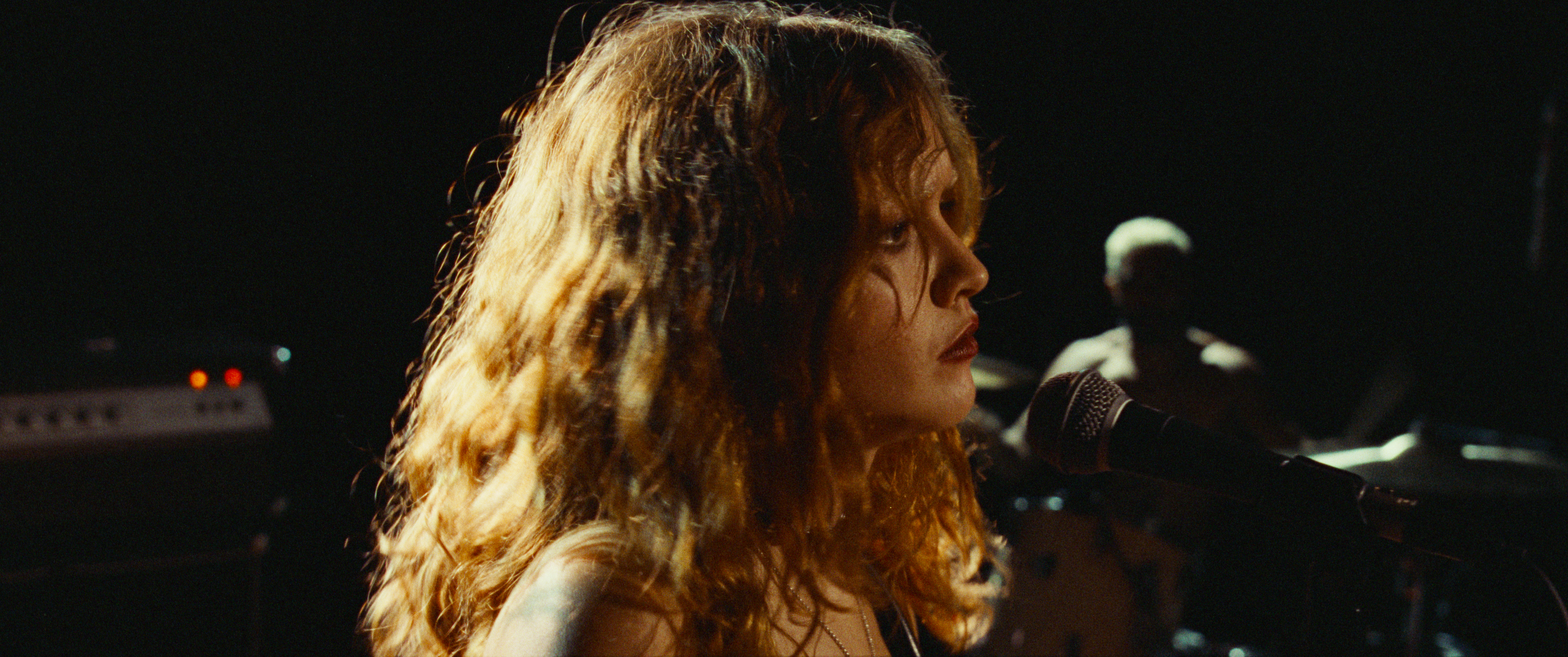
We’re going to have to come up with a better term than POV to describe “Sound of Metal,” the story of a drummer who loses his hearing. POV describes a subjective portrayal, where we see just what the character sees instead of what an outsider can see. But “see” is the operative word. Much of “Sound of Metal” is subjective, so that we hear only what Ruben (brilliantly played by Riz Ahmed) is hearing. Many of the sounds are muted or distorted. Some of the movie is in silence. Sometimes we get a brief chance to hear what he cannot. There are subtitles in some moments but not in others so we can experience Ruben’s sense of confusion and isolation.

This is a remarkably assured debut from co-writer/director Darius Marder and his co-writer/composer/brother Abraham Marder. In an interview with me and a small group of other journalists, Darius Marder said making music the center of Ruben’s life was appealing because music connects people and because hearing loss is both a personal and professionally devastating for a musician. But he also said that music serves as a metaphor for relationships. We all have our own place within a relationship,” Darius said. “I play the drums and you play guitar and together we make this music. But what are we if we start pulling those sounds apart? If you leave, what is left? Abraham and I were both inspired by the concept of using this two-person band as a metaphor for a relationship. Even though it is steeped in a very specific music world, the intention was for it to be universal in
feeling.”

The Marders trust the audience to lean in to the film, to not need to have every detail explained in advance. So we gradually learn that Ruben is a former heroin addict, who has been clean for four years with the support of his girlfriend and bandmate Lou (Olivia Cooke) and his utter devotion to music. We can see from the performance that leads off the film that Ruben gives everything he has to the raw emotion of the punk/metal music he and Lou play.

And then, suddenly, he hears a pop and then sounds are muffled and distorted. A doctor tells him it may be a result of the heroin use and that it isn’t coming back.

It’s just like the Elizabeth Kubler-Ross stages for impending death. The first stage is denial. Ruben plays another gig. He is sure he can fix this. But he can’t. Lou takes him to a rehab program for addicts with hearing loss led by Joe (played by Paul Raci, the son of Deaf parents). The program is attached to a school for Deaf children and at first Ruben is put in class with them to learn to sign.

The Marders show us in an understated way that Ruben’s addictive personality has just transferred from drugs to music and Lou. Away from both, he is lost. He learns to sign and begins to be a part of the new community but he is determined to get back what he lost, at any cost.

Ahmed, Cooke, and Raci all give understated, natural performances that draw us into the story even more than the immersive sound design. Much of Ahmed’s performance is in his deep, expressive eyes, making Ruben one of the most memorable characters on screen this year.

Parents should know that this movie includes very strong language and discussion of substance abuse. There are some graphic images in a scene of an operation.

Family discussion: What will Ruben do next? Did he make the right decision about the operation? Why does Joe insist that Deaf people do not need to be “fixed?”

If you like this, try: “One Trick Pony”

Related Tags:


Disabilities and Different Abilities Drama movie review Movies -- format Movies -- Reviews
Hillbilly Elegy

Hillbilly Elegy

Posted on November 11, 2020 at 10:00 am

D
Lowest Recommended Age: Mature High Schooler
MPAA Rating: Rated R for some violence, language throughout, and drug content
Profanity: Constant very strong language
Alcohol/ Drugs: Alcohol and drug abuse, smoking
Violence/ Scariness: Domestic violence and family dysfunction
Diversity Issues: A theme of the movie is economic diversity
Date Released to Theaters: November 13, 2020

Copyright 2020 Netflix
“Hillbilly Elegy” had just one job: to give us a sympathetic and relatable portrait of people we might dismiss as “rednecks” and, well, hillbillies, without being superficial or condescending. It fails, with a portrait of one dysfunctional Ohio family with roots in the Kentucky hill country that never knows what story it is trying to tell. It is closer to an episode of Jerry Springer than it is to an insightful portrait of the obstacles to opportunity that prevent people, with rare exceptions like Vance, to keep from repeating the same mistakes. (For genuine and meticulously researched understanding, try White Trash by Nancy Isenberg.)

The film is based on the best-selling memoir/anthropological study by J.D. Vance. The timing contributed to its success because it was thought to explain to book-buying, educated, urban voters the perspective of those who supported the election of a failed businessman turned reality TV star in 2016, including policies that seemed to be contrary to their own interests. As we see in this movie, that is consistent with personal choices that are devastating to their own interests, and the interests of the next generations.

The movie arrives at a different time. The resentful rural voters are no longer as exotic or unknown, and they have less political power. Nevertheless, as Democratic voters are still being urged to have empathy for the other side, to the extent there is curiosity about these communities, this is not a movie that is going to provide any enlightenment. It is most telling that it spends much too much time on the blandest and least interesting of the characters, the one based on the author of the book. And so it becomes about his struggle to accept and forgive his family and their history instead of being about them, their lives, their challenges, their choices.

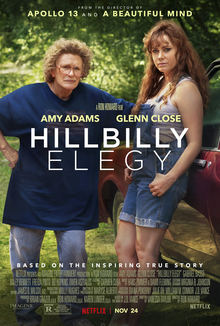
We go back and forth in time with Vance, from the idyllic summers with his Kentucky “hillbilly” relatives to his life with an intelligent but overwhelmed single mother (Amy Adams as Beverly), who makes one catastrophically bad choice after another, and with his tough grandmother Mamaw (Glenn Close), who left home, pregnant, at age 13 and scrabbled a life for herself and her family.

J.D. (Owen Asztalos as a young teenager) tells us the summers in Kentucky were his happiest times, but as we see him with his cousins, we may wonder why. He finds a turtle with a wounded shell and wants to heal it, while his cousins tell him to tear off the shell or throw the turtle. J.D. explains that the turtle’s ribcage is connected to the carapace, which leads them to beat him up, which leads to everyone piling on. It might be worth exploring why there is so much suspicion of knowledge and institutions, why members of this family are unable to consider that the institutions that provide opportunities for economic stability and advancement, as imperfect as they are, may be a more reliable path. That they do not think it within the range of possibilities is rooted in innumerable factors and failures well worth exploring or even portraying, but this movie never tries. All it has to say is that these people think family comes first when it comes to faking drug test results or lying to the police but not so much when it comes to providing guidance, support, consistency, or a good example.

The shifts in time are more distracting than revealing. J.D. (now played by an expressionless Gabriel Basso) is a student at Yale Law School, after serving in the Marines and attending Ohio State. He is interviewing for summer jobs at tony law firms, essential to get the money he needs to pay the tuition for his final year of school. But he feels at a disadvantage compared to his Ivy League classmates, who have social ease. He has to make an emergency call to his girlfriend (Frieda Pinto in the thankless role of beautiful, endlessly patient and understanding support system) to ask which fork to use. This is not only an unforgivable cliche; it gives us no reason to feel sympathetic. A Marine Yale Law student is more than able to look that up before a fancy dinner or just watch what the host does.

J.D. gets an emergency call. His mother is in the hospital. She overdosed. On heroin.

He drives all night to get to Ohio. And we see incidents from the past as Bev struggles with drug abuse (once asking J.D. to pee into a cup to use for her drug test, another time impulsively marrying her supervisor and moving J.D. into his house, getting fired from her nursing job for taking a patient’s medication. If we learn anything it is that having an adult who is committed to keeping a child on the straight and narrow makes a difference. But why there was only one in this child’s life, why his sister seemed to do okay without going to live with Mamaw, and why Mamaw was able to learn from mistakes is all glossed over.

Even Amy Adams and Glenn Close are unable to make this work. They yell at each other with colorful countrified expletives (Close actually has to say at one point, “Kiss my ruby red asshole!”) sounding more like the caricatures on “Mama’s Family” than human beings with vulnerabilities and intimate connections. As we see home movies of the real characters over the credits, our only conclusion is that the filmmakers spent more time getting the outside right than the inside. The members of this community deserve better from the haves in our society, but they deserve better from this movie, too.

Parents should know that this movie includes extensive family dysfunction, substance abuse, and domestic abuse as well as constant strong language. Family members and teenagers use drugs. Domestic violence includes punching, dangerous driving, negligence, and setting a husband on fire.

Family discussion: Why was J.D. able to make a different life for himself? Should he have stayed with his mother when Mamaw wanted to take him? When he left for the interview?

If you like this, try: “White Oleander” and White Trash

Related Tags:


Based on a book Based on a true story Family Issues movie review Movies -- format Movies -- Reviews
The Craft: Legacy

The Craft: Legacy

Posted on October 28, 2020 at 5:54 pm

B +
Lowest Recommended Age: High School
MPAA Rating: Rated PG-13 for thematic elements, brief drug material, language, and crude and sexual content
Profanity: Strong language
Alcohol/ Drugs: Brief drug material
Violence/ Scariness: Extended fantasy peril and violence, references to suicide, abuse, and murder, disturbing images
Diversity Issues: Diverse characters
Date Released to Theaters: October 30, 2020

Copyright Blumhouse 2020
I’m a big fan of the 1996 original “The Craft” with Neve Campbell as one of four teenage witches who get up to mischief and then get into trouble, and then turn on each other. With “The Craft: Legacy,” writer/director Zoe Lister-Jones (“Band Aid”) has given us a smart and witty update that pays tribute to the original but is very much its own take on the subject, with a couple of delicious twists along the way.

Lily (Cailee Spaeny) and her mother Helen (Michelle Monaghan) are driving with a sense of fun and adventure, singing along to Alanis Morrisette’s “One Hand in My Pocket.” But they are not entirely carefree. We can see right away that they are very close but more pals than mother and daughter. When they tear up over some melancholy thought, is is the mother who turns to the daughter for reassurance and a touch-up of her make-up. They are starting something new, a new house, a new town, a new school, and a new family. Helen has a new love, Adam (David Duchovney), and they are moving in with him and his three sons. He welcomes them warmly. Lily is doing her best to be supportive, but she is startled by a striped snake, or perhaps it is just her imagination.

As she gets ready for school, Lily’s mother asks if she is looking forward to making new friends, and Lily answers, “That would imply I had old friends.” Her mother assures her, as she clearly has many times, that “your difference is your power.”

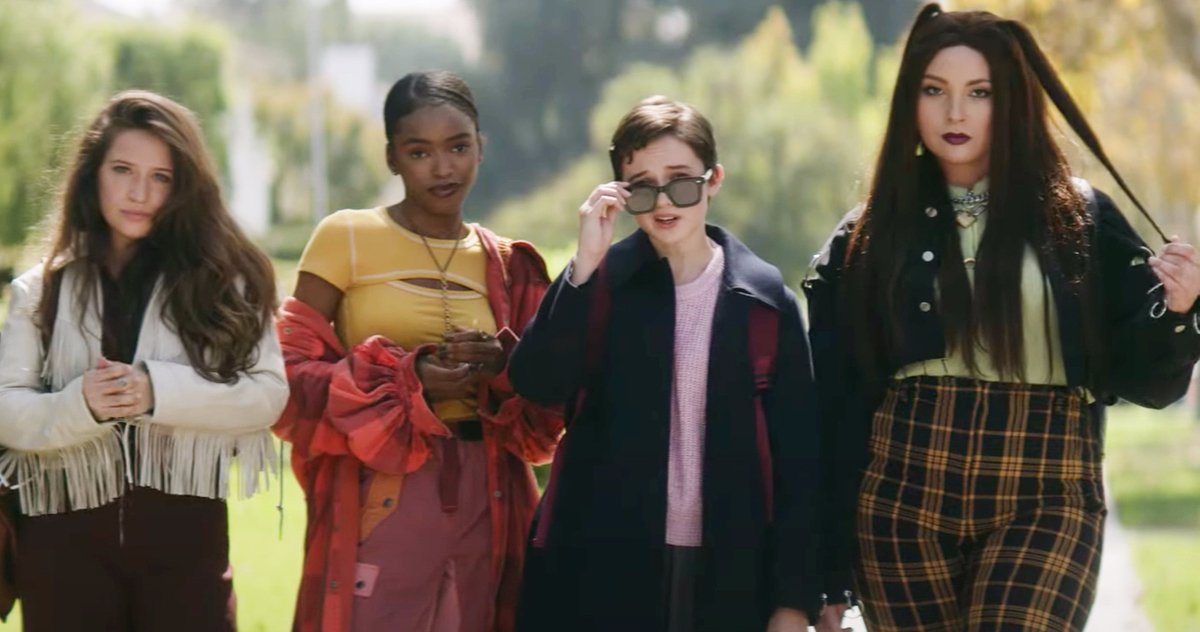
Things do not get off to a good start at school. Lily’s period bleeds through her jeans in class and boys jeer and hoot at her. When she is crying in the restroom, three girls enter to provide some sympathy and support and a change of pants. They are Frankie (Gideon Adlon), Tabby (Lovie Simone), and Lourdes (Zoey Luna), three girls who have been experimenting with witchcraft. They need a fourth to call the corners, so they will represent all of the elements and directions, and they sense Lily may be the one they’ve been waiting for, especially after a boy named Timmy (Nicholas Galitzine) who taunts her with a vulgar whisper in her ear somehow gets slammed into the lockers.

Unlike the 20-something actresses in the original, these girls look like they are in high school and Lister-Jones skillfully and believably mixes their witchcraft with the other concerns of adolescence. They talk about telepathy, shape-shifting, and telekinesis and about boys and parties. When they get dressed up, they don’t need or resort to magic to look their best. But they aren’t above casting a spell on the boy who harassed Lily. In the original film, the girls used magic to make the boy who treated them badly fall in love, and to deceive him. In this one, they use their magic to make him…well, after the spell he talks about reading an interview with Janet Mock, loving singer/activist Princess Nokia, and identifying himself as cisgender male. He is nicknamed “woke Timmy.” His vulnerability makes him attractive to Lily and her acceptance attracts him as well.

But things go wrong and the girls blame Lily, believing she abandoned their rules by acting carelessly and selfishly. They abandon her and bind her powers just as she needs both the most.

It is not as intense or dramatic at the original and spends less time on the girls and their lives and motivations. But it has a strong grounding in the essential power of friendship and loyalty, some revelations that add suspense, a sly take on toxic masculinity, and strong performances by Spaney and Monaghan. It deftly borrows from haunted house films and from scary neighbor films as well. Most important, it gives the girls agency and a sense of responsibility and a much appreciated sweetness.

NOTE: My daughter worked briefly in the costume department on this film. Needless to say, the costumes are outstanding. I don’t always give her films good ratings, so it was an added pleasure to enjoy this one as much as I did.

Parents should know that this film includes bodily functions and sexual references, brief drug content, and extended fantasy peril and violence. There are references to abuse, suicide, and murder.

Family discussion: What rules should a group like this adopt and how should they be enforced? Should Helen have told Lily the truth? Why is Lily’s birth name Lilith?

If you like this, try: “The Craft”

Related Tags:


Fantasy movie review Movies -- format Movies -- Reviews Series/Sequel Stories about Teens Thriller
THE MOVIE MOM® is a registered trademark of Nell Minow. Use of the mark without express consent from Nell Minow constitutes trademark infringement and unfair competition in violation of federal and state laws. All material © Nell Minow 1995-2026, all rights reserved, and no use or republication is permitted without explicit permission. This site hosts Nell Minow’s Movie Mom® archive, with material that originally appeared on Yahoo! Movies, Beliefnet, and other sources. Much of her new material can be found at Rogerebert.com, Huffington Post, and WheretoWatch. Her books include The Movie Mom’s Guide to Family Movies and 101 Must-See Movie Moments, and she can be heard each week on radio stations across the country.

Website Designed by Max LaZebnik