Soul

Soul

Posted on December 22, 2020 at 4:18 pm

A-
Lowest Recommended Age: 4th - 6th Grade
MPAA Rating: Rated PG for some language and thematic elements
Profanity: Mild language
Alcohol/ Drugs: None
Violence/ Scariness: Issues of life and death
Diversity Issues: Diverse characters
Date Released to Theaters: December 25, 2020

Copyright Pixar 2020
Pixar likes to take big swings, not just artistically but thematically. In “Soul,” Pixar has its first adult male (human) and its first Black lead character in Joe Gardner, voiced by Jamie Foxx. It has a less stylized look, set in a sepia-toned New York City. And it is about the most fundamental existential questions of all: Why am I me? What makes life meaningful?

We are human because we ask those questions. And the answer to that second one is: In part to make movies like this one, to explore what makes life worthwhile.

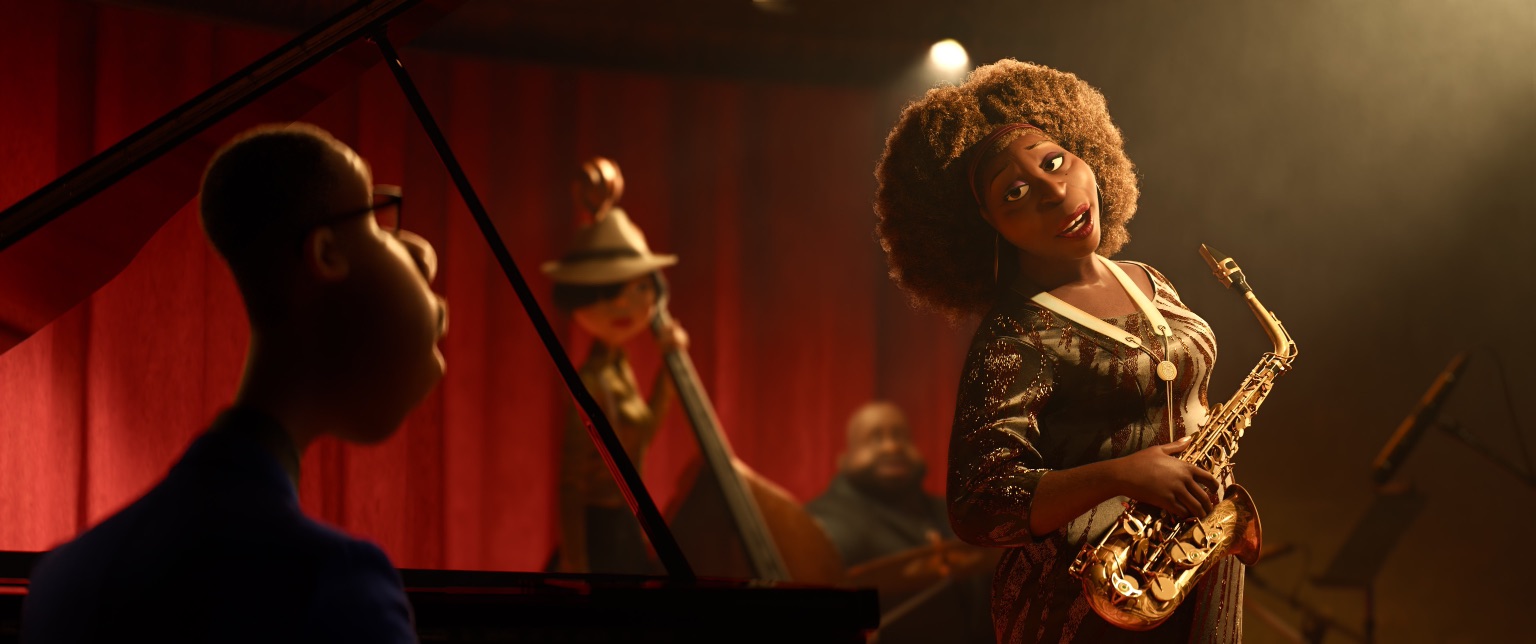
Joe is a jazz musician. At least, that’s what he is in his heart, what he wants to be, what he thinks he was born to be. But what he is at the moment is a high school music teacher trying to make teenagers’ instruments sound less screechy and more on key. And then (this is still in the first minutes of the movie) he gets the chance of his dreams. A former student named Curly (Questlove) invites Joe to to audition for saxophonist Dorothea Williams (Angela Bassett). Joe takes a risk by adding his own ideas to Dorthea’s music, and she agrees to let him join her on stage that night. It’s everything he ever hoped for.

That’s why he is not paying careful attention as he walks home, and so he falls into a sewer and dies. We’re still in the first minutes of the film.

Instead of The Great Beyond, Joe ends up in The Great Before, where young souls prepare to be born. Joe thinks this could be his opportunity to return to earth and become the musician he knows was his reason for being alive. The counselors who guide the little souls think he is a mentor, and assign him to their hardest case, known as 22 (Tina Fey). Mentors like Lincoln, Mother Teresa, and Gandhi have all failed to persuade her. So we have one character who will do anything to get back to life on earth and one who refuses to go because she doesn’t see the point.

Copyright 2020 Pixar

The counselors look like Calder wire sculptures. They are all named Jerry. And they have a diverse range of voices, including Wes Studi, Fortune Feimster, and Richard Ayoade. Why do they look and sound like that? Because they are too complex for humans to comprehend, they have created these simple, accessible forms.

That’s what all story-tellers try to do, what stories are for, and what Pixar has done here: they take very complicated characters and themes and make them accessible to us. When they do it right, we cry. And then we continue to think about what they illuminate for us. If they do it right, we are enlarged by it, as the characters are. This is Pixar, so it will make you laugh, think, and cry, and then think some more. And because it is Pixar the art, from the character design to the real and imagined settings are believable and enthralling. The sublime jazz music is from Jon Batiste and the score is from top team Trent Reznor and Atticus Ross (also heard this year in “Mank” and “Watchmen”).

Co-writer/co-director Kemp Powers (screenwriter of one of December’s other best films, “One Night in Miami”) was one of many Black voices brought in to make sure the film is authentic to the lived experience of Black people for two reasons. First, they wanted Black audience members to recognize the characters and the experiences. Powers encouraged the addition of one of my favorite scenes in the film, the barbershop owned by Joe’s friend Dez (Donnell Rawlings). Co-writer/co-director Pete Docter is exploring what happens to us after we survive growing up, as in his now-classic “Inside Out.”

We learn from Joe’s interactions with Dez and Curly that he is so caught up in music and his fear of not realizing his dream of playing “Black improvisational music” that he does not really listen to others. (An encounter later on with another student helps him begin to realize that even people who are not a part of his “real” life have something to tell him.) And we learn before Joe does that just because we have a dream does not mean it is the only dream or the best dream.

There are so many ideas and insights and so much music in “Soul” that it rewards several viewings. In The Great Before, each soul waiting to be born visits the Hall of You, to pick up individual personal qualities, like being excitable or aloof. They can give the soul the what and the who, but the why is something they have to discover for themselves. There is a sort of no-man’s-land for people who operate outside the rules of The Great Before, including a pirate shipped manned (so to speak) by people like Moonwind (talk show host Graham Norton) who is still alive on earth but through meditation communes with the universe. There are many lovely touches in the details, like the pre-credits “When You Wish Upon a Star” played by Joe’s students.

Joe and 22 end up back on earth, chased by a celestial accountant named Terry (Rachel House) trying to bring them back to The Great Before. Can Joe get to the performance after all? Can 22 find some reason to live as a human? (You don’t have to be an existential philosopher to agree with her that pizza is pretty great.)

We’ve all seen a lot of movies with heroes who seek and find their one true purpose. Many are based on real life, about people who became successful and famous ins spite of doubters. There are always those who nag them to do something else and we are supposed to see them as short-sighted and selfish. “Soul” wants us to see more than that, and it shows us how to begin.

Parents should know that this movie concerns life and death and a character is killed in an accident early in the film and then goes to The Great Before. There is some mild language and some cartoon-style peril.

Family discussion: What would you see in the Hall of You? What would you tell 22? How has this year made you think about what is important?

If you like this, try: “Inside Out” and “Everybody Rides the Carousel”

Related Tags:


Animation Fantasy movie review Movies -- format Movies -- Reviews Spiritual films
News of the World

News of the World

Posted on December 12, 2020 at 11:29 pm

B
Lowest Recommended Age: High School
MPAA Rating: Rated PG-13 for thematic material, some language, disturbing images, and violence
Profanity: Some strong language
Alcohol/ Drugs: Alcohol
Violence/ Scariness: Peril and violence, guns, references to war
Diversity Issues: A theme of the movie
Date Released to Theaters: December 12, 2020

Copyright 2020 Play-Tone
“News of the World,” based on the book by Paulette Jiles is filled with undeniable good intentions, but that does not always translate to the screen. Tom Hanks, who also produced the film, stars as Captain Jefferson Kyle Kidd, a Civil War veteran who travels from town to town, charging crowds to read the aloud the news to crowds who otherwise would not know what was going on outside their community.

A young girl who was captured by Kiowa Indians needs to be taken to the only family she has, an aunt and uncle, but no one is available to get her there. The Captain agrees, even though the girl has forgotten anything about her earlier life and speaks only Kiowa.

So this is the story of a journey, with two very different people who will face many challenges and obstacles as they try to reach to their destination. That destination is not just a place. Both Captain and the girl, once known as Johanna (Helena Zengel) do not know whether any place will be home to them. As the Captain says, Johanna is a child who has lost her family twice. Her birth family was killed by the Kiowa and her Kiowa family was killed by the US Cavalry. And the Captain not only survived the unspeakable brutality of war; he was on the losing side, fighting for the Confederacy. So, two broken people may find that making a connection is, well, the way home.

“News of the World” touches on issues of history, identity, and reconciliation, a response to the classic western myth and movie. This is not about claiming and taming the land. It is about painfully won understandings. There are exciting confrontations along the way but the triumphs here are about relationships and honor. Like the classic westerns, the setting is magnificent, gorgeously photographed by Dariusz Wolski, and the peril is intense, especially a shoot-out when three ex-military come after the girl. The movie has bigger ambitions, but it is the moments between Hanks and Zengel that stand out.

Parents should know that this film includes peril and violence, including the threat of child rape. Characters are injured and killed and there are references to tragic offscreen losses including murder of parents and death of a spouse. Characters use some strong language and drink alcohol.

Family discussion: Why does the Captain become a news reader? How did Johanna change the Captain’s life?

If you like this, try: “True Grit,” “Silverado” and “The Searchers”

Related Tags:


Based on a book Drama Epic/Historical movie review Movies -- format Movies -- Reviews
The Prom

The Prom

Posted on December 10, 2020 at 5:44 pm

B +
Lowest Recommended Age: Middle School
MPAA Rating: Rated PG-13 for thematic elements, suggestive/sexual references, and language
Profanity: Mild language
Alcohol/ Drugs: Some drinking
Violence/ Scariness: Tense confrontations
Diversity Issues: A theme of the movie, homophobia
Date Released to Theaters: December 11, 2020

Copyright Netflix 2020
Irving Berlin was right. There’s no people like show people. And no one knows and loves show people as much as other show people, which is why “The Prom” is 20 percent sly satire and 80 percent love letter to the craziness that goes into entertaining audiences.

“The Prom” was a mildly successful Broadway musical about Broadway stars who want to restore their reputations after their new show has a disastrous opening night (a musical about Franklin and Eleonor Roosevelt). They see an injustice on Twitter. A small Indiana high school has cancelled its prom rather than allow a student to bring a same-sex date. And so, not even sure where Indiana is or what it is, they get on a bus, sure that their Broadway luster and can-do spirit will teach those people in flyover country about respect and inclusion. “This will be the biggest thing that’s happened in Indiana since..whatever the last big thing that happened in Indiana was,” one declares.

As you might guess, the Hoosiers are not impressed, even when Broadway leading lady Dee Dee Allen (Meryl Streep) pulls out her two Tony Awards, which she apparently has on hand at all times, in case someone does not who Who She Is. The high school student at the center of the fuss is Emma (a star-making turn from Jo Ellen Pellman) has a bigger problem than the prom; the girl who would be her date is the daughter of the woman fighting to prevent same-sex couples from attending (Kerry Washington as Mrs. Greene). Caught in the middle is the high school principal, Tom Hawkins, who happens to be a fan of Broadway musicals, especially those featuring Dee Dee (Keegan-Michael Key).

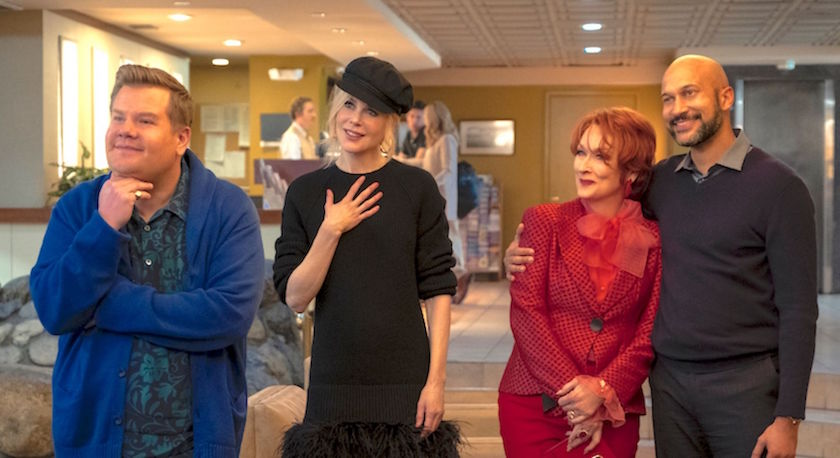
The story adds some unexpected sweetness and reconciliation but really the entire production is just a change to have some fun with some inside theater humor and put on a big, colorful, splashy show with a bunch of Tony and Oscar-winners. Streep has a blast as a larger-than-life personality who is only at home on stage. After letting down someone who genuinely cares for her, the only way she can apologize is to reprise one of her career’s signature numbers. Andrew Rannells (a Tony Award winner for “Book of Mormon”) has a huge musical number with local kids in a shopping mall. Nicole Kidman plays the kind of chorus line hoofer who goes from show to show but never makes it into a lead role, and James Corden is a gay man who sees Emma’s problems in very personal terms because his parents rejected him after he came out.

You don’t have to understand the relative status of a Tony vs. a Drama Desk award or remember which musical had the most performances before “Cats” to sit back and enjoy the good-hearted fun, clever lyrics (by Chad Beguelin), and the jubilant dance numbers choreographed by Casey Nicholaw. It most important message is not inclusion but about the power of art itself, especially big, splashy, energetic, colorful musical, to bring us together and heal what hurts.

Parents should know that the theme of this movie is homophobia and inclusion. It includes some sexual humor and some sexual references, some alcohol, and some strong language.

Family discussion: What would you say to Mrs. Greene? What’s your favorite musical?

If you like this, try: “Bye Bye Birdie,” “Footloose,” “Hairspray,” and “High School Musical”

Related Tags:


Based on a play Comedy GLBTQ and Diversity movie review Movies -- format Movies -- Reviews Musical VOD and Streaming
Love, Weddings & Other Disasters

Love, Weddings & Other Disasters

Posted on December 3, 2020 at 5:26 pm

D
Lowest Recommended Age: High School
MPAA Rating: Rated R for some crude material and strong language
Profanity: Some crude language
Alcohol/ Drugs: Social drinking
Violence/ Scariness: Comic peril and violence, references to mob killings
Diversity Issues: Insensitive portrayal of disability and gender non-conformity
Date Released to Theaters: December 4, 2020

Copyright 2020 Saban
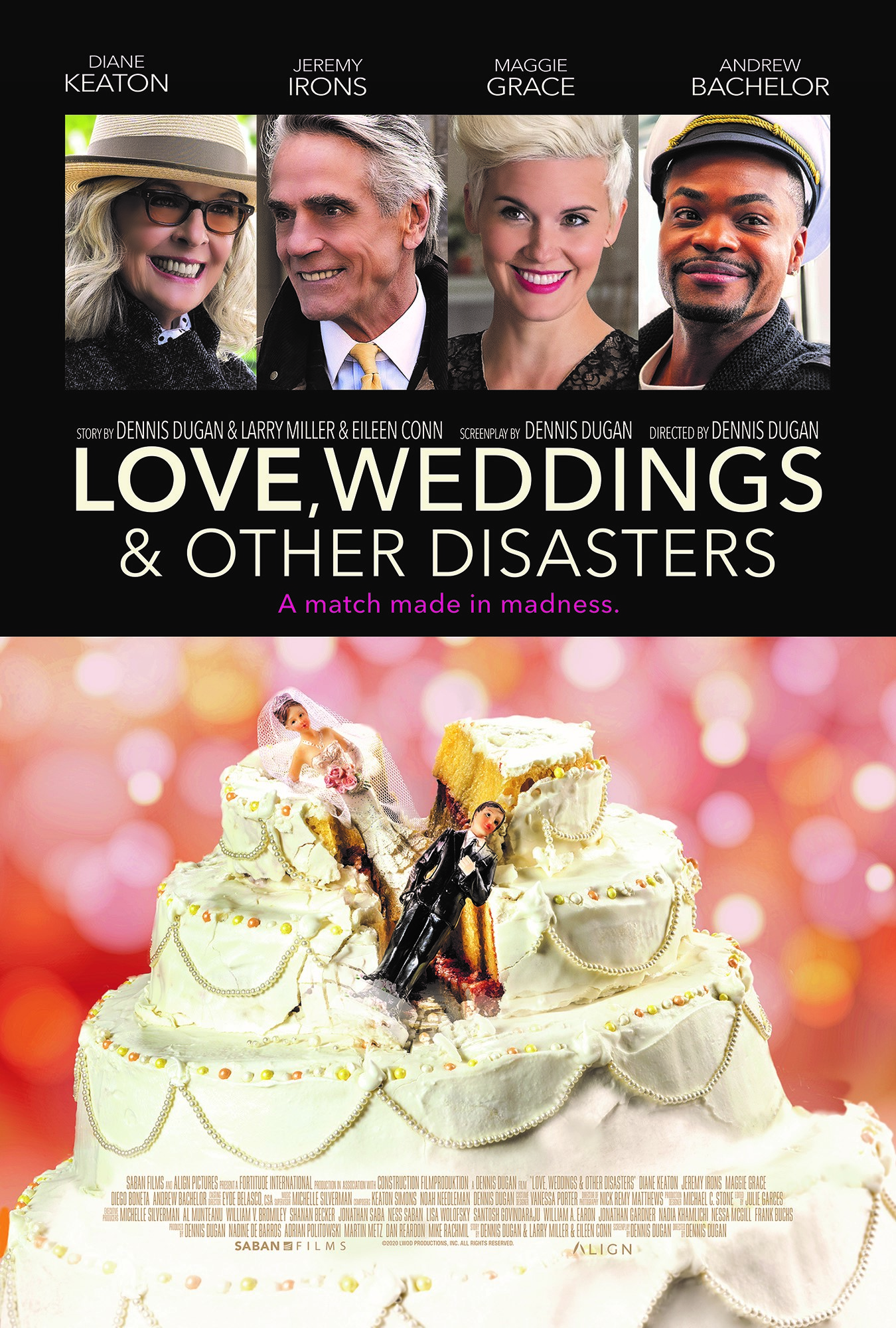
Fifty years ago a movie named “Lovers and Other Strangers” was released. Now best remembered, if at all, for the Carpenters song “For all We Know,” it was a collection of funny, poignant, romantic, hopeless, and hopeful love stories centered around the wedding of a young couple. While it is dated (one storyline is about the couple’s hiding from their parents that they are already living together, pretty racy for that era), it holds up very well, especially the performance by a young Diane Keaton as an unhappy wife contemplating divorce. The scene where her mother-in-law explains her concept of true love with “The Bells of St. Mary’s” as an example is a classic.

And here we are, half a century later, with Keaton in a very similar but not nearly as good movie, “Love, Weddings & Other Disasters.” It’s not just not up to the standards of “Lovers and Other Strangers” or other multi-storyline romances like “Love, Actually.” It is not up the standards of “The Love Boat.” The script sounds like it was written by 11-year-olds, lots of pratfalls and “jokes” about genitalia. None of the characters behave in a manner that is rational, believable, relatable, or appealing. Oddly, it manages to be more dated than the 1970 movie, with insensitive and juvenile jokes about disability and gender presentation.

The ever-young Keaton plays the most ancient of rom-com characters, a manic pixie dream girl, all whimsy and cheer. Her counterpart is played by fellow-slumming Oscar winner Jeremy Irons as a caterer, the kind of rigid perfectionist who uses a ruler to make sure that the wineglasses are not half-an-inch out of alignment and says things like “We start with perfection and ascend from there.” Their meet-cute is a “blind” date. She’s actually blind, get it? And she knocks over his pyramid of champagne glasses because she’s blind, get it? Because of course a lovable wacky girl would have an incompetent guide dog, of course.

The other characters include a would-be wedding planner who literally dumps her fiance as they are sky-diving after he breaks up with her mid-air, a candidate for mayor who is getting married in eight days and his fiancee, a amphibious vehicle tour guide (unlike the movie I highly recommend the Ducks tours, by the way) trying to find the girl of his dreams even though they only spoke for a moment, he doesn’t know her name, and his only description of her is that she has a tattoo of Cinderella’s glass slipper), and, I am not making this up, some game show contestants competing for a million dollars by being literally chained to one another. Note that the female of this chained couple is not a lawyer, as she told the game show; she is a stripper and there are members of the mob (they say Mafia but they have Eastern European accents) who want whatever she wins. By the way, the game show host is smarmily played by the movie’s director, Dennis Dugan, taking a break from Adam Sandler vehicles.

This movie exists in a world where politicians are elected on the basis of their Instagram posts, a family member’s destructive addiction gets shrugged off as if it’s a lovable quirk, people take tours of historical sites to hear made up commentary, and dozens of women get tattoos to try to get a boyfriend they saw on TV. “My jokes are older than these buildings,” says the tour guide (Andrew Bachelor, whose charm and screen chemistry almost triumph over the material). Yeah, that goes for the whole movie.

Parents should know that this movie has crude humor, sexual references, strippers, and comic peril including mobsters who talk about killing people.

Family discussion: Which couple were you rooting for the most? Are you more of a perfectionist or a go with the flow type?

If you like this, try: “Lovers and Other Strangers” and “Valentines Day”

Related Tags:


Comedy movie review Movies -- format Movies -- Reviews Romance
Mank

Mank

Posted on December 2, 2020 at 12:00 pm

A-
Lowest Recommended Age: High School
MPAA Rating: Rated R for some language
Profanity: Very strong language
Alcohol/ Drugs: Alcohol abuse and alcoholism
Violence/ Scariness: None
Diversity Issues: None
Date Released to Theaters: December 4, 2020

Copyright Netflix 2020
“Mank” is a big, breathtakingly ambitious, multii-layered story of Herman Mankiewicz, the man who wrote the original screenplay for what many people consider the greatest film ever made, “Citizen Kane.” This was a passion project for one of the most passionate and meticulous, film-loving directors in Hollywood, David Fincher, partly because the original script for this film was written by his late father, Jack, the sole credited screenwriter.

“Mank” is firmly rooted in its period, down to the black and white film with high ceilings and shadowy images, paying tribute to “Citizen Kane” and other films of that era, it is, like most films set in a different time, very much in conversation with and commentary on where we are today. So. the settings are re-created with exquisite precision and any old Hollywood cinephiles will be overjoyed to be able to visit the office of legendary producer Irving Thalberg (Ferdinand Kingsley) or sit in on a writers’ conference featuring the men who wrote films like Charles Lederer (the original “Oceans 11,” “His Girl Friday,” “Gentlemen Prefer Blondes,” played by Joseph Cross) and Ben Hecht (“Scarface,” “Gunga Din,” played by Jeff Harms. They will also get a kick out of the faux “cue marks,” the circles in the upper right-hand corners of the frame to let the theater projectionist know when it was time to get ready to change reels, long disappeared from movies in the digital era.

And then there is San Simeon, the unimaginably lavish Hearst castle built by the unimaginably wealthy William Randolph Hearst (Charles Dance). He was the heir to a gold mining fortune and a political dynasty. He became the owner of the country’s largest media empire, which he used to push his political priorities. Is the commentary on today coming into focus?

Herman Mankiewicz was brilliant, sardonic, cynical, and a raging alcoholic and gambler. He ruefully notes that his wife is always referred to as ‘poor Sarah” (“Downton Abbey’s” Tuppence Middleton). He was a real-life version of those journalists in the wild wild West days of newspapers, as often portrayed by Clark Gable. He famously sent a telegram to Ben Hecht (in the movie version to Charles Lederer encouraging him to come to Hollywood: “Millions are to be grabbed out here and your only competition is idiots. Don’t let this get around.”

A brilliant trouble-maker of an enfant terrible from radio and theater named Orson Welles (Tom Burke) has been given free rein to make a movie, what he would later call “the The biggest electric train set any boy ever had.” He asks Mankiewicz, recovering from a leg injury, to write the script and puts him in a remote cabin with a secretary (Lily Collins as Rita Alexander) to keep him away from “distractions,” meaning booze and gambling.

Like “Citizen Kane,” the movie goes back and forth in time, the flashbacks illuminating the movie’s present, especially the inspiration for the title character, who would be played by the 25-year-old director himself. We see moments and characters and ideas sparking the ideas in the screenplay. And we see the painful and often self-destructive force of an intellect that is so deeply cynical only because at heart he is so deeply idealistic.

Mank’s warm friendship with Marion Davies (Amanda Seyfried) is at the heart of the movie. He can be honest with her because she is honest with him and because, unlike “poor Sarah,” he does not feel, at least in the earlier days of their relationship, that he is letting her down. Davies was the long-time romantic partner of Hearst, who was married to someone else. He ordered his newspapers to write about her frequently, leading to the joke that every story about a Hollywood event had the line “And Marion Davies looked lovely.” (Because of the Susan Alexander character in “Citizen Kane,” the second wife Kane insisted on promoting as an opera singer with disastrous results, people often think Davies was untalented, but she was a lovely light comedienne with a charming presence on screen.)

Because of Davies, Mankiewicz is often a guest at San Simeon and has a cordial relationship with Hearst, until Hearst’s opposition to the progressive California gubernatorial candidate Upton Sinclair (cannily played by Science Guy Bill Nye) and the movie studios’ anti-Sinclair propaganda “news” films lead to intolerable behavior in social gatherings — and to the corrupt, lonely former idealist Charles Foster Kane.

It is pure pleasure to see a film that respects the audience enough to take on big issues with complexity, humanity, and wit, every careful detail and layered performance providing much to think about and many questions about our own time and how it will be seen eighty years from now, if we are lucky enough to have filmmakers of this quality.

Parents should know that this movie includes strong language, alcoholism and other addictive behavior, some sexual references, and references to the Holocaust.

Family discussion: Who is most like William Randolph Hearst today? Most like Upton Sinclair? Why did Mank change his mind about wanting credit for the movie? Was he fair to Marion Davies?

If you like this, try: “Citizen Kane” and the book about the film by Pauline Kael, Mank: The wit, world, and life of Herman Mankiewicz, and other films by and about the Mankiewicz brothers and Welles. And see some of Marion Davies’ films like “Peg o’ My Heart” and “Show People.”

Related Tags:


Based on a true story Biography Drama movie review Movies -- format Movies -- Reviews
THE MOVIE MOM® is a registered trademark of Nell Minow. Use of the mark without express consent from Nell Minow constitutes trademark infringement and unfair competition in violation of federal and state laws. All material © Nell Minow 1995-2026, all rights reserved, and no use or republication is permitted without explicit permission. This site hosts Nell Minow’s Movie Mom® archive, with material that originally appeared on Yahoo! Movies, Beliefnet, and other sources. Much of her new material can be found at Rogerebert.com, Huffington Post, and WheretoWatch. Her books include The Movie Mom’s Guide to Family Movies and 101 Must-See Movie Moments, and she can be heard each week on radio stations across the country.

Website Designed by Max LaZebnik