
The Night Before Christmas
Posted on December 24, 2018 at 7:00 pm
Posted on December 20, 2018 at 5:37 pm
B +| Lowest Recommended Age: | Middle School |
| MPAA Rating: | PG-13 for sequences of sci-fi violence and action, and for some language |
| Profanity: | A few bad words |
| Alcohol/ Drugs: | Scene in a bar, some alcohol |
| Violence/ Scariness: | Extended comic book/fantasy peril and violence, chases, explosions, monster, sacrifice/suicide of parent, characters injured and killed, some disturbing images |
| Diversity Issues: | None |
| Date Released to Theaters: | December 21, 2018 |
| Date Released to DVD: | March 26, 2019 |
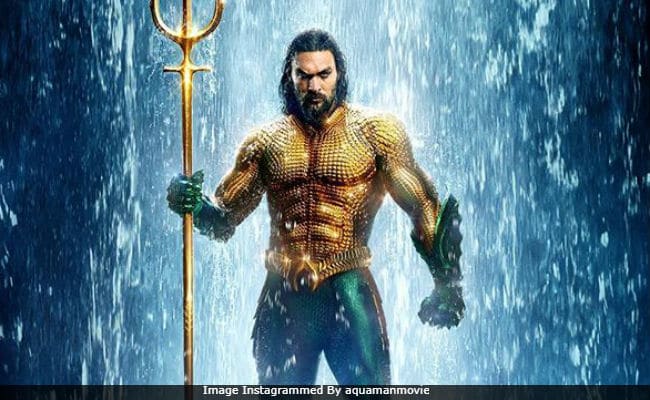
Aquaman is a hoot. In this version of the story, Aquaman is the mixed-race son of a human lighthouse keeper (Temuera Morrison) and an undersea princess (Nicole Kidman) who met when the princess, running away from an arranged marriage, got injured and washed up on the shore. Fortunately, she speaks English, which turns out to be the universal language of all of the undersea kingdoms, who can speak under water as easily and be heard as clearly as though they were on land. See above re laws of physics. Anyway, the human and the underwater princess fall in love and have a much-loved baby named Arthur until her people track her down and she has to go back to protect her husband and child. We will later discover that she returned to the forced marriage, had a son who became heir to the throne, and was killed for having committed the sin of having a “mongrel” child.
Arthur (yes, as in Camelot) grows up with some connection to his undersea heritage, including a Merlin-like guide (Willem Dafoe). He serves as guardian to humans at sea, and early on we see him take on some pirates. One is killed, in part because Arthur refuses to save him, and his son (Yahya Abdul-Mateen II) vows revenge.
Meanwhile, another underwater princess (Amber Heard as Mera) is trying to persuade Arthur to claim the throne. Arthur’s half-brother Orm (Patrick Wilson) is working to unite all of the underwater kingdoms so he can declare war on humans. He has a point — they are upset about all of the poison and junk we keep dumping in the oceans. But we won’t dwell on that because Orm is pretty evil. We know that because he looks like Draco Malfoy and has no sense of humor. And besides, what’s more important is that there is SO MUCH to look at. Each underwater city and population is wildly imaginative and spectacularly gorgeous. If the storyline gets overstuffed, more labors of Hercules than the usual superhero saga (thank you for skipping the origin backstory, by the way), it is a lot of fun, an expert mix of action, adventure, humor, family, and a little romance.
NOTE: Stay for a post-credit scene.
Parents should know that this film includes extended comic-book/fantasy peril and violence with weapons, explosions, spears, knives, suicide sacrifice, monster, characters injured and killed and some disturbing images, along with a few bad words.
Family discussion: What did Arthur understand because of his dual heritage? What made him change his mind about what he thought he wanted?
If you like this, try: the comic books and “The Guardians of the Galaxy”
Posted on December 20, 2018 at 5:34 pm
B| Lowest Recommended Age: | Middle School |
| MPAA Rating: | Rated PG-13 for sequences of sci-fi action violence |
| Profanity: | Brief strong language |
| Alcohol/ Drugs: | None |
| Violence/ Scariness: | Extended sci-fi/action-style violence, weapons, explosions, mayhem, characters injured and killed, some disturbing images |
| Diversity Issues: | None |
| Date Released to Theaters: | December 21, 2018 |
| Date Released to DVD: | April 2, 2019 |
Charlie (Hailee Steinfeld) is an unhappy teenager living in San Francisco in 1987. She is still mourning for her dad, who died suddenly the year before, and counting the days until she can leave home. Everything seems an affront to her — the terrible uniform she has to wear working at the amusement park food stand, selling lemonade and hot dogs on a stick, her mother’s odious boyfriend who has moved into their home and thinks he can tell her what to do, and the monstrous unfairness of not having a car. So she spends much of her free time sulking and wearing an endless assortment of t-shirts from various edgy 80’s bands to show how righteously disaffected she is.
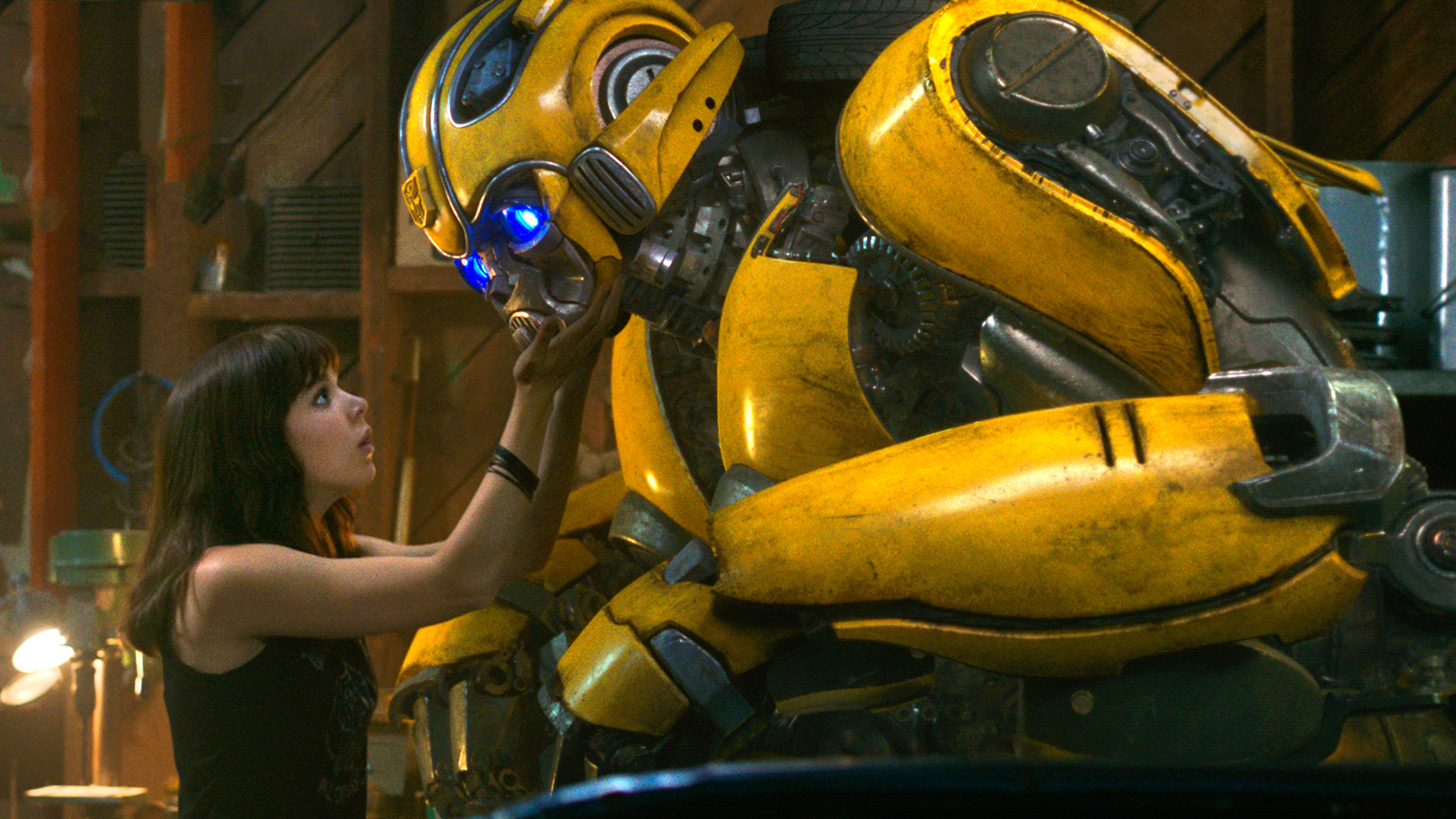
Meanwhile, after losing a battle to the evil Decepticons on their home planet, the good-guy Autobots led by Optimus Prime (still voiced by Peter Cullen, thank goodness) put their top soldier, Bumblebee (voiced by Dylan O’Brien) into an escape pod and tell him to set up a safe place on a remote planet called Earth. He arrives in the middle of a military wargame that leads to a chase, and is soon tracked down by two Decepticons (voiced by Angela Bassett and Justin Theroux), who permanently damage his voicebox and his memory cells. Later on, when Charlie wheedles a beat-up old yellow VW bug from a junk dealer, it turns out to be Bumblebee, and he and Charlie begin to form a friendship.
This takes us back to the first “Transformers” movie, oh, so many explosions and robot fights ago, when it was about the relationship between Sam Witwicky (Shia LaBoeuf) and his special space friend. Bumblebee’s inability to communicate, until Charlie figures out how to give him access to a radio and he figures out to use sound clips from it to “talk,” give a special poignancy to those first encounters. But that is undermined in part by subsequent scenes, which spend too much time on weak sub-plots about mean girls and the nerdy but lovable boy next door. It is nice that Charlie is very clear about setting boundaries with the boy, and he respects that. The movie could have skipped the scenes of Bumblebee inadvertently trashing Charlie’s house TP-ing the bully’s house and overturning her car, diversions that go nowhere and are not nearly as merry or endearing as they are intended to be as Knight seems more interested in the mechanics of the scene than what they add to the storyline.
All of this is of course just building up to lots more action as both the military and the Decepticons (best line in the movie is when Cena points out that the very name Decepticon should make us worry) come after Bumblebee. The Decepticons first appear to befriend the humans (and incidentally invent the Internet). So, lots of bombast and shooting and chases and explosions.
No matter what, I always enjoy seeing cars turn into robots and robots turn into cars, and I appreciated the lower-key, retro setting. If the series is not completely transformed, it does remind us why we liked the Transformers to begin with, and that’s a good start.
Parents should know that this film has a few bad words and extended sci-fi/action-style violence with characters injured and killed, weapons, explosions, and mayhem. Humans are vaporized. A positive element of the movie is Charlie’s clear boundaries with the boy who likes her.
Family discussion: Why does Charlie trust Bumblebee? Why does Agent Burns change his mind?
If you like this, try: “The Iron Giant”
Posted on December 18, 2018 at 10:25 am
A-| Lowest Recommended Age: | Kindergarten - 3rd Grade |
| MPAA Rating: | Rated PG for some mild thematic elements and brief action |
| Profanity: | Mild language in a song |
| Alcohol/ Drugs: | None |
| Violence/ Scariness: | Some peril, references to sad death of parent |
| Diversity Issues: | None |
| Date Released to Theaters: | December 19, 2018 |
| Date Released to DVD: | March 18, 2019 |
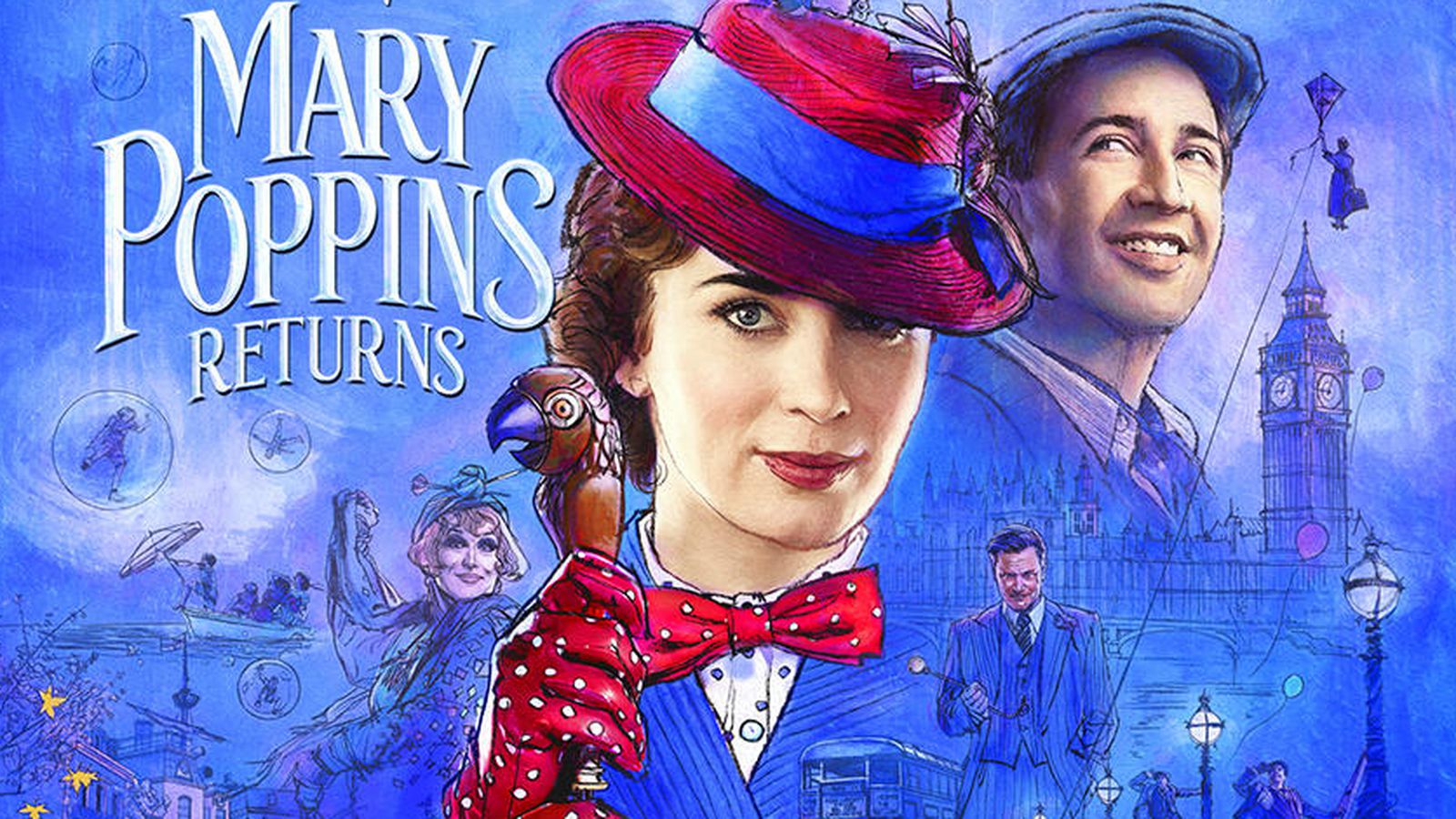
In the first film, she was nanny to Jane and Michael Banks. She took them on magical adventures that included a tea party on the ceiling and diving into a chalk picture for an animated musical number with dancing penguins. But the real magic she brought to the Banks family was a reminder of what was important. The fond but distracted parents learned that it was more important to fly a kite with the family than to keep the job that supports the family and its domestic employees or fight for the rights of women. (Well, the 60’s was a complicated time. But the message of family connections is still valid.)
This sequel very sweetly brings Mary Poppins back, once again arriving from the sky via a parrot-head handled umbrella, again to care for the Banks children, meaning the now-grown Jane and Michael Banks (Emily Mortimer and voice of Paddington Ben Wishaw). Oh, and Michael’s three children, too, who have taken on too many adult responsibilities as the family still mourns the loss of their mother. Jane works for the rights of workers and does her best to help her brother and his children, who still live in the old house on Cherry Tree Lane.
They may lose the house, though, as Michael cannot pay the bank, yes, the same one his father worked at, what he owes. It’s now run by Mr. Wilkins (Colin Firth), who promises he will do everything he can to help Michael, but who shows up as a wolf in an animated adventure when Mary Poppins takes the children into the design on their late mother’s porcelain bowl, so perhaps he should not be trusted.
Jane and Michael remember Mary Poppins, but now believe that they only imagined the magical adventures. They have lost their ability to see magic in the world. Mary Poppins, with her brisk, no-explanations manner, has come back to show them how to find it. And that means a visit to another of her eccentric relatives (Meryl Streep, enjoying herself enormously), and journeys undersea via the bathtub and into the sky with balloons. And it means singing and dancing, too, with a wild music-hall-style number in an animated theater and a tender ballad about The Place Where Lost Things Go. Plus, Dick van Dyke is back. And he dances.
We take it for granted that this movie would have visual Disney magic. No one assembles a more gifted collection of production designers, costume designers, and visual effects designers than Disney, and no studio has a better, more organic sense of its own history and culture. So when Disney decided to revisit the 54-year-old classic based on P.L. Travers’s novels, after having already mined its own history with a movie about the making of that movie, it was fair to expect that it would look and feel as though we had never left. The magic touch is there, with gentle references to the earlier film, including the animated adventure with a retro, hand-drawn, cel-based look along the lines of Disney’s specialty, and an enchanting appearance from Dick Van Dyke, who played two characters in the original. Emily Blunt as Mary Poppins and “Hamilton’s’ Lin-Manuel Miranda as her lamp-lighting friend are practically perfect in every way. And, as “Saving Mr. Banks” reminded us, the real magic, is that at its heart it is not just about fantasy adventures but about healing the family. The songs, the special effects, the imagination are a lot of fun but what makes this movie top ten-worthy is the heart.
Parents should know that there are references to a sad death of a parent, worries about money, and some situations with mild peril. A song has some mildly spicy lyrics with references to nudity.
Family discussion: Which was your favorite adventure? Why didn’t Mary Poppins stay?
If you like this, try: the books by P.L. Travers and the classic original film
Posted on December 16, 2018 at 11:08 am
B +| Lowest Recommended Age: | Middle School |
| MPAA Rating: | Rated PG-13 for brief language |
| Profanity: | Brief strong language |
| Alcohol/ Drugs: | None |
| Violence/ Scariness: | Sad death |
| Diversity Issues: | None |
| Date Released to Theaters: | December 14, 2018 |
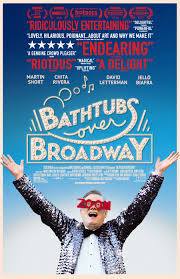
There are really three stories in this adorably engaging documentary about “industrial musicals,” the wildly elaborate in-house productions big corporations used to motivate their employees in the 1950’s-70’s. The first is the story of our guide to this world, Steve Young, a writer for David Letterman’s Late Show who describes himself as comedically “damaged” after years of evaluating everything in the world as comedy material. There was almost nothing that made him laugh anymore. The best he could muster was an analytic, “that’s funny.” “We’ve become hard laughs,” he tells us. Over the course of the film, he will lose the job he has had for two decades when Letterman decides to retire. The second, as in many documentaries, is the story of a tiny sub-culture of people who are deeply passionate about something the rest of the world considers odd or quirky or has never heard of. This one lives “at the far horizon where the adjectives of ‘good’ and ‘bad’ don’t apply anymore.” Young may have found them as something to laugh at but he soon develops affection and then passion for them, and by the end of the movie, we can understand why and feel some of it ourselves.
“How can there be something so large and so crazy in the world that we had no idea of?” Young asks. But the answer we get is to a different question: How can an “eccentric adventure” soothe and enlarge a “comedy-damaged” soul? By the end of the film, Young tells us that delving into this odd world has “opened up my ability to be receptive to people.” Anyone he meets can have this kind of history.
And the third is the story of the musicals themselves, often produced, directed, and performed by actual or future Broadway stars, making a very good living doing something they loved and could learn from instead of waiting tables. Just to give you an idea: one of these musicals had a budget of three million dollars. The original production of “My Fair Lady,” which opened the same season on Broadway, had a budget of $466,000. Were they works of art? Well, no, they had singing and dancing spark plugs and ballads about toilets and an opera about spaghetti sauce called “Raguletto.” But they were very professionally done, often quite clever, astonishingly elaborate, and in their own way artifacts of an era of corporate optimism that saw endless possibilities for itself as providers of consumer goods and great jobs. Of course those jobs were for white males, as we see in the glimpses we get of the audience, all wearing near-identical suits and ties.
“I played a trick on history,” Young tells us. These shows were created for the most specific of audiences and were never intended to be seen by outsiders. The biggest surprise is that these most commercial of enterprises are so free from any kind of cynicism. There’s an innocence about them because they come from the post-WWII era, when America seemed unbeatable, and technology seemed thrilling. The “man in a grey flannel suit” corporate employees were “being shown a version of their world where they’re heroes.” If a marvelous new substance called silicone had 180 uses, why not create a song about it? What better way to introduce fabulous new products to the sales team than a catchy musical number? It may have been the “strangest dead end of show business,” with the idea of “What shouldn’t we write a musical about? Let’s write it and make it good and not let anyone see it!” But companies with lavish budgets created souvenir records for their employees to take home and that is how Young began to discover this world of unseen, un heard entertainment. Over the course of the film he tracks down some of the creators and performers, including Susan Stroman (“The Producers”), who explains that she learned a lot from choreographing industrial shows, Martin Short and Florence Henderson, who talk about the pleasures of performing for wildly enthusiastic audiences (Henderson compares it to a revival meeting), and composer Sid Siegel, who specialized in industrial musicals — and who kept a treasure trove of an archive. They were “selling Tupperware but also selling America,” and their unabashed boosterism makes it impossible to be snarky or condescending, leaving us entertained, and perhaps a little wistful.
Parents should know that this film includes brief strong language and a sad death.
Family discussion: If you were going to create a musical about your job or school, what would you sing about? Which production was your favorite?
If you like this, try: the shows by Sheldon Harnick, Chita Rivera, and Martin Short, and the book by Steve Young. Some of the songs are available, too.