Rated PG for thematic elements and some mild peril
Profanity:
None
Alcohol/ Drugs:
None
Violence/ Scariness:
Sad offscreen deaths of parents, illness, depression, fire
Diversity Issues:
None
Date Released to Theaters:
August 8, 2020
Copyright STX 2020Most of the time I was beguiled by the gorgeously designed latest version of “The Secret Garden,” Frances Hodgson Burnett’s classic 1911 story of the orphan girl named Mary Lennox sent to live with her uncle in a vast castle-like home on the moors. She discovers a locked, hidden garden — and some family secrets. But there were moments when I was as cross as Mary herself, the book version that is.
What I loved most about the book when I first read it as a child and then when I read it aloud to my own children was that Mary is that rare heroine in a classic children’s book who is unapologetically imperious, outspoken, and, until the secret garden works its magic, selfish. Anne Shirley, Pollyanna, Alice, Caddie Woodlawn, and Burnett’s unfailingly saint-like Sara Crewe, Mary Lennox had a sour disposition and yet, she was the heroine of the story. This fifth movie version begins with Mary comforting her doll. The book’s Mary would never do anything so empathetic.
So, it took me a while to let go of my version of Mary and warm to the softer version from screenwriter Jack Thorne (“Wonder”), enjoying the movie within its own conception of the story. As in the book, Mary (Dixie Egerickx) is raised in colonial-era India (here set in 1947), then sent to live with the uncle she does not remember ever having met (Colin Firth as Archibald Craven), in an enormous house called Misselthwaite Manor, on the windy, misty moors of Yorkshire.
She discovers a secret garden and two boys, one who seems to be a part of the moors, and a relative who is as removed from the natural world — even other humans — as it is possible to be. She discovers some important understanding about herself, in part through evidence that helps her reframe her past.
Sumptuously imagined and lovingly presented, this is a fine family film, and a good reminder that even being stuck at home can be an adventure.
Parents should know that this film features three children mourning lost parents and a grief-stricken father/uncle. A character has severe depression, which her daughter interprets as not caring about her. There is some mild peril and a fire.
Family discussion: Grief is expressed in many different ways in this film. What are some of them? What did Mary and Colin learn from the letters that made a difference to them? What would be in your secret garden?
If you like this, try: the book and the earlier versions of the story, especially the 1987 version directed by Agnieszka Holland.
For 50 years, PBS has been America’s trusted home for documentaries. The PBS Documentaries Prime Video Channel is another way for curious viewers to access PBS content outside the PBS Video App.
The PBS Documentaries Prime Video Channel will include a robust library of critically acclaimed, thought-provoking programs including the entire Ken Burns collection as well as films from NOVA, FRONTLINE, AMERICAN MASTERS, NATURE, AMERICAN EXPERIENCE, INDEPENDENT LENS, POV and many independent producers. Subscribers will be able to explore various topics or take an in-depth look at the people, traditions and events that mold our world—all carefully curated for “viewers like you” by America’s most trusted home of documentaries: PBS
“PBS is the leader of high-quality, compelling nonfiction entertainment, and the PBS Documentaries Prime Video Channel is a natural addition to our current streaming offering on Prime Video Channels—PBS MASTERPIECE, PBS LIVING AND PBS KIDS. This channel will not only help bring engaging stories about life in all corners of our country to a new audience, it will provide needed revenues to sustain public broadcasting’s public-private partnership model for the benefit of all stations and the communities they serve,” says Andrea Downing, Co-President of PBS Distribution.
Copyright PBS 2018“We had long hoped to be able to have all of our films available in one place so the public would have access to the body of work,” says Ken Burns. “We’re thrilled that this is now possible thanks to the efforts of PBS Distribution and Amazon to launch the PBS Documentaries Prime Video Channel and also through PBS’s Passport initiative that allows viewers to support their public television stations. Both will also contribute to the larger mission of PBS.”
“FRONTLINE was founded on the belief that longform documentaries could inform, educate and inspire public television’s audiences — and during these historic times, deeply reported and easily accessible journalism is invaluable,” says FRONTLINE Executive Producer Raney Aronson-Rath. “Through this new Channel, we’re excited to see our documentaries reach new and existing streaming audiences.”
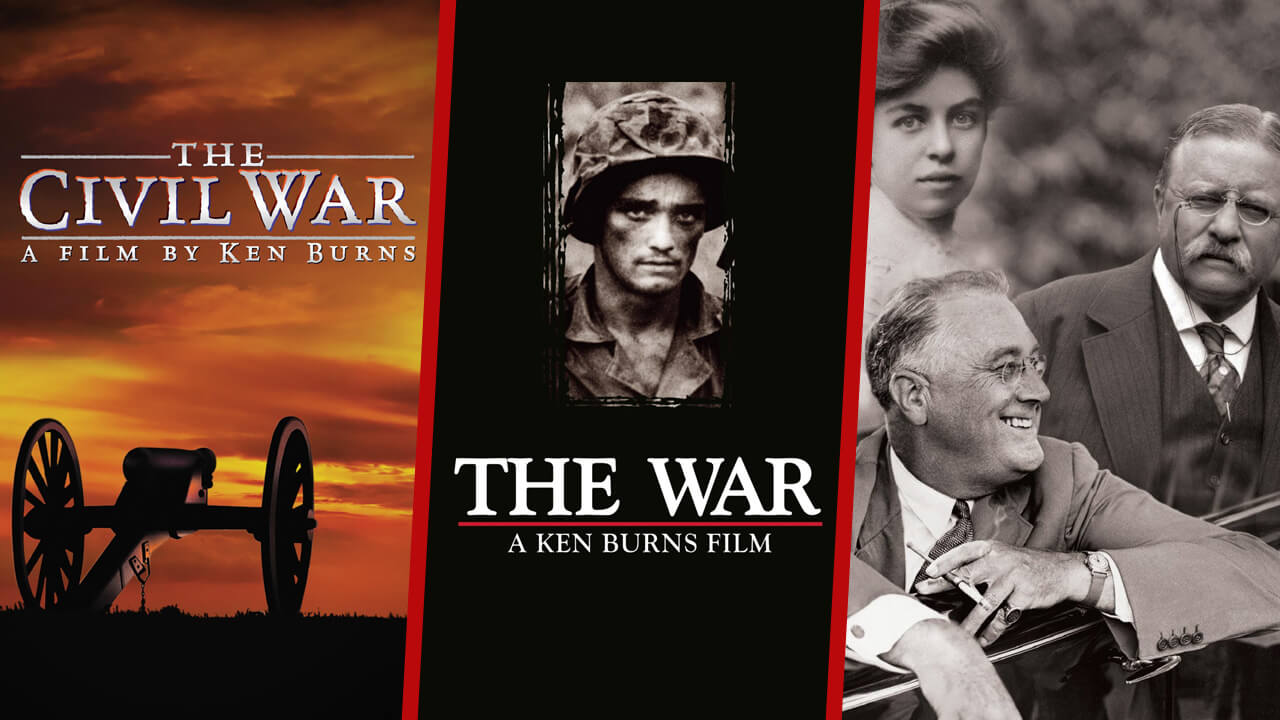
At launch, the channel will feature nearly 1,000 hours of award-winning programming for subscribers to enjoy, including Ken Burns’s landmark series THE CIVIL WAR and COUNTRY MUSIC, Stanley Nelson’s THE BLACK PANTHERS: VANGUARD OF THE REVOLUTION, and Academy Award-Nominated films like FRONTLINE “For Sama” and AMERICAN EXPERIENCE “Last Days in Vietnam.”Copyright PBS 2019
Stanley Nelson comments, “I’m thrilled to see that my work will find a new home on this channel. PBS has become a premier destination for documentary programming in the U.S. and has been hugely invested in giving films by diverse storytellers and emerging filmmakers much-needed national exposure. I’m so glad that my film on the Black Panther Party, which can inform communities in our current historical moment, will be able to reach different audiences on this new service.”
The subscription rate for the PBS Documentaries Prime Video Channel is $3.99/month with an Amazon Prime or Prime Video subscription via Prime Video Channels and is available in the US only. Every purchase helps support public television for all.
The entire Ken Burns collection will also be available via PBS Passport, a member benefit available within the PBS Video App that gives viewers extended access to high-quality content. The PBS Passport library is also full of public television’s acclaimed drama, arts, science, history and lifestyle programs (contact your local PBS station for details).
The PBS Documentaries Prime Video Channel is a subscription video on demand channel exclusive to Amazon launching August 2020. This new streaming channel will feature nearly 900 hours of the highest quality factual programming, including the full catalog of films from Ken Burns and award-winning documentaries from NOVA, FRONTLINE, AMERICAN MASTERS, NATURE and AMERICAN EXPERIENCE, in addition to programming from other independent producers.
Rated PG-13 for thematic elements, disturbing images, brief nudity and a scene of sensuality
Profanity:
Mild language and sexual references
Alcohol/ Drugs:
Social drinking
Violence/ Scariness:
WWI battle scenes,
Date Released to Theaters:
July 24, 2020
Copyright 2020 Amazon Studios
Biopics, even the most sincere, even about the most fascinating real-life characters, even made by directors who are willing to break with the traditional structure, still two things are true. First, the only thing that really matters is the lead performance. Second, there is really no way to get around the basic structure that all lives follow and all biopics follow except those like “Jobs” that focus one or just a few incidents. We see crucial early experiences that either reveal the subject’s special talent or some life-forming experience or both. We see struggle. We see people who foolishly do not believe our subject can succeed. We see our subject succeed.There’s usually a setback or special mid-point challenge. And then we see how it ends.
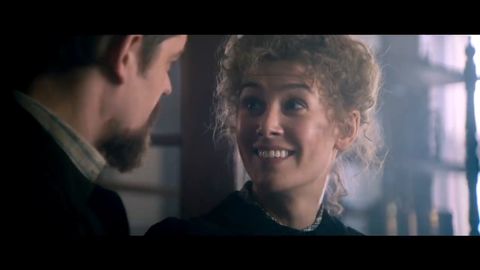
Marie Curie certainly had a fascinating life and Rosamund Pike gives her considerable best. She is never less than mesmerizing. I particularly enjoyed watching her in the first half of the movie, as we see her struggling to be taken seriously as a scientist when she knows she is better than the men who look down at her because she is a woman, because she is Polish, and because she is not shy about letting them know she is better than they are. It’s almost a proto-“Big Bang Theory,” the way that the same determination, single-mindedness, unstoppable curiosity, and relentless quest for truth that makes her a scientist is what makes it difficult for her to get along with anyone well enough to get her the resources she needs to do her experiments.
And that is when she meets Pierre Curie. He tells her he has read her work and it is brilliant. She tells him she has read his and it is very good. He offers her a space in his lab. Her insight and his ideas about how to prove her theories like two covalent bonds or a double helix. A lot happens very fast as the brilliance of her discoveries is evident when she just 32 when her paper on radium was published. But the movie stops for a dinner party so that Marie can explain her research to a non-scientist friend, and to us.
It then hurtles along, trying to cram in every crisis faced by Marie, from continued gender discrimination to being accused of adultery after Pierre’s death, when her letters to her married lover were made public by his wife. Most interesting, and worth an entire movie of its own, is her service during WWI, when she developed portable X-ray machines that saved thousands of lives and prevented needless surgery. Like the man for whom the most important scientific award in the world is named, Alfred Nobel, Marie Curie’s great achievement was responsible for incalculable benefits (we see an early cancer patient treated with radiation) and unthinkable tragedy (we see a Hiroshima resident looking up to see the Enola Gay, and the ravages of Chernobyl. This makes things a bit muddled, but Pike’s stirring performance makes us believe we get a sense of Marie Curie’s fierce intelligence and even may make us wonder about what discoveries we can make.
Parents should know that this film includes WWI battle scenes and characters who have been wounded, characters who are ill and dying and references to deaths of family members, brief rear nudity, non-explicit sexual situation, and references to adultery.
Family discussion: What do we learn from Marie’s reaction to the death of her mother? Why does this film include glimpses of events long after Marie’s death? What can we do to make sure that what we learn about and invent is used to benefit humankind and not for wars and violence?
If you like this, try: the glow-in-the-dark graphic novel the film is based on and another film about scientists and inventors, The Current War.
New on Quibi: A Hilarious, Exciting, Heartwarming Remix of The Princess Bride
Posted on July 18, 2020 at 4:14 pm
No movie is more beloved than The Princess Bride, with a screenplay by William Goldman based on his book and an all-star cast including Robin Wright, Cary Elwes, Mandy Patinkin, Wallace Shawn, Chris Sarandon, and of course Billy Crystal and Carol Kane. It has everything: romance, adventure, a gorgeous score, villainous villains and heroic heroes. It’s close to perfect.Copyright Quibi 2020
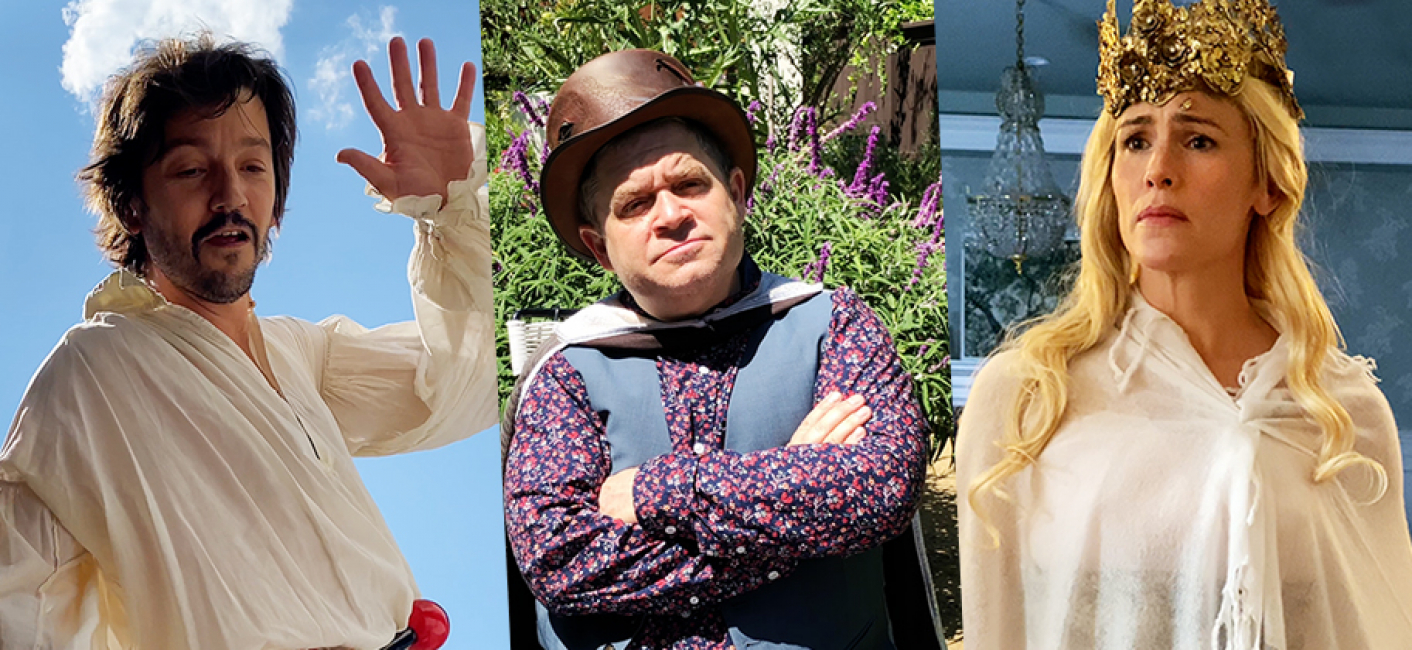
And everyone knows it so well that it is a perfect candidate for a pandemic-era at-home remake to raise money for the World Central Kitchen, “food first responders” whose programs include their clean cookstoves initiative, culinary training programs, and social enterprise ventures that empower communities and strengthen economies.
Some of the biggest stars in the world and some of the hottest up-and-coming newcomers slip in and out of the roles using whatever locations and props and costumes they have at home. It reminds me of the “Sweded” movies in “Be Kind Rewind,” one of my favorites. And one of that movie’s stars, Jack Black, shows up along with Hugh Jackman, Keegan Michael Key, Penelope Cruz, some of the movie’s original cast, and, in the final moment, one of the most touching appearances of the year.
It is pure delight. Now excuse me, I need to go back and re-watch the original.
Rated PG-13 for war-related action/violence and brief strong language
Profanity:
Brief strong language
Alcohol/ Drugs:
None
Violence/ Scariness:
Extended wartime peril and violence, weapons, explosions, some disturbing images, characters injured and killed
Diversity Issues:
Historical issues, segregated all-male military
Date Released to Theaters:
July 10, 2020
Copyright 2020 ApplePeople always remember the wrong part of “The Caine Mutiny.” It’s understandable because Humphrey Bogart is mesmerizing as Captain Queeg, a career officer held in contempt by the junior officer draftees who think he failed so unforgivably in his command that, in this fictional story, there is a mutiny. (In reality, there has never been a mutiny on a US military ship.) One of the most iconic scenes in movie history is when Bogart as Queeg becomes so defensive on the witness stand he undermines his own credibility. Like Jack Nicholson as Colonel Jessup being cross-examined by Tom Cruise in “A Few Good Men,” the short-term smart alecks show up the men who give their lives to the service. But do they? After Queeg decompensates on the witness stand, the mutineers feel vindicated. But the lawyer who argued the case tells them they are wrong. He could have given Nicholson’s speech about those who are smug in the luxury of their principles without having to test them in war. (Of course, SPOILER ALERT Jessup’s actions went far beyond Queeg’s paranoia and poor judgment; there is no possible justification for assaulting a soldier to force him to improve or quit.)
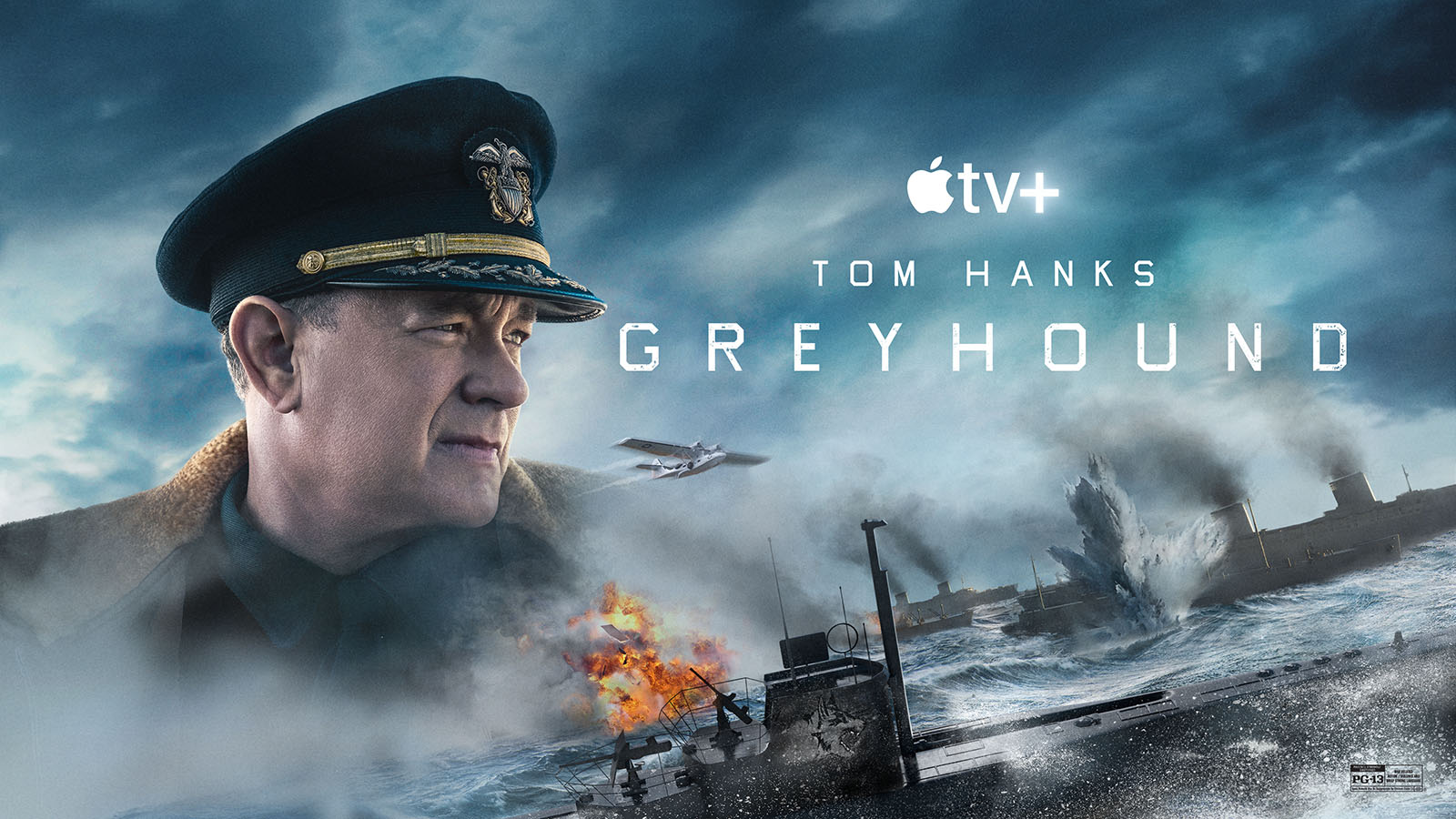
The WWII story “Greyhound,” written by and starring Tom Hanks, is something of a counterweight to those stories. It is based on a book called The Good Shepherd by Horatio Hornblower author C.S. Forester, whose specialty was thrilling naval stories. Hanks plays Captain Ernest Krause, commander of the USS Keeling, known by its callsign Greyhound. Like Queeg and Jessup, Krause was in the Navy before the war. We get a sense that he has been disappointed by not being promoted and perhaps, now that America’s entry into the war has prompted a promotion at last, he may have some doubts about whether he is ready. In a brief and probably unnecessary flashback, we see him propose to his lovely girlfriend, played by the lovelier-than-ever Elisabeth Shue. But she wants to wait. (In Forester’s book, Krause is divorced because his wife could not handle his by-the-book-ishness.). But unlike Jessup and Queeg, Krause is the very model of a decent, honorable, careful, officer. His first thought is for his mission; his second thought is for his men. He never loses sight of the consequences of his actions. As his men rejoice in the sinking of the U-Boat attacking them — “50 less Krauts!” — he says to himself as much as to anyone else, “50 souls.”
Other than that flashback, the quick 90-minute runtime is entirely devoted to a few days as Krause’s destroyer brings cargo ships across the Atlantic so they can deliver critically needed supplies and troops to England. Air cover at the time could not stretch all the way across the ocean, so there was a space in the middle known as the Black Pit. As the movie begins we hear the stirring voice of Winston Churchill describing the “hard unrelenting struggle” of the Atlantic fleet and Franklin Roosevelt, a former Secretary of the Navy, extolling the American spirit: “Damn the torpedoes! Full speed ahead!” “The price of the war has fallen on our sailor men,” we hear. And then we see what that means on Krause’s first crossing.
In addition to the vulnerability of lack of air cover, the equipment they have to work with is endearingly, and horrifyingly basic, analog, almost prehistoric. Their communication with their base is inadequate, even when it works, a critical message arriving two hours too late. The tracking system stops working. On board, Krause gets his intel by voice relay. A sailor has the job of just repeating everything coming from below so he can hear it. A sneeze at the wrong moment can be disastrous. The crew uses grease pencils and protractors. Krause uses binoculars. He uses a pencil-sharpener. They run low on ammo.
As admirable as the movie’s devotion to accuracy is, the tech talk is overwhelming. There’s a lot of “five minutes to course change” and language that is much harder to parse. Much less time is devoted to developing characters other than Krause; he may care a lot about the men but the movie does not seem to. An exception is Rob Morgan, in his third indelible performance of the year so far after “Bull” and “The Photograph.” As a loyal steward in the still-segregated military, he manages to convey infinite dignity and a movie’s worth of back story.
All of the tech talk and even some of the action are a distraction from what the movie is about: risk assessment under the direst circumstances, the responsibility for other people’s lives, both those on board and those they are fighting to protect at home, the wear on the spirit, the resolve to go on. At its foundation, beyond all of the tension and action, this movie is is a continuation of those same issues explored in Hanks’ recent films, especially “Captain Phillips,” “Sully,” and “Bridge of Spies.” Hanks, who often seems to play the role of America’s dad in real life, explores the existential questions that underly all of our choices.
Parents should know that this film includes extended wartime peril and violence, disturbing images, guns, torpedos, explosions, characters injured and killed, and brief strong language. Reflecting the reality of the era, the military is segregated and all-male.
Family discussion: What are some of the biggest differences between the military technology of WWII and today? Which was the most difficult decision Commander Krause had to make? If he had to do it again, what would he do differently?
If you like this, try: “Midway,” “Mr. Roberts,” “Destination Tokyo,” and “Band of Brothers”