Norm of the North

Norm of the North

Posted on January 14, 2016 at 5:46 pm

Copyright 2016 Lionsgate

“Norm of the North” is not awful, but it is also not special, not new, not funny, and not that interesting. The script is over-plotted but under-written, with confusing detours and uneven tone. It’s as though instead of coming up with an actual story the writers tried to assemble a formula from successful animated films — Cute sidekicks! Potty humor! Evil developers who want to despoil pristine environments! Random musical number! Wise advisor! A hero who is a clumsy outsider with a lot of heart! And a rescue! However, it also includes weirdly off-key or unresolved elements. There are actual stories to be told about the damage to the arctic environment and the potential for kids to make a difference in real life, but we’re going with condo developers and corrupt officials as the bad guys? And the issue of hunting other animal characters for food is clumsily handled. Kids may be reassured that Norm does not kill the sea lions, but he is not a vegetarian.

There are a couple of funny lines, but most of the wit of the movie is at the level of “I put the soul in winter soulstice!” “Who needs a bear with too much care and not enough scare?” Plus macho posturing, extended peeing into a fish tank, and a Nancy Pelosi “joke.”

Norm (Rob Schneider, who is quite good in his best-ever movie role) is a kind-hearted polar bear from the arctic who does not fit in because he is a poor hunter and not like the others. Both of these qualities relate to his ability to understand and speak “human” — meaning English. His wise and loving grandfather (Colm Meaney) has the same gift.

Norm’s arctic home is a popular site for tourists, and the animals appreciate tourism as it helps keep their home safe. If tourists want to come see the natural environment, then it will have to be kept as it is. But there is a developer named Mr. Greene (Ken Jeong) and we know he’s a bad guy because he has a dinky ponytail and yells a lot — and, of course, because he is a developer, who wants to build luxury homes for one-percenters on the polar icecap. Norm stows away on Mr. Greene’s company plane to come to the big city and stop the development. Accompanying him are three little arctic lemmings, whose primary characteristics are un-crushable resilience and public bodily functions.

Mr. Greene has a head of marketing, a single mom named Vera (Heather Graham). She is not entirely sure that the development is a good idea, but she desperately wants her daughter to get into a private school for gifted children, and Mr. Greene, as a graduate of the school, has promised an all-important recommendation if the development deal goes through. (The fact that the school produced a nutty crook like Mr. Greene does not cause her to question the school’s indispensability for her daughter.) It is a shame to hear the wonderful actress Salome Jens very briefly as a corrupt official, just there to look witchy and be bribed into approving the development.

It does not make much sense to try to explain the concept of distracting the populace with entertainment “bread and circuses” to children when the movie is a poor example of exactly that idea.

Parents should know that this film includes action-style violence and peril, a character captured and caged, chase scenes, theme of environmental destruction, corruption, mild language, and extended bodily function humor.

Family discussion: Why did Vera go along with Mr. Greene’s plan? What is the best way to protect the Arctic? How did the lemmings help Norm?

If you like this, try: the “Madagascar” movies and “Surf’s Up”
Related Tags:


Animation Comedy Environment/Green Talking animals

New on DVD: Captain Jake and the Neverland Pirates

Posted on January 12, 2016 at 3:58 pm

Join newly promoted Captain Jake as he unites Never Land’s all-time greatest pirates! When evil mer-witch Ezmeralda tries to take over the Never Sea by awakening the Strake, a legendary three-headed sea serpent, Jake and his crew try to intervene but encounter Lord Fathom and his sidekick Sinker. Jake forms a team of “Never Land League of Pirate Captains” to battle them all and in the process, outfitted with a magical new sword and a powerful new ship, (the Mighty Colossus), he becomes a Captain himself. Loaded with excitement, additional adventures and a powerful message about believing in yourself, this high-stakes, high-seas adventure is oceans of swashbuckling fun for everyone!

Related Tags:


Animation Elementary School New on DVD/Blu-Ray Preschoolers
Joy

Joy

Posted on December 24, 2015 at 5:38 pm

Copyright 20th Century Fox 2015

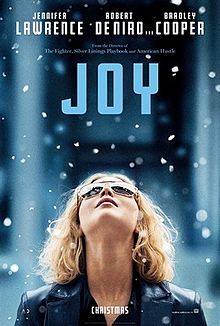
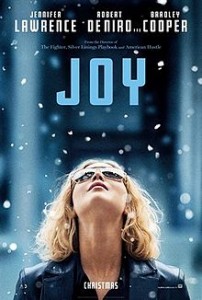
Jennifer Lawrence is “Joy,” reuniting with her “American Hustle” and “Silver Linings Playbook” #squad, director David O. Russell and co-stars Robert De Niro and Bradley Cooper. She plays real-life consumer products inventor and television sales mogul Joy Mangano, who lived something of a Cinderella story — if the fairy godmother was the QVC shopping channel.

The film is something of a mess. It never quite comes together, but some of the individual pieces are marvelous, especially the performances by Lawrence, radiant in her first adult lead (though she still seems too young to have those children), Virginia Madsen as Joy’s dotty mother, De Niro as her father, and Isabella Rossellini as his wealthy new girlfriend. Cooper has so much magnetism as a QVC executive that his tour of the network’s revolving studio provides one of the best moments. He is so good it misdirects us about where the movie is going and leaves us feeling vaguely cheated.

Russell, who so savagely took out after both consumer culture and at those who attack it for the most superficial reasons in the underrated “I Heart Huckabees,” cannot seem to settle into a point of view beyond the idea that the woman with the almost-too-on-the-nose name has the ingenuity and what used to be called moxie to overcome obstacles that include massive family dysfunction and business partners who bully and defraud her. It emphasizes her ability as an inventor and her determination but loses track of the storyline with confusing sequencing and superfluous narration. When a prospective funder asks her if she would be willing to pick up a (possibly metaphorical) gun to protect her invention, she says she would. And when she is turned down, she keeps coming back. But the primary factors in the success of her product are a chance connection and a much-too-convenient discovery of incriminating evidence. The most interesting elements of the story are abruptly glossed over (What? Who sued her?). And lovingly staged episodes from Joy’s mother’s favorite soap opera (starring real-life soap stars including Susan Lucci) are not nearly as entertaining or illuminating as they are intended to be.

Joy has monumental obstacles to overcome and Russell clearly considers her heroic, but there is a heightened gloss on the story that keeps us at a remove. A moment of particular triumph is truncated and artificial and the narration is clumsy and intrusive. “In America,” Cooper’s character tells us, “the ordinary meets the extraordinary every day.” But in this movie, that meeting is awkward, and the result is buyer’s remorse.

Parents should know that this movie includes themes of family conflict and dysfunction, corrupt, thuggish, and fraudulent behavior, some sexual references, and some strong language.

Family discussion: Why did Joy keep taking care of everyone in her family? What did Neil mean about staying friends? What invention would you like to create?

If you like this, try: “Erin Brockovich”

Related Tags:


Based on a true story Biography Family Issues
Daddy’s Home

Daddy’s Home

Posted on December 24, 2015 at 5:25 pm

Copyright Paramount 2015
It is sometimes said that competition between men is a substitute for comparing their male body parts. In “Daddy’s Home,” the men actually lower their trousers — in front of a doctor and a woman who has been married to them both — so they can measure their differences. Belief me, metaphoric competition is better.

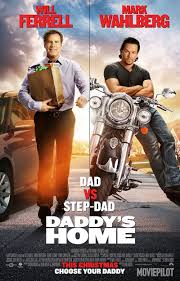
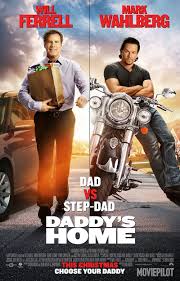
Will Ferrell and Mark Wahlberg, who were terrific together in the buddy cop film The Other Guys, reunite with far less success in “Daddy’s Home,” about the battle between a stepdad and a biological dad for the affections of the wife and children.

Ferrell plays Brad, a decent, devoted, responsible, guy who wants more than anything in the world for his stepchildren to love him. It is supposed to be very funny that (1) he lost his ability to have his own biological children in a dental x-ray machine accident depicted in the film’s first moments, (2) he works for a Smooth Jazz station, and (3) his little step-daughter draws a family portrait that shows him with a knife in his head and poop in his hair. Wahlberg is Dusty, Brad’s worst nightmare. He is dashing, exotic, mysterious, and he looks like Mark Wahlberg.

Each tries to outdo the other to impress the children, their mother (Linda Cardellini), Brad’s boss (Thomas Hayden Church), the fertility doctor (Bobby Cannavale), the handyman (Hannibal Buress in one of the film’s few bright spots), and anyone else they can find.

This is a great issue to explore with comedy and heart. Unfortunately, in this film the comedy is not funny and the heart is missing. The competition is all about the men vying against each other; there is not even the most perfunctory suggestion of any benefit for the children or even any consideration of their feelings. They exist as props, and Cardellini is relegated to a thankless role somewhere between sympathy and scold. Ferrell and Wahlberg still have great chemistry, but their characters are just pale imitations of roles we’ve seen them in too many times. A series of lackluster skits based on insults, virility panic, and slapstick don’t make a movie.

Parents should know that this film includes extremely crude and raunchy content with many sexual, reproductive, and bodily function references, drunkenness, very strong language, and themes of rivalry between step and biological fathers.

Family discussion: What did Brad and Dusty most dislike about each other? What did each do best?

If you like this, try: “Big Daddy” and “The Other Guys”

Related Tags:


Comedy Family Issues
The Ringer

The Ringer

Posted on December 20, 2015 at 3:49 pm

B-
Lowest Recommended Age: Middle School
MPAA Rating: Rated PG-13 for crude and sexual humor, language and some drug references.
Profanity: Some crude language
Alcohol/ Drugs: Scenes in bar, character chews a cigar
Violence/ Scariness: Comic peril and violence, serious injury played for humor
Diversity Issues: A theme of the movie
Date Released to Theaters: December 23, 2015
Date Released to DVD: March 23, 2016

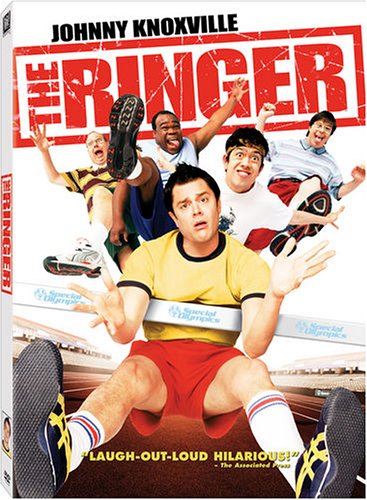
The single most interesting aspect of The Ringer, a movie about a man who pretends to be disabled so that he can compete in the Special Olympics, is that the movie was made in cooperation with and with the endorsement of the Special Olympics organization, and 150 Special Olympics athletes appear in the film.

Unfortunately, the story of how the movie got made is much more interesting than the formulaic story of the movie itself. Steve (Johnny Knoxville), a nice non-disabled guy who needs money to help someone get an operation pretends to be “high-functioning developmentally disabled” to compete in the Special Olympics. He assumes that as a former high school track athlete, he will have no trouble winning, so that his gambler uncle (Brian Cox) can win a huge bet, paying off his own gambling debts and getting the money for an operation. Of course Steve (1) learns that he is the one with the more serious disability, and (2) meets a very pretty volunteer at the Special Olympics (Katherine Heigl as Lynn). You know the rest.

The one thing that is not formula in this movie is its portrayal of the developmentally disabled athletes as loyal, dedicated, smarter than most people think, and very funny. While the non-disabled people in the movie are often clueless, inept, or corrupt, the Special Olympians are on to Steve almost immediately, and they don’t just out-smart him; they out-nice him, too. They become the first real friends he has ever had.

This aspect of the movie provides some fresh and funny moments, but too much of the film is taken up with sub-par “jokes” like Steve’s uncle registering him for the competition under the name of a notorious serial killer and a man having three of his fingers cut off in a lawnmower. The developmentally disabled cast members show considerable charm, especially Edward Barbanell as Steve’s roommate, Billy.   Barbanell contributed the movie’s funniest line and delivers it with exquisite comic timing. But a lackluster script and charm-free performances by Knoxville and Cox don’t do justice to the Special Olympians in the story or in the cast. Furthermore, despite its best intentions, the use of non-disabled actors to play disabled characters in many of the key roles gives the film an air of condescension that is never fully overcome. I’m glad the Special Olympians have been recognized in a mainstream Hollywood movie; I just wish it was the movie they deserved.

Parents should know that the movie has some crude language and crude humor, including getting hit in the crotch. Characters drink (scenes in a bar) and smoke (Steve’s uncle is constantly chewing on a cigar).
Families who see this movie should talk about friends and family members with disabilties and how to prevent prejudice against them.

Families who enjoy this movie will also enjoy an old movie called Miss Tatlock’s Millions, in which a man pretends to be a long-lost heir who is developmentally disabled so that he can get the money. They will also enjoy Stuck on You (some mature material), directed by the Farrelly brothers, who produced this film. They cast disabled performers in all of their movies and the credit sequence in Stuck on You has a lovely speech by one of them about how much the experience meant to him. A scholarly article from Disability Studies Quarterly explores the portrayal of disabled people in the Farrellys’ movies.

Families who see this movie should talk about what Steve learned from his experience and why.

Families who want to learn more about how this movie was made can learn about what it takes to be a Special Olympian.   I recommend this report from the magazine of the Special Olympics organization and this statement from the heads of the organization about what they hoped the film would accomplish:

“Laughing at a person and laughing with a person are very different forms of humor, and it is our belief that this comedy will give audiences the chance to laugh with Special Olympics athletes while appreciating their joy and wisdom. Equally importantly, we believe that the stigmas presented in the early scenes of the movie will be seen as folly by the end of The Ringer. Many of us know all too well how hurtful insensitive words can be. Special Olympics hopes people seeing the movie will be inspired to reach out to people with intellectual disabilities and say, to quote Special Olympics athlete Troy Daniels, ‘Come sit by me’ – a simple gesture that reflects a world of acceptance and mutual respect.”

The Special Olympics, founded by Eunice Shriver, the sister of President John F. Kennedy, now serves more than 1.7 million developmentally disabled athletes in more than 200 programs in more than 150 countries.

Related Tags:


Comedy DVD/Blu-Ray Sports
THE MOVIE MOM® is a registered trademark of Nell Minow. Use of the mark without express consent from Nell Minow constitutes trademark infringement and unfair competition in violation of federal and state laws. All material © Nell Minow 1995-2026, all rights reserved, and no use or republication is permitted without explicit permission. This site hosts Nell Minow’s Movie Mom® archive, with material that originally appeared on Yahoo! Movies, Beliefnet, and other sources. Much of her new material can be found at Rogerebert.com, Huffington Post, and WheretoWatch. Her books include The Movie Mom’s Guide to Family Movies and 101 Must-See Movie Moments, and she can be heard each week on radio stations across the country.

Website Designed by Max LaZebnik