Anomalisa

Anomalisa

Posted on January 7, 2016 at 5:39 pm

B+
Lowest Recommended Age: Adult
MPAA Rating: Rated R for strong sexual content, graphic nudity and language
Profanity: Very strong and explicit language
Alcohol/ Drugs: Drinking
Violence/ Scariness: Peril and unhappiness
Diversity Issues: None
Date Released to Theaters: January 8, 2016

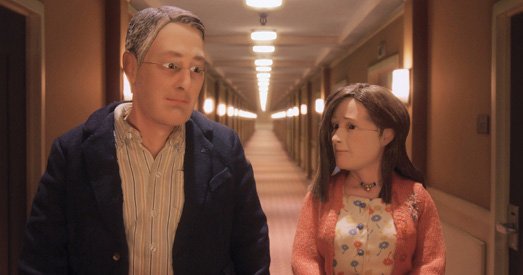
The “Fregoli delusion” sometimes called the delusion of doubles, is a rare disorder that makes people believe that everyone else in the world is in fact a single person who changes appearance or is in disguise. When Michael Stone (David Thewlis) checks into the Fregoli hotel in this stop-motion animated film from Charlie Kaufman (“Being John Malkovich,” “Adaptation,””Eternal Sunshine of the Spotless Mind”), we begin to understand why it is that everyone else we have seen in the film’s first few moments including the passenger sitting next to Stone on the airplane and his cab driver, have the same face and voice (Tom Noonan).

Copyright Paramount 2015

Even his wife and child speak with Noonan’s voice.

Michael checks into the hotel on a business trip. He will be the speaker at a conference on customer service. He has written an acclaimed book on the subject. He teaches customer service representatives, the subject of near-universal frustration and derision. He tells them “Each person you speak to has had a day.” He tries tell them to be aware of what is special about each individual, but around him everyone seems the same. And Michael himself, as he speaks of humanity, is, well, a puppet. Literally. This stop-motion animated film is remarkably realistic with one of the most authentically awkward sex scenes in cinema history. But the figures themselves, expressive as they are and fluid in their movements, are frankly artificial, with clear breaks on their faces at eye level so we can see how the various face parts get swapped in and out to create emotions.

Michael calls a former girlfriend and they meet for a painfully clumsy conversation. And then he happens upon two other hotel guests, women who are in town for the conference and looking forward to hearing him speak. One is Lisa (Jennifer Jason Leigh), a shy woman, self-conscious about a scar on her face, and often second-guessing herself or making self-deprecating comments that anticipate being judged a failure or a bother by those around her.

She thinks that if he is going to make a pass at anyone, it will be her friend, and clearly the friend (who, like everyone else, has the voice of Tom Noonan), does, too. But it is Lisa Michael invites back to his room. She is an anomaly, he tells her. Something about her voice. Anomaly. Lisa. Anomalisa.

The film is beautifully designed. Michael’s hotel room and the hotel bar are masterpieces of bland and yet somehow sinister anonymity. An encounter with a hotel employee who has an office so enormous it must be traversed by golf cart is reminiscent of the daffy between-floors half-level ceilinged office in “Being John Malkovich.” Any writer is in a sense a puppetmaster, and we have seen Kaufman’s fascination with puppets before; in “Being John Malkovich,” John Cusack’s character was a puppeteer and the various characters in essence used actor John Malkovich (playing a version of himself) as a puppet when they took over his consciousness. In “Synecdoche, New York,” Philip Seymour Hoffman’s character was a playwright trying to maintain control over an increasingly uncontrollable narrative. Here the puppets give Kaufman the greatest possible control over the way the story appears and the way it is told. Stop-motion is so exacting that only seconds of footage are completed each day and the sex scene alone took six months to complete. It also allows him to explore issues of memory, identity, imagination, and loneliness. Dream-like images demonstrate through both illustration and contrast the reality behind the platitudes in Michael’s speech. Just as a raw and needy reality keeps bursting through his remarks, the anguish and hopelessness he feels — and the fear and hopefulness that Lisa feels — transcend the plastic pieces of the dolls who are, it must be said, acting.

For a brief moment, it seems Michael has found something extraordinary. But when he tries to find a way to stay with her, the Fregoli syndrome — or maybe just his terror of genuine intimacy — kicks in. By that time, our own connection to these characters, as artificial as they appear, or, perhaps because of the oddness of their artificiality, is surprisingly warm and intimate.

Parents should know that this film includes very explicit sexual situations and frontal male (puppet) nudity, very strong and explicit language, drinking, and adultery.

Family discussion: What does the name of the hotel tell us about the story? Why did Lisa’s voice change?

If you like this, try: “Being John Malkovich” and “Adaptation” by the same screenwriter

Related Tags:


Animation Drama Movies -- format
The Revenant

The Revenant

Posted on January 7, 2016 at 5:35 pm

B+
Lowest Recommended Age: Mature High Schooler
MPAA Rating: Rated R for strong frontier combat and violence including gory images, a sexual assault, language and brief nudity
Profanity: Some strong and racist language
Alcohol/ Drugs: Drinking
Violence/ Scariness: Intense, graphic, and disturbing violence including arrows, knives, guns, sexual assault and prolonged animal attack
Diversity Issues: A theme of the movie
Date Released to Theaters: January 8, 2016
Date Released to DVD: April 18, 2016
Amazon.com ASIN: B01AB0DX2K
Copyright 20th Century Fox 2015

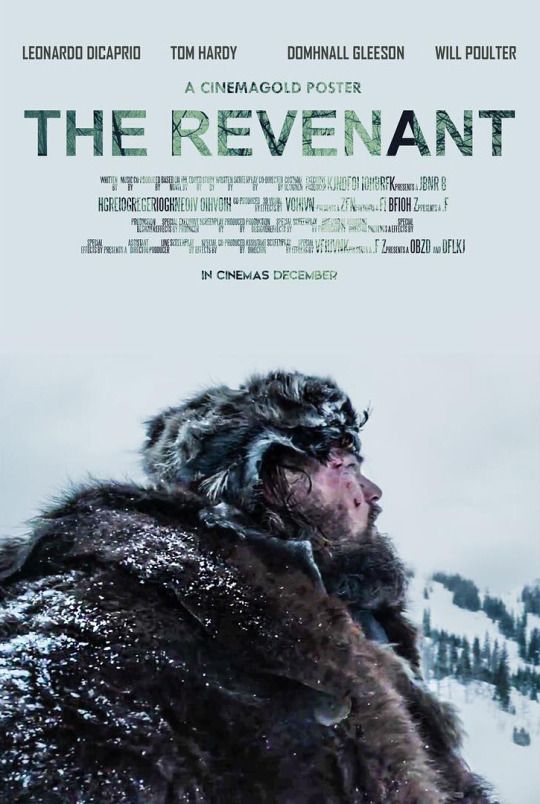
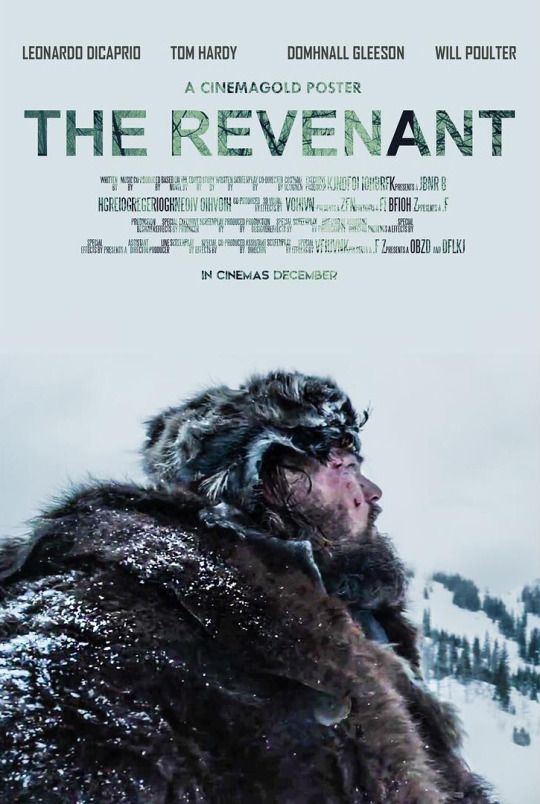
In the 1820’s, ladies of fashion liked fur trim. And, true then as now, men like money. So frontiersmen went on trapping expeditions into the wilderness of the young country of the United States of America (played here by British Columbia and Alberta, Canada). The rewards for bringing back fur pelts are significant. The risks, including attack by the Arikara Indians, are dire.

A frontiersman named Hugh Glass was the guide for one of these expeditions. According to lore, he was savagely attacked by a bear and left to die by his companions, but survived and made it back over 250 miles to the nearest fort, intent on revenge. The story has been told — and embroidered and adapted — over the years, reflecting each era’s perspective and concerns. This version is based on the novel by US Trade Michael Punke (who, as Deputy US Trade representative and Ambassador to the World Trade Organization is restricted from promoting the film). As co-written and directed by “Birdman’s” Alejandro González Iñárritu it is a story of resolve. As often with Westerns, it is a way to explore the fundamental contradictions of the American spirit: determination, vision, courage, but sometimes without any regard for the damage they can cause.

Both Iñárritu and his Director of Photography Emmanuel Lubezki won Oscars for this film. They filmed only in available light, meaning they had to limit themselves to just moments of filming each day. As the director told Deadline, they created “little-by-little jewel moments; that’s the way I designed the production…But those locations are so gorgeous and so powerful, they look like they have never been touched by a human being, and that’s what I needed.” They filmed under conditions so arduous that Will Poulter, who plays real-life frontiersman/trapper Jim Bridger, told me that no acting was necessary to show that they were freezing and exhausted. The bear is CGI (and the bear attack is truly horrifying), but almost everything else was really there and really happening, including diCaprio’s hacking coughs (he had the flu).

The cinematography is the most stunning I have ever seen, perfectly focussed throughout the depth of field, even across endless vistas. Second only to the visuals is the movie’s real theme, not revenge or even will, but law.

When there is no structure, no church, no police, courts, or jail, no lawmakers, no appeals, how do you decide who is in charge and what to do? The film’s most fascinating moments are the ones where we see characters across the continuum on those questions, with one in particular who is still deciding where he fits in, decide what they should do, what they must do. In an early scene, the Indians attack and the frontiersmen’s response is: pelts payload first, and every man for himself second. Wounded men are left behind without a second’s hesitation.

But when Glass (Oscar-winner Leonardo DiCaprio) is critically wounded in the middle of nowhere, Captain Henry, the leader of the expedition (Domhnall Gleeson) is certain what he is owed. Because he has been an essential and honorable part of their expedition (and, unstated but evident, because no one is shooting arrows at them at the moment), he decides two men will be left behind to care for him until he dies and then give him some semblance of a Christian burial. They are John Fitzgerald (Tom Hardy) and Bridger (17 years old at the time). Glass has a teenage son (Forrest Goodluck), from his marriage to a Native American woman who was killed, and he stays with his father as well.

But Fitzgerald becomes impatient and commits a terrible act of cruelty while Bridger is away from the campsite, then lies to him about what happened. Glass is left for dead. As Glass, Fitzgerald, Henry, and Bridger deal with the consequences of these actions, we see the beginnings of a society and culture. Some day, the pristine landscapes explored by Glass and Bridger would be covered with roads and cities and we will try to re-create them by filming in other countries to show us what we were. But the story of the struggle for justice, always the great work of this country, is a story we will keep telling forever.

Parents should know that this film includes extremely graphic and disturbing human and animal violence with many explicit and disturbing images of dead bodies and wounds, murder of family members, sexual assault, brief nudity, some strong language, and racism.

Family discussion: How many different views about law and morality do you see among the characters? What should the group have done with a severely injured member?

If you like this, try: “Touching the Void,” a documentary about an extraordinary story of survival in the wilderness

Related Tags:


Based on a book Based on a true story Drama DVD/Blu-Ray Pick of the Week Epic/Historical Western
Concussion

Concussion

Posted on December 24, 2015 at 7:54 pm

C
Lowest Recommended Age: Middle School
MPAA Rating: Rated PG-13 for thematic material including some disturbing images, and language
Profanity: Some strong language
Alcohol/ Drugs: Alcohol and drug abuse
Violence/ Scariness: Themes of severe brain trauma, dementia, substance abuse, domestic abuse, suicide
Diversity Issues: Some bigotry and xenophobia
Date Released to Theaters: December 25, 2015

Copyright Sony 2015
Copyright Sony 2015
It is a true story that seemed to have all the elements for a heartwarming, uplifting story about speaking truth to power, told with big stars and lots of Hollywood gloss. And yet, it does not work. In football terms, it’s a fumble.

Dr. Bennet Omalu (Will Smith) is a pathologist, an immigrant from Nigeria, with an assortment of degrees and certifications. He lives very quietly and is devoted to his work. When he is asked to perform an autopsy on former Pittsburgh Steelers four-ring center Mike Webster (David Morse), something does not seem right to him. His office will not authorize additional tests, so he pays for them himself: $20,000 to prepare very thin slices of Webster’s brain so that Omalu can figure out why a man who was just 50 had amnesia, depression, and dementia, with indications of brain damage normally not found until extreme old age or severe injury. The tests revealed a syndrome Omalu called CTE: chronic traumatic encephalopathy.

Omalu wanted to find out how pervasive this problem was among former professional football players. But there was a lot of money and a lot of power with no interest in finding out whether a game — no an industry — that “owns a day of the week” and employs tens of thousands of people might be so unsafe for its players that it put the future of professional football at risk.

He gets an ally in former NFL doctor Julian Bailes (Alec Baldwin). And while some of his colleagues consider him a troublemaker or even a traitor, his boss (Albert Brooks) is on his side.

Art didn’t imitate life, but it was most likely shaped by it. The 2014 Sony hack revealed memos that raised concerns from studio executives about the sensitivity of the subject matter and the response of the NFL. That may be why a film about integrity and courage pulls its punches. It ramps up the implications of pressure, unpersuasively attempting to tie unrelated professional and personal setbacks to the NFL. A climactic job offer does not have the meaning that the film attempts to assign to it. Gugu Mbatha-Raw is sadly underused as the loyal spouse. And Smith himself is underused with a one-note performance that makes Omalu a cardboard figure. A movie about courage shows very little of its own.

NOTE: Slate’s Daniel Engbar contradicts some of the allegations in the film. The week of the film’s release, the NFL pulled its funding from an independent research project about the link between professional football and brain injuries.

Parents should know that this story concerns severe traumatic brain injury from professional sports with catastrophic consequences including dementia, substance abuse, domestic abuse, and suicide, as well as the obstructionist efforts by the authorities to deny the injuries, some strong language.

Family discussion: Why did Bennet Omalu pay for the additional tests? Why didn’t the NFL do more to protect its players? Who is most like Dr. Omalu in your life?

If you like this, try: “The Pursuit of Happyness”

Related Tags:


Movies -- format
Joy

Joy

Posted on December 24, 2015 at 5:38 pm

Copyright 20th Century Fox 2015

Jennifer Lawrence is “Joy,” reuniting with her “American Hustle” and “Silver Linings Playbook” #squad, director David O. Russell and co-stars Robert De Niro and Bradley Cooper. She plays real-life consumer products inventor and television sales mogul Joy Mangano, who lived something of a Cinderella story — if the fairy godmother was the QVC shopping channel.

The film is something of a mess. It never quite comes together, but some of the individual pieces are marvelous, especially the performances by Lawrence, radiant in her first adult lead (though she still seems too young to have those children), Virginia Madsen as Joy’s dotty mother, De Niro as her father, and Isabella Rossellini as his wealthy new girlfriend. Cooper has so much magnetism as a QVC executive that his tour of the network’s revolving studio provides one of the best moments. He is so good it misdirects us about where the movie is going and leaves us feeling vaguely cheated.

Russell, who so savagely took out after both consumer culture and at those who attack it for the most superficial reasons in the underrated “I Heart Huckabees,” cannot seem to settle into a point of view beyond the idea that the woman with the almost-too-on-the-nose name has the ingenuity and what used to be called moxie to overcome obstacles that include massive family dysfunction and business partners who bully and defraud her. It emphasizes her ability as an inventor and her determination but loses track of the storyline with confusing sequencing and superfluous narration. When a prospective funder asks her if she would be willing to pick up a (possibly metaphorical) gun to protect her invention, she says she would. And when she is turned down, she keeps coming back. But the primary factors in the success of her product are a chance connection and a much-too-convenient discovery of incriminating evidence. The most interesting elements of the story are abruptly glossed over (What? Who sued her?). And lovingly staged episodes from Joy’s mother’s favorite soap opera (starring real-life soap stars including Susan Lucci) are not nearly as entertaining or illuminating as they are intended to be.

Joy has monumental obstacles to overcome and Russell clearly considers her heroic, but there is a heightened gloss on the story that keeps us at a remove. A moment of particular triumph is truncated and artificial and the narration is clumsy and intrusive. “In America,” Cooper’s character tells us, “the ordinary meets the extraordinary every day.” But in this movie, that meeting is awkward, and the result is buyer’s remorse.

Parents should know that this movie includes themes of family conflict and dysfunction, corrupt, thuggish, and fraudulent behavior, some sexual references, and some strong language.

Family discussion: Why did Joy keep taking care of everyone in her family? What did Neil mean about staying friends? What invention would you like to create?

If you like this, try: “Erin Brockovich”

Related Tags:


Based on a true story Biography Family Issues
Daddy’s Home

Daddy’s Home

Posted on December 24, 2015 at 5:25 pm

Copyright Paramount 2015
It is sometimes said that competition between men is a substitute for comparing their male body parts. In “Daddy’s Home,” the men actually lower their trousers — in front of a doctor and a woman who has been married to them both — so they can measure their differences. Belief me, metaphoric competition is better.

Will Ferrell and Mark Wahlberg, who were terrific together in the buddy cop film The Other Guys, reunite with far less success in “Daddy’s Home,” about the battle between a stepdad and a biological dad for the affections of the wife and children.

Ferrell plays Brad, a decent, devoted, responsible, guy who wants more than anything in the world for his stepchildren to love him. It is supposed to be very funny that (1) he lost his ability to have his own biological children in a dental x-ray machine accident depicted in the film’s first moments, (2) he works for a Smooth Jazz station, and (3) his little step-daughter draws a family portrait that shows him with a knife in his head and poop in his hair. Wahlberg is Dusty, Brad’s worst nightmare. He is dashing, exotic, mysterious, and he looks like Mark Wahlberg.

Each tries to outdo the other to impress the children, their mother (Linda Cardellini), Brad’s boss (Thomas Hayden Church), the fertility doctor (Bobby Cannavale), the handyman (Hannibal Buress in one of the film’s few bright spots), and anyone else they can find.

This is a great issue to explore with comedy and heart. Unfortunately, in this film the comedy is not funny and the heart is missing. The competition is all about the men vying against each other; there is not even the most perfunctory suggestion of any benefit for the children or even any consideration of their feelings. They exist as props, and Cardellini is relegated to a thankless role somewhere between sympathy and scold. Ferrell and Wahlberg still have great chemistry, but their characters are just pale imitations of roles we’ve seen them in too many times. A series of lackluster skits based on insults, virility panic, and slapstick don’t make a movie.

Parents should know that this film includes extremely crude and raunchy content with many sexual, reproductive, and bodily function references, drunkenness, very strong language, and themes of rivalry between step and biological fathers.

Family discussion: What did Brad and Dusty most dislike about each other? What did each do best?

If you like this, try: “Big Daddy” and “The Other Guys”

Related Tags:


Comedy Family Issues
THE MOVIE MOM® is a registered trademark of Nell Minow. Use of the mark without express consent from Nell Minow constitutes trademark infringement and unfair competition in violation of federal and state laws. All material © Nell Minow 1995-2026, all rights reserved, and no use or republication is permitted without explicit permission. This site hosts Nell Minow’s Movie Mom® archive, with material that originally appeared on Yahoo! Movies, Beliefnet, and other sources. Much of her new material can be found at Rogerebert.com, Huffington Post, and WheretoWatch. Her books include The Movie Mom’s Guide to Family Movies and 101 Must-See Movie Moments, and she can be heard each week on radio stations across the country.

Website Designed by Max LaZebnik