

Interview: Brian Stelter and Andrew Rossi of ‘Page One’
Posted on June 28, 2011 at 8:00 am
“Page One” takes us behind the scenes at the New York times in a year of turmoil and transition. We see how its media reporters cover their own industry. We see the release of the first Wikileaks material and how it competes with and is reported on and interpreted by the main-est of the mainstream media. We see how the Times buys out and lays off experienced staff and brings on a college student who has been scooping them with his blog about television news. I sat with director Andrew Rossi and blogger-turned New York Times reporter Brian Stetler in the sunny courtyard of a Washington DC hotel to talk with them about reporting on the reporters and the future of journalism.
A recent law school class was asked how many of them read a paper newspaper every morning and not one hand went up. What does that mean about the future of newspapers and of news?
Stelter: People get the news in different sources. They may be getting links on Twitter or Facebook. As Katrina vanden Heuvel says in the film, there’s lots of information out there. That’s the predicament “Page One” is trying to address.
I thought the most powerful statement in the film was “Daniel Ellsberg needed us. Wikileaks does not.” And yet, the movie shows that reader do need the New York times to digest and interpret and verify the material.
Stelter: In a day where everyone can be a publisher, not everyone can be an editor. The film fundamentally is about editing. You see reporters and editors figuring out what’s news and what’s not news and in the case of Wikileaks, figuring out how to cover someone who is a publisher, but not an editor. Wikileaks does sometimes redact material and decide what not to post, but fundamentally they’re not bringing to bear those judgment calls that journalists are. I love the movie for those scenes with editors where you see them making judgment calls.
We’ve seen new media blow the whistle on failures of old media and old media expose the failures and misrepresentations of new media. Are we going to be in an endless cycle of “gotcha?”
Stelter: That’s an element going forward, one element of a complicated structure. It’s good that we can all truth squad each other. In the film you see the Times trying to decide how to handle a report by NBC news about the end of the Iraq war and eventually deciding not to write about it because it was, I don’t want to say an imagined end but a “mission accomplished” moment.
It was surprising to see in the film the way Brian Williams made NBC’s role a part of the story and fascinating to watch the reaction in the newsroom.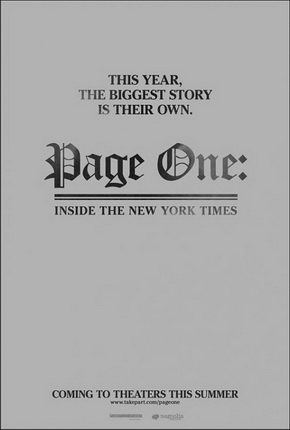
Stelter: It baffles my mind.
How do the changes in media and reporting affect elections and politics?
Stelter: We get more saturated by the day-to-day minutia of the campaigns. It’s easier to write about and follow along. What me may lose there is the broader picture. But the other change is the interactivity. Citizens now can prod journalists to cover the campaign differently. Readers, listeners, viewers can push us to do a better job. We’ve seen some of that already but we will see more going forward. That’s one reason transparency is such a positive force. We can talk back in a way we couldn’t before. I love when readers talk back to me and tell me what to improve on.
I was very intrigued by the use of music in the film. How did you select it?
Rossi: “Paper Tiger” is the song that plays beneath the credits. It’s by Beck. It has a very sort of somber but driving sound and David Carr’s final lines in the film that drive the song are “The New York Times does not need to be a monolith to survive.” I think that is one of the very important messages of the film. There are multiple voices and there shouldn’t be any Zeus character with thunderbolts saying, “This is the only truth that can be known.” “Paper Tiger,” there’s a double entendre because of the word “paper” but it is also an expression the Chinese have for something that seems scary but really is not. Mao used to use that expression to refer to Russia and England as monolithic powers that were really just made of paper. The song has the right audiophilic quality but also a double meaning. Paul Brill did the score. He’s worked a lot on films that treat very serious topics but in ways that are accessible and have an entertainment value. That is the type of palette we were going for in the film.
You include reporters who cover the business side of the media, but you do not include anyone from the business side of the New York Times. Why is that?
Rossi: There’s a high and firm wall between the newsroom and the corporate side. Bill Keller, the executive editor, authorized the project after various discussions and meetings and it was really done under the purview of the newsroom so we really never butt up against the corporate side. I did request an interview with the publisher and CEO, both of whom declined. The film is really trying to look at the journalism involved, though certainly we treat the financial obstacles.
What’s the difference between writing for the web and writing for print?
Stelter: Paper is so permanent, a one time shot to get it right and there’s a high cost to making a correction. If I write something for the web in the afternoon I can make it better all day and then put the final product in the paper. Corrections are the first symbol of us opening ourselves up to the public. This movie is just another form of transparency.



 , his passing reminds us of his wide-ranging work as everything from a singing gangster to an animated shark. He was the story-telling grandfather in
  , the spy who created pre-wedding chaos in the original (and far better) “The In-Laws” (1979), the neglected gem inspired by a true story about a grandfather who raises first his grandson and then his great-grandchildren in
  , and an essential contributor to the ground-breaking naturalism of pioneering indie-film director John Cassavetes in films like
  . His live theater work included a Tony award- winning performance in Neil Simon’s “The Prisoner of Second Avenue” and he was twice nominated for an Oscar, for “Murder Inc.” and “Pocket Full of Miracles.” Many of his fans never realized that he had a glass eye because of cancer when he was a child or that he was a CPA.