Good Fortune

Good Fortune

Posted on October 16, 2025 at 7:44 pm

B +
Lowest Recommended Age: High School
MPAA Rating: Rated R for language and some drug use
Profanity: Very strong language
Alcohol/ Drugs: Drinking, smoking, drugs
Violence/ Scariness: Comic peril, no one hurt
Diversity Issues: Diverse characters
Date Released to Theaters: October 17, 2025

If you could trade places with someone, who would it be? Going back to Mark Twain’s The Prince and the Pauper (this is the best movie version), the idea of switching lives with someone who seems to have a more comfortable, secure, happier existence has been an appealing fantasy. The stories usually end with the discovery that the original life was better, harking back to the old Indian aphorism that you should never judge someone until you have walked in his moccasins. We’ve seen that play out in Hallmark movies (the “Princess Switch” trilogy and “Switched for Christmas”), with focus on family in “Freaky Friday” and all of its many remakes and variations, and, sometimes with more commentary on class and economic issues, as in “Trading Places.”

Copyright 2025 Lionsgate

Aziz Ansari’s “Good Fortune” draws from all of the above with a smart, fresh, and funny take on the switched lives fantasy that has some punch in its depiction of the gig economy, the people who struggle with it and the people who profit from it.

Keanu Reeves is well cast as an angel named Gabriel, first seen in a nod to Wim Wnders’ “Wings of Desire” as he stands on top of a skyscraper, gazing down at humanity with a serious but patient and benign expression.

While other angels are responsible for big, life-changing, highly satisfying tasks, like showing a despondent man the value of his life (Stephen McKinley Henderson as Azrael), Gabriel is relegated to “texting while driving” duty. All he does is ride invisibly in the back seat of cars and touch the shoulder of the texting drivers to remind them to pay attention. He may be saving their lives but he is not involved in their lives. He complains to his supervisor, Martha (Sandra Oh) that he wants to save lost souls, but she tells him that is a complicated and demanding task and he, with the small wings of a trainee, is not ready.

Writer-director Ansari plays Arj, living in his car as he tries to stay afloat with an assortment of gig jobs, assembling furniture, waiting in line, delivering food. He lies to his father about having a new apartment as his father tells him about the success of his cousin Nuveen who works for Microsoft.

A wealthy venture capitalist named Jeff (Seth Rogen) hires Arj to clean up his garage. Arj offers to stay on as his assistant, and Jeff agrees to a one-week trial. It goes very well at first but when something goes wrong, Jeff fires Arj.

Gabriel, who has been watching Arj, decides that he has found a lost soul. And he decides that the way to make Arj appreciate all he has to live for is to switch him with Jeff. Martha asks what Gabriel is doing, and he says, “I tried to show him that wealth wouldn’t solve all his problems. It seems to have solved most of his problems.” Arj is having the time of his live in Jeff’s fabulous house and also enjoying Jeff’s having to learn what it’s like at the bottom of the socio-economic hierarchy.

We get to enjoy our own wish fulfillment on both counts, and the movie is packed with jokes that are shrewd as well as hilarious, with specifics about the details on both sides. Ansari’s range as an actor is limited but he mitigates that by writing around those limits. Rogen keeps getting better and Reeves is well cast, especially when Martha takes his wings and makes him a human, so he gets to try human pleasures like burgers, milkshakes, “chicken buggies,” and dancing for the first time. Reeves can have a blank quality that works very well in roles like John Wick, Neo, and Ted Logan. Here, though looking gaunt with his beard and long hair, it helps convey Gabriel’s innocence. The three of them have excellent chemistry. And there is the always-wonderful Keke Palmer, bringing endless warmth, grace, and good humor to give life to an underwritten role as a big-hearted co-worker who wants to organize a union and becomes Arj’s love interest.

This movie reminded me of Ken Loach’s “Sorry We Missed You,” a devastating look at the corrosive, dehumanizing, exploitive impact of the gig economy, with its faux “you’ll be our partner, not an employee” bait and switch. This film has the same impact, taking on the small indignities, dispiriting invisibility, and shattering hopelessness of the working poor with the same specificity in a highly comic fantasy/comedy. Ansari wants to make us laugh because he likes being funny, but he also wants to make us laugh because he knows that is how unsettling realities bypass our defenses.

Parents should know that this film has very strong language, smoking, drinking, and drugs.

Family discussion: What did Arj learn from living Jeff’s life? Who would you like to trade places with? What should qualify an angel for a higher-level responsibility?

If you like this, try: “Here Comes Mr. Jordan”
Related Tags:


Comedy Fantasy Movies -- format Movies -- Reviews
Dumb Money

Dumb Money

Posted on September 14, 2023 at 5:15 pm

B +
Lowest Recommended Age: Mature High Schooler
MPAA Rating: Rated R for pervasive language, sexual material, and drug use
Profanity: Constant very strong and crude language
Alcohol/ Drugs: Alcohol and brief drug use
Violence/ Scariness: None
Diversity Issues: None
Date Released to Theaters: September 15, 2023
Date Released to DVD: November 13, 2023

Copyright Sony 2023
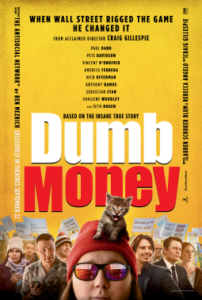
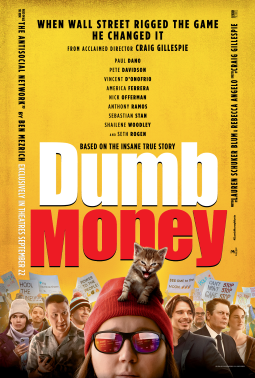
Crazy times create crazy events. There has seldom been a crazier time in the United States than the early months of the pandemic and there has seldom been a crazier series of events in the modern history of investing than the time a group of small individual investors with very little capital took on some of the wealthiest and most powerful people on Wall Street and they kind of won. Now that sounds like a movie, and, for the second time, it is.

First there was the documentary, Eat the Rich: the GameStop Saga. And now, the feature film, “Dumb Money,” with an all-star cast, a smart screenplay by Lauren Schuker Blum and Rebecca Angelo, and lively direction from Craig Gillespie. The movie does a good job of conveying the intricate details of investing and finance in the context of a movie that maintains a heightened tone through sharply executed editing, provocative needle-drops on the soundtrack (beginning with WAP), and minimal exposition.

In very sharp contrast to the music on the soundtrack, Paul Dano plays the central figure, mild-mannered Keith Gill, who lives with his wife, Caroline (Shailene Woodley), and their baby daughter in a modest home in Brockton, Massachusetts. Like a movie superhero, he has a secret identity. By day he was a financial analyst with MassMutual. By night he had not one but two personas, one on the subreddit r/wallstreetbets (DeepF***ingValue) and one on YouTube (Roaring Kitty). In both, he talked about stocks he liked and he revealed his own trades. In January 2021, he announced that he had invested in 50,000 shares and 500 call options for GameStop, the store that sells video games in malls. Most investors, including Wall Street billionaires, thought GameStop was going to go bankrupt. The US was still in pre-vaccine pandemic lockdown, though GameStop somehow got listed as an essential business because it sold some computer peripherals, so the stores were still open. But Keith explained his reasons for thinking the stock, trading at under $4 a share, was undervalued.

The Wall Street billionaires also put their money where their mouths were and bet against the company by going “short,” meaning they would make money if the stock went down. Normally, they would have succeeded. But nothing in this story was normal. It was a perfect storm. First, the pandemic shut everything down and made people feel even more mistrustful of big institutions than they were before. This was especially true of the people of Keith’s generation, who were in school on 9/11 and were entering the job market just as the financial meltdown hit the economy with no consequences for the people who caused it. Second, social media made it possible for anyone, like Keith for example, to express views on platforms that were as accessible as traditional media. And it made it possible for followers to support each other and bring in more. Gill went viral. Third, thanks to a new app with no fees, buying and selling stock and even complicated securities like puts and calls (options) was suddenly as easy as sending a text. And fourth, people were stuck at home. They felt stuck in an unfair world. They did not have access to complex investment securities analysis about big, complicated corporations. But they could understand Roaring Kitty, and they could understand GameStop.

And then, Roaring Kitty. People followed his recommendations because he showed them that he was using his own money, because he was an outsider and therefore more like them, because that trading app on their phones was called Robin Hood and trades were “free,” and, this is the key point, after a while, when it was clear that they were costing the Wall Street short sellers billions as their purchases made the stock go up, they were just as happy to be beating the mega-wealthy as they were to be making thousands, tens of thousands, and in Keith’s case, millions for themselves. The trading app was named Robin Hood, which sounded anti-Wall Street. These new investors came up with a new meme-able term: “stonks,” meaning “we’re doing it our own way and it is more about the fun than about making money.” Their loss is almost entirely limited to their modest investments while the short sellers risk losses one television commentator (in real-life archival footage) calls “infinity.”

Gillespe has a sure hand with a chaotic story, giving us just enough information to follow what is happening without weighing us down with the details of finance. Schuker Blum and Angelo have a sharp sense for telling detail. One of the investors is a GameStop employee (Anthony Ramos) with a bureaucratic boss. We get a glimpse of the gulf between the MBAs at headquarters sending out lists about which products have the highest profit margins (“push the loyalty card!”) and the reality of the tiny shop in the otherwise-empty mall. Other investors include a nurse and single mother (America Ferrara) and a pair of debt-ridden college students played by Talia Ryder and Myha’la. Sebastian Stan appears as Robin Hood co-founder Vladimir Tenev. He claims that they were inspired by Occupy Wall Street and his coyness about how they make money when they do not charge a transaction fee turns out to be very significant when Robin Hood’s connection to another player in this story comes out.

There’s an “Empire Strikes Back” element when the people with billions at risk start playing hardball. But Gill understands that Wall Street is overlooking the app investors the way they look the customers of GameStop and his followers, dazzled by their gains and thrilled by schadenfreude. If they had not felt that they were being treated like losers for so long, the win would not mean as much.

The superb cast includes Clancy Brown and Kate Burton as Keith’s parents and Pete Davidson as his slacker brother, whose job in the movie is to contrast and target for exposition. Nick Offerman is excellent as billionaire Ken Griffin and Seth Rogen is in top form as Gabe Plotkin, the guy whose highly leveraged bet against GameStop turns out to be a monumental mistake. In the beginning of the film, his casual entitlement in talking to a contractor who is supposed to be tearing down a house so Plotkin can have a tennis court is in sharp contrast to his unraveling as things go south. You can see the real Plotkin’s testimony here. (Don’t feel sorry for him. He’s now an owner of the Hornets.) There are a dozen clever details that give the story texture, from the recreation of the stonk memes to the coaching for the zoom testimony to a Congressional committee. (You can see Gill’s testimony here.)

It’s entertaining and thought-provoking. With any luck, it will inspire other Gills to find what the experts overlook, which is, after all, how capitalism works.

Parents should know that this film has non-stop strong and vulgar language, spoken by the characters and on the soundtrack, including the n-word. Characters drink alcohol and briefly smoke marijuana and there is a bawdy, sexualized game at a college party.

Family discussion: Who would you trust to give you investment advice? Why did so many people trust Keith?

If you like this, try: the “Eat the Rich” documentary, the book by Ben Mezrich, and “The Big Short” (Note a brief appearance by the real-life character played by Leonardo DiCaprio in “The Wolf of Wall Street,” Jordan Belfort)

Related Tags:


Based on a true story Comedy Drama DVD/Blu-Ray movie review Movies -- format
Teenage Mutant Ninja Turtles: Mutant Mayhem

Teenage Mutant Ninja Turtles: Mutant Mayhem

Posted on August 2, 2023 at 5:40 pm

B +
Lowest Recommended Age: 4th - 6th Grade
MPAA Rating: Rated PG for sequences of violence and action, language and impolite material
Profanity: Some crude schoolyard language: crap, puke, piss off, etc.
Alcohol/ Drugs: None
Violence/ Scariness: Extended and tense peril and violence, threats of wiping out humanity, scary creatures, weapons, disturbing images, sad deaths, barfing
Diversity Issues: None
Date Released to Theaters: August 4, 2023

Copyright 2023 Paramount
Imagine a movie much more artistically ambitious than the toys it is based on. Yes, that would be “Barbie.” But it turns out “Teenage Mutant Ninja Turtles: Mutant Mayhem” is a nice surprise, with exceptionally inventive and vibrant animation and a funny script from the prolific Seth Rogen and Evan Goldberg (“Superbad,” “Pineapple Express,” “”Sausage Party”), Jeff Rowe (“The Mitchells vs. The Machines”) and Benji Samit and Dan Hernandez (“The Addams Family 2,” “Detective Pikachu”), and an all-star cast of voice talent that knocks the films best lines out of the park and into the next town.

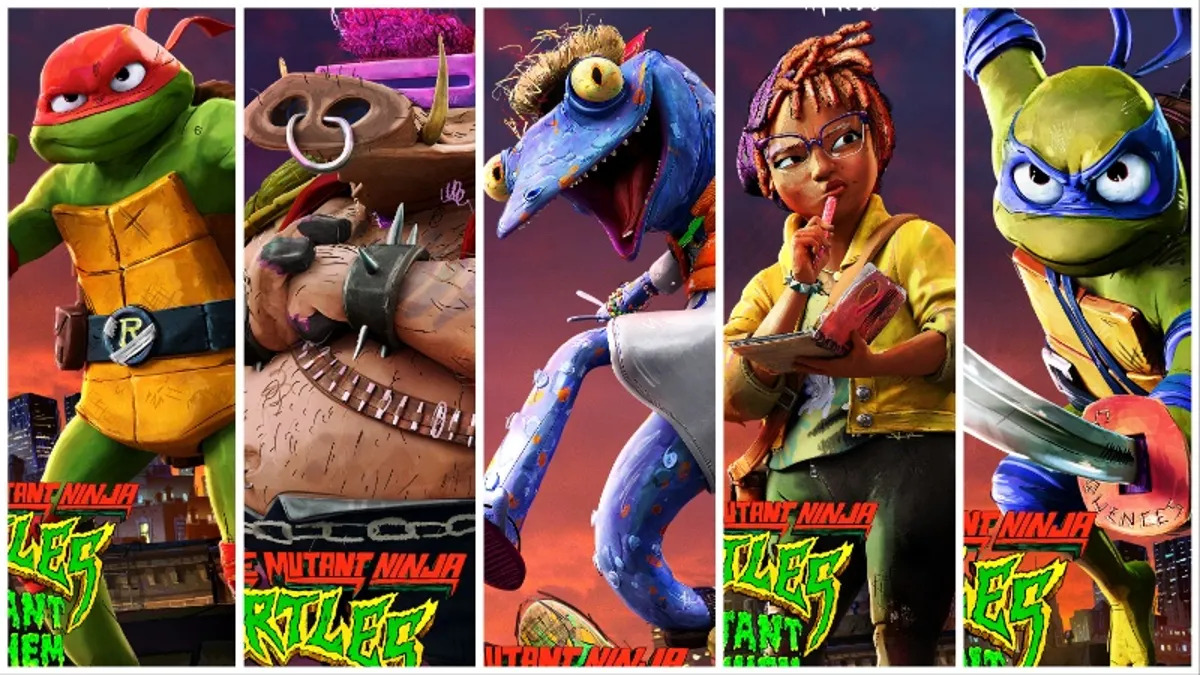
We know the drill so well we can recite it along with the movie. Baby turtles and a rat were exposed to radioactive ooze (do not call it slime). The rat was Splinter (voiced here by Jackie Chan), who became an adoptive parent to the and 15 years later the turtles were walking upright, talking, trained in ninja-style combat, and named for four groundbreaking Renaissance artists: Leonardo (Nicolas Cantu) told briskly and energetically, establishing the stakes. In this version a scientist named Baxter Stockman (Giancarlo Esposito) created the ooze because he always felt like an outcast, closer to animals than to humans. Don’t think too hard about why, if this is so, he would want to mutate the animals so they would be closer to humans, just go with it.

Scary henchmen for imperious Cynthia Utrom (Maya Rudolph) arrive and kill Stockman. The ooze and the rat and turtle babies are washed away into the sewer. After one disastrous try, Splinter decides that to keep his adopted sons safe from humans, they would stay out of sight forever. But the teenagers want to explore the world and meet people. They’d even like to go to high school. A crime boss named “Superfly” has been organizing heists around the city. The turtles think they could win the support of the human community if they can stop him.

They have one human friend, a high school student and aspiring reporter named April (Ayo Edebiri of “The Bear”). She has been researching Superfly, and she wants to write about the turtles, so they team up.

The animation style has an engaging looseness, even messiness, to it, a welcome change from the pristine perfection of hyper-lifelike CGI or the thin, under-designed images of the original cartoons. There are plenty of pop culture references (Adele, “Avengers: Endgame,” Cool Ranch Doritos — party size), and some self-aware jokes (Donatello wonders why his only weapon is a stick — and learns to appreciate it, too). The interplay between the four turtles is high-spirited and Chan makes a warm-hearted and concerned adoptive dad. And when we meet up with Superfly and his team, we get a new bunch of characters with wild designs and brilliant voices. Paul Rudd’s mutant Gecko with a fondness for Four Non Blondes is one of the great cinematic treats of the summer. Rogen, his “Platonic” co-star Rose Byrne, and John Cena add their voices. But the standout of the film is Ice Cube as Superfly, who hates humans, but loves bowling.

Parents should know that this movie has extended fantasy-style peril and action with some scary-looking monsters and disturbing images, crude schoolyard language (crap, puke) and references, and a sad death.

Family discussion: What is the best way to show people you deserve appreciation and respect? Which turtle is your favorite and why?

If you like this, try: the other TMNT stories, “The Mitchells vs the Machines,” “The Bad Guys,” and “Spider-Man: Into the Spider-Verse)

Related Tags:


Animation Based on a television show Fantasy movie review Movies -- format Movies -- Reviews Scene After the Credits Science-Fiction Series/Sequel
The Lion King

The Lion King

Posted on July 16, 2019 at 1:22 pm

B +
Lowest Recommended Age: 4th - 6th Grade
MPAA Rating: Rated PG for sequences of violence and peril, and some thematic elements
Profanity: None
Alcohol/ Drugs: None
Violence/ Scariness: Peril and violence, very sad and scary death of a parent
Diversity Issues: None
Date Released to Theaters: July 18, 2019
Date Released to DVD: October 21, 2019

Copyright Disney 2019
I had a lot of skepticism going in to the “live action” remake of “The Lion King.” The last two live action remakes of animated Disney classics were disappointments. Even the best so far (in my opinion, “Beauty and the Beast“), could not escape its, well, remake-ness and justify itself as an independent work worthy of the time and attention of the filmmakers and the audience.

Also, I am not the biggest fan of the original “Lion King.” I would not go as far as this very extreme critique, but it always bothered me that all the animals were supposed to sing happily about the circle of life when that means something very different to those at the lower end of the food chain to those at the top. The idea of Simba’s right to the throne made me uneasy (Nala is much more worthy, or maybe let the lions choose who is best). And I never got past the Hakuna Matata idea that a good way to deal with life’s problems is to run away from them. Plus, how can they call this live action when the animals are CGI?

All of which is to explain that I was very pleasantly surprised and it won me over. The opening scene is a shot for shot recreation of the original, but more spectacularly beautiful, thanks to Director of Photography Caleb Deschanel (the cinematographer of the most beautiful film of all time, The Black Stallion). The quality of the light, the texture of the terrain, the fur, the feathers all lend a grandeur to the story. And the music is sumptuously produced, evoking the holiness of the natural world.

We all know the story, which draws from Shakespeare (“Hamlet” and “Henry IV”), the myths collected by Joseph Campbell (the hero’s journey), and perhaps from the Bible as well (the prodigal son). Simba is the lion prince, born to rule as far as he can see. But his father, Mufasa (voiced again by James Earl Jones, as in the original) teaches him that the ruler serves those he rules. Simba will be responsible for their welfare, Mufasa tells him. “It will be yours to protect…A true king searches for what he can give.” Still, Simba chafes at the rules and dreams of a day when he is king and can do anything he wants.

Mufasa’s brother Scar (Chiwetel Ejiofor) wants to be king. He resents Mufasa and Simba. In a brutal scene that will be too intense for younger children and many older children and adults, he kills Mufasa and blames Simba. The cub is devastated, and runs away. He is befriended by a warthog (Seth Rogen as Pumbaa) and a meerkat (Billy Eichner as Timon), who sing to him about the pleasures of a worry-free life. (Eicher has a great singing voice! Who knew?)

The lions believe Simba died with his father. But when Nala (Beyonce) finds him, she tells him that Scar and his hyena henchmen have all but destroyed their community. Can he be the hero they need?

This version makes an attempt to address some of the issues that concerned me in the animated feature, though Mufasa’s explanation of the circle of life is not entirely reassuring. But director Jon Favreau (“Iron Man,” “Chef,” Happy in the Avengers movies) brings together the realism of the animals, who come across as authentic and expressive, with a capable balancing of humor and drama. John Oliver’s Zazu and Keegan-Michael Key’s Kamari are comic highlights. Was this necessary? No. But it earns its place.

Parents should know this film has some intense scenes of peril and violence, very sad death of a parent as the child watches, severe feelings of guilt and abandonment, murder and attempted murder, predators, some potty humor, and references to the “circle of life.”

Family discussion: Why is a group of lions called a “pride?” What from your family do you carry with you? What is the difference between Mufasa’s idea about responsibility and heritage and Timon’s idea that nothing matters?

If you like this, try; the animated “Lion King” and “Lion King 1 1/2” and “The Black Stallion” a beautiful film from the same cinematographer

Related Tags:


Coming of age DVD/Blu-Ray Fantasy movie review Movies -- format Musical Remake Talking animals
Long Shot

Long Shot

Posted on May 2, 2019 at 5:50 pm

B +
Lowest Recommended Age: Mature High Schooler
MPAA Rating: Rated R for strong sexual content, language throughout and some drug use
Profanity: Constant very strong and vulgar langauge
Alcohol/ Drugs: Drinking, including drinking to deal with stress, drunkenness, drug use
Violence/ Scariness: Comic peril and violence, some wartime violence
Diversity Issues: A theme of the movie
Date Released to Theaters: May 3, 2019
Date Released to DVD: July 22, 2019

Copyright 2019 Lionsgate Entertainment

Remember in “Say Anything” when high school valedictorian who had done everything right and won every prize Diane Cort was described as a brain “trapped in the body of a game show hostess?” Well, imagine her character grown up and in Washington.

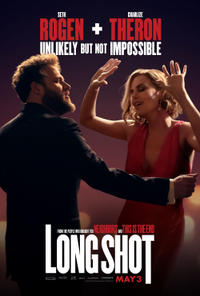
In “Long Shot,” Charlotte Field (Charlize Theron) is Secretary of State for a dimwit TV-star-turned President (Bob Odenkirk). She is still head of the class, doing extra credit homework while she’s on the treadmill, taking brief eyes-open standing power naps, and reading summaries of popular television shows so she can make smooth, diplomatic chit chat about media she has no time to actually watch. Needless to say, she is single. And, because she is played by Theron, she looks like a supermodel, very much appreciated by the American public which, her pollster tells her, gives her their highest ranking for “elegance.” This is the American public that elected an actor who played the President on television to the actual White House, so elegance — and a possible romance with the swooningly handsome Prime Minister of Canada (Alexander Skarsgård) are real plusses with the voters, who probably think that if they get married the two countries will merge, as though they are Sleeping Beauty and Prince Charming.

But the fairy tale here is more like Beauty and the Beast, if it was an extremely raunchy romantic comedy. Charlotte used to babysit for Fred Flarsky (Seth Rogen), who is now a shlubby but passionate Brooklyn journalist who has just quit on principle because his lefty alternative paper has been bought by media mogul and all-around bully Parker Wembley (Andy Serkis, so unrecognizable that he might as well be CGI). Charlotte sees Fred at a reception (featuring Boyz II Men, for whom they both stan). She impulsively offers him a job polishing her speeches to make them less Cabinet-officer-formal and careful and more “I’d actually like to run for President and I’m both super-competent and relatable!”

And so the out of work but highly principled Fred joins the team. Charlotte feels safe with him because they literally come from the same place, and he is able to remind her of a time when she was not as careful and not as isolated. He makes her speeches warmer and more personal. And they…like each other.

It’s funny and occasionally even sharp, but most of all it is really quite sweet. Theron is captivating as the good girl who longs to be a little less elegant and there is actually some genuine chemistry with Rogen, whose shambling demeanor she sees as refreshingly authentic. The film touches more lightly on subjects like political compromises and media pressure that we might think from an early scene of the idiot President watching himself on television in the good old days, when he only had to pretend to be the Chief Executive. The supporting cast includes O’Shea Jackson Jr. (“Straight Outta Compton”) as Fred’s loyal best friend, and their scenes together are some of the movie’s best.

There is enough sharp interplay on both current affairs and relationships to keep things moving briskly. Improbable as the pairing may be as characters and performers, Theron and Rogen have a nice easy rhythm, and it is heartwarming to see Charlotte and Fred each learn to relax a bit, her being less careful, more vulnerable, and more true to her less-than-perfect self and him being less sure of his opinions and more sure of his value.

Parents should know that this movie has very explicit and gross-out sexual humor, references and situations, very strong language, drinking and drunkenness, and some slapstick and military-style peril and violence.

Family discussion: Could a candidate like Charlotte get elected?  What does she like about Fred?  Would you want to read a journalist like Fred?

If you like this, try: “50/50,” also with Rogen, from the same director

Related Tags:


DVD/Blu-Ray movie review Movies -- format Politics Romance
THE MOVIE MOM® is a registered trademark of Nell Minow. Use of the mark without express consent from Nell Minow constitutes trademark infringement and unfair competition in violation of federal and state laws. All material © Nell Minow 1995-2026, all rights reserved, and no use or republication is permitted without explicit permission. This site hosts Nell Minow’s Movie Mom® archive, with material that originally appeared on Yahoo! Movies, Beliefnet, and other sources. Much of her new material can be found at Rogerebert.com, Huffington Post, and WheretoWatch. Her books include The Movie Mom’s Guide to Family Movies and 101 Must-See Movie Moments, and she can be heard each week on radio stations across the country.

Website Designed by Max LaZebnik