Thank You For Your Service

Thank You For Your Service

Posted on October 26, 2017 at 5:35 pm

B
Lowest Recommended Age: Mature High Schooler
MPAA Rating: Rated R for violence, language and some sexuality
Profanity: Very strong language
Alcohol/ Drugs: Drinking, drugs and drug abuse
Violence/ Scariness: Intense and graphic wartime violence, suicide
Diversity Issues: None
Date Released to Theaters: October 27, 2017
Date Released to DVD: January 22, 2018
Copyright 2017 Universal

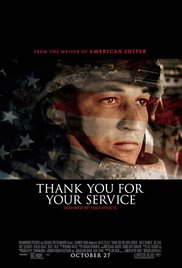
Thank You for Your Service,” based on the book by David Finkel about returning servicemen and their feelings of dislocation when they try to adjust to civilian life, is so decent, respectful, sincere, and, most of all, so vitally needed that it is difficult to evaluate it as a movie. It follows in the tradition of one of the best American movies of all time, The Best Years of Our Lives, which won nine Oscars, including Best Picture, Best Director, Best Screenplay, Best Score, Best Actor, and Best Supporting Actor Oscars. Like that film, “Thank You for Your Service” follows three servicemen, one disabled by injuries and one not sure how to rejoin the civilian workforce when his last job before the military was as a teenager. But this movie is not nearly as optimistic.

Miles Teller plays Adam Schumann, who tells us in the movie’s first scene that he was a good soldier and he was proud of what he did. He was responsible for his squad and he was responsible for spotting improvised explosive devices, which he looked for under every scrap of trash in the road and learned to feel by instinct. This hyper-alertness to danger served him well in the military, but it was difficult to turn off, especially because some of his experiences left him with intense survivor guilt and post-traumatic stress. He comes home to a loving, wise, strong, and supportive wife (Haley Bennett as Saskia), who tells him that she can handle anything he has to tell her except not telling her anything about his experience. He barely knows his children, at first almost forgetting the baby who was born while he was away. He has no idea how to get a job other than the one he had before his service. But he assures Saskia that everything is “perfect.”

Solo (Beulah Koale) is struggling with a traumatic brain injury that has impaired his memory and cognitive function. He wants to stay in the military because being a part of his team was a major part of his identity, but they do not want him. That’s “Whale Rider’s” Keisha Castle-Hughes as his wife.

And there’s Will Wall (Joe Cole), excited about coming home to marry his fiancee. “No bachelor party,” he tells Adam and Solo. His girl does not approve. But it turns out that she has left him. He is devastated.

The movie’s most wrenching scene comes when the characters are finally willing to admit that they need help and they go to the VA, only to find soul-destroying bureaucracy and endless waits, up to 12 weeks to even see someone who can begin to treat them. The returning soldiers are given pills instead of support. While some people at the VA are sympathetic but overloaded, there are also those like one former commanding officer who tells Adam to buck up so that he does not affect the morale of the others. Real help comes from a phone number passed along by the survivor of a soldier who did not get any support, and from an act of selflessness from one of the vets that is one of the most effective ways to show himself that even at home, he can still serve.

Parents should know that this movie includes intense and graphic wartime violence, characters severely injured and killed, disturbing images, suicide, drinking, drugs, drug dealing, very strong language with crude epithets, and sexual references and situations.

Family discussion: What is the best way to honor the service of returning military? Why was it hard for the soldiers to talk about their experiences?

If you like this, try: “The Best Years of Our Lives,” “Captain Newman M.D.” and the book and its predecessor by David Finkel
Related Tags:


Based on a book Based on a true story Drama DVD/Blu-Ray DVD/Blu-Ray Pick of the Week War
Suburbicon

Suburbicon

Posted on October 26, 2017 at 5:30 pm

C
Lowest Recommended Age: Mature High Schooler
MPAA Rating: Rated R for violence, language and some sexuality
Profanity: Strong language including racist epithets
Alcohol/ Drugs: Drinking, smoking
Violence/ Scariness: Intense and graphic violence including multiple murders, many grisly and disturbing images
Diversity Issues: A theme of the movie
Date Released to Theaters: October 27, 2017
Date Released to DVD: February 5, 2018
Copyright 2017 Paramount

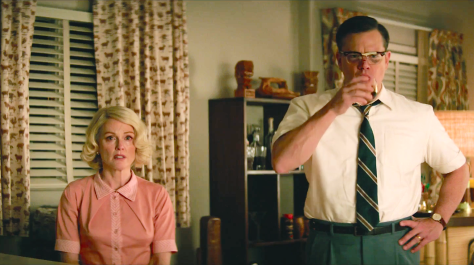
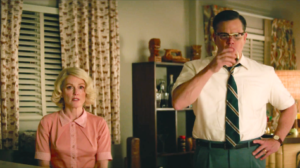
“Suburbicon” is like a beautifully gift-wrapped box that turns out to be empty or a shaggy-dog story that entices you with promising details and then it is supposed to be funny that there’s no ending. A script by the Coen brothers that plays like a correctly discarded early draft of “Fargo” has been tweaked by George Clooney and Grant Heslov, a long way from their brilliant “Good Night and Good Luck,” and directed by Clooney. Even full-on stars Matt Damon and Julianne Moore (in a dual role!) cannot outshine the real star of the movie, the ironic air-quoting production design. The only member of the cast who makes any real impression is Oscar Isaac as an insurance investigator who calls himself a “professional skeptic” and provides a too-brief jolt of energy and interest in a movie that is otherwise way to amused by itself.

“Suburbicon” begins with a cute commercial for a idealized 1950’s planned community that ends with a cheery, “The only thing missing is YOU!” It looks like Walt Disney, Norman Rockwell, Dick and Jane readers, and all those sitcoms with cheery moms who vacuum in pearls and full makeup got together in all of their mid-century, postwar, consumerist, idealized, sanitized, and claustrophobically conformist and Everyone is welcome, it tells us, whether you’re from New York, Ohio, or Mississippi. But all of the people in the ad are white and all of the people in Suburbicon are white….until the Myers family moves in. They are black. This is a pointed reference to the real-life experience of the real-life black Myers family who moved to the conformist, consumerist planned community of Levittown in in 1957, resulting in constant harassment, threats, and a three-week-long riot, which the family endured with grace and patience.

That goes on here, as we see Mrs. Myers (Karimah Westbrook) told by the manager at the grocery that for her the price of a gallon of milk is $20, neighbors build a fence around their yard, and a crowd gathers outside their house, taunting them and setting their car on fire.

But that is not what the movie is about. The movie is mostly about what is going on next door, where armed intruders tie up and chloroform a family, Gardner Lodge (Matt Damon), his wife Rose, who is confined to a wheelchair (Julianne Moore), her sister Maggie (more Moore), and his young son, Nick (an excellent Noah Jupe). Rose dies in the attack and Maggie moves into the house to help take care of Nick and Gardner.

And then things get really tangled. They just don’t get interesting. The production design and camera work are excellent, but what actually happens on screen is just a pointless escalation of deranged violence with cutaways to the poor Myers family to show how dumb it is that the neighbors are terrified of the black family while the white family is what should terrify them. But just making that point as people run around doing terrible things to each other and to a child is neither insightful nor effective.

Parents should know that this film is filled with horrifying violence, some of it very explicit and bloody. There are many murders and other bad behavior. A child is in peril, and he witnesses violence, sex, and bad behavior by the adults in his life. Virulent racism is a theme in the movie and characters use strong language including racist epithets.

Family discussion: Ask members of your family for their memories of the 1950’s. Why did the Myers family stay?

If you like this, try: “Fargo,” “Blood Simple,” “Confessions of a Dangerous Mind,” and “Serial Mom”

Related Tags:


Comedy Crime DVD/Blu-Ray movie review Movies -- format Thriller
Breathe

Breathe

Posted on October 19, 2017 at 5:50 pm

B
Lowest Recommended Age: High School
MPAA Rating: Rated PG-13 for mature thematic material including some bloody medical images
Profanity: Some strong language
Alcohol/ Drugs: Drinking and drunkenness, smoking
Violence/ Scariness: Severe illness, medical situations with some graphic images, issue of assisted death
Diversity Issues: A theme of the movie
Date Released to Theaters: October 20, 2017
Date Released to DVD: January 1, 2018
Copyright 2017 Bleeker Street

“Plucky or pitiful?” a man asks his wife as they drive toward a grand British estate to beg for funding to provide wheelchairs for the severely disabled. They meet with a crusty old aristocrat (Diana Rigg, always a treasure) who says that normally she has no trouble turning people down but she feels she must say yes to them. And, because they are so dashed plucky, so do we.

Robin Cavendish called himself a “responaut,” a jaunty, adventurous term for a man who was completely paralyzed by polio in his 20’s. And this jaunty, adventurous, paralyzed man’s story is told, perhaps a little too lovingly, by his filmmaker son in “Breathe,” about Cavendish, who revolutionized the mobility and accessibility of the severely disabled in mid-century Britain.

But this film is less about his activism than it is about his love story. Robin (Andrew Garfield) married Diana (“The Crown”), and their unswerving devotion and determined spirits are the heart of the film.

Like “The Theory of Everything,” which it resembles, the movie opens with our hero doing something active. He races along in a car and then swings a cricket bat, trying to catch the attention of the bored beauty sitting by the tea table. Soon they are married and off to Kenya, where he is a tea broker and she goes along with him for the fun of it. They are blissfully happy until, just after she tells him she is pregnant, he becomes very ill with polio, paralyzed from the neck down, and given just three months to live.

She manages to get him back to England, where he is put in a ward with other paralyzed men. He cannot speak. He cannot move. He cannot think of any reason to see Diana or the baby or to try to live. When a priest comes by with platitudes, he manages to spit at him.

But Diana’s devotion and his restored ability to speak inspire him to insist on going home. Nothing like that has ever been tried before and the doctor in charge forbids it. Another patient bets him a fiver that he won’t last. But he does. And he works with a friend to invent a wheelchair with a respirator that gives him mobility.

First-time director Andy Serkis (the motion capture actor from “Planet of the Apes” and “Lord of the Rings”) has a disarmingly light touch. The escape from the hospital is accompanied by the kind of musical score we might expect in a heist film with more humor than tension. Plus, if there’s anything better than one Tom Hollander in a movie, it is two Tom Hollanders, utterly charming playing Diana’s affectionate but eccentric twin brothers. Most of the dialog is delivered with an understated smile, the kind of “Hullo, darling,” we used to get in movies of the 1930’s. I found that endearing. This is very much a love story, not just between Diana and Robin but between a son and his parents.

Parents should know that this film includes severe illness and paralysis, some graphic and disturbing images, some sexual references and situation, and the issue of assisted death.

Family discussion: What made Robin different from the other patients? Do you agree with his decision about when to die?

If you like this, try: “The Theory of Everything” and “The Intouchables”

Related Tags:


Based on a true story DVD/Blu-Ray Illness, Medicine, and Health Care movie review Romance
Only the Brave

Only the Brave

Posted on October 19, 2017 at 5:19 pm

B
Lowest Recommended Age: High School
MPAA Rating: Rated PG-13 for thematic content, some sexual references, language and drug material
Profanity: Some strong and crude language
Alcohol/ Drugs: Drinking, drugs, substance abuse
Violence/ Scariness: Extended peril and violence, many characters killed, snake bite
Diversity Issues: None
Date Released to Theaters: October 20, 2017
Date Released to DVD: February 5, 2018
Copyright 2017 Sony

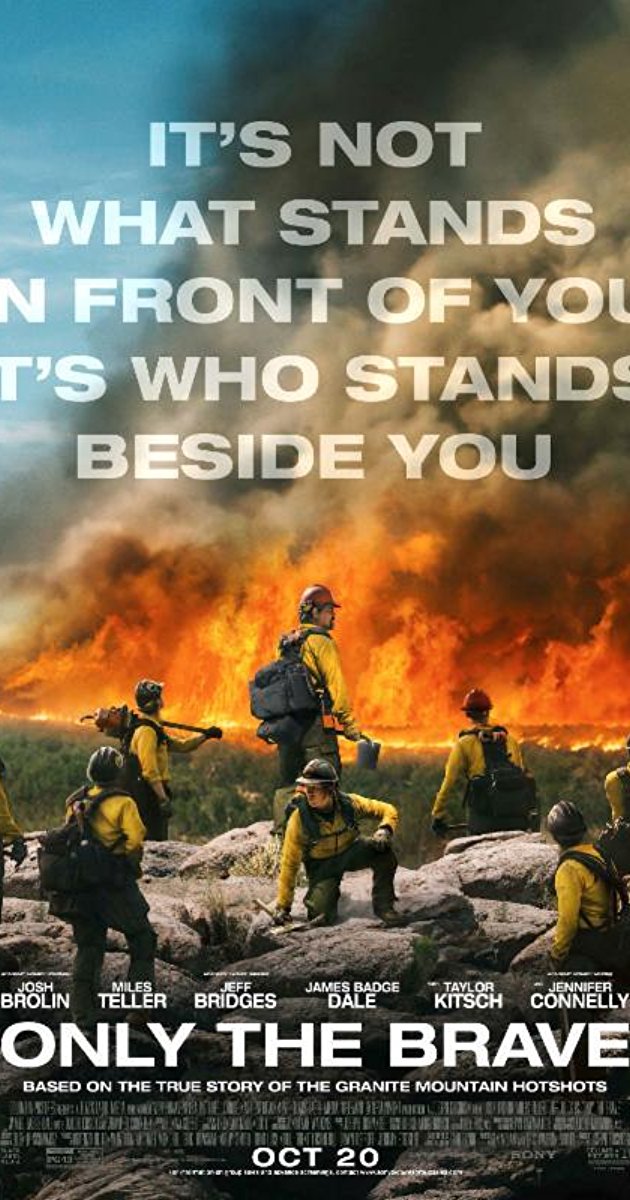
They literally fight fire with fire. Unlike “structure fires,” burning buildings doused with water, wildfires in non-residential areas are contained by setting a line of fire to stop them from spreading. Sometimes it does not work. “Only the Brave” is the story of the Granite Mountain hotshots, the “alpha” team of 19 Arizona firefighters who were killed in 2013. Like “The Perfect Storm,” this is a real-life story that spends three-quarters of its time making us love the characters and then heart-wrenchingly shows us how painful it was to lose them.

Josh Brolin, who has spent some real-life time as a firefighter, plays Eric, the leader of the group that, as the movie begins, is the second team, not allowed to set the fires on “the line.” “You guys are type two and we’re hotshots so why don’t you do what deucers do best, which is stay in the back and mop up our ?” sneers the leader of the alpha team. Eric and his group want very much to be certified as alphas and they train hard, the more experienced members of the team as the newcomer, Brandon (Miles Teller), good-naturedly dubbed “Donut” by the team for his zero score when quizzed on the rulebook.

“It’s not easy sharing a man with a fire,” a wife explains. The same qualities that make these men (they are all men) good at what they do can make it difficult for them to be the good husbands and fathers they strive to be.  For Brandon, the discipline and support of the team makes it possible for him to stay away from his past life of slacking and substance abuse.  But for some of the others, the intensity of the fire fighting experience is something of an addiction and it is difficult for them to go back to normal life with their families, who can never really understand what they face and what they do.

The moments of struggle are touching, as Brandon’s discovery that he is going to be a father inspires him to change his life and Eric’s wife Amanda (Jennifer Connelly) tries to stay close to a husband who is not ready to share what he has been through. The movie’s greatest strength is in its presentation of the music of man-talk, indirect, mock-aggressive, often crude, but always in service of the most profound commitment and loyalty.  For a moment, we get to be a part of that group of hotshots, and it is piercingly sad to lose them.

Parents should know that this is the true story of firefighters with a lot of peril and many sad deaths, some strong language, sexual references (some crude) and situations, pregnancy, drinking, and some drug use and references to substance abuse.

Family discussion: What qualities does someone have to have to be a hotshot? Why didn’t Brendan want painkillers at the hospital?

If you like this, try: “The Perfect Storm,” “Backdraft,” and “Ladder 49″

Related Tags:


Based on a true story Drama DVD/Blu-Ray Pick of the Week
Goodbye Christopher Robin

Goodbye Christopher Robin

Posted on October 12, 2017 at 5:53 pm

C
Lowest Recommended Age: Middle School
MPAA Rating: Rated PG for thematic elements, some bullying, war images and brief language
Profanity: Brief strong language
Alcohol/ Drugs: Alcohol
Violence/ Scariness: Wartime violence, post-traumatic stress
Diversity Issues: None
Date Released to Theaters: October 13, 2017
Copyright 2017 Fox Searchlight

This telling of the story behind the creation of some of the world’s most beloved books for children is sincere and well-intentioned but what Pooh might call a bit of a muddle. The movie is not at all clear about whose perspective it is giving us or what story it is trying to tell.

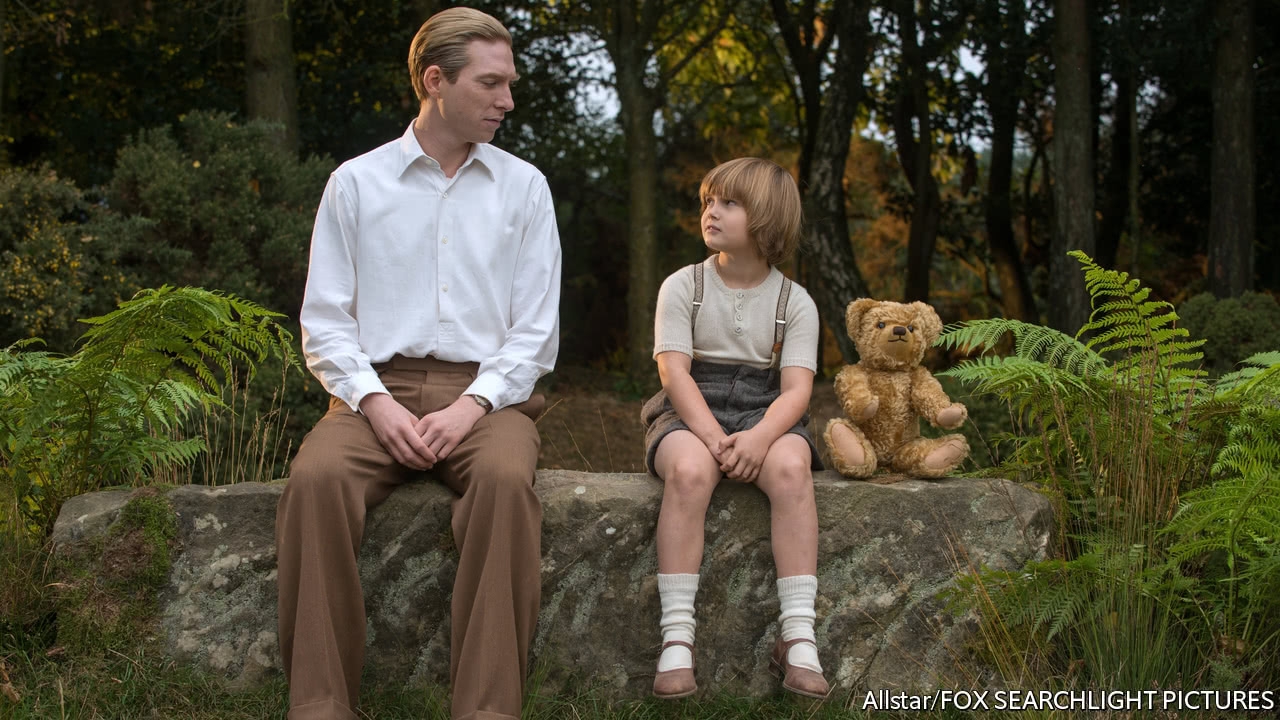
Author A.A. Milne, called Blue by his family and played by Domhnall Gleeson, was a successful playwright and humorist before the Great War, but came back badly shaken from the experience of combat and carnage. His wife Daphne (Margot Robbie) is affectionate but impatient. Neither one of them is very interested in their son, Christopher Robin (Will Tilston), who spends most of his time with his devoted nanny, Nou (Kelly Macdonald). Milne insists the family move to the country, where Daphne feels isolated from the parties and friends she enjoys. She goes back to London, saying she won’t return until Milne begins to write again, just as Nou has to take some time off to care for her mother. This leaves Milne alone with his son, called Billy Moon by the family, and for the first time they spend time together, playing in the woods with the child’s stuffed bear, named Winnie after the bear in the zoo. It is these days that inspire the two chapter books and two books of poems that have been read aloud to generations of children who have grown up and read them to their own children, plus, Disney movies and a television series (Disney now own the rights to the characters) and more books and toys.

And it is these days that are the best part of the film, especially when Milne’s friend, the illustrator Ernest Howard Shepard (Stephen Campbell Moore) comes to visit, and we see the stories Milne and Billy Moon tell melting into the sketches that are as beloved as the writing.

The problem is the rest of the movie, which is really four movies fighting with each other, none of them very good. There is the story of a shattered veteran trying to find a way to return to civilian life and work that is meaningful to him. There is the story of a man and a boy who do not realize how much they need each other discovering a common language. There is the story of enormous success that benefits one family member but at great cost to another.  The stories lead to feelings of betrayal and bitterness when Billy Moon becomes famous, more famous than his father, and much more famous than his boarding school classmates.  And there is the story of estrangement and partial reconciliation.

It is never clear what the point of view of the movie is, or what the point of the movie is.  Is it that art can be healing and wounding at the same time?  Is it that behind tales of wonder and enchantment there can be pain and bitterness?  Fans of the Winnie the Pooh books may enjoy some of the classic biopic “ah, that’s where this part I loved came from” moments, but they do not provide any additional insight or depth to the work itself, not even an exploration of what the books have to say about childhood and whether they represent a child’s perspective or a parent’s.  Most of all, unlike Pooh, Piglet, Kanga, Roo, and Owl, these characters are not very interested or interesting.

Parents should know that this movie includes wartime violence, PTSD, marital estrangement, sad offscreen death of a parent, apparent death of a child, and social drinking.

Family discussion:  What should Blue and Daphne have done differently?  Why did Christopher want to go into the army?  Is “the great thing” finding something to be happy about?

If you like this, try: the books of A.A. Milne

Related Tags:


Based on a true story Biography Drama DVD/Blu-Ray Family Issues movie review Movies -- format Movies -- Reviews
THE MOVIE MOM® is a registered trademark of Nell Minow. Use of the mark without express consent from Nell Minow constitutes trademark infringement and unfair competition in violation of federal and state laws. All material © Nell Minow 1995-2026, all rights reserved, and no use or republication is permitted without explicit permission. This site hosts Nell Minow’s Movie Mom® archive, with material that originally appeared on Yahoo! Movies, Beliefnet, and other sources. Much of her new material can be found at Rogerebert.com, Huffington Post, and WheretoWatch. Her books include The Movie Mom’s Guide to Family Movies and 101 Must-See Movie Moments, and she can be heard each week on radio stations across the country.

Website Designed by Max LaZebnik