The Lady in the Van

The Lady in the Van

Posted on January 21, 2016 at 5:55 pm

Copyright 2015 Sony Pictures

What connects us to each other? What creates a sense of obligation? Why is it that we somehow find ourselves alone when we don’t want to be and with others when we don’t want to be? Are there secrets that completely change the way we think about people we thought we knew?

And is it possible to be fair to the other people in our lives when we tell stories about them?

Writer Alan Bennett (“The History Boys,” “The Madness of King George”) got an urgent appeal from a disheveled woman in a kerchief. You know the kind of person I am talking about, the ones we ignore or pretend to ignore. She is not exactly homeless. She has a dilapidated, broken-down van parked on the street near his new home. His neighbors are not unkind. One even tries to bring her food. But for some reason, Miss Shepherd (Maggie Smith) likes Bennett. And for some equally inexplicable reason, he kind of doesn’t dislike her. And for another equally inexplicable reason, as frustrating and annoying and inconvenient and often infuriating as Miss Shepherd (as he always calls her) is, he finds it easier to deal with her than with his own mother, who is beset with her own cognitive challenges.

“A writer is doubled,” Bennett tells us, “the one who writes, the one who lives.” He is clearly most comfortable as the one who writes. And we get to see them both. Alex Jennings plays two slightly different variations on Bennett, the subtle variations of clothing and attitude showing us the tension as he wavers between being involved and observing. Part of him recoils from Miss Shepherd’s “multi-flavored aroma” with a thin layer of talcum powder. Part of him knows that she could lead to exactly what we are watching — a book, a radio play, a theatrical production, a movie with an Oscar-winning Dame in the title role. Yes, she asks if she can park temporarily in his driveway and stays for 15 years. But given the money he made from the story, who was sponging on who?

A writer will inevitably be drawn to the peculiar mix of sense and nonsense, sometimes called a word salad, coming from someone like Miss Shepherd. There’s something about the way she ends her mildly preposterous statements with equivocation. “I’m in an incognito position, possibly,” she tells Bennett. He will learn more about her past, but Bennett has enough respect for us and for Miss Shepherd that there is no attempt to try to explain her. It is just to help us do what he did instinctively, though perhaps reluctantly — to see the person inside the weirdness.

“A proper writer might welcome such an encounter.” Yes, he might. Yet, he thinks, “You won’t catch Harold Pinter pushing a van down the street.” Shouldn’t a writer get to pick his subject? “I don’t want to write about her,” he says. “I want to write about spies.” He knows that “you don’t put yourself into what you write; you find yourself.” And his two selves seem to come closer together as Miss Shepherd disintegrates further. If, as Arthur Miller wrote in “Death of a Salesman,” attention must be paid to people we would prefer to overlook, Bennett has done that for Miss Shepherd, with grace and humanity.

Parents should know that this film includes themes of mental and physical illness, fatal car accident, blackmail, and non-explicit sexual situations and bodily functions.

Family discussion: Why did Alan treat his mother and Miss Shepherd differently? Why does he let her stay? Why are there two Alans and what can we tell from the way they dress and speak?

If you like this, try: “The Madness of King George” by the same author and his early work in “Beyond the Fringe”


Related Tags:


Based on a book Based on a play Based on a true story Drama Family Issues
Son of Saul

Son of Saul

Posted on January 14, 2016 at 5:56 pm

A-
Lowest Recommended Age: Mature High Schooler
MPAA Rating: Rated R for disturbing violent content, and some graphic nudity
Profanity: Racist language
Alcohol/ Drugs: None
Violence/ Scariness: Intense and deeply disturbing Holocaust atrocities including shooting, gas chambers, graphic images
Diversity Issues: A theme of the movie
Date Released to Theaters: January 15, 2016
Date Released to DVD: April 25, 2016
Amazon.com ASIN: B01BZBOA30
son of saul
Copyright 2015 Sony Pictures Classics

As we move past the time when there are living witnesses to the Holocaust who can tell us their stories, we need more than ever voices like first-time writer/director László Nemes to tell the stories. I know there are those who will shrug sheepishly and say that they just can’t handle another one.  But each story is about a singular individual who had a singular experience.  And this Oscar-winning drama is distinctively different in subject matter and in the form of storytelling. It deserves careful attention.

The Nazis took more than lives in the concentration camps. They took identities and they took souls. Saul (Géza Röhrig), the title character, is a Hungarian Jew in an unnamed extermination camp near the end of the war. Because Hungarian dictator Miklos Horthy cooperated with the Nazis but did not allow them to take the 800,000 Hungarian Jews until he could no longer prevent it in 1944 (see Walking with the Enemy), Saul has only been there a short time. Throughout the movie, the camera is close to his face or at his shoulder as he numbly tries to hold on to his life and to some sense of himself amidst the horrific slaughter and nightmarish chaos all around him. We get only glimpses.

In the very first moments, we see him standing silently as a reassuring German voice tells the new arrivals that there will be jobs and food for them, as soon as they clean off in a shower. They leave everything they brought with them, clothes, jewels, money, photos, in the outer room and then, naked, walk into the gas chamber, where they are killed.

What happens to Saul is worse than death. He is a Sonder-kommando, a prisoner forced to assist in this process, from making the new arrivals feel a little less hopeless to ransacking their belongings and removing the remains, which the Nazis will not dignify with the term “bodies.” They are called “pieces.” And he is forced to be a part of it.

Somehow, a boy, perhaps 10 or 11 years old, survives the gas chamber. He is still breathing. So he is sent to the doctor (another prisoner) to be killed and autopsied, to help make the killing process more efficient.

And that is Saul’s breaking point. He becomes convinced that the boy is his son, though it appears likely he never had a child. This may be manifestation of trauma-induced delusion, or it may be an adaptive mechanism to restore his shattered sense of the world. He knows he cannot save this both in life. But perhaps in death he can do one kindness and provide the boy with a religious burial, away from the discarded “pieces.” Increasingly desperate, contrary to his previous flat affect, Saul seeks a rabbi who can say the mourner’s prayer over the boy. Throughout the film, we see quick glimpses of the ways other prisoners hold on to some tiny element of control. For some, it may be keeping a record. For Saul, who seems to see very little of what is going on around him, it is giving a boy a better death.

This insistence on a sacred burial at any cost is a direct link to Sophocles’ 442 BC play Antigone, the final chapter in the Oedipus trilogy. Three thousand years of human history later, and someone is still finding meaning by refusing to make one final compromise.

Parents should know that this is a Holocaust movie with scenes of Nazi brutality and disturbing themes and images including gas chambers, shooting, suffocation, and dead bodies, some nude.

Family discussion: How does the style of this film help to convey the experience of the concentration camp? Why was this boy so important to Saul? What were the special issues faced by the Sonder-kommandos and the doctor?

If you like this, try: “Conspiracy,” “Schindler’s List,” and “Labyrinth of Lies”

Related Tags:


Drama DVD/Blu-Ray Pick of the Week Tragedy War
Norm of the North

Norm of the North

Posted on January 14, 2016 at 5:46 pm

Copyright 2016 Lionsgate

“Norm of the North” is not awful, but it is also not special, not new, not funny, and not that interesting. The script is over-plotted but under-written, with confusing detours and uneven tone. It’s as though instead of coming up with an actual story the writers tried to assemble a formula from successful animated films — Cute sidekicks! Potty humor! Evil developers who want to despoil pristine environments! Random musical number! Wise advisor! A hero who is a clumsy outsider with a lot of heart! And a rescue! However, it also includes weirdly off-key or unresolved elements. There are actual stories to be told about the damage to the arctic environment and the potential for kids to make a difference in real life, but we’re going with condo developers and corrupt officials as the bad guys? And the issue of hunting other animal characters for food is clumsily handled. Kids may be reassured that Norm does not kill the sea lions, but he is not a vegetarian.

There are a couple of funny lines, but most of the wit of the movie is at the level of “I put the soul in winter soulstice!” “Who needs a bear with too much care and not enough scare?” Plus macho posturing, extended peeing into a fish tank, and a Nancy Pelosi “joke.”

Norm (Rob Schneider, who is quite good in his best-ever movie role) is a kind-hearted polar bear from the arctic who does not fit in because he is a poor hunter and not like the others. Both of these qualities relate to his ability to understand and speak “human” — meaning English. His wise and loving grandfather (Colm Meaney) has the same gift.

Norm’s arctic home is a popular site for tourists, and the animals appreciate tourism as it helps keep their home safe. If tourists want to come see the natural environment, then it will have to be kept as it is. But there is a developer named Mr. Greene (Ken Jeong) and we know he’s a bad guy because he has a dinky ponytail and yells a lot — and, of course, because he is a developer, who wants to build luxury homes for one-percenters on the polar icecap. Norm stows away on Mr. Greene’s company plane to come to the big city and stop the development. Accompanying him are three little arctic lemmings, whose primary characteristics are un-crushable resilience and public bodily functions.

Mr. Greene has a head of marketing, a single mom named Vera (Heather Graham). She is not entirely sure that the development is a good idea, but she desperately wants her daughter to get into a private school for gifted children, and Mr. Greene, as a graduate of the school, has promised an all-important recommendation if the development deal goes through. (The fact that the school produced a nutty crook like Mr. Greene does not cause her to question the school’s indispensability for her daughter.) It is a shame to hear the wonderful actress Salome Jens very briefly as a corrupt official, just there to look witchy and be bribed into approving the development.

It does not make much sense to try to explain the concept of distracting the populace with entertainment “bread and circuses” to children when the movie is a poor example of exactly that idea.

Parents should know that this film includes action-style violence and peril, a character captured and caged, chase scenes, theme of environmental destruction, corruption, mild language, and extended bodily function humor.

Family discussion: Why did Vera go along with Mr. Greene’s plan? What is the best way to protect the Arctic? How did the lemmings help Norm?

If you like this, try: the “Madagascar” movies and “Surf’s Up”

Related Tags:


Animation Comedy Environment/Green Talking animals

Trailer: Midnight Special

Posted on January 11, 2016 at 8:00 am

Michael Shannon plays the father of a boy with special powers in “Midnight Special,” from writer/director Jeff Nichols (“Take Shelter”). The cast includes Adam Driver (“Star Wars: The Force Awakens”), Kirsten Dunst (“Fargo” TV series), Sam Shepard (“August: Osage County”), and Joel Edgerton (“The Gift”).

Related Tags:


Trailers, Previews, and Clips
Anomalisa

Anomalisa

Posted on January 7, 2016 at 5:39 pm

B+
Lowest Recommended Age: Adult
MPAA Rating: Rated R for strong sexual content, graphic nudity and language
Profanity: Very strong and explicit language
Alcohol/ Drugs: Drinking
Violence/ Scariness: Peril and unhappiness
Diversity Issues: None
Date Released to Theaters: January 8, 2016

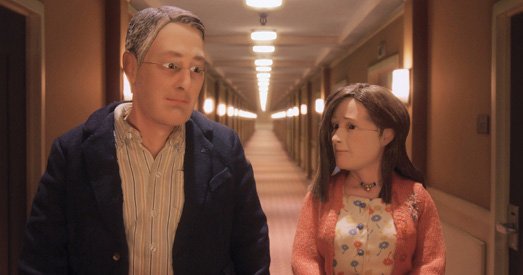
The “Fregoli delusion” sometimes called the delusion of doubles, is a rare disorder that makes people believe that everyone else in the world is in fact a single person who changes appearance or is in disguise. When Michael Stone (David Thewlis) checks into the Fregoli hotel in this stop-motion animated film from Charlie Kaufman (“Being John Malkovich,” “Adaptation,””Eternal Sunshine of the Spotless Mind”), we begin to understand why it is that everyone else we have seen in the film’s first few moments including the passenger sitting next to Stone on the airplane and his cab driver, have the same face and voice (Tom Noonan).

Copyright Paramount 2015

Even his wife and child speak with Noonan’s voice.

Michael checks into the hotel on a business trip. He will be the speaker at a conference on customer service. He has written an acclaimed book on the subject. He teaches customer service representatives, the subject of near-universal frustration and derision. He tells them “Each person you speak to has had a day.” He tries tell them to be aware of what is special about each individual, but around him everyone seems the same. And Michael himself, as he speaks of humanity, is, well, a puppet. Literally. This stop-motion animated film is remarkably realistic with one of the most authentically awkward sex scenes in cinema history. But the figures themselves, expressive as they are and fluid in their movements, are frankly artificial, with clear breaks on their faces at eye level so we can see how the various face parts get swapped in and out to create emotions.

Michael calls a former girlfriend and they meet for a painfully clumsy conversation. And then he happens upon two other hotel guests, women who are in town for the conference and looking forward to hearing him speak. One is Lisa (Jennifer Jason Leigh), a shy woman, self-conscious about a scar on her face, and often second-guessing herself or making self-deprecating comments that anticipate being judged a failure or a bother by those around her.

She thinks that if he is going to make a pass at anyone, it will be her friend, and clearly the friend (who, like everyone else, has the voice of Tom Noonan), does, too. But it is Lisa Michael invites back to his room. She is an anomaly, he tells her. Something about her voice. Anomaly. Lisa. Anomalisa.

The film is beautifully designed. Michael’s hotel room and the hotel bar are masterpieces of bland and yet somehow sinister anonymity. An encounter with a hotel employee who has an office so enormous it must be traversed by golf cart is reminiscent of the daffy between-floors half-level ceilinged office in “Being John Malkovich.” Any writer is in a sense a puppetmaster, and we have seen Kaufman’s fascination with puppets before; in “Being John Malkovich,” John Cusack’s character was a puppeteer and the various characters in essence used actor John Malkovich (playing a version of himself) as a puppet when they took over his consciousness. In “Synecdoche, New York,” Philip Seymour Hoffman’s character was a playwright trying to maintain control over an increasingly uncontrollable narrative. Here the puppets give Kaufman the greatest possible control over the way the story appears and the way it is told. Stop-motion is so exacting that only seconds of footage are completed each day and the sex scene alone took six months to complete. It also allows him to explore issues of memory, identity, imagination, and loneliness. Dream-like images demonstrate through both illustration and contrast the reality behind the platitudes in Michael’s speech. Just as a raw and needy reality keeps bursting through his remarks, the anguish and hopelessness he feels — and the fear and hopefulness that Lisa feels — transcend the plastic pieces of the dolls who are, it must be said, acting.

For a brief moment, it seems Michael has found something extraordinary. But when he tries to find a way to stay with her, the Fregoli syndrome — or maybe just his terror of genuine intimacy — kicks in. By that time, our own connection to these characters, as artificial as they appear, or, perhaps because of the oddness of their artificiality, is surprisingly warm and intimate.

Parents should know that this film includes very explicit sexual situations and frontal male (puppet) nudity, very strong and explicit language, drinking, and adultery.

Family discussion: What does the name of the hotel tell us about the story? Why did Lisa’s voice change?

If you like this, try: “Being John Malkovich” and “Adaptation” by the same screenwriter

Related Tags:


Animation Drama Movies -- format
THE MOVIE MOM® is a registered trademark of Nell Minow. Use of the mark without express consent from Nell Minow constitutes trademark infringement and unfair competition in violation of federal and state laws. All material © Nell Minow 1995-2026, all rights reserved, and no use or republication is permitted without explicit permission. This site hosts Nell Minow’s Movie Mom® archive, with material that originally appeared on Yahoo! Movies, Beliefnet, and other sources. Much of her new material can be found at Rogerebert.com, Huffington Post, and WheretoWatch. Her books include The Movie Mom’s Guide to Family Movies and 101 Must-See Movie Moments, and she can be heard each week on radio stations across the country.

Website Designed by Max LaZebnik